Michael Maltzan’s RIT Performing Arts Center Adds a Cool Metal to a Staid Campus Palette
Rochester, New York

Architects & Firms
Rochester Institute of Technology (RIT), a renowned leader in STEM disciplines, offers top-of-the-line facilities within a staid suburban modernist campus. Its core—of which the first three buildings and master plan were designed by Roche-Dinkeloo following a move from downtown Rochester—opened in 1968, and since then the university has steadily expanded with buildings that echo a similar material palette and rectilinear forms. Consisting of nearly 16 million red bricks, the campus ensemble is affectionately dubbed Brick City.
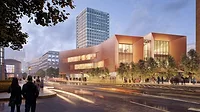
Somewhat incongruously with RIT’s reputation, much of its student body is also deeply engaged in the performing arts. For decades, the absence of a dedicated multiuse venue was a point of frustration for students, and it dampened enthusiasm from would-be applicants. Completed in April 2026, the RIT Performing Arts Center, designed by Los Angeles–based Michael Maltzan Architecture (MMA), addresses this gap with a state-of-the-art three-tiered auditorium and ancillary spaces. The building, with a volumetric massing enclosed in a white metal facade, also serves as a bold new campus gateway.
The project originated as part of a broader capital plan developed under the leadership of RIT president David C. Munson, who retired in 2025. A key aspect of the campaign was, according to inaugural RIT Performing Arts Center director Erica Haskell, to create the best performing arts program for nonmajors in the country. “The center is a draw for students who have been active in the arts in high school and wish to remain engaged at an extracurricular level,” she notes. MMA was awarded the project in 2019, and then brought on architect of record and structural engineer SWBR, a regional firm responsible for numerous projects on campus.

The lobby is wrapped in glazing and faces north. Photo © Iwan Baan, click to enlarge.
Regarding the center’s relationship to its surroundings, James Yarrington, the university architect and director of planning and design, explains, “there was a feeling that perhaps millions of bricks were more than enough, and that we could introduce a building a bit more radical here.”
Given that creative latitude, MMA design principal Michael Maltzan, for his firm’s first performance space, looked to precedents both near and far. “Some of my favorite theaters, such as Gunnar Asplund’s Skandia Theater and Alvar Aalto’s Finlandia Hall, dissolve your sense of where the outside world begins and expand perceived space within,” he says. The abstract textures and geometries of the sculptural works of Harry Bertoia and murals by Josef Albers—both present on campus—also informed the project and served as a contextual bridge.
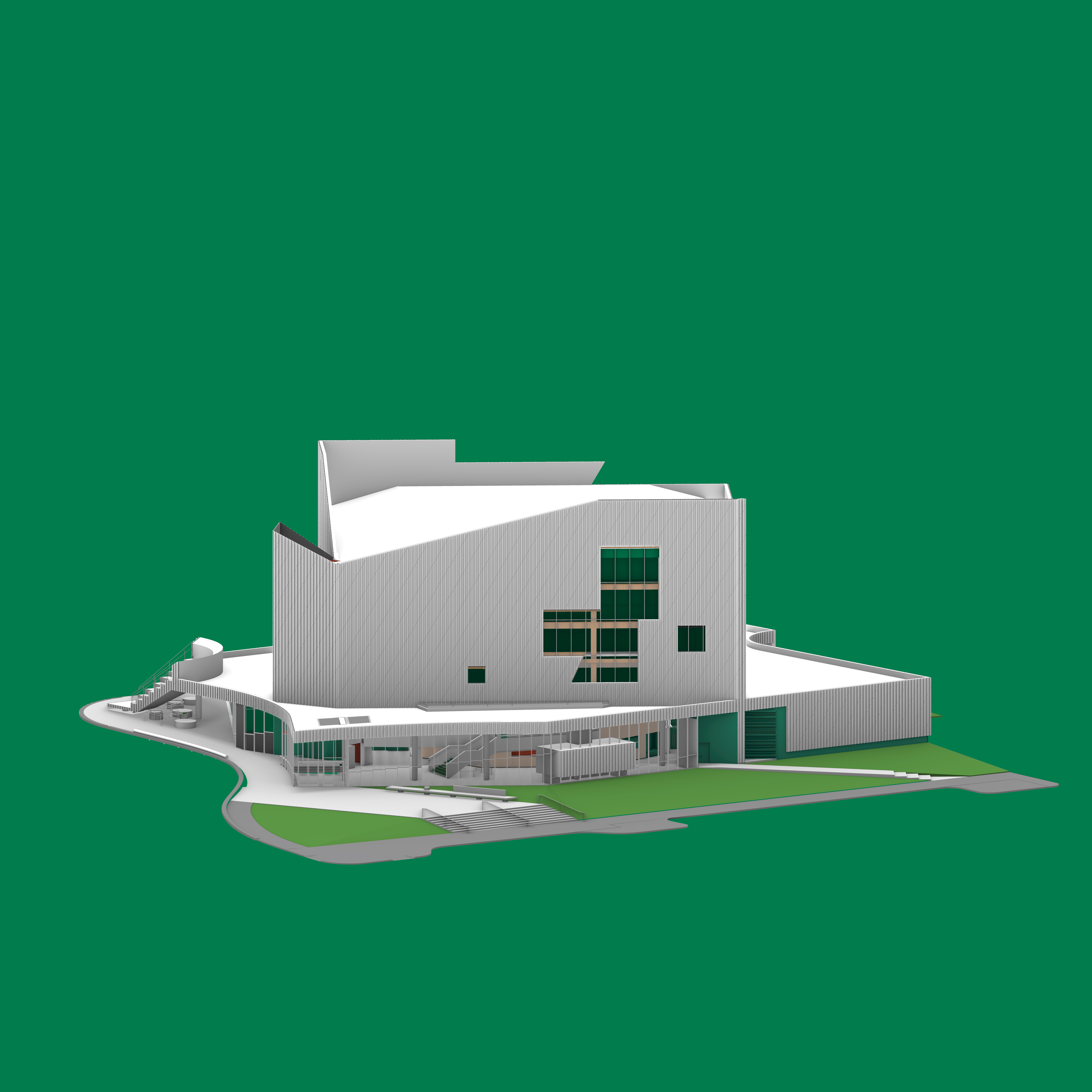
The 50,390-square-foot center occupies a prominent site at the northern border of the grounds. Constructed of structural steel and concrete floor decks, its exterior is wrapped in white aluminum panels articulated with diagonal seams and extruded ribs. Coupled with its jagged profiles, the center carries a likeness to a peaked iceberg. Expansive glazing at the ground level reveals back-of-house spaces—including the costume studio, rehearsal room, and scene shop—typically hidden from view. These areas, along with the loading dock, are painted in vivid colors and deliberately showcased.
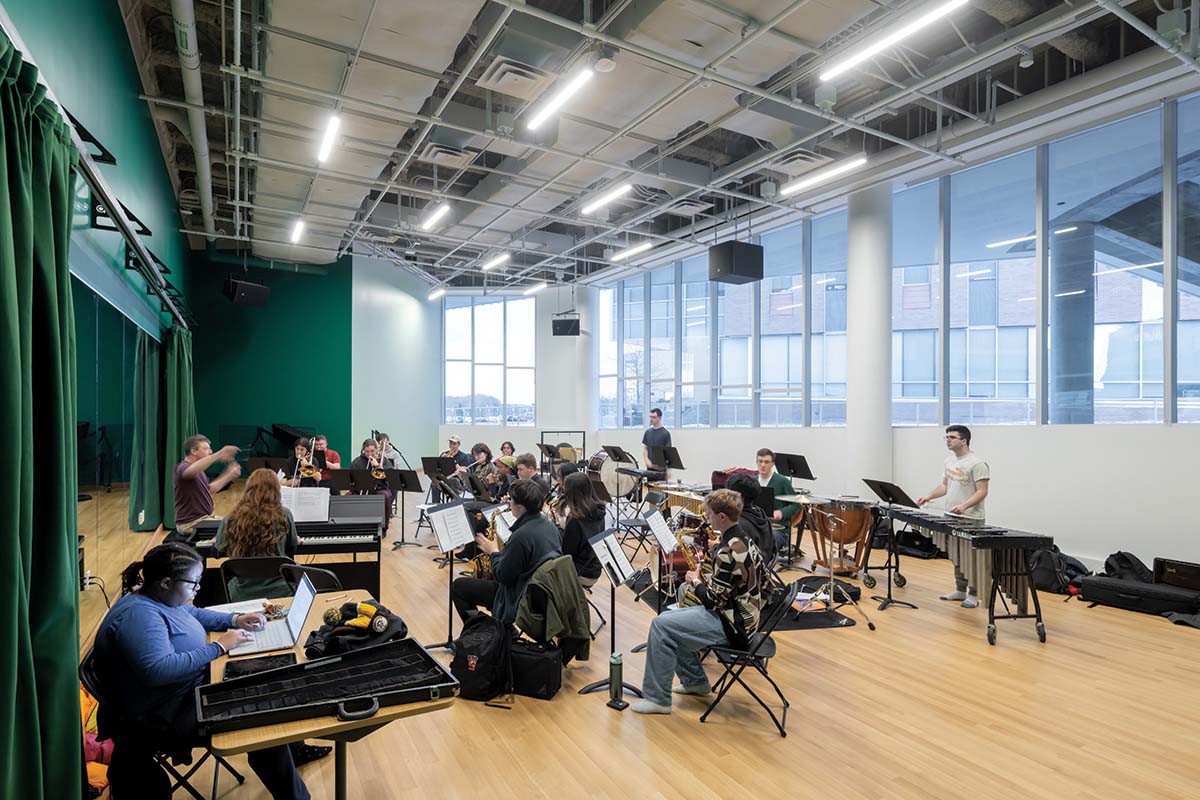
Views are offered into the rehearsal room. Photo © Iwan Baan
“The use of color offers a sense that this isn’t an opaque building with a completely internal life,” says Maltzan. “We wished to turn as many spaces as possible within the center outward, to participate in the day-to-day life of the campus that surrounds it.”
Looking for quick answers on architecture and design topics?
Try Ask RECORD, our new smart AI search tool.
Ask RECORD →
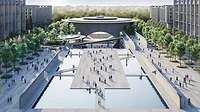
That dialogue extends to an outdoor amphitheater, built of poured concrete, that cascades from the structure’s southeast corner toward a campus quadrangle.
The primary entrance faces northeast. It leads to the center’s main lobby, which is simply finished with polished concrete flooring, moments of oak wall paneling, such as at the concession booth, and tubular hockey-stick-shaped lamps affixed to interior columns (a nod to the exterior’s extruded elements). A main staircase with polished brass rails anchors the space and rises to the mezzanine level; both feature lush green carpeting, with walls painted to match. Stairs at the north and northeast corners of the plan direct attendees through the structure. The former is painted in a blood orange hue and the latter, made visible externally by a nearly 40-foot-tall window, is bright pink.

A staircase leads to the mezzanine. Photo © Iwan Baan
The auditorium’s two balcony tiers are reached via corridors treated with similar bold colors. At the third level, the need to accommodate structural steel beams produced an inverted ziggurat-like profile for the auditorium-adjacent wall, creating an undefined void overhead. “You can’t quite get a sense of where that space ends above you,” notes Maltzan. Suspended lighting proved impractical from that height; instead, the corridor is lit by wall-mounted bulb fixtures that, in aggregate, resemble deconstructed marquee lighting. An asymmetrical cut in the east facade makes this composition visible and provides glimpses of the wood-veneered structural grid.

1

2
The balcony corridors (1) are reached by two stairwells painted in bright colors (2). Photos © Iwan Baan
In contrast, the 750-seat auditorium itself resembles a black-box theater. Its walls are clad in gypsum boards, painted black, which are studded with circular perforations to aid with acoustic performance, while the curvilinear suspended ceiling modulates sound. To add a measure of warmth to the space, the balcony fasciae are paneled in oak, as are two sound buffers—one is rectangular and the other semicircular—placed at the uppermost corners of the auditorium. The stage is set just 15 feet from the first row of seating, to foster a greater sense of intimacy between the audience and performers. Above, visually prominent catwalks hover over rows of seating to further bring the inner workings of productions to the fore.
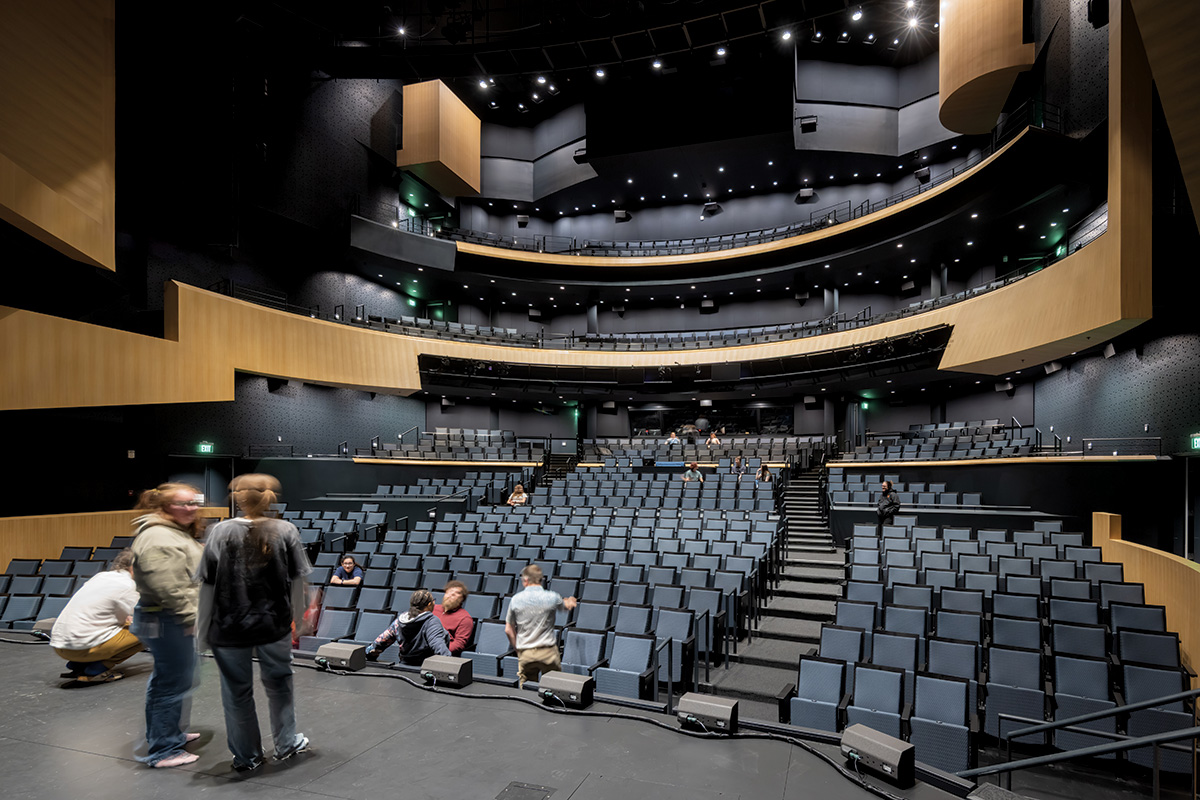
The auditorium is surfaced in perforated gypsum boards and oak paneling. Photo © Iwan Baan
During the design process, Munson asked to incorporate a pipe organ in the Performing Arts Center. Through connections at the University of Michigan, where Munson served as dean of the School of Engineering, RIT was able to secure a Barton Opus built in 1927 and salvaged from Detroit’s Hollywood Theatre. The instrument—featuring four keyboards and thousands of parts, some two stories tall—had spent decades in storage after the theater was demolished in 1963.
The organ and its many pipes are currently undergoing restoration, and, once that process is completed, they will be housed in two double-height lofts positioned at the balcony level, left and right of the stage. Both are framed in white oak, and the instrument is made visible to the audience through a set of gargantuan, vertically oriented shutters. Behind the scenes, incorporating the instrument required the installation of approximately 240 feet of galvanized-steel piping to distribute air from a separate organ-blower room. Each loft is encased in concrete and accessed through a 3½-inch-thick steel-faced door with acoustic filler to prevent the organ’s vibrations from shaking the auditorium.
During my visit on a cold January day, the structure’s facade was intermittently shrouded in blusters of snowfall while the exposed interior spaces, with their bold colors, starkly contrasted the leaden sky. Inside, MMA’s many gestures make the experience of the center as transporting and luxurious as that of a classic movie palace or historic theater, albeit with an unabashedly contemporary bearing. By the end of this year, when the Barton Opus is ready to bellow, the crowds gathering in the RIT Performing Arts Center will surely bring the house down.

3
4
Axonometric drawings of the RIT Performing Arts Center. Images courtesy Michael Maltzan Architecture
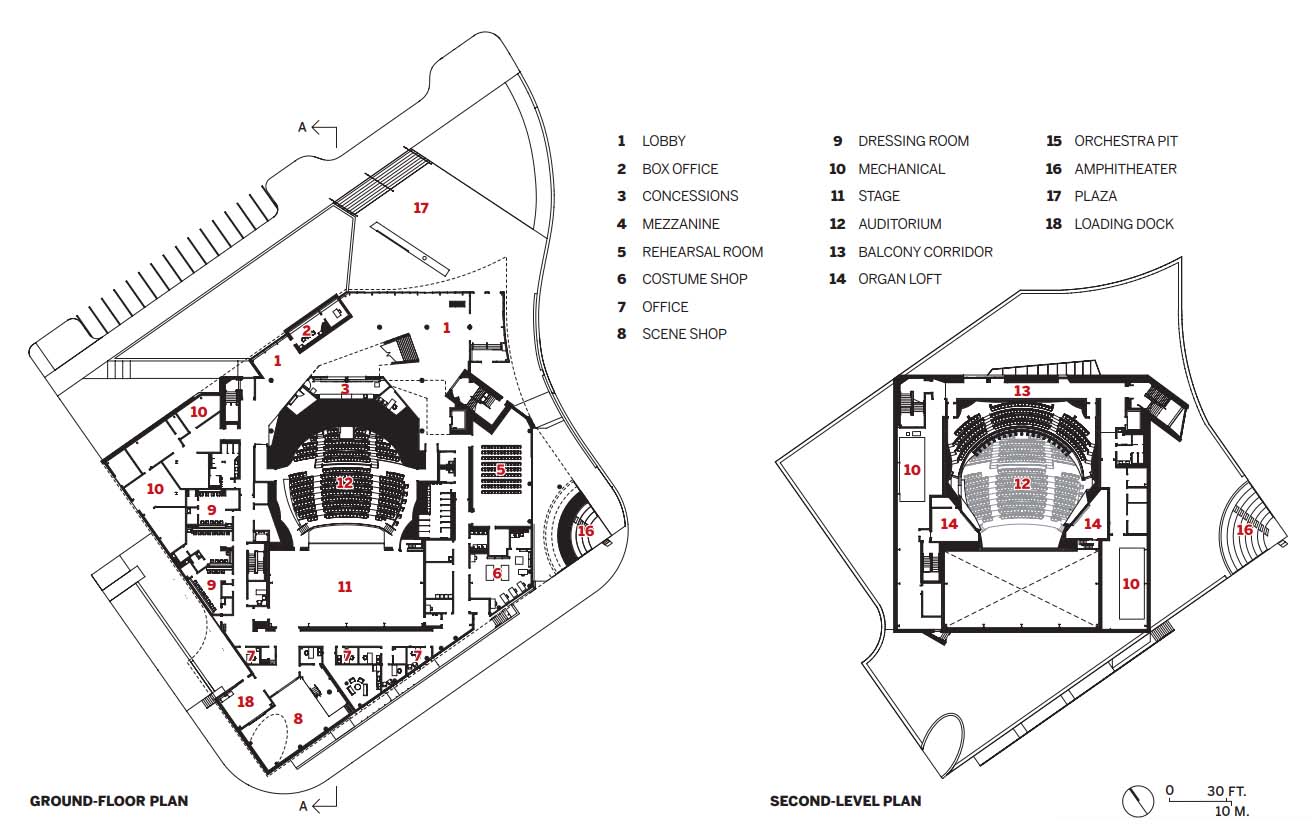
Image courtesy Michael Maltzan Architecture

Image courtesy Michael Maltzan Architecture
Credits
Architect:
Michael Maltzan Architecture — Michael Maltzan, design lead; Tim Williams, principal in charge; Nick McAdoo, project manager; Yun Yun, job captain; Vano Haritunians, technical; Khoa Vu, designer; Gee-ghid Tse, Min Chen, design team
Architect of Record:
SWBR
Engineers:
SWBR (structural); M/E Engineering (MEP); Erdman Anthony (civil)
Consultants:
Fisher Dachs Associates (theater); Nagata Acoustics International (acoustics); Carlton Smith Organ Restorations
General Contractor:
Le Chase Construction Services
Client:
Rochester Institute of Technology
Size:
50,390 square feet
Cost:
$74.4 million (project)
Completion:
April 2026
Sources
Exterior Cladding:
Kingspan (metal panels); EFCO (curtain wall)
Roofing:
Carlisle Syntec Systems
Glazing:
Guardian
Doors:
Masonite Architectural (wood); Steelcraft (metal): Singcore (sliding)
Hardware:
Schlage (locksets); LCN (closers); Von Duprin (exit devices); Ives (pulls)
Ceilings:
Armstrong
Solid Surfacing:
Corian
Floor and Wall Tile:
Daltile
Furnishings:
Series Seating (fixed seating)
Lighting:
Axis (interior ambient); Gotham (downlights); Selux, WE-EF (exterior); ETC (lighting controls)
Conveyance:
Otis
Looking for a reprint of this article?
From high-res PDFs to custom plaques, order your copy today!