From the RECORD Archives: ‘The USTA National Tennis Center by David Kenneth Specter’

Electric, sometimes raucous games under the night lights, have been a hallmark of the U.S. Open—one of tennis’s four prestigious Grand Slam tournaments—thanks to its home: the USTA National Tennis Center in Queens, New York. Opened in 1978, this ever-evolving complex, now named after Billie Jean King, transformed the once quaint, country-clubby competition held in Forest Hills into a public spectacle. Its first major venue, the Louis Armstrong Stadium, was a steep-sided square court carved out of Singer Bowl—a relic of the 1964 World’s Fair—with a smaller grandstand tucked to one side like a sidecar. If this setup seems hazy to recent visitors, it is because both structures were demolished in 2016 to make way for larger, roofed arenas carrying the same names. For a snapshot of the quirky original design, read the following article from the February 1980 issue of RECORD, where the center was featured as part of a triple-header of new sports facilities.
Editor’s note: This article has been condensed for ease of online reading but reflects the original text.

© Architectural Record, February 1980. Click to enlarge
“The USTA National Tennis Center by David Kenneth Specter”
No Author Attributed
Architectural Record, February 1980
For the better part of this century, American tennis and Forest Hills seemed to be synonymous. The West Side Tennis Club—nestled amid the brick and Tudor houses of this tidy New York suburb—was the Mother Church of the sport (at least in America) and the scene each summer of a series of events that culminated in the staging of the U.S. National Championships. This was, of course, an event of considerable glamour and tradition, a tradition that was richly expressed in the West Side’s handsome old half-timber clubhouse, its venerable stadium, and its gracious expanse of beautifully manicured lawns. Even the surrounding community, built up around narrow, tree-lined streets with names like Dartmouth and Exeter, seemed to bestow an added measure of lordly dignity.
But even before 1968, when tennis began its great surge, Forest Hills had become a tight-fitting suit. After 1968, when the U.S. National Championship became the U.S. Open, American tennis needed a new home.
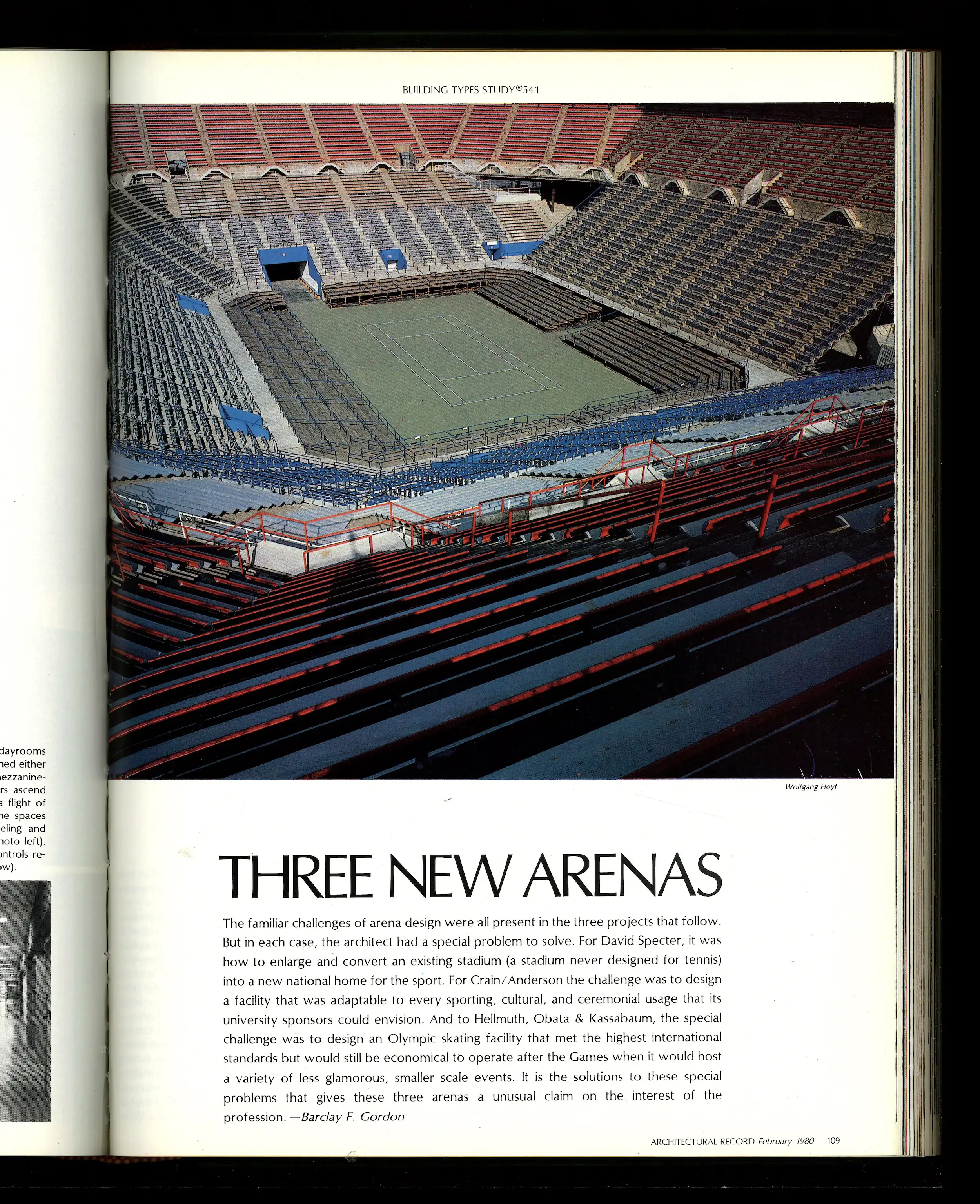
© Architectural Record, February 1980. Photo by Wolfgang Hoyt
The new site, only a few miles from the old, was nevertheless very different in character. It centered on an all but derelict stadium left over from the 1964–65 World’s Fair in Flushing Meadow. Originally called the Singer Bowl, later renamed after Louis Armstrong, the stadium was a shallow, rectangular tray ringed by a low grandstand of small capacity with most of its seating located too far from a potential center court—a court that would lie in the wrong axis for tennis anyway. But if the geometry was unpromising, the stadium was well located with respect to transportation both public and private, and the surrounding space was more than ample.
These were among the considerations that USTA president Slew Hester and architect David Specter grappled with during feasibility studies. It was during one of these early meetings between Specter and structural engineer Ysrael Seinuk (principal in the Office of Irwin Cantor) that the idea of superimposing a new grandstand ring over a portion of the old stadium was first advanced. Obvious only in retrospect, it was an idea with powerful implications. It made it possible to bring large numbers of seats within comfortable viewing distance of a center court that could now be realigned north–south. And it left an existing area of seating to frame a smaller secondary arena or “grandstand court.” The decision was made to plunge ahead. Using fast-tracking techniques and a range of industrial materials and finishes, the project was brought to completion (or at least to a satisfactory level of completion) in the remarkably brief period of 10 months, a tribute not only to the architect but to USTA officials, responsible city agencies, and construction crews alike.
Looking for quick answers on architecture and design topics?
Try Ask RECORD, our new smart AI search tool.
Ask RECORD →

© Architectural Record, February 1980. Photos by Norman McGrath
As built, the new stadium addition is structurally independent of the existing grandstand. Together they provide seating for just under 20,000 spectators in the main stadium with an additional 6,000 in the grandstand arena. (At the West Side Tennis Club, the seating capacity was between 14,000 and 15,000). Access to the new facility is easy and on-site circulation routes and clearly developed.
Many of the problems that inevitably arise in a large new facility of this kind have been solved in the first two years of shakedown. Of those that remain, the most vexing results from the Center’s location under a major air-traffic approach to nearby LaGuardia Airport. The loud drone of low flying aircraft overhead is a continuing annoyance to players, spectators, and broadcasters. A minor but continuing controversy also centers on the character of the playing surfaces. The courts are finished in Deco Turf II, a rubber-fortified, elastomeric coating over an asphalt base. Some prominent players argue that the surface is “too fast” and penalizes those players who learned the game on the slower clay surfaces of Europe. It should be noted, however, that no court surface yet developed suits everybody, and that this surface was selected only after a thorough poll of player preferences. Apart from the question of surface, tournament players give the new facility high marks. They enjoy a privacy here that they never had at Forest Hills and the number of practice courts available for their use is generous.

© Architectural Record, February 1980. Photos by Wolfgang Hoyt, Norman McGrath
One of the most important features of the new Center—and one that distinguishes it sharply from the West Side Tennis Club—is that for 10 months of the year, the Center is a public facility and adds importantly to the slender inventory of local, rentable courts. Under terms of an agreement worked out between the USTA and the City, the USTA has exclusive use of the Center for 60 days each year and control during this period of all incoming revenues. For this, it maintains the facility year-round and pays the City a guaranteed annual minimum of $125,000. It is a happy arrangement for both parties and one that could and might serve well as a model for cooperation between the public and private sectors everywhere.
Looking for a reprint of this article?
From high-res PDFs to custom plaques, order your copy today!