In Focus
The O’Donnell + Tuomey–Designed V&A East Museum Engages London with a Couturier-Inspired Facade
London
Architects & Firms
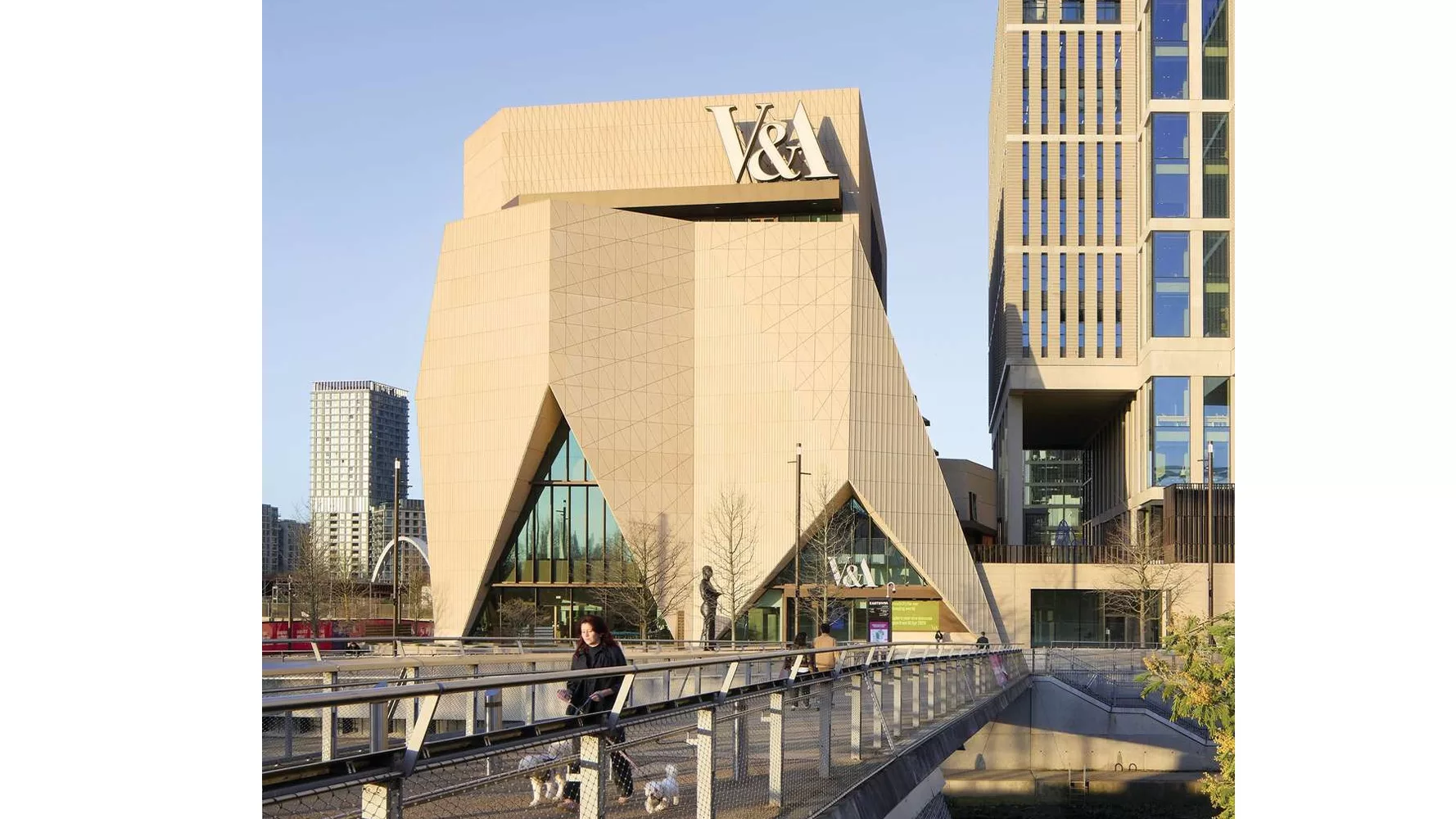
Perched above London’s Lea River, the newly opened V&A East Museum presents an enigmatic face to nearby Olympic Park. It rises five stories on pointed arms of sand-colored concrete, like a praying mantis or perhaps a friendly crab. On its main facade, the familiar logo of the Victoria & Albert Museum sends a signal toward the city center: high design, inventive and ambitious, has arrived in the East London district of Stratford.
Irish architects O’Donnell + Tuomey (ODT) designed the 73,300-square-foot museum to house a new location of the V&A, the world’s largest museum of design. If its massing might suggest an inward orientation, the intent—and the effect—is the opposite. The new building is a “civic-minded project,” said John Tuomey, who leads Dublin-based ODT with Sheila O’Donnell. “We’re trying to keep this feeling that you are walking on public ground, whatever level you’re on.”
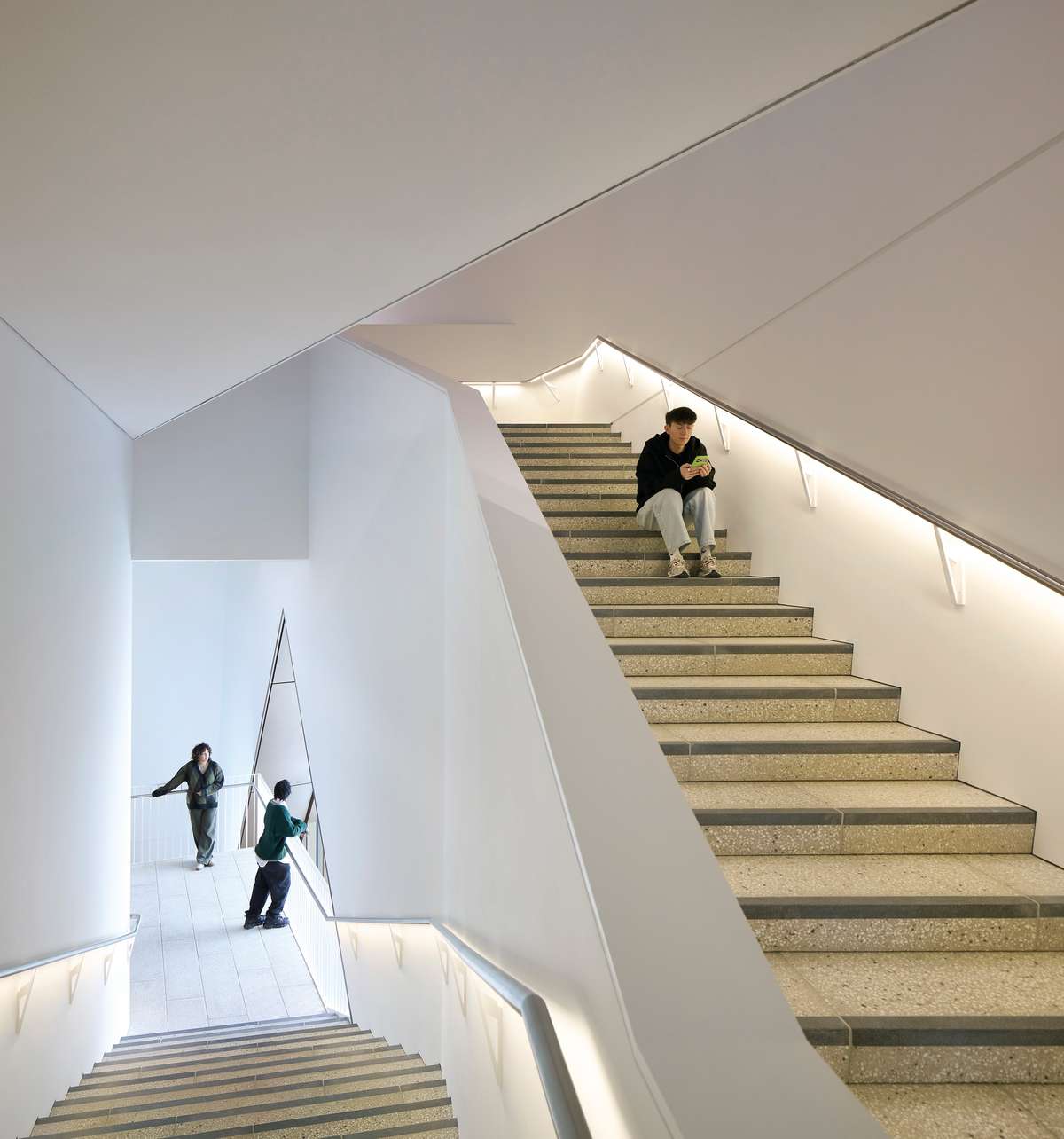
A daylit staircase weaves its way through the structure and connects public plazas and interior spaces. Photo © Hufton + Crow
The museum forms part of a redevelopment of the London Olympics site. In 2015, ODT, London’s Allies and Morrison, and the Spanish firm Camps Felip won a two-stage competition to master-plan a narrow spit of land, just across the River Lea from the Olympic Park (by Field Operations) and the former Olympic Stadium. Their scheme includes three residential towers, now under construction to the west, and four public buildings, including V&A East Museum and V&A East Storehouse nearby, designed by Diller Scofidio + Renfro.
The museum’s lowest level opens onto a riverside square. Here, A Place Beyond, by sculptor Thomas J. Price, depicts a Black girl looking pensively to the horizon. This 18-foot-tall piece welcomes East Londoners into the museum, which is specifically intended to engage “people who’ve said that museums don’t feel like places for them,” according to V&A project director Jen McLachlan. “We wanted a building that was distinctive, bold, and inviting and porous.” Like all U.K. national museums, the V&A East Museum is free to enter, except for temporary exhibitions.
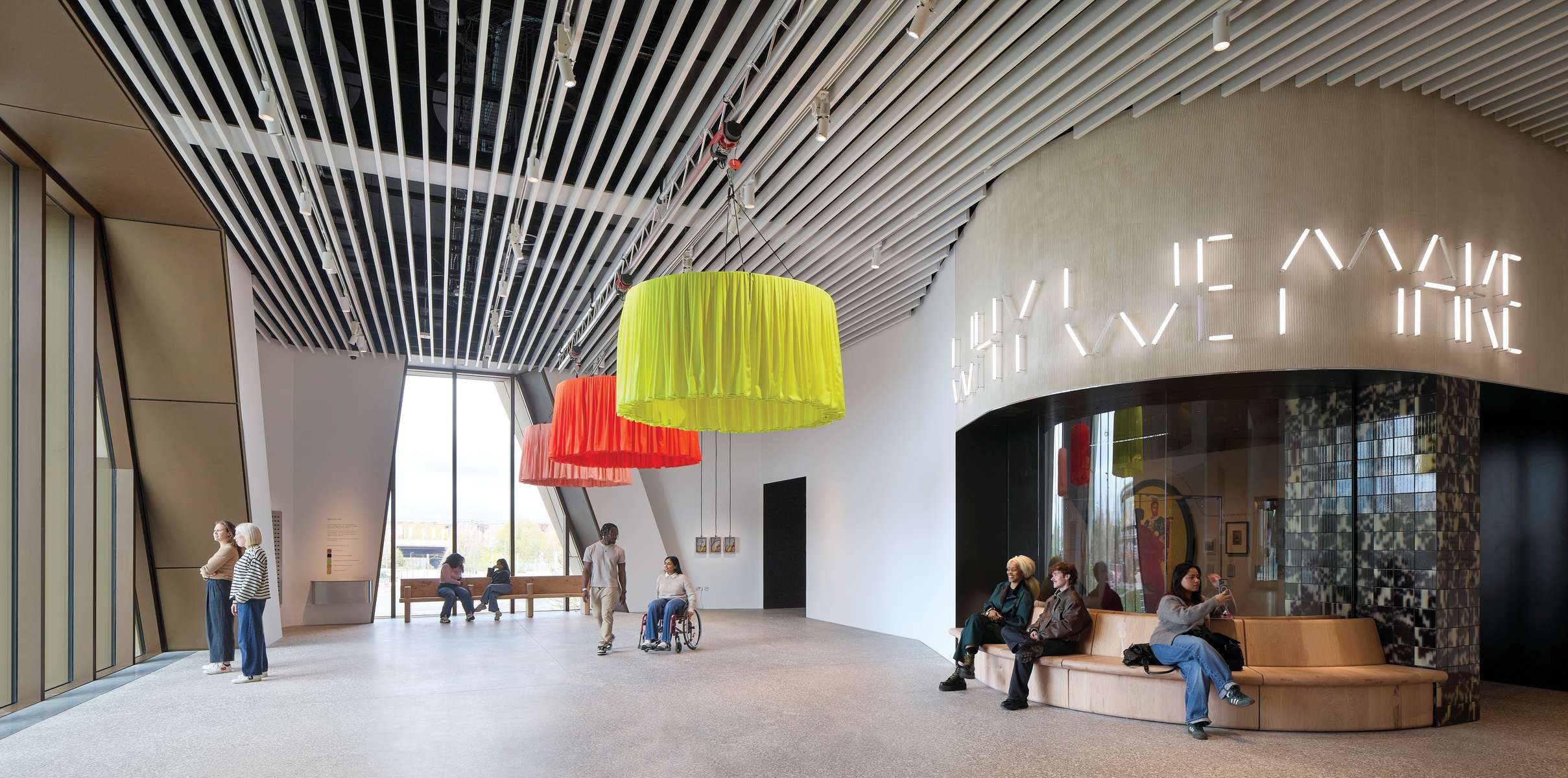
The museum features large areas for gathering. Photo © Hufton + Crow
The long lower lobby includes an Indian restaurant and café. ODT also designed its furniture, including a leather-seated bench whose steel structure echoes the cladding’s triangular motif. A stair positioned at the building’s north side winds its way to the second level, and then snakes back to an eastern entrance that connects the museum to a second public plaza.
The stair, which shrinks and expands in plan, provides a playful route upward, linking the two levels of permanent-exhibition galleries, one temporary-exhibition gallery, and a rooftop terrace. The permanent galleries, called Why We Make, contain 500 objects across art, fashion, architecture, and industrial design. (East London’s JA Projects led the exhibition design.)
The plaza at the second level connects the V&A East Museum with three other new public buildings: the London College of Fashion and new BBC rehearsal studios, both by Allies and Morrison, and Sadler’s Wells East, a contemporary-dance theater that O’Donnell + Tuomey completed in 2025. The latter features a sawtooth form and exuberantly detailed redbrick cladding.
Looking for quick answers on architecture and design topics?
Try Ask RECORD, our new smart AI search tool.
Ask RECORD →
Such large structures, on what are effectively blank-slate sites, are fresh territory for ODT; the studio started out with small cultural projects in Dublin, and their sensibility emphasizes craft, detail, and spatial and visual variety.
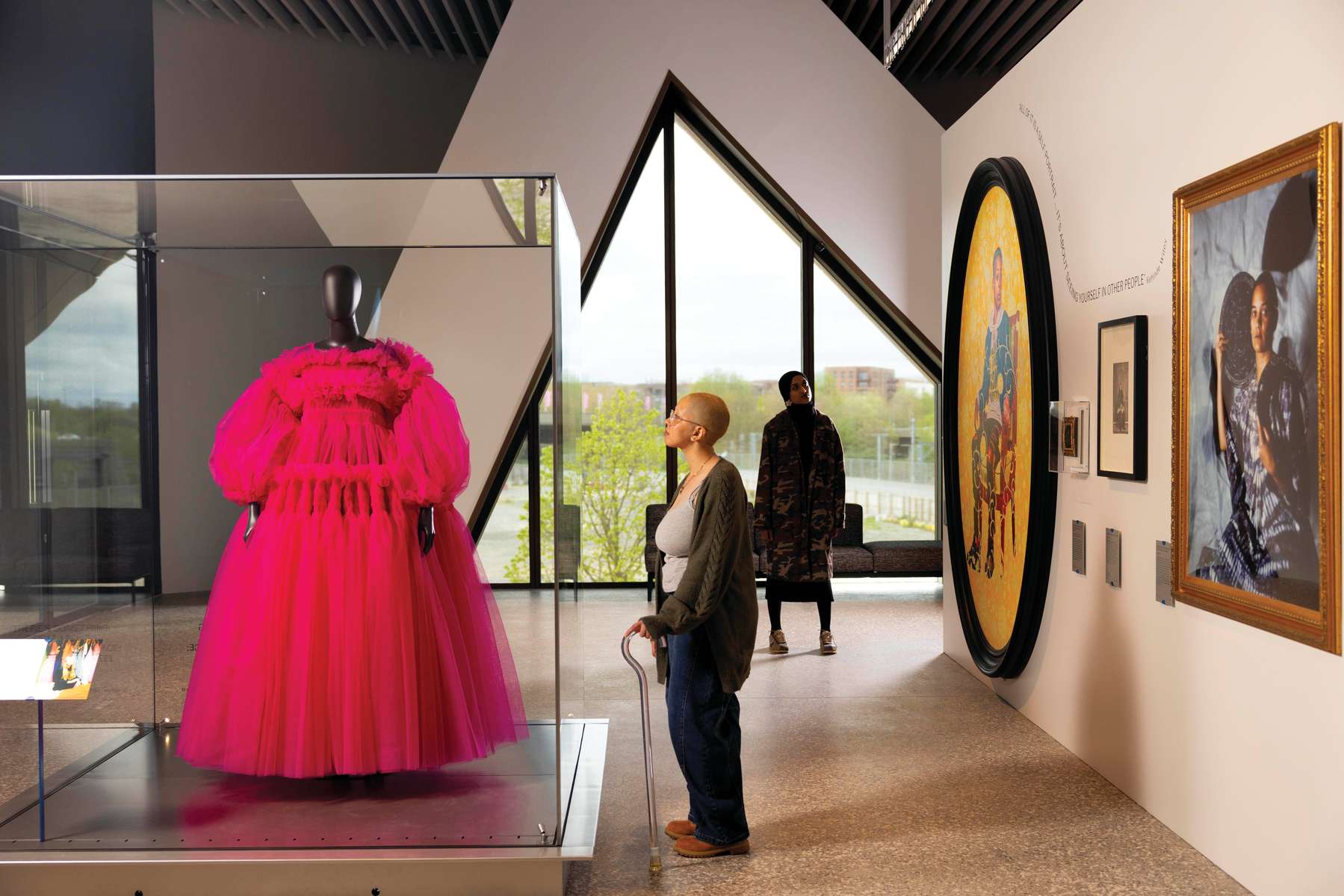
The museum has two permanent galleries. Photo © Hufton + Crow
Here they’ve dressed the museum in a skin of triangular and trapezoidal precast concrete. Tuomey says this robust material, finished with a variety of subtle striping and bush-hammering, alludes to the Lea Valley’s long industrial history. “We wanted these buildings to feel solid,” he says. The masterplan team “agreed on a language so that each building will feel as if it’s made of solid stuff and have depth to it.”
The 479 concrete panels are each unique in plan and profile, created through CNC-produced molds to fit the varied angles of the envelope.
ODT associate director Eimear Hanratty, who led the project, credits this formal language to a 2017 V&A exhibition on Balenciaga, where the architects noted the couturier’s attention to the space between the body and the enclosing fabric.
There are more obvious architectural precedents for this box-and-veil strategy, including many of Frank Gehry’s later buildings, such as the Fondation Louis Vuitton in Paris. But the stairs and foyer spaces themselves are convincing, drawing on ODT’s long-standing interest in thresholds and “the in-between world,” as Tuomey puts it. Concrete floor tile with a coarse aggregate provides a mineral texture, and triangular windows—shaped by the irregular geometry of the building’s pointed “arms”—bring in angular views of the city outside.
“The idea of depth is lacking in so much contemporary architecture,” Tuomey says. “This building has recesses and therefore it has benches to sit on, it has places to shelter. It receives rather than repels.”
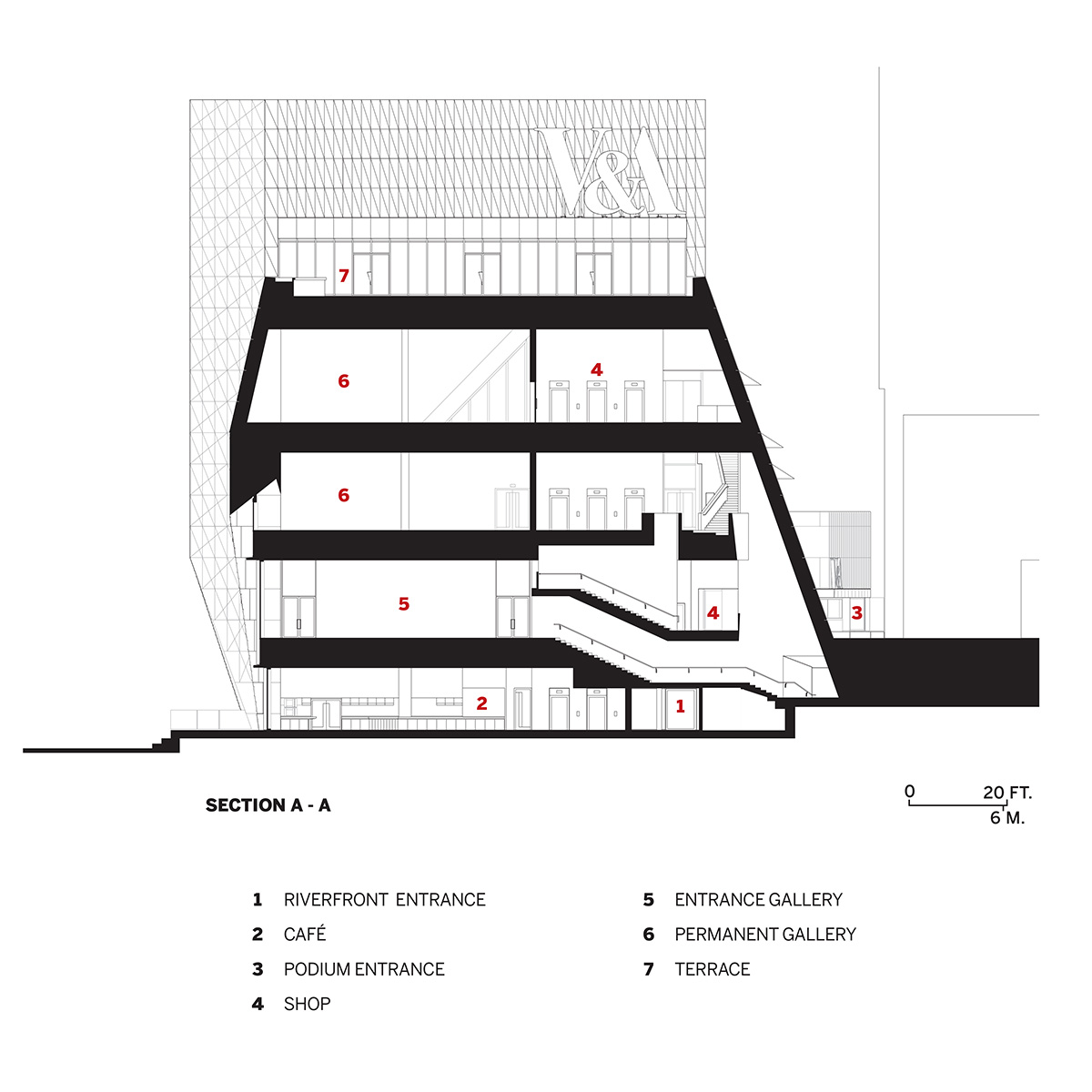
Image courtesy O’Donnell + Tuomey; click to enlarge
Credits
Architect:
O’Donnell + Tuomey — John Tuomey, Sheila O’Donnell, founding directors; Mark Grehan, director; Eimear Hanratty, associate director; Brian Barber, associate architect, Kevin O’Brian, architect
Engineer:
Buro Happold (structural, MEP, facade)
Consultants:
LDA Design (landscape); JA Projects (exhibition design)
General Contractor:
Mace (construction manager); Rise Contracts (tenant)
Client:
Victoria & Albert Museum
Size:
73,300 square feet
Cost:
$183 million
Completion:
April 2026
Sources
Precast Concrete:
Techrete
Curtain Wall:
Schneider Facades
Looking for a reprint of this article?
From high-res PDFs to custom plaques, order your copy today!