Architectural Record
search
cart
facebook twitter linkedin youtube
  • Sign In
  • Subscribe
  • Sign Out
  • My Account
Architectural Record
  • NEWS
    • Latest News
    • Awards
    • Interviews
    • Obituaries
    • Podcasts
      • Design:Ed Podcast
      • Sponsored Podcasts
  • OPINION
    • Book Reviews / Excerpts
    • Exhibition Reviews
    • Forum
  • EXCLUSIVES
    • Videos
    • Design Vanguard
    • Top 300 Firms
    • Sponsored Content
    • Sponsored eBooks
    • From the Archives
  • CONTINUING ED
    • Editorial Continuing Ed
    • CE Center
    • CE Academies
  • PROJECTS
    • Buildings By Type
    • Reuse & Renovation
    • Museums & Arts Centers
    • Colleges & Universities
    • Multifamily Housing
    • Interiors
    • Lighting
    • Kitchen & Bath
  • HOUSES
    • Record Houses
    • House of the Month
    • Featured Houses
  • PRODUCTS
    • Products by Category
    • Record Products of the Year
    • Latest Products
  • EVENTS
    • Dates & Events
    • Record on the Road
    • Innovation Conference
    • Sustainability in Practice
    • Women In Architecture
    • Webinars
    • Ad Excellence Awards
    • Submit an Event
  • CONNECT
    • Ask RECORD AI
    • Newsletters
    • Contact
    • Advertise
    • Editorial Calendar
    • Store
    • Customer Service
  • SUBMIT
    • Submission Guidelines
    • RECORD Competitions
  • MAGAZINE
    • Subscribe
    • My Account
    • Digital Edition
    • Current Issue
    • Firm Pass
    • Historic Archive
Architectural TechnologyArchitect Continuing Education

Practice Matters 2026

Professors’ Peril: The Hybrid Teaching-Practice Model
By Patrick Templeton
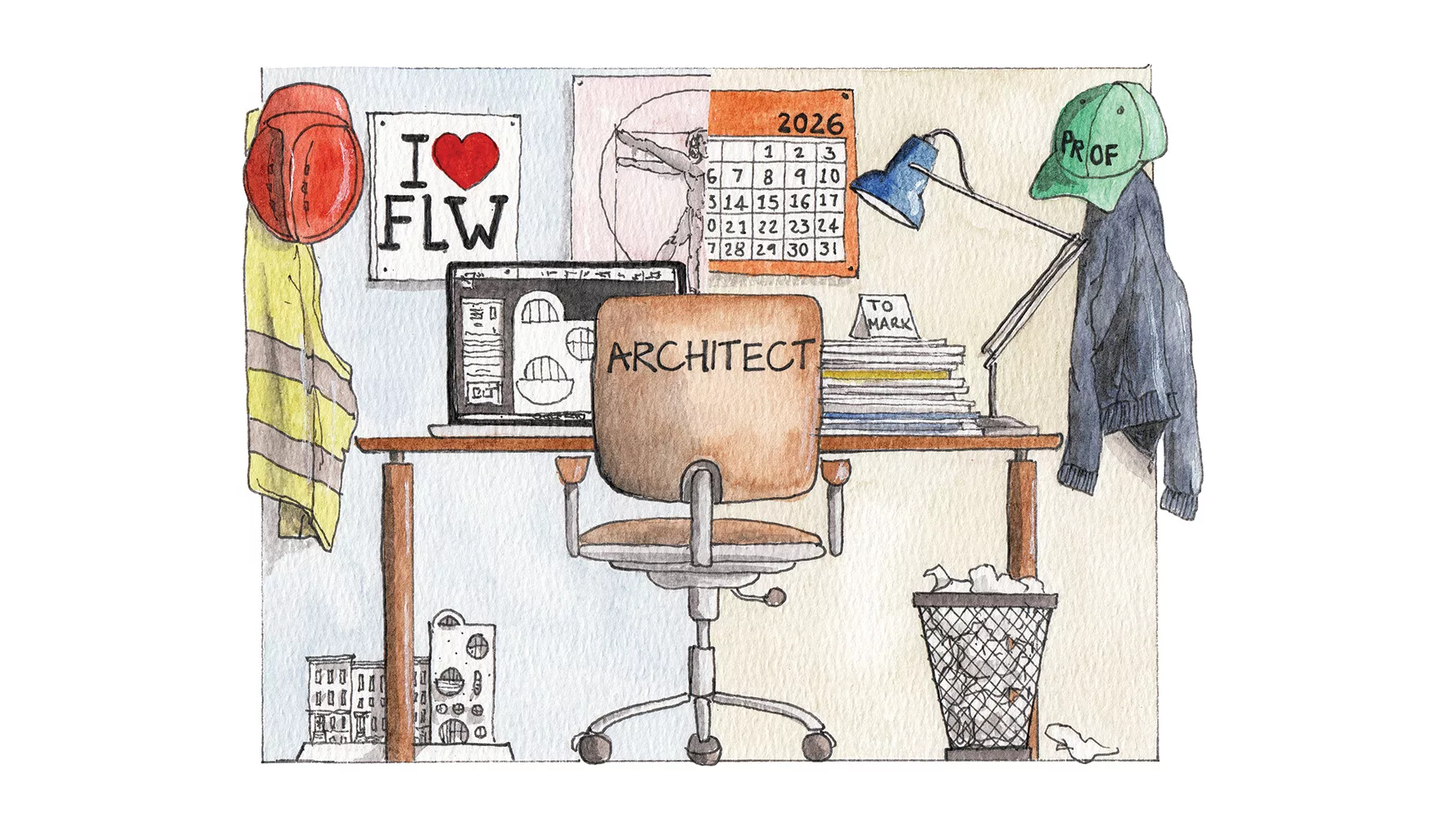
Practice Matters Illustration
Illustration by Anna Gibb
June 4, 2026
✕
Image in modal.
The artistic or “avant-garde” side of architecture has long been the domain of independent practitioners who design small-scale projects while also teaching. The bargain of this split focus is that the income from working as an educator gives architects a degree of creative autonomy to pursue less prolific but more experimental work, while academic research lends itself to more prestigious projects, such as publications and exhibitions.

In their essay for The Hybrid Practitioner, Eireen Schreurs, Eva Storgaard, and Marjan Michels explain that this type of “architectural practitioner draws from and interprets the skills of the academic in [an] awareness of a wider, deeper context and debate, a methodological approach to evidence and interpretation, the importance of distant perspective, and an ambition to be scholarly.” In other words, this career path could be called architecture’s discursive model, and it is the one followed by those who get top recognitions, articulate groundbreaking theories, and design canonical buildings.

“Academia has allowed me to participate in discourse and given me the luxury to explore ideas,” says Andrew Atwood, cofounder of First Office in Los Angeles and a professor at UC Berkeley. “That, I think, is unique to architects who work with one foot in academia,” he adds. “It’s also, frankly, the only place I make any money.” While evaluating the economics of corporate firms is common, questioning the financial position of these luminaries—who are so often discussed only in abstract terms—might seem profane. But bills have to be paid, and, in the United States, health insurance must come from somewhere. Prolonged declines in the Architecture Billings Index (ABI) and the sharp fall in college enrollment suggest that maintaining one foot in practice and one foot in academia might become an increasingly difficult balancing act.

As RECORD has continuously reported online, the ABI has been uniformly weak since early 2022, meaning that, for four years now, a narrow majority of firms regularly surveyed by the American Institute of Architects has reported having less work than previously. Prognosticating the future of the construction industry is its own science, observing mercurial ebbs and flows that can be related to transitory supply chain issues, long-term shifting demands, or the health of the economy as a whole. While there are storm clouds and silver linings for the practice side of this hybrid business model, more can be said with some certainty about the grim future of academia.

In his 2018 book Demographics and the Demand for Higher Education, economist Nathan Grawe coined the term “demographic cliff” to put a name to the precipitous collapse of college entrants, causing layoffs and school closures, which had already been forecast for the better part of a decade. Unlike other businesses, higher education can reasonably predict how many “customers” it will have 18 years in advance, when they are born. Undergraduate enrollment in the United States peaked in 2010 and has declined almost every year since. According to the Chronicle of Higher Education, despite attempts to draw in more nontraditional applicants, to reach communities less likely to go to college, and to appeal to international students, academia would run off this cliff—when attenuating enrollment coupled with its high-tuition/high-aid financial model would no longer be sustainable—by 2026.

In a December 2025 survey of administrators, two-thirds say they are at least “somewhat concerned” about their institutions’ long-term financial health, but, in conversations with some hybrid practitioners, there is a sense that architecture, as an accredited program, might be insulated. It is a mistake, however, to narrowly focus on architecture schools rather than the entire higher education sector, in part because layoffs risk an oversupply in the labor market of academia that will exacerbate what sociologist Randall Collins called “credential inflation.” Although it is a persistent trend, in which greater scholastic attainment takes priority over other measures of qualification in employment, one can imagine hybrid practitioners struggling to compete against candidates with terminal degrees in related fields or more experience as educators. An April 2026 report projects that more than 25 percent of American private colleges could close within the next 10 years, setting a lot of professors in search of work.

While not an architecture school, the University of the Arts in Philadelphia—which abruptly closed in June 2024, claiming an inability to reconcile its financial issues—appears to have been a bellwether for the increasingly frequent news of cuts and closures across American universities. Penn State approved winding down a total of seven campuses across the commonwealth in 2025. In January 2026, citing declining enrollment and an unsustainable tuition structure, the president of the California College of the Arts in San Francisco released a statement outlining the school’s closure. The facilities will be sold to Vanderbilt University, but, if there are plans to retain its architecture program or any of its staff, none have been made public as of press time. In March, the New School in New York City, which encompasses the Parsons School of Design, announced that it will soon be laying off 15 percent of its faculty and staff on top of a recent slew of buyout offers. And, in April, Syracuse University decided to suspend 93 of its 460 academic programs.

The fall from the demographic cliff is unlikely to be felt evenly among hybrid practitioners, with the type of school (public universities, liberal arts colleges, or private institutions) and one’s position (tenured, adjunct, or visiting) significantly affecting outcomes. It’s also noteworthy that, while the precariousness appears to be worsening, academia never provided a completely solid foundation for hybrid practitioners who are non-tenure-track faculty. “As an adjunct, every spring you’d get these letters saying that you had been fired from the school,” says Ashley Bigham, cofounder of Outpost Office and professor at the Ohio State University. “It was a bureaucratic thing, but it was a reminder that there was no guarantee of being rehired in the fall.”

American universities have effectively served a role comparable to that of the classical patron, providing architects the resources and creative autonomy for experimentation and the pursuit of ideas. If the longevity of architecture’s discursive model proves to be contingent on demographic and economic factors that make it no longer viable, what is at risk might be more than just the financial well-being of a particularly influential cohort within the field but rather the advancement of the discipline of architecture itself.

It’s likely that the split focus required to teach and practice will become increasingly difficult and that these pressures will force many to choose between working on lesson plans or business development. Some hybrid practitioners, particularly younger architects with less experience teaching, may have to forgo prestigious publications and exhibitions for the bread-and-butter projects that sustain independent firms. But, as Sean Canty, a Harvard professor and independent practitioner, points out: “As long as the academy exists, there will be an aspiration to follow this model, or something like it, because the field needs thinkers who exist outside of conventional norms of the market.”

Back to Continuing Education: Practice Matters 2026
KEYWORDS: architecture education

Share This Story

Looking for a reprint of this article?
From high-res PDFs to custom plaques, order your copy today!

Patrick templeton
Patrick Templeton is a senior editor at Architectural Record. He was the managing editor of the architectural journal Log for eight years, before which he worked for five years as a designer specializing in high-end residential renovations in New York. Patrick received a Bachelor of Architecture from the Fay Jones School of Architecture at the University of Arkansas.

Post a comment to this article

Report Abusive Comment

Subscription Center
  • Create an Account
  • Start a Subscription
  • Manage My Account
  • Sign Up for Newsletters
  • Visit Customer Service
  • Update Preferences

More Videos

Sponsored Content

Sponsored Content is a special paid section where industry companies provide high quality, objective, non-commercial content around topics of interest to the Architectural Record audience. All Sponsored Content is supplied by the advertising company and any opinions expressed in this article are those of the author and not necessarily reflect the views of Architectural Record or its parent company, BNP Media. Interested in participating in our Sponsored Content section? Contact your local rep!

close
  • cold storage facility
    Sponsored byCarlisle SynTec Systems

    How Architects Can Design More Continuous Cold Storage Envelopes

  • TAMLYN XtremeTrim Exterior Trim
    Sponsored byTamlyn

    Designing Cleaner Panel Facades: Why Exterior Trim Details Matter

  • Building with Vapor Barriers
    Sponsored byReef Industries, Inc.

    Vapor Barriers Help Control Moisture in Tighter Building Designs

DESIGN:ED Podcast
Listen to Architectural Record’s DESIGN:ED Podcast

Events

June 23, 2026

Enhancing Fire Resistance with Advanced PVC Solutions

Credits: 1 AIA LU/HSW; 1 AIBD P-CE; 0.1 ICC CEU; 1 IIBEC CEH

Evaluate advanced PVC solutions that improve fire resistance, support WUI compliance, and enhance resilience in residential and commercial building design.

June 25, 2026

Designing Glass Railing Systems that Enhance Aesthetics and Meet Code

Credits: 1 AIA LU/HSW; 1 AIBD P-CE; 0.1 ICC CEU

Upon course completion, participants will possess a deeper understanding of glass railings to help ensure that safety, aesthetic, and performance objectives are achieved.

View All Submit An Event

Products

2026 Architect's Square Foot Costbook

2026 Architect's Square Foot Costbook

See More Products

Popular Stories

Lorcan O' Herilhy

California Architect Lorcan O’Herlihy Has Died, Age 66

Obama Presidential Center, Chicago

The Obama Presidential Center Opens on Chicago’s South Side

Spoonbill Ranch

Johnsen Schmaling Architects Integrates Spoonbill Ranch into a Pristine Landscape

Image of Bruce Springsteen Center for American Music

The CookFox-designed Bruce Springsteen Center for American Music Opens in New Jersey

Three Courtyards House

Design Vanguard 2026: Balsa Crosetto Piazzi

Enhancing Fire Resistance with Advanced PVC Solutions - Free Webinar - June 23, 2026

Related Articles

  • Viollet-le-Duc Drawing Worlds materials

    The Bard Graduate Center Mounts the First U.S. Exhibition of Viollet-le-Duc’s Expansive Drawing Practice

    See More
  • Kyabirwa Surgical Center

    A Seven-Building Campus in Rural Uganda Becomes a Model for Constructing Off-Grid Medical Facilities

    See More
  • UM Centennial Village

    VMDO Architects Completes the First Phase of a Freshmen Housing Complex in the Heart of the UMiami Campus

    See More

Related Products

See More Products
  • drawingfrommodel.jpg

    Drawing from the Model: Fundamentals of Digital Drawing, 3D Modeling, and Visual Programming in Architectural Design

  • sustainable building.jpg

    Sustainable Building Design: Principles and Practice

See More Products

Events

View AllSubmit An Event
  • April 22, 2026

    One Foot In, One Foot Out—The Balancing Act of Teaching and Practicing Architecture

    NOW ON DEMANDCredits: 1 AIA LU/Elective; 1 AIBD P-CE;  0.1 ICC CEU; 0.1 IACET CEUJoin Architectural Record for a discussion with three leading firms on the future of the academic–practice hybrid model and its impact on the next generation of architects.
  • October 2, 2025

    Rewriting the Fee Formula: A Smarter Model for Pricing Your Services

    NOW ON DEMANDCredits: 1 AIA LU/Elective; 1 AIBD P-CE; 0.1 ICC CEU; 0.1 IACET CEUThis webinar reveals a more powerful approach to pricing that aligns with the actual value you create for clients, not just the time you spend or the construction costs you influence.
View AllSubmit An Event
×

The latest news and information

#1 Source for Architectural Design, News and Products

SUBSCRIBE
  • RESOURCES
    • Advertise
    • Contact Us
    • Submit
    • Store
  • ACCOUNT CENTER
    • Create an Account
    • Start a Subscription
    • Manage My Account
    • Sign Up for Newsletters
    • Visit Customer Service
    • Update Preferences
  • PRIVACY
    • PRIVACY POLICY
    • TERMS & CONDITIONS
    • DO NOT SELL MY PERSONAL INFORMATION
    • PRIVACY REQUEST
    • ACCESSIBILITY
  • SERVICES
    • Marketing Services
    • Reprints
    • Market Research
    • List Rental
    • Survey/Respondent Access
  • STAY CONNECTED
    • Linkedin
    • Facebook
    • Instagram
    • YouTube
    • X (Twitter)

Copyright ©2026. All Rights Reserved BNP Media, Inc. and BNP Media II, LLC.

Design, CMS, Hosting & Web Development :: ePublishing