‘Architects of Liberation: Modernism in Western Africa’ Opens at MoMA
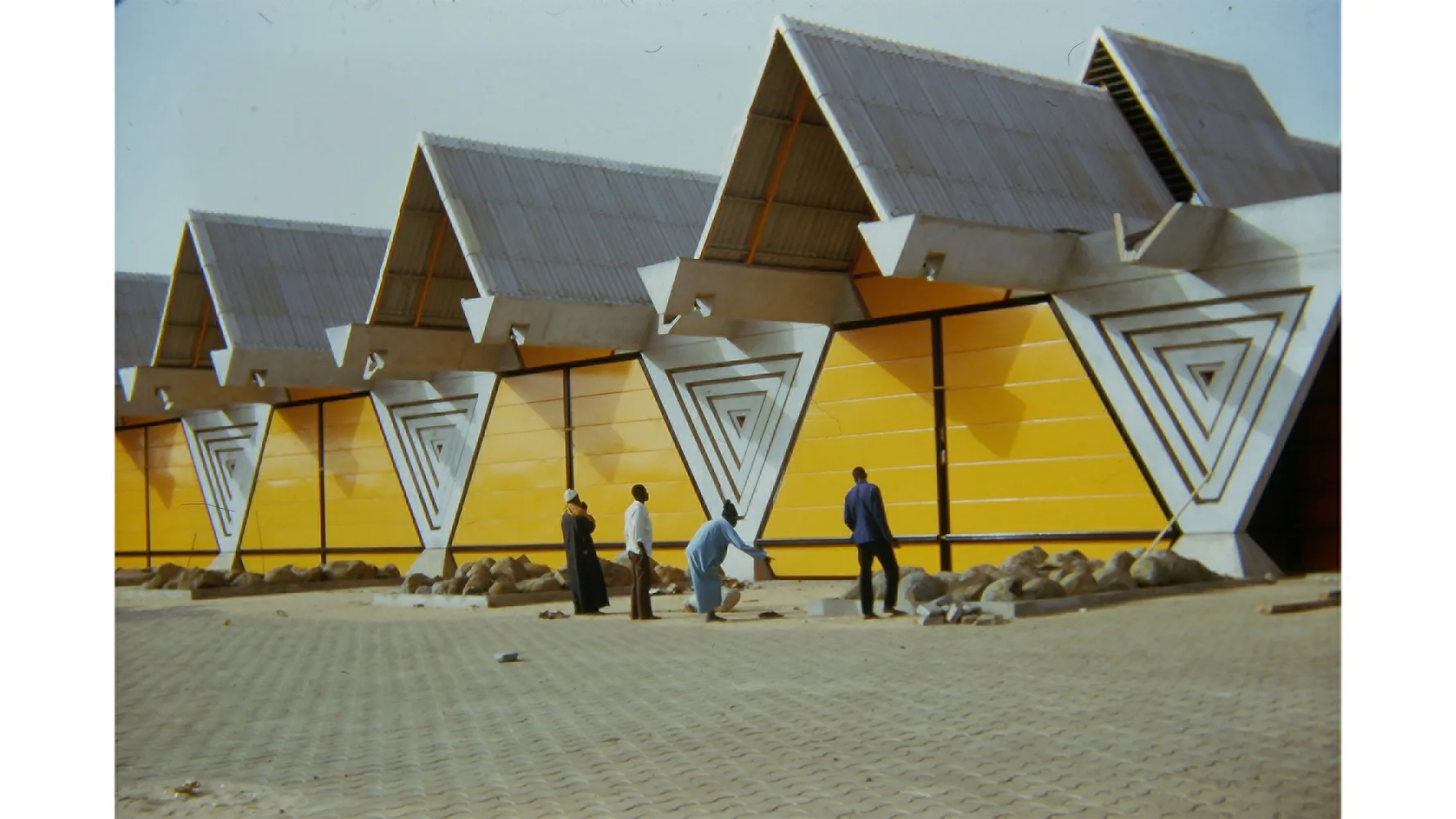
Centre International du Commerce Extérieur du Sénégal (CICES), Dakar, Senegal. 1971–74. Jean-François Lamoureux and Jean Louis Marin.
Architects of Liberation: Modernism in Western Africa, which opened at the Museum of Modern Art (MoMA) in New York City on Sunday, July 5th, is an ambitious exhibition that examines architecture as a medium through which liberation was negotiated. Curators Martino Stierli and Ikem Stanley Okoye cast a wide net across West Africa, bringing together projects from the late 1950s through the early 1980s (both unbuilt and realized) from seven modern nations—Benin, Cameroon, Côte d’Ivoire, Ghana, Nigeria, Senegal, and Togo. The exhibition attempts to connect architecture to political independence by presenting drawings, models, and archival photography and film, along with newly commissioned photographs of extant buildings. Recreated models repeatedly drew me close enough that a docent had to ask me to step back as I peered closely at their details.
Ultimately, the show asks how the built environment gave spatial form to projects of self-determination. Making such a history digestible for the public is no easy feat for any institution. To this end, the exhibition moves between displays of construction photographs, technical drawings, and archival film, focused presentations of individual architects, and reconstructed models that help viewers visualize projects that no longer exist or were never realized.
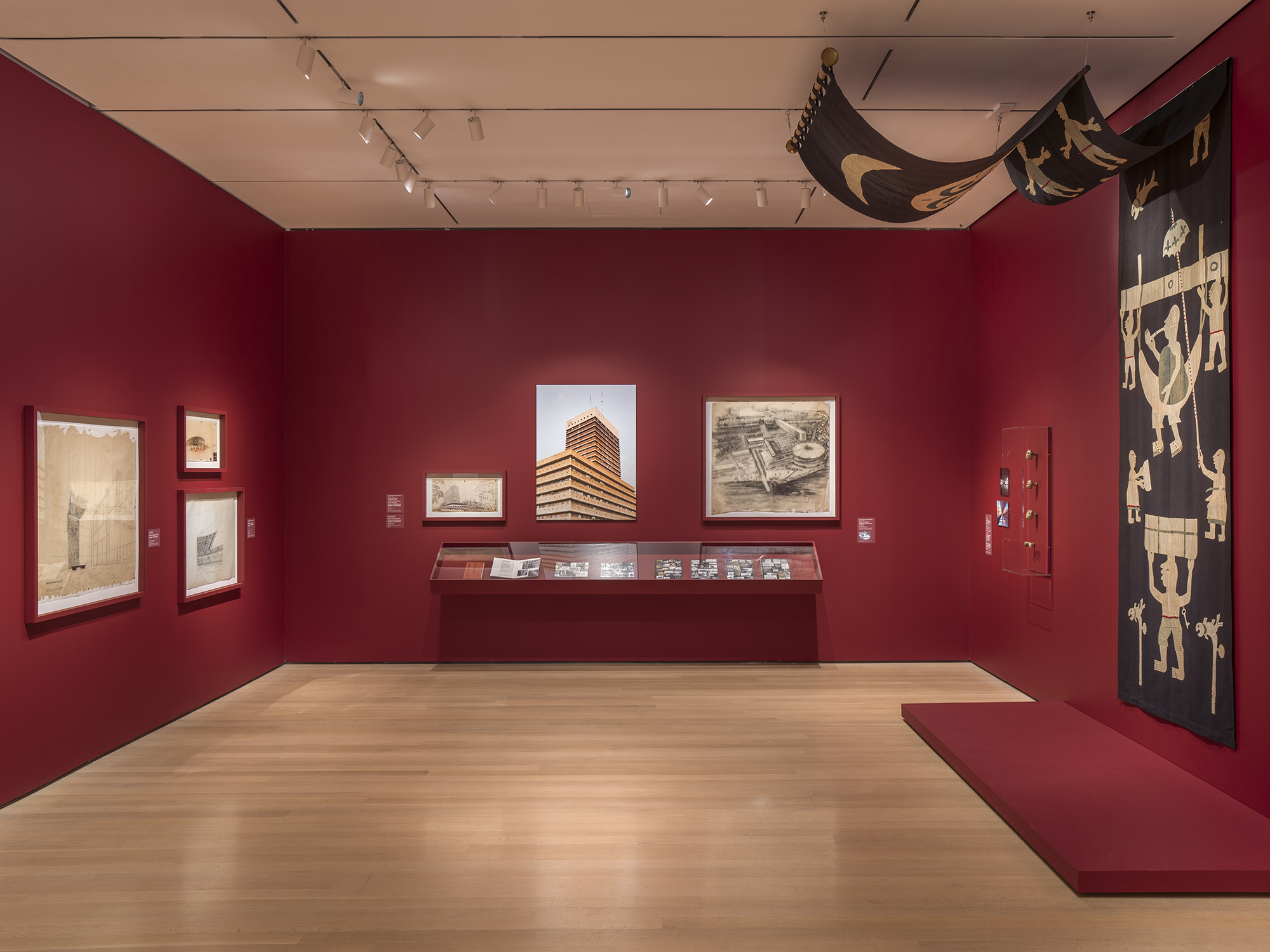
Installation view of Architects of Liberation: Modernism in Western Africa, now on view at the Museum of Modern Art, New York through Jan 2, 2027. Photo by Martin Parsekian, © The Museum of Modern Art, New York
The show begins in a room with tripartite archival footage from across West African decolonization projected on two walls. A horizontal wall-mounted case spans the third far wall; it contains journals, novels, and political texts associated with Pan-Africanism, Négritude, and broader postcolonial intellectual culture. Chinua Achebe’s novel A Man of the People, editions of Black Orpheus, the Nigerian literary journal founded by Ulli Beier, and Kwame Nkrumah’s I Speak of Freedom form a kind of canon of postcolonial thought, though their presence alone stops short of offering a proper introduction to the literary and political currents that shaped the region.
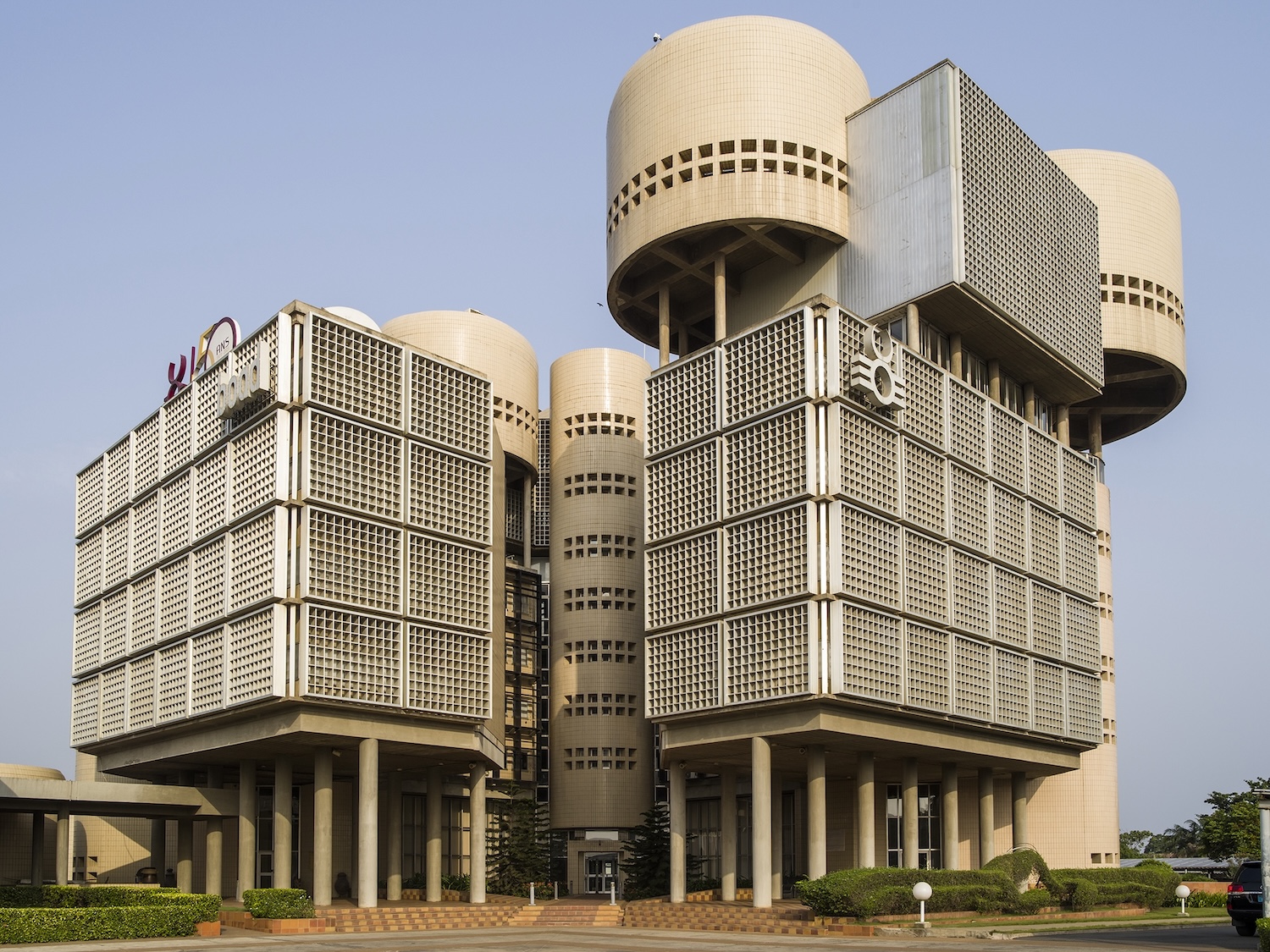
Banque Ouest Africaine de Développement (BOAD), Lomé, Togo. 1979–80. Guy Durand, Yves Ménard, and Messan Raphaël Ekoué-Hagbonon. 2025. Photograph by François-Xavier Gbré
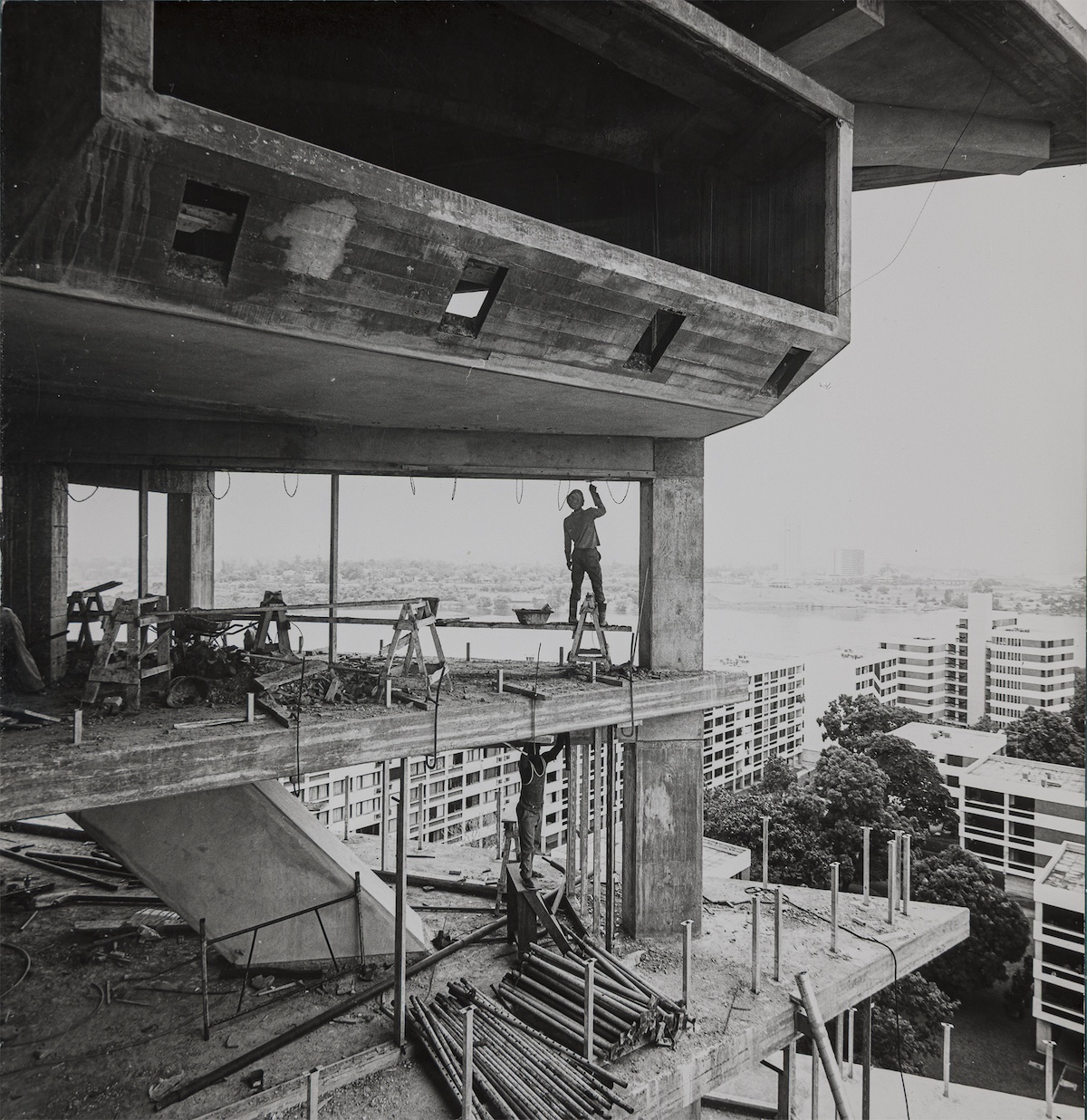
La Pyramide, Abidjan, Côte d’Ivoire. 1968–73. Rinaldo Olivieri (1931–1998). External view, circa 1973. Photograph by Rinaldo Olivieri; Rinaldo Olivieri Archives, Verona
The following rooms move from infrastructural projects to the skyscrapers of rising international business districts in Abidjan, Côte d'Ivoire, and Lagos, Nigeria. The archival drawings for La Pyramide, an office complex designed by Rinaldo Olivieri in Abidjan, are accompanied by a stunning model reconstructed by students from the Cooper Union, in which the louvers on the pyramidal facades demonstrate careful attention to solar shading. While the exhibition acknowledges environmental design—a persistent frame through which African architecture is interpreted—it thankfully avoids reducing postcolonial architecture to climatic adaptation.
Together, these projects suggest that what binds the nations represented in the exhibition is a shared investment in circulatory infrastructure, energy, and commerce. It also serves as a primer for a show dedicated to the built environment, one that shifts the focus away from the predominant media of decolonization in West Africa, namely the literature with which the exhibition begins.
While the exhibition examines architecture as a medium through which liberation was negotiated, it often avoids defining the intellectual concepts that made liberation meaningful in the first place. The opening galleries seem designed to evoke the effect of liberation, but the concepts of Africanization and Pan-Africanism were not merely emotional projects. They were intellectual frameworks that attempted to address the fracture between the precolonial past and the decolonizing present, theorized in real time by many of the same figures who would become leaders of newly independent states. Without a rich exploration of this context in tandem, the architecture risks appearing detached from the ideas that animated it.
In his curatorial statement in the exhibition catalog, Martino Stierli writes that Architects of Liberation is the final installment in a triptych of MoMA architecture exhibitions centered on political emancipation, following The Project of Independence: Architectures of Decolonization in South Asia, 1947–1985 (2022) and Toward a Concrete Utopia: Architecture in Yugoslavia, 1948–1980 (2018). Yet the exhibition may be just as productively situated alongside Ideas of Africa: Portraiture and Political Imagination, a recent exhibition from MoMA’s Department of Photography. That exhibition concludes with Air Afrique, the airline jointly owned by several West African nations from 1960 to 2002, presenting it as the materialization of a dream of African cosmopolitanism. Architects of Liberation invites a related question: if Air Afrique embodied a vision of liberation through mobility and continental connection, what were its attendant architectural forms? The exhibition’s movement from infrastructure to business districts, hotels, and trade fairs offers a compelling response, tracing how political independence was translated into spaces of exchange, movement, and cultural production.
Looking for quick answers on architecture and design topics?
Try Ask RECORD, our new smart AI search tool.
Ask RECORD →
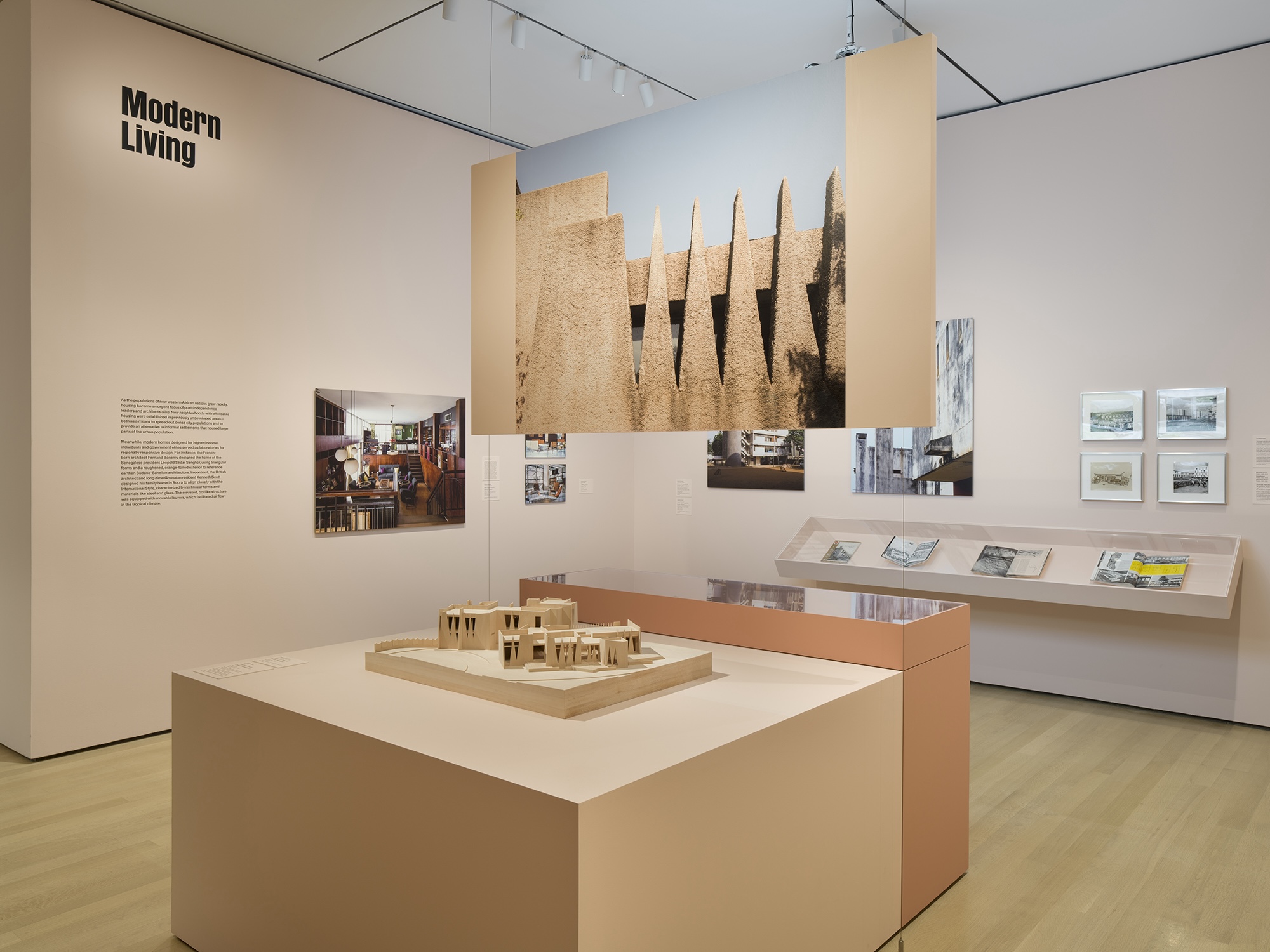
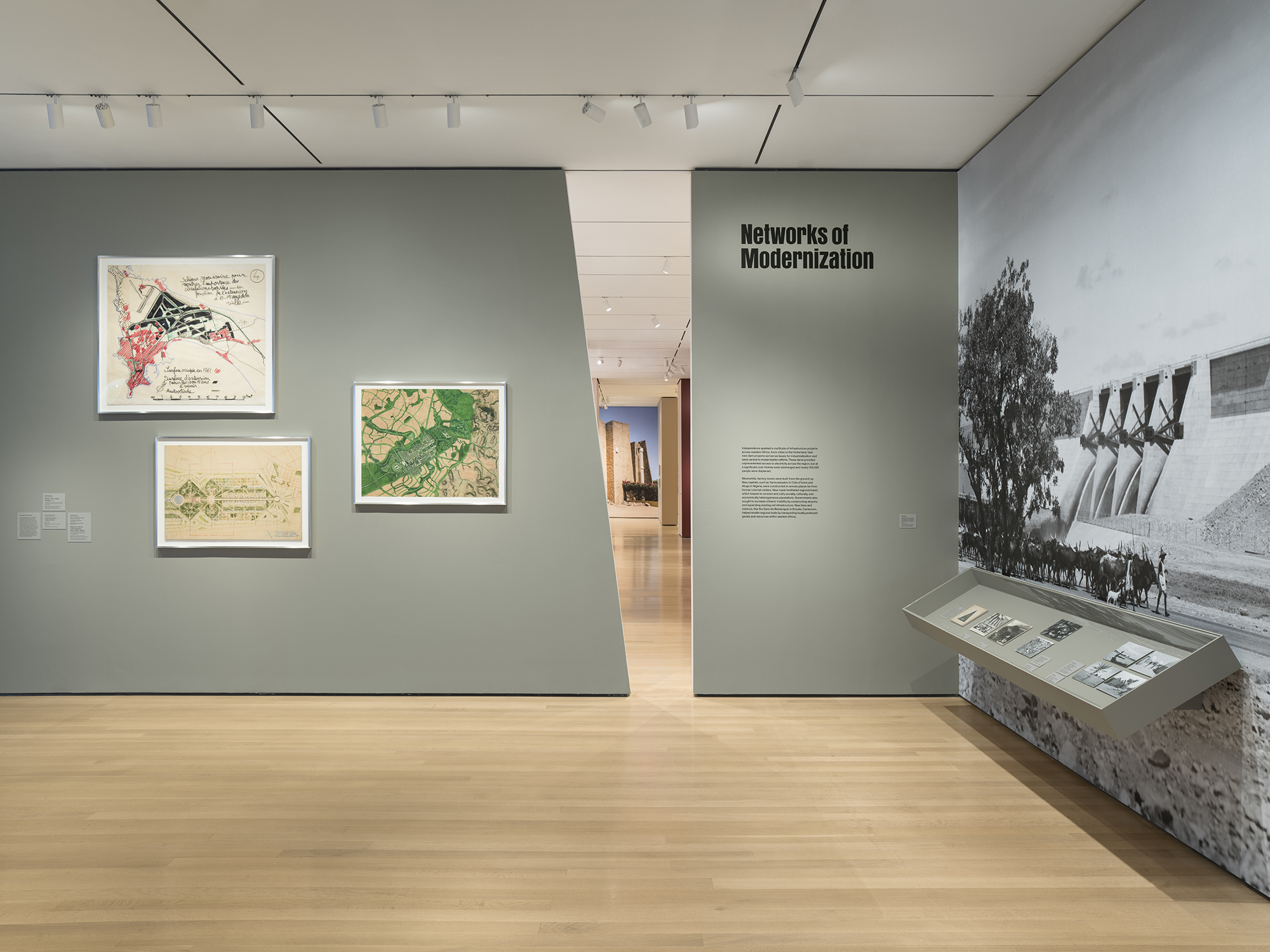
Installation views of Architects of Liberation. Photos by Martin Parsekian © The Museum of Modern Art, New York
The exhibition's greatest strength, however, lies in its final rooms: one gallery is devoted to event architecture, such as economic and cultural fairs, and another is focused on institutions of higher education. Photographs of John Andrews’s Nigeria Pavilion at Expo 67 in Montreal share wall space with Zoran Bojović’s International Trade Fair (ITF) in Lagos in the late 1970s. In these juxtapositions, the exhibition begins to stitch together intellectual movements and the built environment, revealing the ongoing negotiation between economic development and aesthetics. Similarly, in James Barnor’s photographs of the Africa Pavilion at the 1967 Ghana International Trade Fair in Accra, among the more familiar objects in the exhibition, one understands how architecture is central to a nation-building project that is as much a project of cultural production as an economic one.
In a smaller gallery space linking event and institutional architectures, there are drawings and an original model for the (unbuilt) Musée des Civilisations Noires, envisioned by Senegalese president Léopold Sédar Senghor. Conceived as a cultural institution rooted in the ideals of Négritude, the project promoted knowledge of Africa's cultural production and its diaspora. This project reveals how architectural production was directly entangled with the intellectual ambitions of liberation.
More broadly, the second half of the exhibition attributes architectural production to identifiable actors rather than treating it as an anonymous process of modernization. It is also here that the exhibition begins to fulfill its promise to highlight “the critical contributions of the first generation of trained African architects.”
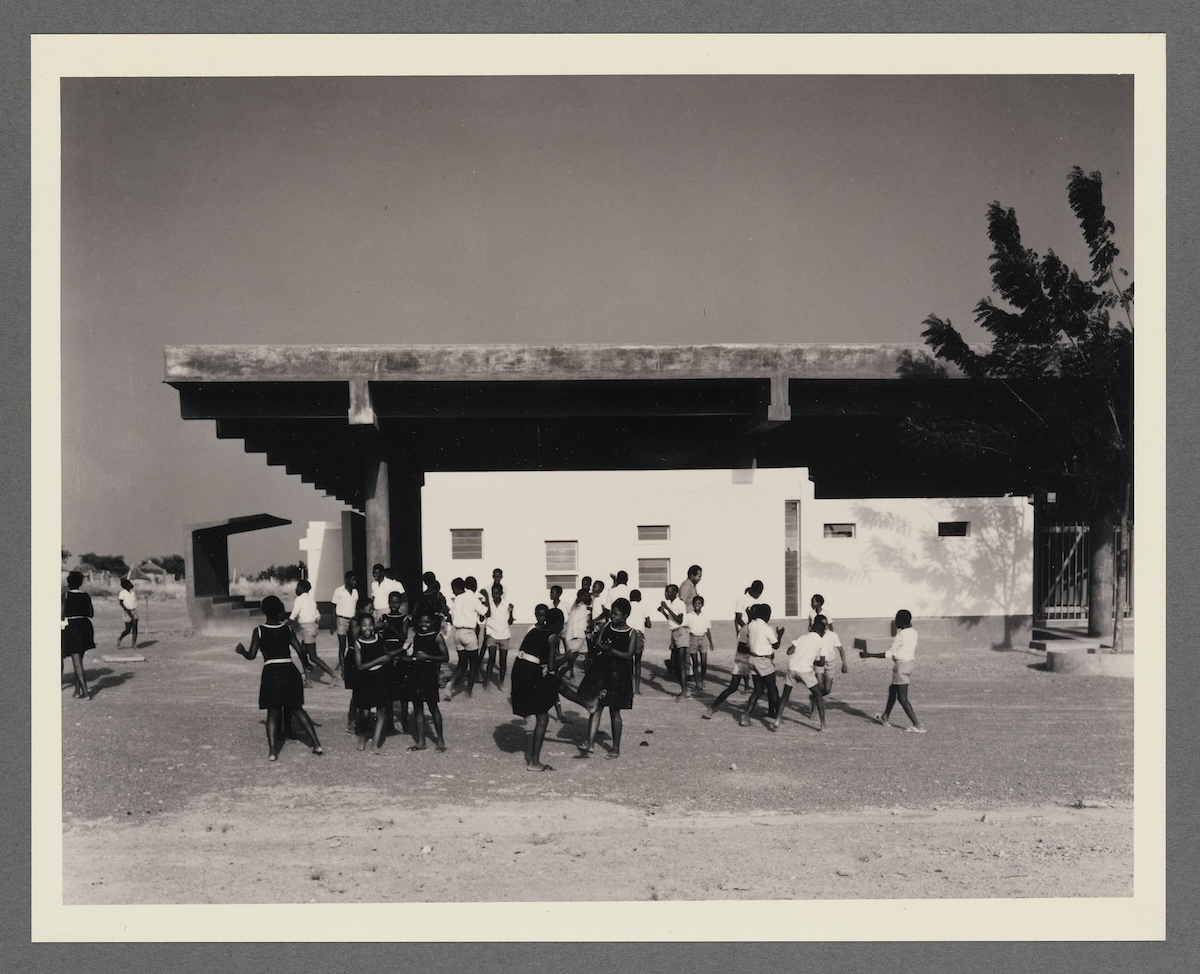
Children outside Bolgatanga Library, Ghana. December 1967. Photograph by Willis E. Bell. J. Max Bond Jr. papers, 1955–2009, Department of Drawings & Archives, Avery Architectural & Fine Arts Library, Columbia University. © Mmofra Foundation.
The final gallery, titled “Landscapes of Education,” identifies the locus of a modern African cultural production on the continent. Major examples include the École Nationale Supérieure d’Agronomie, an institution of science, landscape, and commerce in Yamoussoukro, the capital of Côte d’Ivoire, and the University of Ife in Nigeria, both of which fostered collaborations between African and international students and scholars. These projects suggest that independence was not only a political achievement but also an institutional one, requiring new systems for the production of knowledge and professional identities.
In contrast to the first half of the exhibition, these last two galleries confront the central challenges of decolonization (economics, education, and cultural production) and, in doing so, begin to answer questions of liberation rather than modernization alone.
Architects of Liberation: Modernism in Western Africa promises to show how architecture participated in liberation. It is unquestionably a feat of archival research. It sometimes falters when it invokes liberation without fully defining the ideas that gave the term historical meaning, but ultimately succeeds when it reveals the intellectual, political, and educational actors behind that process. Perhaps the exhibition’s deepest insight lies in the questions it cannot fully settle. Those unresolved tensions reveal that liberation was never a settled aesthetic program but an ongoing argument about how political independence might be translated into institutions, culture, and space.
Architects of Liberation: Modernism in Western Africa is on view at MoMA through Jan 2, 2007.
Looking for a reprint of this article?
From high-res PDFs to custom plaques, order your copy today!