Architectural Record
search
cart
facebook twitter linkedin youtube
  • Sign In
  • Subscribe
  • Sign Out
  • My Account
Architectural Record
  • NEWS
    • Latest News
    • Awards
    • Interviews
    • Obituaries
    • Podcasts
      • Design:Ed Podcast
      • Sponsored Podcasts
  • OPINION
    • Book Reviews / Excerpts
    • Exhibition Reviews
    • Forum
  • EXCLUSIVES
    • Videos
    • Design Vanguard
    • Top 300 Firms
    • Sponsored Content
    • Sponsored eBooks
    • From the Archives
  • CONTINUING ED
    • Editorial Continuing Ed
    • CE Center
    • CE Academies
  • PROJECTS
    • Buildings By Type
    • Reuse & Renovation
    • Museums & Arts Centers
    • Colleges & Universities
    • Multifamily Housing
    • Interiors
    • Lighting
    • Kitchen & Bath
  • HOUSES
    • Record Houses
    • House of the Month
    • Featured Houses
  • PRODUCTS
    • Products by Category
    • Record Products of the Year
    • Latest Products
  • EVENTS
    • Dates & Events
    • Record on the Road
    • Innovation Conference
    • Sustainability in Practice
    • Women In Architecture
    • Webinars
    • Ad Excellence Awards
    • Submit an Event
  • CONNECT
    • Ask RECORD AI
    • Newsletters
    • Contact
    • Advertise
    • Editorial Calendar
    • Store
    • Customer Service
  • SUBMIT
    • Submission Guidelines
    • RECORD Competitions
  • MAGAZINE
    • Subscribe
    • My Account
    • Digital Edition
    • Current Issue
    • Firm Pass
    • Historic Archive

Steilneset Memorial to the Victims of the Witch Trials by Peter Zumthor and Louise Bourgeois

Vardø, Norway
By Suzanne Stephens
Steilneset Memorial
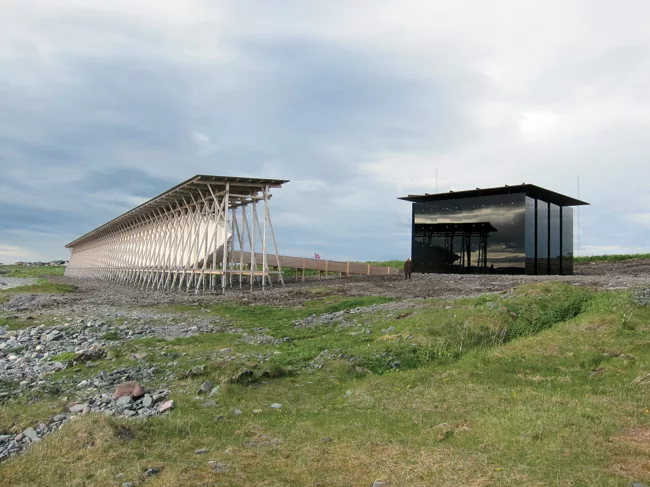
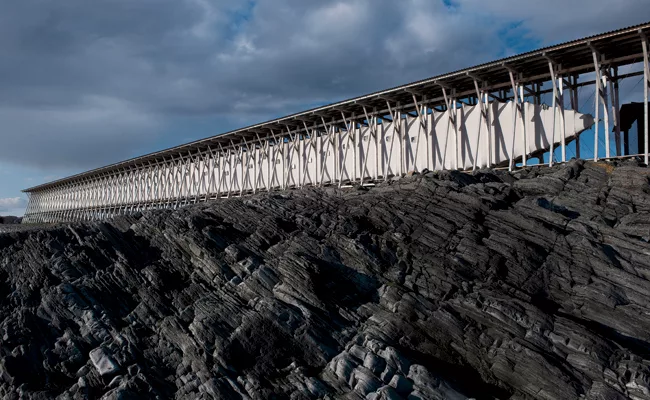
Peter Zumthor designed two distinct structures, one a delicate, elongated, wood-frame building perched on a granite coast above a sound; the other, a glass and Cor-Ten steel-frame volume containing Louise Bourgeois's installation.
 
Photo © Matilda McQuaid
Steilneset Memorial
Peter Zumthor designed two distinct structures, one a delicate, elongated, wood-frame building perched on a granite coast above a sound; the other, a glass and Cor-Ten steel-frame volume containing Louise Bourgeois's installation.
 
Photo © Matilda McQuaid
Steilneset Memorial
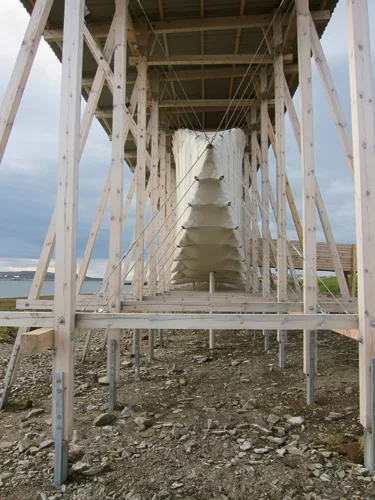
The end of the 410-foot-long structure illustrates how the cable-stayed PTFE-coated fiberglass exhibition space is tapered at the end and suspended within the wood frame composed of 60 bays. The roof is corrugated aluminum.
 
Photo © Matilda McQuaid
Steilneset Memorial
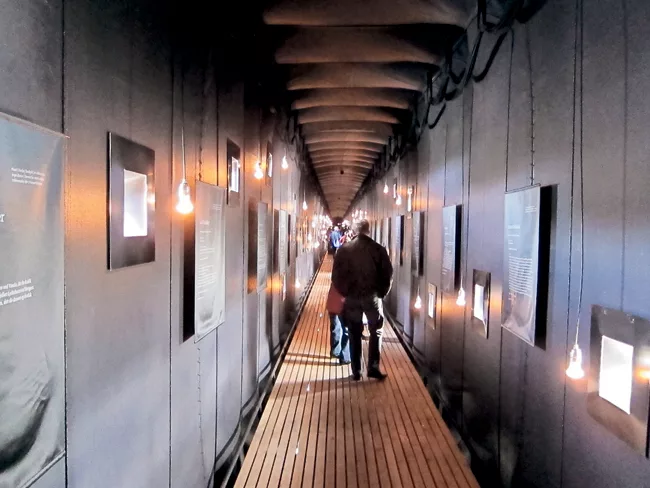
In the long house, the floor extends 328 feet. Deep windows set in metal frames are clamped onto the fiberglass fabric panels that are stitched together. Exposed-filament bulbs hang in the center of the 91 windows: On one side of the apertures suspended silk scrolls detail the individual histories of the victims, compiled by Liv Helene Willumsen.
 
Photo © Matilda McQuaid
Steilneset Memorial
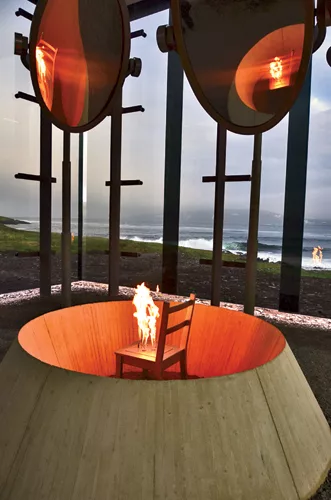
In the pavilion Zumthor designed for Louise Bourgeois's installation, Cor-Ten steel columns and brackets support tinted glass panels and a Cor-Ten roof. In the center is a rough concrete tub containing an aluminum chair. Gas-fueled flames shoot up from the chair seat, reflected by seven oval mirrors on columns encircling it.
 
Photo © Lysholm Hege
Steilneset Memorial
Steilneset Memorial
Steilneset Memorial
Steilneset Memorial
Steilneset Memorial
August 19, 2011

Architects & Firms

Atelier Peter Zumthor & Partners

Raw beauty and haunting poetry emerge from the idiosyncratic collaboration between Swiss architect Peter Zumthor and the late French-born artist Louise Bourgeois in Vardø, Norway. Here in the country's northeasternmost town (population: 2,000) above the arctic circle, you now find an arresting shrine to 91 people in the area who were tried and burned at the stake in the 17th century for the crime of witchcraft. Centuries later, the Steilneset Memorial for the Victims of the Witch Trials in Vardø officially opened June 23, presided by Her Majesty Queen Sonja of Norway.

The unusual project, sponsored by the town of Vardø, Finnmark County, the Varanger Museum, and the Norwegian Public Roads Administration, offers another stop on the much- heralded National Tourist Routes in Norway [Record, October 2007, page 90]. Because the memorial brings belated attention to aberrations of justice that occurred long ago, it may seem just a touristic ploy to attract sightseers to the craggy Steilneset promontory off the barren Varanger peninsula, where reindeer gambol and sheep never seem to sleep ' at least on sunny summer nights. However, as Sturla J. Stalsett, general secretary of the Vardø Church City Mission, pointed out during the opening ceremonies, the memorial is meant to remind us of the ongoing danger of collectively creating scapegoats. If historical circumstances seem peculiar now, the intent behind the work addresses larger moral claims.

While Norwegian architects competed for commissions to design the rest areas and look-out points on the scenic routes, the Steilneset memorial, initiated in 2000, was different. Artist Knut Wold, a consultant and curator for the National Tourist Routes, along with colleague Svein R'nning, suggested Bourgeois be commissioned for a different point of view. Since an architect would be needed to enclose her piece, Wold thought of Zumthor, whom he knew from the design of the Zinc Mine Museum in Sauda, Norway, begun in 2002 and now under construction. Wold discovered that Zumthor and Bourgeois already were working together on an art/architecture project for Dia:Beacon museum in Hudson, New York (2003), that ultimately was not realized. The new collaboration seemed a natural.

Since Bourgeois, who died in 2010, was 94 at the start of the memorial design in 2006, she enlisted her longtime assistant, Jerry Gorovoy, to help execute her ideas and asked Zumthor to go to the site first for his impressions. As Zumthor puts it,'She was to make the art installation, and I would make the shell.' Arriving in Vardø, the architect was struck by the harsh, treeless landscape along the Barents Sea, and the indigenous man-made elements such as spindly diagonal wood racks for drying fish, once a major export item. He also found the lamps in the small curtainless windows of the houses had a certain poignancy.

To memorialize the 77 women and 14 men who were victims of the witch hunt, Zumthor envisioned a long building with a taut wood-frame structure and a sailclothlike walls, to be perched atop the rocky, granite coast. Inside the elevated structure, he designed small windows randomly punched on both sides to commemorate those executed. In the center of each window would be suspended a single lightbulb. 'I didn't want an aggressive, massive monument. Creating a light, delicate structure was best for this rough place,' he says.

When Zumthor showed his sketches to Bourgeois, she said she liked them but felt his work was complete. She needed her own space, and so it was agreed that Zumthor would design a separate building for Bourgeois's piece, which features a burning chair.

Visitors enter the memorial on the north by a gangplank placed perpendicularly to the elevated Zumthor structure, a 410-foot-long building within which a tensile structure of polytetrafluoroethylene (PTFE)-coated fiberglass fabric is suspended on cables. Once inside, the visitors proceed along a 328-foot wood-plank catwalk about 5 feet wide. As they thread their way through the dark cocoon of the interior, visitors pass 91 windows, each dimly lit by an exposed-filament bulb. Ropelike cords from the lamps form scalloped borders at the edges of the undulating ceiling. The feeling is like being in the stomach of some prehistoric creature, half-fish, half-reptile ' except there is a glimmer of light.

At the south end, visitors exit on a gangplank that leads down to the entrance of the glass cubiform volume housing Bourgeois's piece. The pavilion's 39-by-39-foot square roof of Cor-Ten steel is supported by Cor-Ten steel columns at the room's perimeter. Horizontal steel brackets in turn brace the 17 large panes of dark glass, which Zumthor likens to welding goggles.

Looking for quick answers on architecture and design topics?
Try Ask RECORD, our new smart AI search tool.
Ask RECORD →

Owing to the high winds on the site, the glass walls stop short of the ceiling and floor and slide past each other to allow gaps for wind drafts. In the middle of the space is Bourgeois's piece, an aluminum chair with gas flames shooting out of the seat. In this rather literal evocation, the burning chair is reflected in seven oval mirrors placed on metal columns in a ring around the fiery seat, like judges circling the condemned. If you think you'll be too warm standing near the burning chair, don't worry. In this blustery place, temperatures rarely rise above 51 degrees Fahrenheit.

The extremely harsh climate naturally raises the question about the life of the long house's fiberglass fabric. Zumthor maintains that it is supposed to last 77.2 years. Let's hope. Because of the soil and wind, wood is hardly plentiful, and so the framing members were fabricated off-site. The membrane, made in Germany, with panels stitched in the factory, had to be installed in place using heat bags. In spite of the vernacular build-it-yourself look of the long house, its fabrication, like the glass pavilion, depended on contemporary techniques.

In the last analysis, you might well wonder if you need two separate structures, at a cost of about $15 million, to commemorate events that took place so long ago. Zumthor's long house would seem to do the job very effectively. But then again, you do get two distinct, provocative experiences for making the pilgrimage to Vardø.


KEYWORDS: Norway Peter Zumthor

Share This Story

Looking for a reprint of this article?
From high-res PDFs to custom plaques, order your copy today!

Stephens

Suzanne Stephens, a former deputy editor of Architectural Record, has been a writer, editor, and critic in the field of architecture for several decades. She has a Ph.D. in architectural history from Cornell University, and teaches a seminar in the history of architectural criticism in the architecture program of Barnard and Columbia colleges.

Post a comment to this article

Report Abusive Comment

Subscription Center
  • Create an Account
  • Start a Subscription
  • Manage My Account
  • Sign Up for Newsletters
  • Visit Customer Service
  • Update Preferences

More Videos

Sponsored Content

Sponsored Content is a special paid section where industry companies provide high quality, objective, non-commercial content around topics of interest to the Architectural Record audience. All Sponsored Content is supplied by the advertising company and any opinions expressed in this article are those of the author and not necessarily reflect the views of Architectural Record or its parent company, BNP Media. Interested in participating in our Sponsored Content section? Contact your local rep!

close
  • TAMLYN XtremeTrim Exterior Trim
    Sponsored byTamlyn

    Designing Cleaner Panel Facades: Why Exterior Trim Details Matter

  • Building with Vapor Barriers
    Sponsored byReef Industries, Inc.

    Vapor Barriers Help Control Moisture in Tighter Building Designs

  • Duct Interior with Prodeq System
    Sponsored byHenry, a Carlisle Company

    Designing Resilient Water Containment Systems

DESIGN:ED Podcast
Listen to Architectural Record’s DESIGN:ED Podcast

Events

June 10, 2026

Rethinking Stormwater – The Power of Porous Paving

Credits: 1 AIA LU/HSW; 1 AIBD P-CE; 0.1 ICC CEU

Learn how porous paving systems support stormwater management, reduce heat island effects, and enhance sustainable site design performance.

June 11, 2026

Very Early Warning Fire Detection for Mission-Critical Facilities

Credits: 1 AIA LU/HSW; 1 AIBD P-CE; 0.1 ICC CEU

Examine advanced fire detection strategies that support uptime and enhance safety in data centers and other mission-critical facilities.

View All Submit An Event

Products

2026 Architect's Square Foot Costbook

2026 Architect's Square Foot Costbook

See More Products

Popular Stories

Practice Matters illustration

What’s in a (Firm’s) Name? Thinking About Succession and Legacy

Practice Matters illustration

By the Numbers: Counting America's Architects

Riverdale House by Studio Lau

Riverdale House by Studio Lau

House on a Hill

Design Vanguard 2026: Forma

Crane Cove, ONO

Design Vanguard 2026 Winners

Broader Sustainability of CMU - Free Webinar - May 21, 2026

Related Articles

  • Memorial to the Victims of Violence in Mexico

    See More
  • Kolumba, Art Museum of the Archdiocese of Cologne, by Atelier Peter Zumthor

    See More
  • In Memory: Tobias Wong & Louise Bourgeois

    See More

Related Products

See More Products
  • 3dthinking.jpg

    3D Thinking in Design and Architecture: From Antiquity to the Future

  • GlobalData_logo_blue_header.png

    Construction in the US - Key Trends and Opportunities to 2023

See More Products
×

The latest news and information

#1 Source for Architectural Design, News and Products

SUBSCRIBE
  • RESOURCES
    • Advertise
    • Contact Us
    • Submit
    • Store
  • ACCOUNT CENTER
    • Create an Account
    • Start a Subscription
    • Manage My Account
    • Sign Up for Newsletters
    • Visit Customer Service
    • Update Preferences
  • PRIVACY
    • PRIVACY POLICY
    • TERMS & CONDITIONS
    • DO NOT SELL MY PERSONAL INFORMATION
    • PRIVACY REQUEST
    • ACCESSIBILITY
  • SERVICES
    • Marketing Services
    • Reprints
    • Market Research
    • List Rental
    • Survey/Respondent Access
  • STAY CONNECTED
    • Linkedin
    • Facebook
    • Instagram
    • YouTube
    • X (Twitter)

Copyright ©2026. All Rights Reserved BNP Media, Inc. and BNP Media II, LLC.

Design, CMS, Hosting & Web Development :: ePublishing