Architectural Record
search
cart
facebook twitter linkedin youtube
  • Sign In
  • Subscribe
  • Sign Out
  • My Account
Architectural Record
  • NEWS
    • Latest News
    • Awards
    • Interviews
    • Obituaries
    • Podcasts
      • Design:Ed Podcast
      • Sponsored Podcasts
  • OPINION
    • Book Reviews / Excerpts
    • Exhibition Reviews
    • Forum
  • EXCLUSIVES
    • Videos
    • Design Vanguard
    • Top 300 Firms
    • Sponsored Content
    • Sponsored eBooks
    • From the Archives
  • CONTINUING ED
    • Editorial Continuing Ed
    • CE Center
    • CE Academies
  • PROJECTS
    • Buildings By Type
    • Reuse & Renovation
    • Museums & Arts Centers
    • Colleges & Universities
    • Multifamily Housing
    • Interiors
    • Lighting
    • Kitchen & Bath
  • HOUSES
    • Record Houses
    • House of the Month
    • Featured Houses
  • PRODUCTS
    • Products by Category
    • Record Products of the Year
    • Latest Products
  • EVENTS
    • Dates & Events
    • Record on the Road
    • Innovation Conference
    • Sustainability in Practice
    • Women In Architecture
    • Webinars
    • Ad Excellence Awards
    • Submit an Event
  • CONNECT
    • Ask RECORD AI
    • Newsletters
    • Contact
    • Advertise
    • Editorial Calendar
    • Store
    • Customer Service
  • SUBMIT
    • Submission Guidelines
    • RECORD Competitions
  • MAGAZINE
    • Subscribe
    • My Account
    • Digital Edition
    • Current Issue
    • Firm Pass
    • Historic Archive

Philly Forward

The arrival of the Barnes Foundation in its new quarters on the Benjamin Franklin Parkway promises to further Philadelphia's identity as an artistic magnet.
By Diana Lind
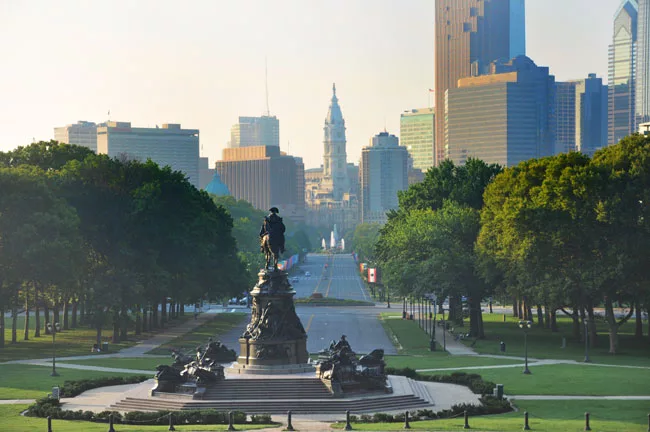
The Eakins Oval, just southeast of the Philadelphia Museum of Art, contains the Washington Monument fountain by sculptor Rudolf Siemering. The 1897 statue, moved to this site in 1928, points down the
Benjamin Franklin Parkway
The Eakins Oval, just southeast of the Philadelphia Museum of Art, contains the Washington Monument fountain by sculptor Rudolf Siemering. The 1897 statue, moved to this site in 1928, points down the tree-lined Benjamin Franklin Parkway to City Hall.
Photo © Bill Cannon
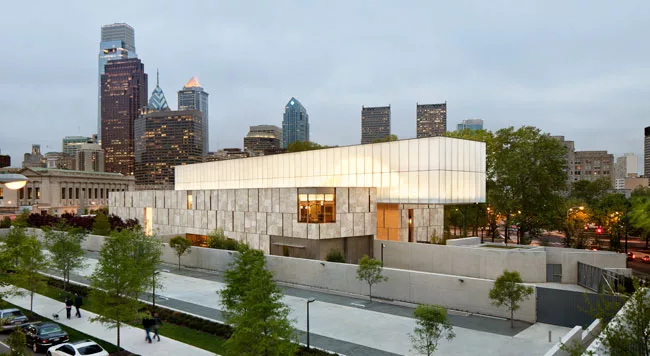
The actual entrance to the Barnes occurs at  the  east end of the north facade, not on the Parkway.  A landscaped court separates the structure from a parking lot (foreground) near the loading dock at
The Barnes Foundation
Tod William Billie Tsien Architects
The actual entrance to the Barnes occurs at the east end of the north facade, not on the Parkway. A landscaped court separates the structure from a parking lot (foreground) near the loading dock at the northwest end.
Photo © Michael Moran
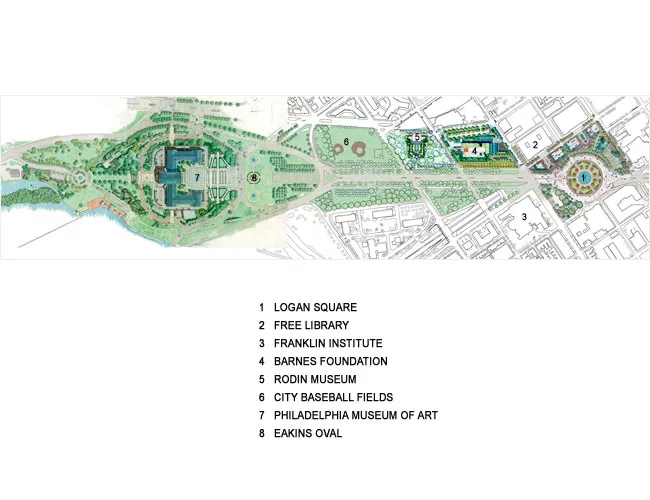
Benjamin Franklin Parkway Master Plan. <br><br> <a href='/features/Philadelphia-Remix/images/Barnes-Foundation-on-Benjamin-Franklin-Parkway-Master-Plan.jpg' target='_blank' >Click to view larger image
Benjamin Franklin Parkway Master Plan
OLIN
Benjamin Franklin Parkway Master Plan.

Click to view larger image.
Image courtesy OLIN
The Eakins Oval, just southeast of the Philadelphia Museum of Art, contains the Washington Monument fountain by sculptor Rudolf Siemering. The 1897 statue, moved to this site in 1928, points down the
The actual entrance to the Barnes occurs at  the  east end of the north facade, not on the Parkway.  A landscaped court separates the structure from a parking lot (foreground) near the loading dock at
Benjamin Franklin Parkway Master Plan. <br><br> <a href='/features/Philadelphia-Remix/images/Barnes-Foundation-on-Benjamin-Franklin-Parkway-Master-Plan.jpg' target='_blank' >Click to view larger image
June 16, 2012

Sandwiched between Washington, the capital, and New York, the center of culture, commerce, and media, Philadelphia has long had an inferiority complex. But the city's recent addition of nearly 90,000 people since 2006, ending a population free fall since 1950, attests to Philadelphia's comeback. It wasn't easy, or without controversy. The most notorious example of the city's bid to capture attention and boost tourism came in 2004, when the state government, the powerful Pew Charitable Trusts, the Lenfest Foundation, and the Annenberg Foundation staged a significant cultural coup. Along with a handful of other local players, they agreed to provide the venerated Barnes Foundation with $150 million to shore up its endowment if it would move from suburban Merion to Center City. With its world-famous $25 billion collection of art, the Barnes's move downtown was a major win for Philly.

Tod Williams and Billie Tsien Architects’ new building for the Barnes Foundation, a monumental, limestone-clad structure, balances both its civic role and its function as a gallery for viewing art in an intimate setting. The dignified museum creates important metaphorical and physical links to the surrounding urban fabric, while its art program complements the city’s cultural scene. It’s not too much of a stretch to predict that the Barnes will bridge another gap: Philadelphia’s perceived cultural lag among America’s most important cities. If Washington has dozens of institutions surrounding the Mall, and New York has upper Fifth Avenue’s Museum Mile, now Philadelphia offers a corollary with the Benjamin Franklin Parkway, where the Philadelphia Museum of Art, the Rodin Museum, and the Franklin Institute have been marooned for years waiting for good cultural company.

The 1.5-mile Parkway, designed in 1917 by Jacques Gréber as part of the City Beautiful movement, diagonally slices through the urban grid from City Hall at one end to the Philadelphia art museum at the other. But even with Horace Trumbauer’s Beaux Arts buildings at Logan Square, where a six-lane boulevard to the museum begins, the Parkway never became Philadelphia’s Champs-Élysées. The city put an end to that hope by having the Vine Street Expressway (Route 676) cross under the Parkway at Logan Square.

Now the Barnes occupies a plot that once housed the Youth Study Center (an outdated 1953 Modern building by Carroll, Grisdale & Van Alen) just northwest of Logan Square and adjacent to Trumbauer’s Free Library (1927), which is still fundraising for an expansion by Moshe Safdie. On the other side of the Barnes is the Rodin Museum (designed in 1929 by Paul Cret, who also designed the original gallery building in Merion in 1925), and on the south side of the parkway sits the Franklin Institute (1934). In this corridor of important cultural institutions, the Barnes and the Franklin Institute now can be read as a gateway to the once-neglected, tree-lined boulevard. David Brownlee, professor of art history at the University of Pennsylvania, says the simple fact of the Barnes’s presence has “enormously intensified the pleasure of walking along the Parkway. It’s reduced the psychological size of the Parkway, and the experience is much more one of continuous architectural excitement.”

That pleasure derives from the Barnes’s quasi-public grounds, which help complete the series of intimate park spaces that pedestrians can enjoy from Dilworth Plaza at City Hall (under renovation) up to the Schuylkill River path and Fairmount Park beyond the art museum. On the Barnes site, the design manages transitions not only in scale and character but also a 12-foot drop in grade. Landscape architect Laurie Olin, whose firm has master planned the landscaping of the whole Parkway, sought to guide visitors from a civic promenade into a domestically scaled garden that prepares viewers for the intimate experience of the Barnes’s galleries. Tod Williams says the building “wants to be a quiet citizen on the Parkway,” and indeed, its beige limestone walls and translucent glass-roof structure blend into the landscaping. When visitors finally approach the entrance, on the north facade of the museum, away from the Parkway, there is a sense of a discovered treasure, a small journey that mimics the former trip out to Merion.

The aura of seclusion that the Barnes conjures is rare in cities, and is nearly ruined by an unfortunate parking lot attached to the building’s north side. But while tourists will undoubtedly identify the Foundation as another institution on the Parkway, locals will likely often approach the building from the side streets. Callowhill Street, which runs just behind the museum, connects the hallowed ground of the Parkway to the grungy Loft District a few blocks east. There, the Reading Viaduct, an abandoned rail line much like New York’s High Line, is undergoing landscaping that will help rejuvenate the surrounding neighborhood. The Viaduct is a contemporary, and more organic, version of the Parkway, where the institutions edging it are appropriately smaller-scale galleries with unsanctioned public art.

Philadelphia officials are keen to support these alternate cultural corridors and to refute the notion that the Barnes is the main attraction in town; rather, it is just one of a constellation of artistic offerings. Its opening coincides with a new, two-year, tourism program, “With Art.” As Gary Steuer, Philadelphia’s Chief Cultural Officer of the Office of Arts, Culture and the Creative Economy, says, “[Albert] Barnes was a contemporary art collector. And while we celebrate the opening of the Barnes, we recognize this is not just a city of archival art presentation but a place where art is living, breathing, and being made today.”

When asked if the architecture responds to Philadelphia’s vernacular, Williams replies that he looked to the work of Louis Kahn, Frank Furness, and Trumbauer. These connections can be clearly seen in Williams and Tsien’s choices of traditional materials and massing along with Modernist construction techniques and details. The combination of old and new call to mind many buildings in Philadelphia that have been added onto and altered over the years. Its unassertive mien doesn’t scream, “I am a Monument”—to borrow Robert Venturi and Denise Scott Brown’s famous denunciation of objectlike architecture. By delighting in this dialogue between poles of the historical and Modern, the Barnes shows a way for Philadelphia to move ahead, while looking back and forward at the same time.

Diana Lind is the executive director and editor in chief of Next American City.

KEYWORDS: Philadelphia Tod Williams Billie Tsien Architects

Share This Story

Looking for a reprint of this article?
From high-res PDFs to custom plaques, order your copy today!

Diana Lind writes the Substack “The New Urban Order” and is the author of the book Brave New Home: Our Future in Smarter, Simpler, Happier Housing.

Post a comment to this article

Report Abusive Comment

Subscription Center
  • Create an Account
  • Start a Subscription
  • Manage My Account
  • Sign Up for Newsletters
  • Visit Customer Service
  • Update Preferences

More Videos

Sponsored Content

Sponsored Content is a special paid section where industry companies provide high quality, objective, non-commercial content around topics of interest to the Architectural Record audience. All Sponsored Content is supplied by the advertising company and any opinions expressed in this article are those of the author and not necessarily reflect the views of Architectural Record or its parent company, BNP Media. Interested in participating in our Sponsored Content section? Contact your local rep!

close
  • cold storage facility
    Sponsored byCarlisle SynTec Systems

    How Architects Can Design More Continuous Cold Storage Envelopes

  • TAMLYN XtremeTrim Exterior Trim
    Sponsored byTamlyn

    Designing Cleaner Panel Facades: Why Exterior Trim Details Matter

  • Building with Vapor Barriers
    Sponsored byReef Industries, Inc.

    Vapor Barriers Help Control Moisture in Tighter Building Designs

DESIGN:ED Podcast
Listen to Architectural Record’s DESIGN:ED Podcast

Events

June 23, 2026

Enhancing Fire Resistance with Advanced PVC Solutions

Credits: 1 AIA LU/HSW; 1 AIBD P-CE; 0.1 ICC CEU; 1 IIBEC CEH

Evaluate advanced PVC solutions that improve fire resistance, support WUI compliance, and enhance resilience in residential and commercial building design.

June 25, 2026

Designing Glass Railing Systems that Enhance Aesthetics and Meet Code

Credits: 1 AIA LU/HSW; 1 AIBD P-CE; 0.1 ICC CEU

Upon course completion, participants will possess a deeper understanding of glass railings to help ensure that safety, aesthetic, and performance objectives are achieved.

View All Submit An Event

Products

2026 Architect's Square Foot Costbook

2026 Architect's Square Foot Costbook

See More Products

Popular Stories

SanDiegoAirport

Top 300 Architecture Firms of 2026

Lorcan O' Herilhy

California Architect Lorcan O’Herlihy Has Died, Age 66

Coronado Bridge

The Architect’s Guide to San Diego

CCA, Studio Gang

The Winners of the AIA’s 2026 Architecture Award Range from Collegiate Rowing Hubs to Housing for the Homeless

Dusk House

Design Vanguard 2026: ONO

Enhancing Fire Resistance with Advanced PVC Solutions - Free Webinar - June 23, 2026

Related Articles

  • Philadelphia Roundhouse

    Save the Roundhouse? A Case for Demolition

    See More
  • Casa Poli

    See More
  • New York City

    Reinventing Solutions to Urban Living

    See More

Related Products

See More Products
  • WC_-SCA.png

    Building Great Schools for a Great City

See More Products
×

The latest news and information

#1 Source for Architectural Design, News and Products

SUBSCRIBE
  • RESOURCES
    • Advertise
    • Contact Us
    • Submit
    • Store
  • ACCOUNT CENTER
    • Create an Account
    • Start a Subscription
    • Manage My Account
    • Sign Up for Newsletters
    • Visit Customer Service
    • Update Preferences
  • PRIVACY
    • PRIVACY POLICY
    • TERMS & CONDITIONS
    • DO NOT SELL MY PERSONAL INFORMATION
    • PRIVACY REQUEST
    • ACCESSIBILITY
  • SERVICES
    • Marketing Services
    • Reprints
    • Market Research
    • List Rental
    • Survey/Respondent Access
  • STAY CONNECTED
    • Linkedin
    • Facebook
    • Instagram
    • YouTube
    • X (Twitter)

Copyright ©2026. All Rights Reserved BNP Media, Inc. and BNP Media II, LLC.

Design, CMS, Hosting & Web Development :: ePublishing