Architectural Record
search
cart
facebook twitter linkedin youtube
  • Sign In
  • Subscribe
  • Sign Out
  • My Account
Architectural Record
  • NEWS
    • Latest News
    • Awards
    • Interviews
    • Obituaries
    • Podcasts
      • Design:Ed Podcast
      • Sponsored Podcasts
  • OPINION
    • Book Reviews / Excerpts
    • Exhibition Reviews
    • Forum
  • EXCLUSIVES
    • Videos
    • Design Vanguard
    • Top 300 Firms
    • Sponsored Content
    • Sponsored eBooks
    • From the Archives
  • CONTINUING ED
    • Editorial Continuing Ed
    • CE Center
    • CE Academies
  • PROJECTS
    • Buildings By Type
    • Reuse & Renovation
    • Museums & Arts Centers
    • Colleges & Universities
    • Multifamily Housing
    • Interiors
    • Lighting
    • Kitchen & Bath
  • HOUSES
    • Record Houses
    • House of the Month
    • Featured Houses
  • PRODUCTS
    • Products by Category
    • Record Products of the Year
    • Latest Products
  • EVENTS
    • Dates & Events
    • Record on the Road
    • Innovation Conference
    • Sustainability in Practice
    • Women In Architecture
    • Webinars
    • Ad Excellence Awards
    • Submit an Event
  • CONNECT
    • Ask RECORD AI
    • Newsletters
    • Contact
    • Advertise
    • Editorial Calendar
    • Store
    • Customer Service
  • SUBMIT
    • Submission Guidelines
    • RECORD Competitions
  • MAGAZINE
    • Subscribe
    • My Account
    • Digital Edition
    • Current Issue
    • Firm Pass
    • Historic Archive
Commentary & Criticism

A Failure to Communicate Leads to Other Failures

By Robert Campbell, FAIA
August 16, 2008

Years ago, in Washington, D.C., I had dinner with Peter Blake. Peter was at that time teaching architecture at Catholic University. But he was best known as a journalist— a former editor of Architectural Forum and the founding editor of Architecture Plus, two of the best architecture magazines of the 20th century.
Werner Otto Hall
Werner Otto Hall
Photo © Paul Warchol
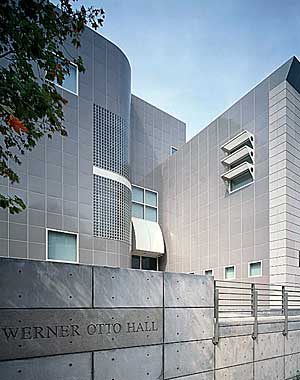
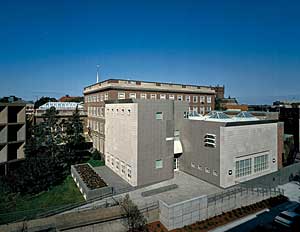
Harvard plans to tear down Werner Otto Hall (top and above), an addition to the Fogg Museum, rather than repair its exterior walls.

Peter also wrote books, and books were the subject of our dinner. He spoke of a famous series of articles in The New Yorker by Berton Roueche, called “Annals of Medicine.” Each was a medical detective story. A patient would come down with some bizarre symptom and doctors would work to trace the cause the way detectives trace the perpetrator of a crime. Why not, mused Peter, a book like that about architecture?

Think of the famous Hancock Tower case in Boston as a medical problem. Here was a building with a mysterious skin disease. Its 10,000 mirror-glass cladding panels were cracking and failing. Nobody knew the cause. Maybe the foundations were settling? Maybe the building’s rhomboid shape created pockets of high winds? Maybe the slender tower was waving back and forth too much?

It was years before the cause was finally isolated, as a defective design by glass supplier Libby Owens Ford. (The Hancock’s “doctors”—the forensic engineers—also determined that the building was in danger of falling over, but that was an unrelated medical problem.)

Peter suggested that the two of us should collaborate on an Annals of Architecture, starting with the Hancock. Alas, we never got around to doing it. But I still think it was a good idea.

So here’s a late-inning shot at one such annal. Once again, we’re talking about a case of architectural skin disease. For a long time, nobody could diagnose the problem. By the time the experts did, they decided that the best solution would be to kill the patient—the building—and start over. That’s the “cure” that’s now about to be implemented.

The building is Werner Otto Hall at Harvard. It is a three-story addition at the rear of the university’s famous Fogg Art Museum. Otto houses Harvard’s Busch Reisinger Museum, which houses a major collection of Germanic art, mostly of the 20th century. Indoors, it’s a delightful set of galleries. Outside, it’s a rotting mess.

Otto opened in 1991. Today, 17 years later, its exterior walls have deteriorated so badly that Harvard says the only way to repair them would be to take them off entirely and start over.

Yet this disaster was created by the best and the brightest.

The client was Harvard, or more specifically, its Faculty of Arts and Sciences. The architect was the firm Gwathmey Siegel, known for its superb 1992 addition to another museum, the Guggenheim in New York, among other buildings. The general contractor was Walsh Brothers, a Boston firm now in its fourth generation that has long been regarded as one of the region’s best.

Otto was much praised when it opened. It was a clean example of Modernism, bold but not so bold as to upstage the more celebrated Carpenter Center next door, by Le Corbusier. Inside, it offered a series of small galleries that flowed into one another in unexpected ways.

Thus, it’s hard to believe that today the entire building—not just the wall, the whole thing—is slated to be completely demolished and removed. New construction will engulf Otto’s former site. The new work will be part of a major addition to the museum, being designed by Pritzker Prize–winning Italian architect Renzo Piano, due to open in 2013.

When you talk to Harvard’s facilities managers, they try to draw your attention away from Otto’s sick wall by claiming that Otto just didn’t fit in with plans for a new, larger museum, so it had to go anyway. But Harvard also admits, when pressed, that the exterior wall was probably incurable.

So what happened? What’s the diagnosis? To put it simply, the guys who worried about the museum’s art were not the guys who worried about the weather. It was a classic failure of communication. We'll call them the art guys and the weather guys.

The art guys, applying a conventional standard, decided that Otto’s interior should be kept at a temperature of 70 degrees, with 50 percent humidity. Those numbers would be best, they believed, for the health of the artworks.

Not only that, but the museum curators and conservators asked that the interior be pressurized, like the fuselage of an airplane. They didn’t want cold, dry Cambridge, winter air slipping in and damaging the precious art. If there were going to be any air leaks through the exterior wall, the curators wanted to be sure the air would leak out of the building, not into it. The museum owned world-class stuff, including what may be my favorite Harvard treasure, a fantastic self-portrait by Max Beckmann standing in a tuxedo and holding a cigar, an image of hollow and doomed sophistication.

Share This Story

Looking for a reprint of this article?
From high-res PDFs to custom plaques, order your copy today!

Robert Campbell, FAIA, was architecture critic for the Boston Globe and a longtime RECORD contributor.

Post a comment to this article

Report Abusive Comment

Subscription Center
  • Create an Account
  • Start a Subscription
  • Manage My Account
  • Sign Up for Newsletters
  • Visit Customer Service
  • Update Preferences

More Videos

Sponsored Content

Sponsored Content is a special paid section where industry companies provide high quality, objective, non-commercial content around topics of interest to the Architectural Record audience. All Sponsored Content is supplied by the advertising company and any opinions expressed in this article are those of the author and not necessarily reflect the views of Architectural Record or its parent company, BNP Media. Interested in participating in our Sponsored Content section? Contact your local rep!

close
  • TAMLYN XtremeTrim Exterior Trim
    Sponsored byTamlyn

    Designing Cleaner Panel Facades: Why Exterior Trim Details Matter

  • Building with Vapor Barriers
    Sponsored byReef Industries, Inc.

    Vapor Barriers Help Control Moisture in Tighter Building Designs

  • Duct Interior with Prodeq System
    Sponsored byHenry, a Carlisle Company

    Designing Resilient Water Containment Systems

DESIGN:ED Podcast
Listen to Architectural Record’s DESIGN:ED Podcast

Events

June 10, 2026

Rethinking Stormwater – The Power of Porous Paving

Credits: 1 AIA LU/HSW; 1 AIBD P-CE; 0.1 ICC CEU

Learn how porous paving systems support stormwater management, reduce heat island effects, and enhance sustainable site design performance.

June 11, 2026

Very Early Warning Fire Detection for Mission-Critical Facilities

Credits: 1 AIA LU/HSW; 1 AIBD P-CE; 0.1 ICC CEU

Examine advanced fire detection strategies that support uptime and enhance safety in data centers and other mission-critical facilities.

View All Submit An Event

Products

2026 Architect's Square Foot Costbook

2026 Architect's Square Foot Costbook

See More Products

Popular Stories

Practice Matters illustration

What’s in a (Firm’s) Name? Thinking About Succession and Legacy

Practice Matters illustration

By the Numbers: Counting America's Architects

House on a Hill

Design Vanguard 2026: Forma

Crane Cove, ONO

Design Vanguard 2026 Winners

KRESA by DLR

In Kalamazoo, DLR Group Completes a Mass-Timber Hub for Career and Technical Education Programs

Broader Sustainability of CMU - Free Webinar - May 21, 2026

Related Articles

  • A Failure to Communicate Leads to Other Failures

    See More
  • November Product Case Study

    Tinker Imagineers’ Temporary Kids’ Clinic Leads to a Permanent Solution

    See More
  • Swimming to Suburbia and Other Essays

    Review of 'Swimming to Suburbia and Other Essays'

    See More

Related Products

See More Products
  • movable arch.jpg

    Movable Architecture: A Design Guide to Container Reuse

  • GlobalData_logo_blue_header.png

    Construction in the US - Key Trends and Opportunities to 2023

  • 3dthinking.jpg

    3D Thinking in Design and Architecture: From Antiquity to the Future

See More Products
×

The latest news and information

#1 Source for Architectural Design, News and Products

SUBSCRIBE
  • RESOURCES
    • Advertise
    • Contact Us
    • Submit
    • Store
  • ACCOUNT CENTER
    • Create an Account
    • Start a Subscription
    • Manage My Account
    • Sign Up for Newsletters
    • Visit Customer Service
    • Update Preferences
  • PRIVACY
    • PRIVACY POLICY
    • TERMS & CONDITIONS
    • DO NOT SELL MY PERSONAL INFORMATION
    • PRIVACY REQUEST
    • ACCESSIBILITY
  • SERVICES
    • Marketing Services
    • Reprints
    • Market Research
    • List Rental
    • Survey/Respondent Access
  • STAY CONNECTED
    • Linkedin
    • Facebook
    • Instagram
    • YouTube
    • X (Twitter)

Copyright ©2026. All Rights Reserved BNP Media, Inc. and BNP Media II, LLC.

Design, CMS, Hosting & Web Development :: ePublishing