Acoustics in school building moves toward the head of the class
From cacophony in the schoolyard and tense quiet during finals to the social jungle of the cafeteria and the read-out-loud of Roald Dahl: Maybe no acoustic environment is expected to perform in such a variety of ways as the contemporary school.
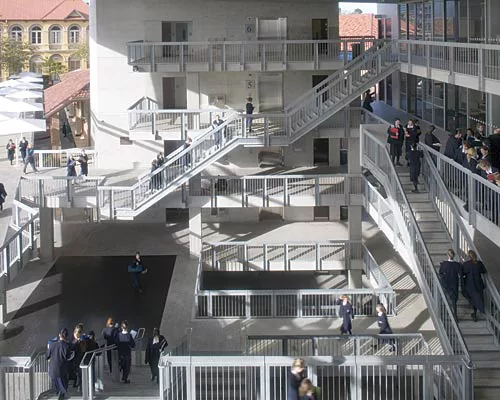
Acoustics in School Buildings Moves Toward the Head of the Class
A new creative-arts building at Brisbane Girls Grammar School is organized around a multistory, activity-filled hub.
Photo © Jon Linkins
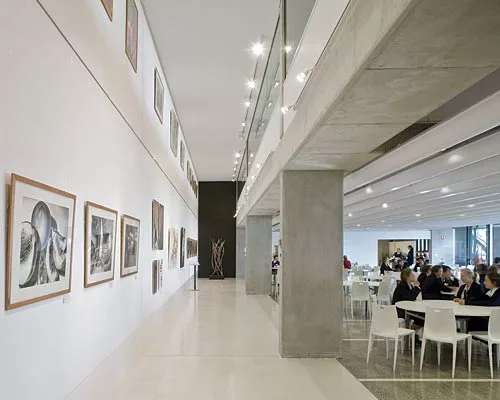
Acoustics in School Buildings Moves Toward the Head of the Class
Billowy fabric ducts on the ceiling of the cafeteria at the Brisbane Girls Grammar School help mitigate the acoustically undesirable characteristics of the mostly exposed concrete structure.
Photo © Jon Linkins

Acoustics in School Buildings Moves Toward the Head of the Class
At Benjamin Franklin Elementary School, sliding glass doors between classrooms.
Photo © Benjamin Benschneider
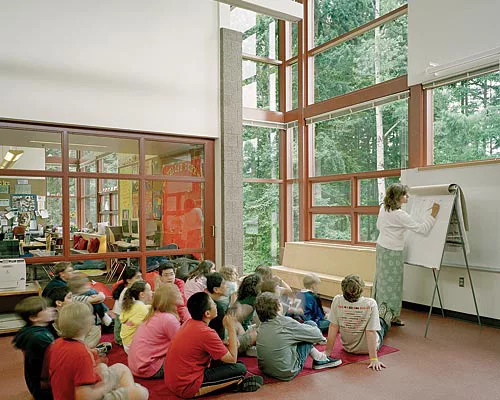
Acoustics in School Buildings Moves Toward the Head of the Class
Benjamin Franklin Elementary’s shared multi-use spaces support the district’s teaching philosophy, but compromise the acoustical isolation.
Photo © Benjamin Benschneider
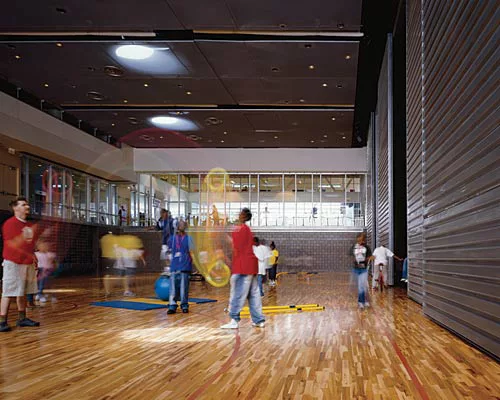
Acoustics in School Buildings Moves Toward the Head of the Class
Benjamin Franklin Elementary’s shared multi-use spaces support the district’s teaching philosophy, but compromise the acoustical isolation.
Photo © Steve Hall/Hedrich
Acoustics in School Buildings Moves Toward the Head of the Class
Benjamin Franklin Elementary’s shared multi-use spaces support the district’s teaching philosophy, but compromise the acoustical isolation.
Photo © Steve Hall/Hedrich Blessing
Energy and persistence
Facing a stand of fir trees in Kirkland, Washington, is the three-year-old Benjamin Franklin Elementary School, the vision of contemporary learning in the pine-green and tech-forward northwest. Mahlum Architects of Seattle garnered several awards with the two-story building that features classrooms clustered around open learning areas — a layout that is an outgrowth of the school’s educational philosophy. The local district chose daylighting and natural ventilation for Ben Franklin well before green mandates for schools and other state-funded buildings passed in 2005. These measures have helped the building earn high marks with staff for air quality, thermal comfort, and lighting. But Ben Franklin isn’t perfect.
It’s too quiet. Using natural ventilation at the school changed the everyday environment so much that it may prompt installing artificial background noise in some locations. The lack of white noise from forced ventilation draws attention to other distracting sounds. This points to a broader issue for architects, says Mahlum design director Anne Schopf, FAIA. Sometimes sustainable approaches can hamper acoustic performance.
What is to be done?
Mahlum, like most architects now, almost always calls in an acoustic consultant for new schools. An acoustician on board is cost-effective; the expense only arises when acting on some of the findings and advice. It’s not all lavish high-tech. Basic measures can be inexpensive, requiring only advance planning. But for Seattle-based acousticians SSA and Greenbusch Group, and for acoustic engineers from Bremen to Brisbane to Berlin, budgeting is always a sensitive topic.
If a project is over budget, the first thing a district does is cut acoustic design, says Mohamed Ait Allaoua, an SSA managing partner. “We work on many schools after the fact. It’s hard. There is no magic spray to fix everything,” he says. Wolfgang Ahnert, a Berlin-based acoustic engineer who has worked on projects such as the Deutsche Opera and electronically linked lecture halls, is more blunt. “The question is just money,” he says. Ahnert estimates 5 percent of recent German schools live up to acoustic standards. Older schools have more pressing problems, says Christian Nocke, a physicist and acoustic consultant based in Bremen. “They’re worried about leaking roofs.”
Architects and engineers say that the ideal learning environment has identifiable acoustic qualities. “It should provide a good environment for speaking without raising the voice. Good listening conditions mean not having to concentrate to understand spoken words. It is freedom from distraction,” Allaoua says. This demands attention to reverberation, sound absorption, the strength of direct sound, and the involvement of the listener. Nocke says the rule of thumb is about half a second for reverberation; no more than one. There’s no shortage of goals and standards for acoustics. There’s LEED For Schools acoustic requirements, older guidelines such as the NC 30-35 (NC stands for noise criteria), and the American National Standards Institute (ANSI) 12.60.
Elements of style
Bringing acoustic elements into high-performance schools will become a more common and thorny issue, especially when designers strip away finishes, predicts Greenbusch president and acoustician Julie Wiebusch, who has worked on many school projects, including Ben Franklin, with Mahlum. Glass, drywall, and exposed concrete are equal: They do not absorb sound, she says. The ceiling finish must be absorptive, and wall treatment is desirable.
Ben Franklin’s acoustical shortcomings can’t be attributed to improper finishes, since classrooms do incorporate absorptive material, such as carpet tile and suspended ceilings. Along with the lack of ambient noise from a mechanical system, Schopf says the problem is the sliding glass doors separating the shared multipurpose space and the classrooms. The scheme provides flexibility and allows teachers to supervise pull-out groups in multiple rooms. However, this type of arrangement and teaching style compromises acoustical isolation, Schopf says. “It’s very complex balancing.”
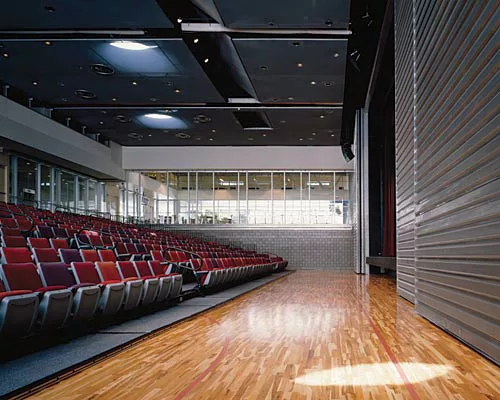
Further complicating things is the need for durable materials, which tend to be the most reflective, points out Chicago architect John Ronan, AIA, who is now working on four school projects. At the Gary Comer Youth Center, which opened in mid-2006 on the city’s South Side, Ronan tackled competing requirements with a largely glass-enclosed gym that converts to a top-notch theater. Although glass is not ideal acoustically, curtains extend to act as a bass trap and block out light from neighboring spaces when the room is in use as a performance space. Corrugated-steel walls, which retract to reveal the stage, have duct liner behind a perforated skin.
Many acousticians recommend including absorptive materials into furniture. Allaoua likes to use acoustic metal-roof decking with fiberglass in the flutes. “If acoustical material is part of the structure, it can’t be deleted.”
Australian outfit m3architecture used a different strategy with its recent creative-arts building at Brisbane Girls Grammar School. The architects surrounded a multistory open space with practice and music rooms, drama studios, classrooms, and a cafeteria. No special efforts were taken to isolate the adjacent spaces from this central social hub. Noise is instead handled by scheduling. “For the most part, classes are either on or off. When they are off, there is very little activity in that central environment,” according to Michael Banney, m3 director. “But as soon as class finishes, it becomes an ant hive,” he says. “The sound of students buzzing in the void is a wonderful thing,” he adds.
The surrounding rooms are loftlike, with raw concrete ceilings. But they take a sophisticated approach to acoustics. Inside the cafeteria, for example, the ceiling is covered with billowy radial ducts that not only deliver air, but also help control noise. They are made of an absorptive material: cloth.
Looking for a reprint of this article?
From high-res PDFs to custom plaques, order your copy today!