Architectural Record
search
cart
facebook twitter linkedin youtube
  • Sign In
  • Subscribe
  • Sign Out
  • My Account
Architectural Record
  • NEWS
    • Latest News
    • Awards
    • Interviews
    • Obituaries
    • Podcasts
      • Design:Ed Podcast
      • Sponsored Podcasts
  • OPINION
    • Book Reviews / Excerpts
    • Exhibition Reviews
    • Forum
  • EXCLUSIVES
    • Videos
    • Design Vanguard
    • Top 300 Firms
    • Sponsored Content
    • Sponsored eBooks
    • From the Archives
  • CONTINUING ED
    • Editorial Continuing Ed
    • CE Center
    • CE Academies
  • PROJECTS
    • Buildings By Type
    • Reuse & Renovation
    • Museums & Arts Centers
    • Colleges & Universities
    • Multifamily Housing
    • Interiors
    • Lighting
    • Kitchen & Bath
  • HOUSES
    • Record Houses
    • House of the Month
    • Featured Houses
  • PRODUCTS
    • Products by Category
    • Record Products of the Year
    • Latest Products
  • EVENTS
    • Dates & Events
    • Record on the Road
    • Innovation Conference
    • Sustainability in Practice
    • Women In Architecture
    • Webinars
    • Ad Excellence Awards
    • Submit an Event
  • CONNECT
    • Ask RECORD AI
    • Newsletters
    • Contact
    • Advertise
    • Editorial Calendar
    • Store
    • Customer Service
  • SUBMIT
    • Submission Guidelines
    • RECORD Competitions
  • MAGAZINE
    • Subscribe
    • My Account
    • Digital Edition
    • Current Issue
    • Firm Pass
    • Historic Archive
Architecture ProductsProducts by TypeGreen & Sustainable

Made of the Right Stuff?

New disclosure tools highlight data on the sustainability of building products.
By Paula Melton
The Declare Program
January 16, 2013
As market demand for healthier building products is reaching critical mass, a whole new industry sector is responding with more powerful tools for assessing and improving materials. Some of the new programs help manufacturers provide high-quality information while leaving less room for them to make questionable marketing claims. Others offer a framework for developing better products but don't necessarily require public disclosure of ingredients. Both types will likely be recognized in LEED v4, an update to the popular green-building rating system slated to be voted on by members of the U.S. Green Building Council (USGBC) in June.

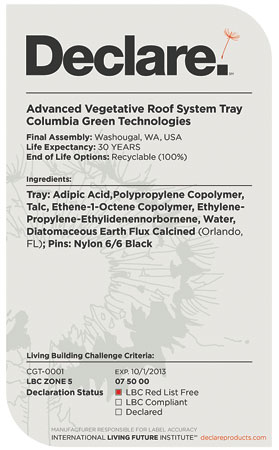
The Declare Program

 
Image courtesy International Living Future Institute
The Declare program includes an on-product “nutrition label” that lists ingredients and life-cycle information.


Nearly all these efforts have emerged as a collaboration among green-building advocacy groups, construction and design professionals, and manufacturers. “We were talking at manufacturers previously,” quips Brendan Owens, the USGBC's vice president of LEED technical development. “When we started talking with manufacturers, many problems fell away.”

The Health Product Declaration (HPD), officially released in mid-November, provides a standard format for ingredient disclosure. The development effort was initiated by the Healthy Building Network and the publisher BuildingGreen (the editorial partner of RECORD'S sister publication GreenSource). Architecture firms, property owners, and product manufacturers also participated. The aim of the HPD is to get beyond the cherry-picking style of labeling (“BPA-free” or “50 percent recycled content”) in favor of a complete health-hazard list.

The similar Declare product database, launched in October, is a program allowing manufacturers to voluntarily publish ingredients, sources, and manufacturing locations for their products. It can be used by anyone, but its current focus is on “red-list-ready” products for projects pursuing Living Building Challenge certification. A red-list-ready product is one that contains no ingredients from the stringent rating system's hazard list, such as PVC and added formaldehyde. Ingredients and life-cycle information are also displayed on an at-a-glance product “nutrition label.”

One concern is the potential for information overload. Is it really an architect's or specifier's job to scrutinize every ingredient? “I don't think everyone needs to become an industrial hygienist or a Ph.D. candidate in chemistry,” says Perkins+Will associate principal Peter Syrett. “But we do need more awareness of what products are made of.”

Even if most building professionals don't have the time or expertise to process the data themselves, it's important for the information to be available, argues Mark Rossi, policy director of Clean Production Action, a green-chemistry working group. Consumers may not have extensive knowledge of the ingredients in cleaning products or shampoo, he says, but if the information is public, experts can serve as “a lens for interpreting that information.”

Similarly, Owens views disclosure as the next step in information sharing. With HPDs and Declare as public data sources, anyone with the right expertise can filter and share information in an accessible way. Owens predicts that such data will eventually be incorporated into building-information-modeling software.

Now that the concept of disclosure is gaining market traction, more manufacturers are looking for ways to clean up their products. One established framework for doing so is Cradle to Cradle (C2C), which just released its 3.0 version. C2C is a “multi-attribute” certification that helps manufacturers improve on a range of environmental and health impacts. It is distinguished by a focus on gradual removal of all toxic ingredients.

What C2C does not require is public disclosure of ingredients. That may seem odd to people following the development of LEED v4, which in its current draft recognizes C2C for encouraging transparency. LEED's proposed disclosure credits are meant to push manufacturers to assess their products, even if they're not ready to make that information public. “We want to reward [manufacturers] for that behavior,” says Owens, adding that subsequent versions of LEED will not likely recognize C2C as a transparency tool unless it is modified. William McDonough, cofounder of C2C, wants the program to move toward more disclosure. “Transparency is important,” he said at a November press conference. “We've always had that as an ambition.”

A newer framework for continual product improvement–and one that's more likely to be accessible to smaller companies–is laid out in The Guide to Safer Chemicals, recently published by Clean Production Action. Like C2C, the guide recognizes multiple levels of improvement leading to a nontoxic ideal. Unlike C2C, it evaluates only toxicity (not environmental impacts like carbon or energy), but it includes public disclosure of ingredients and manufacturer support for further market innovation.

With so many programs in play, it can be easy to spend time discussing each system's strengths and weaknesses, but Syrett says that is a distraction. “I look at the work of the HPD and other endeavors as part of a larger effort to build better and smarter,” he says. “If we really carry this forward, we will have more jobs, a better planet, and healthier humans.”

Paula Melton is managing editor of Environmental Building News, published by BuildingGreen.

Share This Story

Looking for a reprint of this article?
From high-res PDFs to custom plaques, order your copy today!

Post a comment to this article

Report Abusive Comment

Subscription Center
  • Create an Account
  • Start a Subscription
  • Manage My Account
  • Sign Up for Newsletters
  • Visit Customer Service
  • Update Preferences

More Videos

Sponsored Content

Sponsored Content is a special paid section where industry companies provide high quality, objective, non-commercial content around topics of interest to the Architectural Record audience. All Sponsored Content is supplied by the advertising company and any opinions expressed in this article are those of the author and not necessarily reflect the views of Architectural Record or its parent company, BNP Media. Interested in participating in our Sponsored Content section? Contact your local rep!

close
  • cold storage facility
    Sponsored byCarlisle SynTec Systems

    How Architects Can Design More Continuous Cold Storage Envelopes

  • TAMLYN XtremeTrim Exterior Trim
    Sponsored byTamlyn

    Designing Cleaner Panel Facades: Why Exterior Trim Details Matter

  • Building with Vapor Barriers
    Sponsored byReef Industries, Inc.

    Vapor Barriers Help Control Moisture in Tighter Building Designs

DESIGN:ED Podcast
Listen to Architectural Record’s DESIGN:ED Podcast

Events

June 18, 2026

Rebooting the Aging Office Building

Credits: 1 AIA LU/HSW; 1 AIBD P-CE; 0.1 ICC CEU; 1 PDH

Explore façade retrofit strategies and award-winning design concepts that can transform aging office buildings into healthier, higher-performing workplaces for today’s hybrid workforce.

June 23, 2026

Enhancing Fire Resistance with Advanced PVC Solutions

Credits: 1 AIA LU/HSW; 1 AIBD P-CE; 0.1 ICC CEU; 1 IIBEC CEH

Evaluate advanced PVC solutions that improve fire resistance, support WUI compliance, and enhance resilience in residential and commercial building design.

View All Submit An Event

Products

2026 Architect's Square Foot Costbook

2026 Architect's Square Foot Costbook

See More Products

Popular Stories

SanDiegoAirport

Top 300 Architecture Firms of 2026

Lorcan O' Herilhy

California Architect Lorcan O’Herlihy Has Died, Age 66

Coronado Bridge

The Architect’s Guide to San Diego

CCA, Studio Gang

The Winners of the AIA’s 2026 Architecture Award Range from Collegiate Rowing Hubs to Housing for the Homeless

Dusk House

Design Vanguard 2026: ONO

Rebooting the Aging Office Building - Free Webinar - June 18, 2026

Related Articles

  • Argos Hotel

    ‘Architecture and the Right to Heal’ Traces Displacement in the Wake of the Ottoman Empire

    See More
  • Clinic Made of Freight Containers Heads to Haiti

    See More

Related Products

See More Products
  • reuse.jpg

    Resource Salvation: The Architecture of Reuse

  • 1444336282.gif

    The Handbook of Interior Design

See More Products

Events

View AllSubmit An Event
  • April 29, 2026

    Data Center Design: Specifying the Right Closure Products to Safeguard Critical Infrastructures

    NOW ON DEMANDCredits: 1 AIA LU/HSW; 1 AIBD P-CE; 0.1 ICC CEU; 0.1 IACET CEU This webinar explores different data center models and the ways that architects and designers can incorporate rolling and sectional closures into their designs to meet operational goals.
View AllSubmit An Event
×

The latest news and information

#1 Source for Architectural Design, News and Products

SUBSCRIBE
  • RESOURCES
    • Advertise
    • Contact Us
    • Submit
    • Store
  • ACCOUNT CENTER
    • Create an Account
    • Start a Subscription
    • Manage My Account
    • Sign Up for Newsletters
    • Visit Customer Service
    • Update Preferences
  • PRIVACY
    • PRIVACY POLICY
    • TERMS & CONDITIONS
    • DO NOT SELL MY PERSONAL INFORMATION
    • PRIVACY REQUEST
    • ACCESSIBILITY
  • SERVICES
    • Marketing Services
    • Reprints
    • Market Research
    • List Rental
    • Survey/Respondent Access
  • STAY CONNECTED
    • Linkedin
    • Facebook
    • Instagram
    • YouTube
    • X (Twitter)

Copyright ©2026. All Rights Reserved BNP Media, Inc. and BNP Media II, LLC.

Design, CMS, Hosting & Web Development :: ePublishing