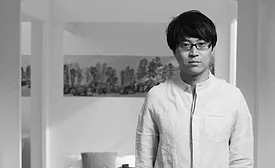
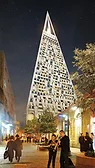
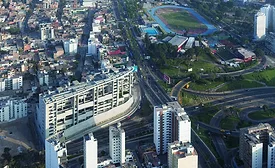
“The acrobatic novelty of much of today’s architecture doesn’t interest us,” says Alejandro Guerrero. He and Andrea Soto describe themselves as traditionalists, with one caveat: their tradition is modernism.
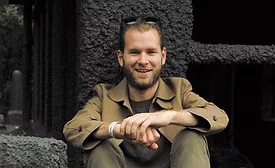
The 38-year-old Dutchman Anne Holtrop talks about his work with an artist’s sensibility, extracting form from existing, or completely random, conditions.
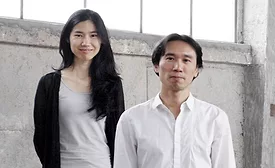
In 2005, architects Jianxiang He and Ying Jiang were working on the Guangzhou Baiyun International Convention Center, a project by the Chinese-government-run CITIC ADI and its design partner, Belgian firm BURO II.
A short walk down a ramshackle alley typical of Beijing’s hutong neighborhoods leads to a pivoting steel door deeply recessed between a pair of gray-brick buildings.
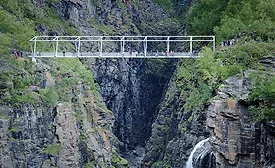
in the the northern Norwegian village of Birtavarre, the Sabetjohk Pedestrian Bridge spans 147 feet across the 500-foot-deep Gorsa Gorge—northern Europe’s deepest canyon.
It’s an urban oasis, an indoor landscape, and an effective solution to brand a university campus otherwise lost in the chaos of downtown Toronto. Designed by Snøhetta in collaboration with local firm Zeidler Partnership Architects, Ryerson University’s new Student Learning Centre is an audacious bid to redefine the concept of an inner-city student commons. “The program is amazingly open,” says project architect Michael Cotton, of Snøhetta’s New York office. “It’s almost like a 10-story lobby. Sometimes we call it a library without books.”