This website requires certain cookies to work and uses other cookies to help you have the best experience. By visiting this website, certain cookies have already been set, which you may delete and block. By closing this message or continuing to use our site, you agree to the use of cookies. Visit our updated privacy and cookie policy to learn more.
This Website Uses Cookies By closing this message or continuing to use our site, you agree to our cookie policy. Learn MoreThis website requires certain cookies to work and uses other cookies to help you have the best experience. By visiting this website, certain cookies have already been set, which you may delete and block. By closing this message or continuing to use our site, you agree to the use of cookies. Visit our updated privacy and cookie policy to learn more.
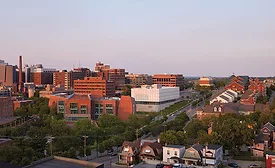
On a tidy parcel of land in Kansas City, Missouri, the Ewing Marion Kauffman School demonstrates an elegant sense of order and pragmatism while suggesting a forward-thinking attitude.
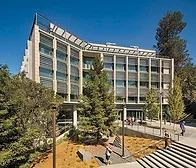
Developed to appeal to a creative labor pool, the year-old Newell Rubbermaid Design Center lies within southwest Michigan's hub of industrial design, just a stone's throw from internationally acclaimed manufacturers Haworth, Herman Miller, and Steelcase.
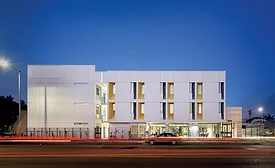
Encircled by a stand of towering deciduous trees, Benjamin E. Mays High School keeps a low profile, despite having been home to such notable alumni as visual artist Radcliffe Bailey and musician Cee Lo Green, and currently being the largest school serving grades nine through 12 in the Atlanta Public Schools (APS).
Under African Skies: The first phase of an ambitious national university creates a community of buildings and outdoor spaces adapted to a hot, dry climate.
Under African Skies: The first phase of an ambitious national university creates a community of buildings and outdoor spaces adapted to a hot, dry climate. When Perkins+Will's Ralph Johnson first visited the site of the new campus of Universidade Agostinho Neto, near Luanda, Angola, in 2001, the five-mile drive from the city center involved military checkpoints, refugees living in squalid camps along the road, and warnings to steer clear of land mines. Back then, the country was still in the throes of a decades-long civil war. But Angola was beginning to use oil revenue to improve its social infrastructure. At