Twenty years ago, Rem Koolhaas published a fat doorstop of a book, S, M, L, XL, which included his manifesto on Bigness: “Bigness is ultimate architecture,” he wrote. “Only Bigness instigates the regime of complexity that mobilizes the full intelligence of architecture and its related fields.”
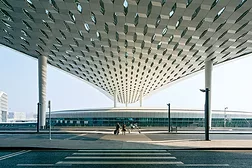
Treating an enormous airport in Shenzhen, China, as a cinematic experience, a Rome-based firm designs a series of architectural scenes in which light and space play leading roles.
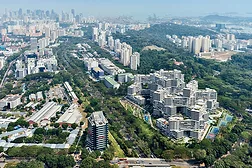
Stack the Decks: Architect Ole Scheeren hypothesized that dense urban residential living didn't have to occur in an isolating skyscraper—and he was right.
Ole Scheeren is no stranger to megaprojects. As a former partner and director at the Office for Metropolitan Architecture (OMA), he led the design and construction of the 5.1 million-square-foot CCTV Headquarters in Beijing and was the lead designer of the MahaNakhon Tower in Bangkok, which, when completed in 2016, will be the tallest in the city at 77 stories and 1,030 feet.
Bringing XL Back Home: Having completed huge projects in Asia, Rem Koolhaas and his Office for Metropolitan Architecture apply their strategies for building extra-large to the small city in which they are based.
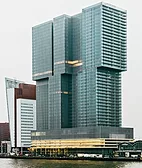
When I went to Rotterdam to see the largest single building in The Netherlands, the eponymous De Rotterdam by OMA, it reminded me of something. But I couldn't put my finger on it.
On a barren patch of desert in New Mexico’s Jornada del Muerto basin, just 50 miles west of the site where scientists detonated the first nuclear weapon, Foster + Partners took on an extraordinary task: to construct the world’s first private hangar facility for spaceflight.
By Alexander Gorlin. Pointed Leaf Press, 2013, 192 pages, $60. Mystical Thinking This informative and heavily illustrated book is not so much about places where artists have applied principles of Kabbalah—the Jewish mystical interpretation of the universe—but where Alexander Gorlin takes readers to find them. Gorlin, a New York architect and author, uses Kabbalah as a lens for “re-reading . . . art and architecture,” much as critics might interpret art through the filters of class, race, gender, or the Holocaust. The book stems from his fascination with the Kabbalistic idea of genesis expressed as light, space, and geometry, which
This colorful little book—published in connection with last year's exhibition at the Royal Academy, Richard Rogers: Inside Out—explains how the architect, known for some sensational urban buildings, exemplifies the ideals with which Modern architecture was founded.
Foster+Partners has designed megaprojects around the globe, from airports to skyscrapers. How are super-size buildings, such as Apple's future headquarters, shaped for the people who will use them?
As founder and chairman of Foster+Partners, Norman Foster has created projects at every scale but may be best known for such innovative tall buildings as the Hong Kong and Shanghai Bank Headquarters in Hong Kong (1986), the Swiss Re tower in London, a.k.a. “the Gherkin” (2004), and the Hearst Tower in New York (2006).
 RSS
RSS