In recent decades, Southeast Asia has become a vibrant laboratory of high-density urbanism with places such as Singapore, Bangkok, and Hong Kong packing more people into taller buildings on smaller parcels of land.
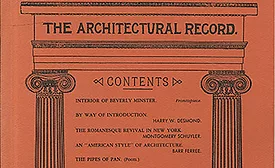
Frank Lloyd wright did not take criticism lightly. He was furious at the stinging denunciation of his revolutionary Larkin Building in Buffalo that was published in Architectural Record in April 1908. Its author, Russell Sturgis, an eminent architect and historian who had written for RECORD since its inception in 1891, called Wright’s office building for a mail-order soap company “ungainly” and “awkward.” Wright retaliated in an unpublished reply that it was “pathetic” to see a well-respected critic “picking over bit by bit his architectural ragbag for architectural finery wherewith to clothe the nakedness of the young giant.”
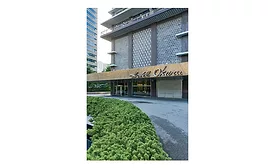
Located in the Akasaka area, near the U.S. embassy, the Midcentury classic—which opened in 1962 and was designed by Yoshiro Taniguchi and Hideo Kosaka—closes this month. Much of it will be torn down.
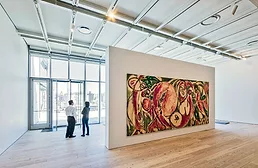
On the far west end of a wall on the sixth floor of the new Whitney Museum of American Art hangs Frank Stella’s great and influential, black proto-Minimalist painting Die Fahne hoch! (1959).
The controversial restoration of the interiors of a sacrosanct cathedral elicits a call to action. Among modern architects, Chartres Cathedral, largely built in the first half of the 13th century, holds a special place. Philip Johnson famously said, “I would rather sleep in Chartres Cathedral, with the nearest toilet two blocks away, than in a Harvard house with back-to-back bathrooms.” (He first visited Chartres at age 13 with his mother, but the comparison came after he attended Harvard.) Much later, Johnson remarked, “I don't see how anybody can go into the nave of Chartres Cathedral and not burst into tears.”
The avant-garde's defense of the mountainous blob that Star Wars creator George Lucas wants to erect on Chicago's lakefront speaks volumes about all that's wrong with architecture today: a celebration of object-making at the expense of public space, plus a shameless coddling of the powerful, provided they serve one's aesthetic agenda.