Francisco “Patxi” Mangado, the 54-year-old Spanish architect, compares his bronze-clad Archaeological Museum of Álava in Vitoria, Spain, to a “coffer guarding a treasure.”
For nearly half a century, the Royal Conservatory, Canada’s venerable music education institution, has occupied a distinctive late-19th-century masonry building at the northern edge of the University of Toronto campus on Bloor Street, one of the city’s major east-west thoroughfares.
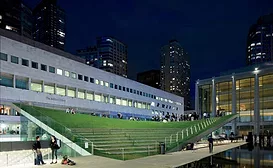
Designing a small performing arts building that would work for both indoor recitals and outdoor concerts, Craig Hodgetts and Hsinming Fung drew inspiration from musical instruments.
Your visit starts in an unremarkable city park adjacent to a generic shopping mall. Local kids are playing tag, while a man in short sleeves throws a stick for his dog and a family picnics on the grass. You follow a concrete path, which turns into a gently sloping ramp descending into the ground. On either side of you, concrete walls rise to meet an angled green roof, slowly blocking out the sounds of people enjoying the park. The laughter gets more faint, the excited chatter less distinct. As you enter the Los Angeles Museum of the Holocaust (LAMOTH), you
The evocative title of the exhibition Cities of Artificial Excavation: The Work of Peter Eisenman, 1978–1988 at the Canadian Centre for Architecture in Montreal in 1994 turns out to be an oracular description of the architect’s City of Culture of Galicia in northwest Spain. Eisenman’s project of a lifetime, now 12 years in design and construction, has involved serious digging and earthmoving to create topographical man-made structures that blur figure and ground. With two buildings just open, the complex’s raw state presents an artificial landscape of thrashing, gnashing stone creatures restlessly rising up from the earth before subsiding into calm
 RSS
RSS