Architectural Record
search
cart
facebook twitter linkedin youtube
  • Sign In
  • Subscribe
  • Sign Out
  • My Account
Architectural Record
  • NEWS
    • Latest News
    • Awards
    • Interviews
    • Obituaries
    • Podcasts
      • Design:Ed Podcast
      • Sponsored Podcasts
  • OPINION
    • Book Reviews / Excerpts
    • Exhibition Reviews
    • Forum
  • EXCLUSIVES
    • Videos
    • Design Vanguard
    • Top 300 Firms
    • Sponsored Content
    • Sponsored eBooks
    • From the Archives
  • CONTINUING ED
    • Editorial Continuing Ed
    • CE Center
    • CE Academies
  • PROJECTS
    • Buildings By Type
    • Reuse & Renovation
    • Museums & Arts Centers
    • Colleges & Universities
    • Multifamily Housing
    • Interiors
    • Lighting
    • Kitchen & Bath
  • HOUSES
    • Record Houses
    • House of the Month
    • Featured Houses
  • PRODUCTS
    • Products by Category
    • Record Products of the Year
    • Latest Products
  • EVENTS
    • Dates & Events
    • Record on the Road
    • Innovation Conference
    • Sustainability in Practice
    • Women In Architecture
    • Webinars
    • Ad Excellence Awards
    • Submit an Event
  • CONNECT
    • Ask RECORD AI
    • Newsletters
    • Contact
    • Advertise
    • Editorial Calendar
    • Store
    • Customer Service
  • SUBMIT
    • Submission Guidelines
    • RECORD Competitions
  • MAGAZINE
    • Subscribe
    • My Account
    • Digital Edition
    • Current Issue
    • Firm Pass
    • Historic Archive

Beyond Cubed

By Suzanne Stephens
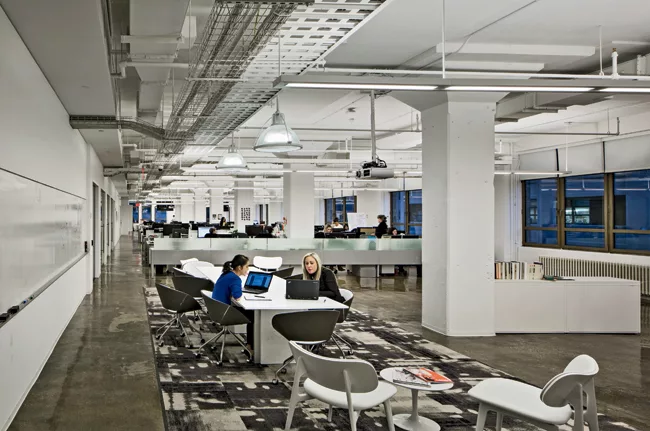
In 2013, Perkins + Will used benching—desks arranged like conference tables—for the New York offices of Vente Privée USA, a joint partnership of the French online fashion retailer and
Beyond Cubed
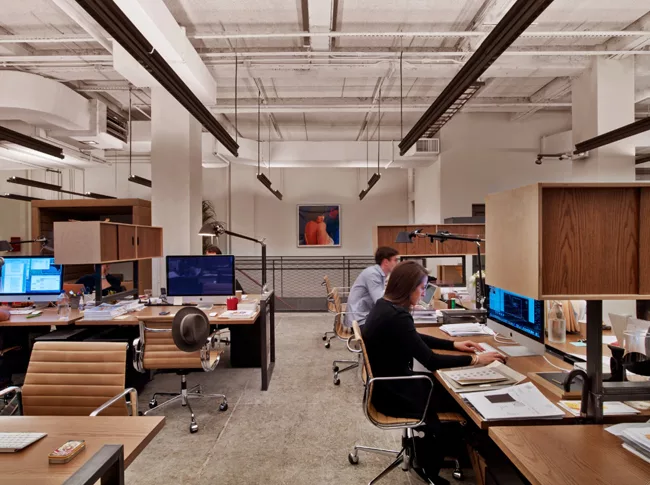
In 2013, Perkins + Will used benching—desks arranged like conference tables—for the New York offices of Vente Privée USA, a joint partnership of the French online fashion retailer and American Express. The main workspace lacks walls or partitions and features casual seating clusters.
Photo © Eduard Hueber
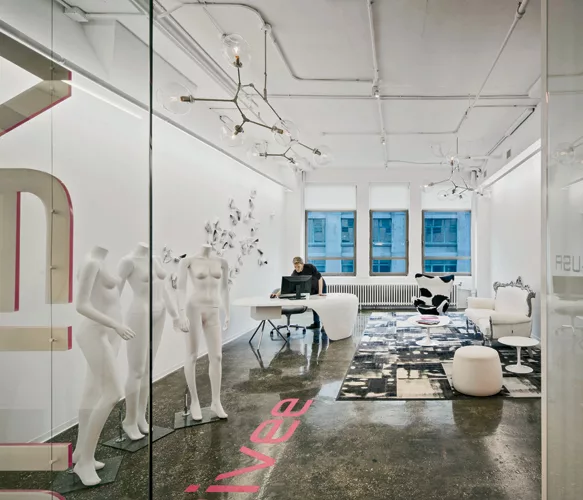
The reception area is furnished with found art and idiosyncratic furniture, to give the space the energy and insouciance it purveys in its business.
Beyond Cubed
The reception area is furnished with found art and idiosyncratic furniture, to give the space the energy and insouciance it purveys in its business.
Photo © Eduard Hueber
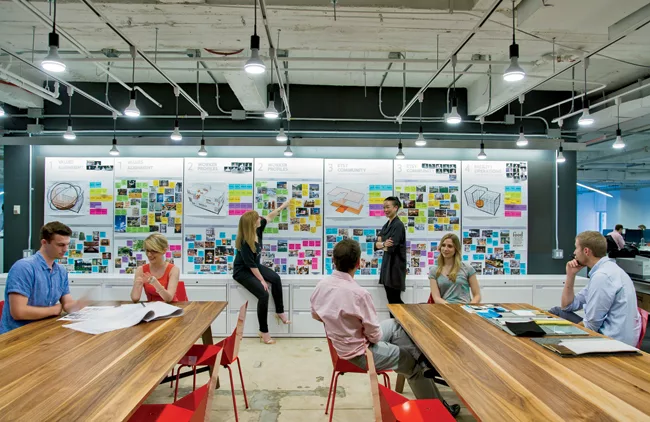
On the seventh floor of its New York offices, Gensler has created numerous places for its staff to experiment with design ideas to propose to clients. In the pinup area, long tables with stackable cha
Beyond Cubed
On the seventh floor of its New York offices, Gensler has created numerous places for its staff to experiment with design ideas to propose to clients. In the pinup area, long tables with stackable chairs encourage quick collaborations and meetings to be held on the spur of the moment.
Photo © Chris Leonard
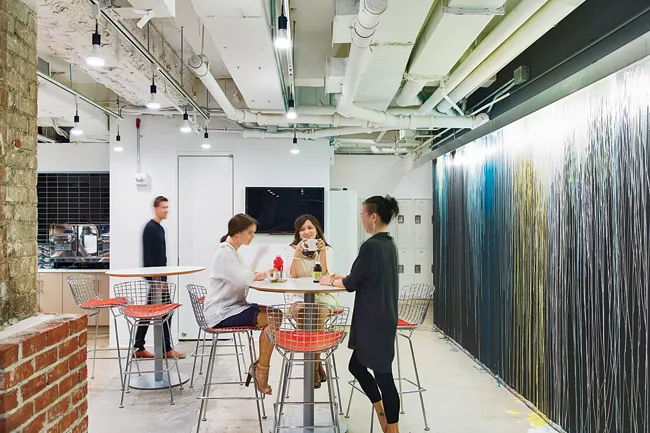
The café features exposed ceilings and an end wall painted by the staff to look like an abstract painting.
Beyond Cubed
The café features exposed ceilings and an end wall painted by the staff to look like an abstract painting.
Photo © Chris Leonard
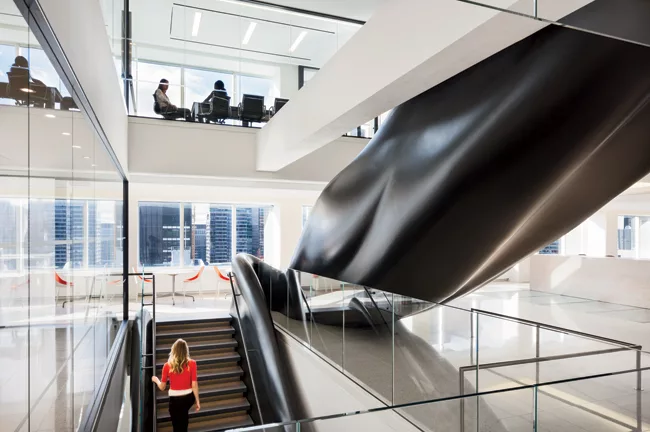
STUDIOS created an internal stairway of fiberglass to connect the reception, café, and conference areas for Intercontinental Exchange (ICE) in New York in 2013. The fluid, organic feature dramati
Beyond Cubed
STUDIOS created an internal stairway of fiberglass to connect the reception, café, and conference areas for Intercontinental Exchange (ICE) in New York in 2013. The fluid, organic feature dramatizes the three-level atrium; elsewhere, glass walls and floors heighten visual accessibility.
Photo © Bilyana Dimitrova
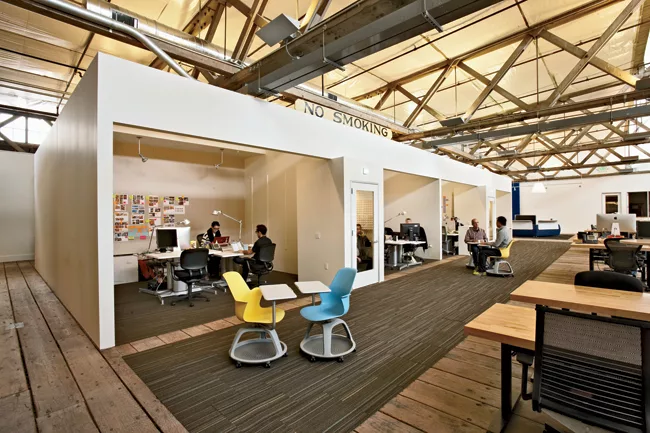
Jensen Architects carved niches for offices and meetings, plus inserted private phone booths in a barlike structure for the San Francisco offices of IDEO, a design firm. Completed in 2012, offices occ
Beyond Cubed
Jensen Architects carved niches for offices and meetings, plus inserted private phone booths in a barlike structure for the San Francisco offices of IDEO, a design firm. Completed in 2012, offices occupy a 1920s pier facility. “It’s an armature for the work process,” says principal Mark Jensen.
Photo courtesy IDEO
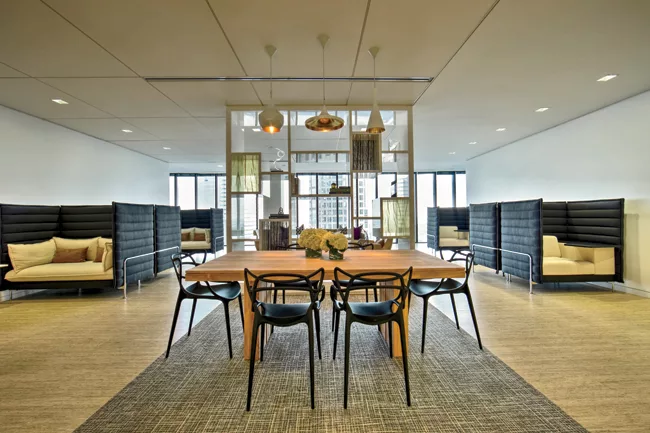
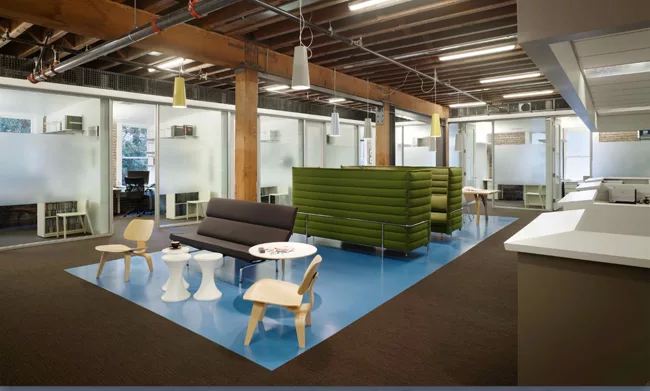
For the law offices of Seyfarth Shaw in Houston (2014), the Rottet Studio designed lounges to function as meeting or study spaces, since the firm does not have a library. The high-backed settees allow
Beyond Cubed
For the law offices of Seyfarth Shaw in Houston (2014), the Rottet Studio designed lounges to function as meeting or study spaces, since the firm does not have a library. The high-backed settees allow private conversations.
Photo © Caitlin Graham
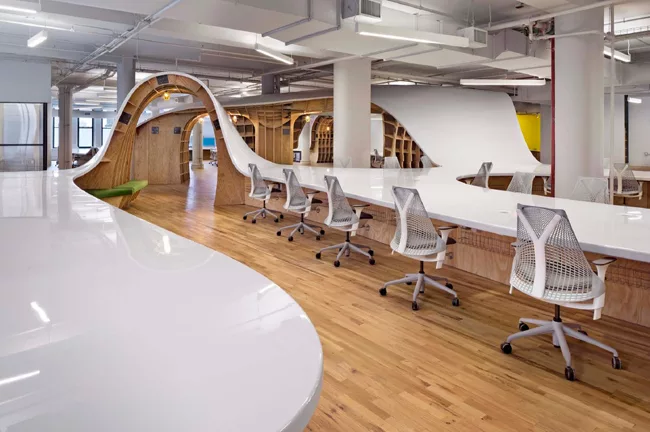
Beyond Cubed
Barbarian Group
Clive Wilkinson Architects
New York City
Photo © Michael Moran
Beyond Cubed
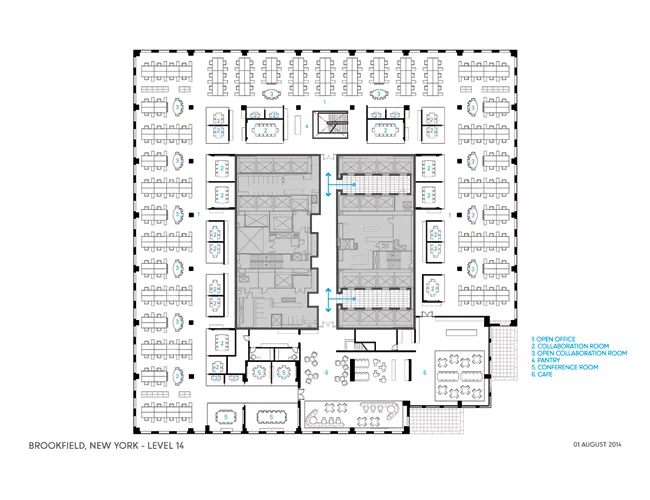
Brookfield Office Properties Headquarters (floor plan)
Lehman Smith McLeish
Brookfield Place, New York City
Image courtesy Lehman Smith McLeish
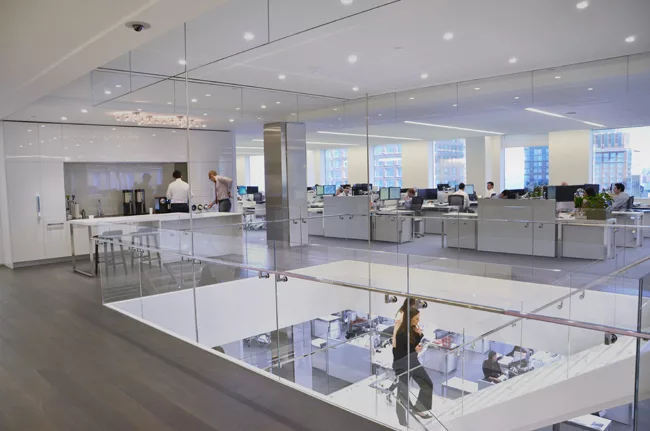
Beyond Cubed
Brookfield Office Properties Headquarters
Lehman Smith McLeish
Brookfield Place, New York City
Photo courtesy Lehman Smith McLeish
Beyond Cubed
Durie Tangri Offices
Envelope A+D
San Francisco
Photo © Cesar Rubio
Beyond Cubed
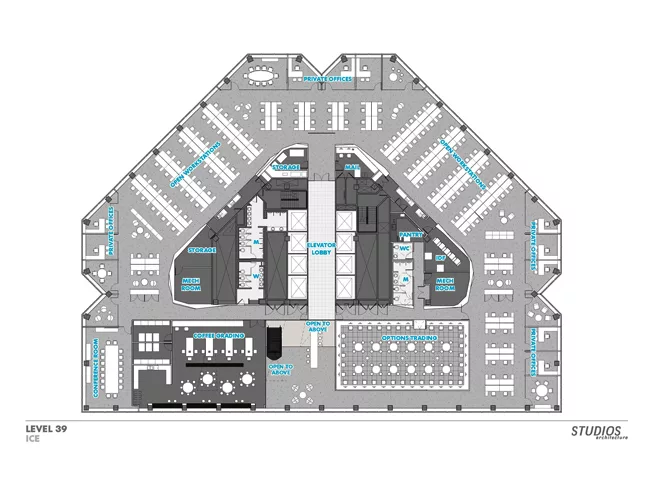
ICE (floor plan)
Studios Architecture
New York City
Image courtesy Studios Architecture
Beyond Cubed
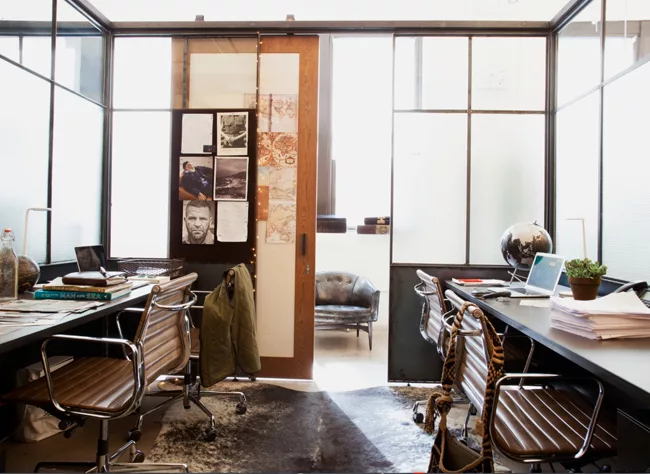
NeueHouse, typical 'studio.'
Rockwell Group
New York City
Photo © Dan Freeman
Beyond Cubed
NeueHouse, typical 'atelier.'
Rockwell Group
New York City
Photo © Eric Laignel
Beyond Cubed
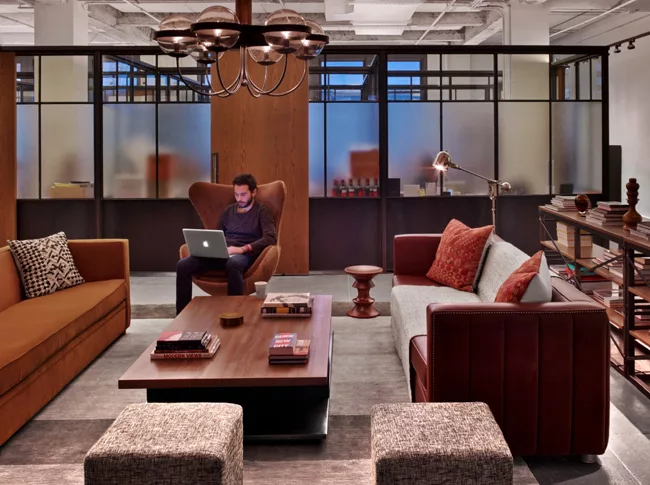
NeueHouse, sitting area.
Rockwell Group
New York City
Photo © Eric Laignel
In 2013, Perkins + Will used benching—desks arranged like conference tables—for the New York offices of Vente Privée USA, a joint partnership of the French online fashion retailer and
The reception area is furnished with found art and idiosyncratic furniture, to give the space the energy and insouciance it purveys in its business.
On the seventh floor of its New York offices, Gensler has created numerous places for its staff to experiment with design ideas to propose to clients. In the pinup area, long tables with stackable cha
The café features exposed ceilings and an end wall painted by the staff to look like an abstract painting.
STUDIOS created an internal stairway of fiberglass to connect the reception, café, and conference areas for Intercontinental Exchange (ICE) in New York in 2013. The fluid, organic feature dramati
Jensen Architects carved niches for offices and meetings, plus inserted private phone booths in a barlike structure for the San Francisco offices of IDEO, a design firm. Completed in 2012, offices occ
For the law offices of Seyfarth Shaw in Houston (2014), the Rottet Studio designed lounges to function as meeting or study spaces, since the firm does not have a library. The high-backed settees allow
Beyond Cubed
Beyond Cubed
Beyond Cubed
Beyond Cubed
Beyond Cubed
Beyond Cubed
Beyond Cubed
Beyond Cubed
September 16, 2014
 

Changes in office design give new meaning to “open plan.”

The reception area is furnished with found art and idiosyncratic furniture, to give the space the energy and insouciance it purveys in its business.

Speed, spontaneous interaction, flexibility, and collaboration describe the brief for office design today, where the “open plan” reigns. Fueled by the success of start-up tech offices, and with them media and advertising companies, casual workspace that can jolt users into fast thinking and faster acting is prompting the more sedate businesses—such as financial and law offices—to try out new kinds of flexible settings.

Open office design, as Nikil Saval points out in his lively book Cubed: A Secret History of the Workplace (Doubleday, 2014), has been around for at least four decades. While you could argue that even before that, clerks, reporters, and architects performed their tasks in rooms without walls, the notion of its being a design solution arrived much later. With the growth of middle management in the post–World War II period, the pressures of real estate induced corporate America—and its architects and designers—to try something different. Influenced by Germany's Burolandschaft (office landscape), with its open, organically arranged, and non-hierarchical layout, or Herman Miller’s Action Office I and II workstations designed by Robert Probst in the 1960s, the modern office began to take shape. Action Office II, based on three panels that could be flexibly positioned at obtuse angles, became wildly influential—but not in the way conceived by Probst. Instead, a watered-down version—fabric-covered cubicles with partitions at 90-degree angles—arranged according to a grid, was adopted. It filled the bill economically. As Frank Duffy, a British architect and expert on office planning, who has studied and worked in the U.S., notes, open planning never really caught on in Germany and Scandinavia, where work councils had formed to ensure employees have control over their environment.

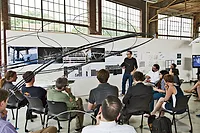
Ironically, now, in the U.S., the cubicle appears to be near extinction. It has largely been supplanted by partition-free desks or long tables referred to as “benching.” It saves space and money, and arguably fits into the dynamic of changing modes of work. As STUDIOS Architecture principal and CEO Todd diGarmo points out, benching—the kind he designed for Bloomberg’s New York office—took a while to catch on. It did so, he says, “because the cubicle was expensive and needed to be upgraded with changes in technology.” The digital start-up world of Silicon Valley, diGarmo says, “doesn’t have time for this, or for hierarchy.” Benching can lead to striking interiors: in one recent example, the offices of the Barbarian Group, an interactive marketing agency with headquarters in New York, enlisted Clive Wilkinson Architects from Los Angeles to create a 1,100-foot-long (!) serpentine table that swirls around the office, swooping up here and there to create arched portals and to shelter conference areas.

A gamut of architectural features provide alternative spaces as backups to benching. In many media and design companies, the enclosed conference room has given way to glassed-in project meeting areas to encourage teamwork, add transparency, and admit more daylight. If each person’s space at a long table only extends 4 to 5 feet, the individual bench area is counterbalanced by “huddle” areas where three to four people can get together, in addition to “pods” for even smaller meetings. To foster spontaneous interaction and movement, stairs of expansive width connect two or three floors internally, such as the sculptural fiberglass one at the Intercontinental Exchange (ICE) in Manhattan conceived by STUDIOS. In some cases, the stairs take the form of bleachers, providing convenient places to sit and chat or hear group presentations as well as get from one level to another. Kitchens and quick meeting/café areas abound, and the corporate kindergarten amenities that Silicon Valley made so popular in the past (Ping-Pong tables or basketball courts) can still be found.

But does this panoply of clubhouse features get in the way of actually . . . working? An active, open office might generate excitement and foment creative sparks, but surveys, studies, and anecdotal evidence reveal that too much fun can bring with it noise, chaos, and distraction. Over the last decade, complaints of lowered concentration and productivity constantly flood the internet. The Center for the Built Environment at the University of California, Berkeley, reported in 2007 that acoustical conditions were a leading source of dissatisfaction among employees: in one study of seven office buildings, as many as 72 percent of the respondents registered discomfort with speech privacy—that is, overhearing others, or being overheard. A poll of 2,060 by Harris Interactive on behalf of Ask.com in March 2013 reported that 61 percent of the employees in the U.S. found noise from colleagues to be the major office distraction affecting productivity. (Full disclosure: this writer is preparing this article wearing a headset in a vintage “cubicle.”)

Says Douglas Burnham of Envelope Architecture+Design in Berkeley, “Some people don’t like the open plan because you can’t get anything done.” While his architectural office employs it (as do most design studios), the firm included assorted spaces for privacy as it grew and renovated. Clive Wilkinson, who designed Google’s offices Mountain View, California, in 2005, says that his firm has been addressing the backlash to too much open space “by providing a greater variety of options, like phone booths and study carrels.” For the San Francisco office of IDEO, the design-strategy firm, Jensen Architects placed white rectilinear structures on its loftlike floors to contain a row of rooms for conferences and pinup sessions, as well as acoustically sealed telephone booths.

To counter the complaints about noise and distraction and generally improve upon unenclosed environments, other architects and interior designers are systematically exploring strategies to ameliorate open plans on their own turf. Robin Klehr Avia, chair of Gensler, notes that her firm has devoted a floor of its New York offices to experimental, changeable areas, where they can test out various ideas. The firm hopes to apply its findings to its design of interiors for such companies as Condé Nast, which is moving to New York’s One World Trade Center this fall, or for Time Warner, the television, film, and entertainment company, when it eventually takes up residence in the Hudson Yards development in west Midtown.

Yet design advisors need to face certain realities. “Many say that an open-plan environment is unconditionally better than one with private offices,” observes Janet Rankin, the director of Washington, D.C.–based Lehman Smith McLeish (LSM), which has just completed the interiors for Brookfield Office Properties Headquarters, a real estate firm at Brookfield Place, formerly the World Financial Center in New York. “But you have to think about what people really need to do their jobs,” she warns. “It’s not a one-size-fits-all.” Ron Fiegenschuh, a partner in LSM, adds, “The program and the solution must jibe.”

Among those who need to be sounded out are lawyers and financial executives—legendary for wanting to hold onto their enclosed spaces. However, some are thinking differently about the actual sizes and configurations of the layout: Lauren Rottet, of Rottet Studio, says that one of her clients, the Houston law firm of Seyfarth Shaw, wanted a light-filled work environment, without the hierarchy of the perimeter rooms. So Rottet pulled the offices away from the glass wall, creating “verandas” with views of the city, and added a variety of team conference areas. By tinkering with the layout, “We were able to allow a 25 percent increase in [the number of] employees for the original floor plan while keeping the offices the same size,” she says.

Other firms, such as American Express or Unilever, are trying out “mobility” programs, where seats (and desks) are not necessarily assigned, says Joan Blumenthal, interior design director of Perkins + Will in New York. Often, as part of this mobility, only about 80 seats are available for every 100 people, based on whether members of a group spend much of their time elsewhere.

As a variant of such mobility, “co-working” venues strike many as the most flexible solution available—at least for small businesses. In New York, NeueHouse, founded by Joshua Abram and Alan Murray and designed by David Rockwell with NeueHouse Studio in 2013, has proved successful enough that the group plans to open another one in Los Angeles in 2015. NeueHouse, like many other co-working establishments (numbering about 800 in the U.S. at the moment) is membership-based, with subscription fees for the different types of spaces: a lounge-like main-floor “gallery” with library and café, where you can drop in and work on your laptop; and—on floors above—“studios,” glass-enclosed rooms with open tables for a handful or more people, or “ateliers,” totally in the open, for which you have an assigned desk. To address sound control, architect Anthony Fieldman, a former occupant whose firm, Raft, outgrew the space, is advising NeueHouse on modifications, such as inserting more acoustical materials into the studios or increasing the thickness of glass. As Duffy points out, the co-working space offers the same rubbing-shoulders benefit of 18th-century gentlemen’s clubs in England, with its similar membership admission and fee arrangement. The past still guides the future.

The only problem with the whole spate of imaginative solutions to make the open office appealing and productive is money. Telephone booths, pods, huddle rooms, project spaces, bleachers, even large enclosed sofas for small spontaneous conversations, all add costs that go beyond the benching desks. Innovative tech firms with geyser-like cash flows need not worry. But will the typical corporate firm buy into all the extras? In years to come, we may well be looking at the cube—reviled for its lousy acoustics and its uniformity, but endowed with its own storage bins, shelves, counters, and a smidgen of visual privacy—as an object of nostalgia and longing.

Share This Story

Looking for a reprint of this article?
From high-res PDFs to custom plaques, order your copy today!

Stephens

Suzanne Stephens, a former deputy editor of Architectural Record, has been a writer, editor, and critic in the field of architecture for several decades. She has a Ph.D. in architectural history from Cornell University, and teaches a seminar in the history of architectural criticism in the architecture program of Barnard and Columbia colleges.

Post a comment to this article

Report Abusive Comment

Subscription Center
  • Create an Account
  • Start a Subscription
  • Manage My Account
  • Sign Up for Newsletters
  • Visit Customer Service
  • Update Preferences

More Videos

Sponsored Content

Sponsored Content is a special paid section where industry companies provide high quality, objective, non-commercial content around topics of interest to the Architectural Record audience. All Sponsored Content is supplied by the advertising company and any opinions expressed in this article are those of the author and not necessarily reflect the views of Architectural Record or its parent company, BNP Media. Interested in participating in our Sponsored Content section? Contact your local rep!

close
  • TAMLYN XtremeTrim Exterior Trim
    Sponsored byTamlyn

    Designing Cleaner Panel Facades: Why Exterior Trim Details Matter

  • Building with Vapor Barriers
    Sponsored byReef Industries, Inc.

    Vapor Barriers Help Control Moisture in Tighter Building Designs

  • Duct Interior with Prodeq System
    Sponsored byHenry, a Carlisle Company

    Designing Resilient Water Containment Systems

DESIGN:ED Podcast
Listen to Architectural Record’s DESIGN:ED Podcast

Events

June 11, 2026

Very Early Warning Fire Detection for Mission-Critical Facilities

Credits: 1 AIA LU/HSW; 1 AIBD P-CE; 0.1 ICC CEU

Examine advanced fire detection strategies that support uptime and enhance safety in data centers and other mission-critical facilities.

June 16, 2026

Focus on the Façade: Exploring Steel, Timber & Fire-Rated Curtain Walls and Channel Glass Systems

Credits: 1 AIA LU/HSW; 1 AIBD P-CE; 0.1 ICC CEU

Explore modern façade and glazing systems that enhance daylighting, fire safety, and thermal performance while expanding architectural design possibilities.

View All Submit An Event

Products

2026 Architect's Square Foot Costbook

2026 Architect's Square Foot Costbook

See More Products

Popular Stories

Coronado Bridge

The Architect’s Guide to San Diego

Practice Matters illustration

By the Numbers: Counting America's Architects

SanDiegoAirport

Top 300 Architecture Firms of 2026

House on a Hill

Design Vanguard 2026: Forma

Crane Cove, ONO

Design Vanguard 2026 Winners

Broader Sustainability of CMU - Free Webinar - May 21, 2026

Related Articles

  • Pavilion-of-Plastic-and-Algae-625px.jpg

    America's Top Architecture Schools 2015

    See More
  • Sag Harbor House

    Sag Harbor House by Ted Porter Architecture

    See More
  • America's Top Architecture Schools 2014

    America's Top Architecture Schools 2014

    See More

Events

View AllSubmit An Event
  • August 4, 2026

    Beyond the Membrane: Detailing Below-Grade Waterproofing for Real-World Performance

    Credits: 1 AIA LU/HSW; 1 AIBD P-CE; 0.1 ICC CEU Evaluate below-grade waterproofing strategies that improve long-term durability through coordinated detailing, system integration, and construction quality.
View AllSubmit An Event
×

The latest news and information

#1 Source for Architectural Design, News and Products

SUBSCRIBE
  • RESOURCES
    • Advertise
    • Contact Us
    • Submit
    • Store
  • ACCOUNT CENTER
    • Create an Account
    • Start a Subscription
    • Manage My Account
    • Sign Up for Newsletters
    • Visit Customer Service
    • Update Preferences
  • PRIVACY
    • PRIVACY POLICY
    • TERMS & CONDITIONS
    • DO NOT SELL MY PERSONAL INFORMATION
    • PRIVACY REQUEST
    • ACCESSIBILITY
  • SERVICES
    • Marketing Services
    • Reprints
    • Market Research
    • List Rental
    • Survey/Respondent Access
  • STAY CONNECTED
    • Linkedin
    • Facebook
    • Instagram
    • YouTube
    • X (Twitter)

Copyright ©2026. All Rights Reserved BNP Media, Inc. and BNP Media II, LLC.

Design, CMS, Hosting & Web Development :: ePublishing