Architectural Record
search
cart
facebook twitter linkedin youtube
  • Sign In
  • Subscribe
  • Sign Out
  • My Account
Architectural Record
  • NEWS
    • Latest News
    • Awards
    • Interviews
    • Obituaries
    • Podcasts
      • Design:Ed Podcast
      • Sponsored Podcasts
  • OPINION
    • Book Reviews / Excerpts
    • Exhibition Reviews
    • Forum
  • EXCLUSIVES
    • Videos
    • Design Vanguard
    • Top 300 Firms
    • Sponsored Content
    • Sponsored eBooks
    • From the Archives
  • CONTINUING ED
    • Editorial Continuing Ed
    • CE Center
    • CE Academies
  • PROJECTS
    • Buildings By Type
    • Reuse & Renovation
    • Museums & Arts Centers
    • Colleges & Universities
    • Multifamily Housing
    • Interiors
    • Lighting
    • Kitchen & Bath
  • HOUSES
    • Record Houses
    • House of the Month
    • Featured Houses
  • PRODUCTS
    • Products by Category
    • Record Products of the Year
    • Latest Products
  • EVENTS
    • Dates & Events
    • Record on the Road
    • Innovation Conference
    • Sustainability in Practice
    • Women In Architecture
    • Webinars
    • Ad Excellence Awards
    • Submit an Event
  • CONNECT
    • Ask RECORD AI
    • Newsletters
    • Contact
    • Advertise
    • Editorial Calendar
    • Store
    • Customer Service
  • SUBMIT
    • Submission Guidelines
    • RECORD Competitions
  • MAGAZINE
    • Subscribe
    • My Account
    • Digital Edition
    • Current Issue
    • Firm Pass
    • Historic Archive
Commentary & Criticism

Going the extra mile to make mass transit more personal

By William J. Mitchell
August 16, 2007

For too long, too much of the discussion about urban mobility and its relationship to sustainability has been locked into an increasingly sterile debate between proponents of public transit and advocates of the automobile. Both sides ignore some inconvenient truths.
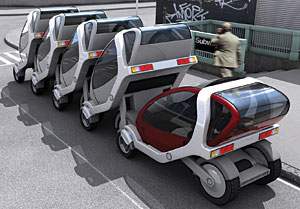
City Car
Image: © Franco Vairani/MIT Smart Cities Project
Six to 8 stacked City Cars can fit into one traditional parking space. When located at major origin and destination spots, such as transit stations, they can carry people the last mile to their final destinations.

Transit enthusiasts point out the inherent efficiencies of high-capacity public-transportation networks, but often neglect to mention that, under most practical circumstances, they offer no solution to the “last-mile” problem. They can get you to approximately where you want to go approximately when you want to get there, but rarely exactly. You still have to get from the nearest transit stop to your actual destination. It is nice to imagine that this problem could be handled by clustering high-density development within convenient walking distance of transit nodes, and sometimes it can—at least partially. But this is far from a general solution. Often, circumstances conspire against it: The distances are too great; it’s impractical for the aged, small children, and the physically impaired; it can expose you to a variety of dangers; it’s unattractive in rainy, snowy, very cold, or very hot weather; and it just doesn’t work if you have a lot of stuff to carry.

Defenders of the private automobile emphasize that it provides mobility on demand, there are no timetables for its use, and it gets you right to your destination. As a result, people really like their cars—not only for the convenience they offer and their elimination of the “last mile,” but also because they function as powerful emblems of personal freedom and social status. Furthermore, the economic, social, and cultural vibrancy of cities depends upon dense, convenient, unrestricted interconnectivity, and automobiles have become universal agents of this.

The problem with cars, which has become increasingly evident as their popularity has grown, is that the scale effects and externalities come back to bite you. When there is an extensive road network with few vehicles on it—as, for example, on the Los Angeles freeway system late at night, it’s indeed astonishingly quick and easy to get around. But when the network becomes choked with traffic, congestion and delays begin to negate the automobile’s advantages. Automobiles account for huge percentages of the energy consumption of cities, producing economic and geopolitical problems in the short term and a significant threat to sustainability in the long term. Tailpipe emissions turn out not only to produce local pollution, but also to contribute to global warming.

In my Smart Cities group at the MIT Media Laboratory, we have been developing a third option—a clean, compact, energy-efficient City Car that promises high levels of personal mobility at low cost, and effectively complements transit systems by, among other things, efficiently solving the “last-mile” problem. This project illustrates the growing potential of ubiquitously embedded intelligence and networking to revolutionize the ways we design and operate buildings and cities.

The crucial enabling technology of the City Car is an omnidirectional robot wheel that we have developed. This wheel contains an electric-drive motor, suspension, steering, and braking. There are no mechanical linkages connecting the robot wheels to the driver’s controls. In other words, the car is fully drive-by-wire, with just an electric cable and a data cable going into each wheel, which has a simple, snap-on mechanical connection to the chassis.

Elimination of the traditional engine and drive train enables modularization of the mechanical systems and offers great flexibility in design of the body and interior. We have taken advantage of this to create small, lightweight passenger vehicles that fold and stack like shopping carts at the supermarket or luggage carts at the airport.

The independent, omnidirectional wheels provide extraordinary maneuverability: Cars can spin on their own wheelbases instead of making U-turns, and can parallel park by slipping in sideways. Depending on context, six to eight folded and stacked City Cars can fit in one traditional parking space.

Share This Story

Looking for a reprint of this article?
From high-res PDFs to custom plaques, order your copy today!

Post a comment to this article

Report Abusive Comment

Subscription Center
  • Create an Account
  • Start a Subscription
  • Manage My Account
  • Sign Up for Newsletters
  • Visit Customer Service
  • Update Preferences

More Videos

Sponsored Content

Sponsored Content is a special paid section where industry companies provide high quality, objective, non-commercial content around topics of interest to the Architectural Record audience. All Sponsored Content is supplied by the advertising company and any opinions expressed in this article are those of the author and not necessarily reflect the views of Architectural Record or its parent company, BNP Media. Interested in participating in our Sponsored Content section? Contact your local rep!

close
  • TAMLYN XtremeTrim Exterior Trim
    Sponsored byTamlyn

    Designing Cleaner Panel Facades: Why Exterior Trim Details Matter

  • Building with Vapor Barriers
    Sponsored byReef Industries, Inc.

    Vapor Barriers Help Control Moisture in Tighter Building Designs

  • Duct Interior with Prodeq System
    Sponsored byHenry, a Carlisle Company

    Designing Resilient Water Containment Systems

DESIGN:ED Podcast
Listen to Architectural Record’s DESIGN:ED Podcast

Events

June 10, 2026

Rethinking Stormwater – The Power of Porous Paving

Credits: 1 AIA LU/HSW; 1 AIBD P-CE; 0.1 ICC CEU

Learn how porous paving systems support stormwater management, reduce heat island effects, and enhance sustainable site design performance.

June 11, 2026

Very Early Warning Fire Detection for Mission-Critical Facilities

Credits: 1 AIA LU/HSW; 1 AIBD P-CE; 0.1 ICC CEU

Examine advanced fire detection strategies that support uptime and enhance safety in data centers and other mission-critical facilities.

View All Submit An Event

Products

2026 Architect's Square Foot Costbook

2026 Architect's Square Foot Costbook

See More Products

Popular Stories

Practice Matters illustration

What’s in a (Firm’s) Name? Thinking About Succession and Legacy

Practice Matters illustration

By the Numbers: Counting America's Architects

House on a Hill

Design Vanguard 2026: Forma

Crane Cove, ONO

Design Vanguard 2026 Winners

House A on a Hill

Design Vanguard 2026: Santiago Valdivieso

Broader Sustainability of CMU - Free Webinar - May 21, 2026

Related Articles

  • Going the extra mile to make mass transit more personal

    See More
  • Tel Aviv's Long-Delayed Mass Transit Project Finally Under Way

    See More
  • The Brutalist lead.jpg

    To Make ‘The Brutalist’ Monumental, the Filmmakers Approached Cinema as Architecture

    See More

Related Products

See More Products
  • 9 ways.jpg

    9 Ways To Make Housing for People

See More Products

Events

View AllSubmit An Event
  • November 18, 2025

    Back to Cool: Designing Learning Spaces That Make the Grade in Acoustics and Aesthetics

    NOW ON DEMANDCredits: 1 AIA LU/HSW; 1 AIBD P-CE; 0.1 ICC CEU; 0.1 IACET CEUThis course examines how acoustics and aesthetics in educational environments can enhance student experience, well-being, and engagement.
View AllSubmit An Event
×

The latest news and information

#1 Source for Architectural Design, News and Products

SUBSCRIBE
  • RESOURCES
    • Advertise
    • Contact Us
    • Submit
    • Store
  • ACCOUNT CENTER
    • Create an Account
    • Start a Subscription
    • Manage My Account
    • Sign Up for Newsletters
    • Visit Customer Service
    • Update Preferences
  • PRIVACY
    • PRIVACY POLICY
    • TERMS & CONDITIONS
    • DO NOT SELL MY PERSONAL INFORMATION
    • PRIVACY REQUEST
    • ACCESSIBILITY
  • SERVICES
    • Marketing Services
    • Reprints
    • Market Research
    • List Rental
    • Survey/Respondent Access
  • STAY CONNECTED
    • Linkedin
    • Facebook
    • Instagram
    • YouTube
    • X (Twitter)

Copyright ©2026. All Rights Reserved BNP Media, Inc. and BNP Media II, LLC.

Design, CMS, Hosting & Web Development :: ePublishing