Architectural Record
search
cart
facebook twitter linkedin youtube
  • Sign In
  • Subscribe
  • Sign Out
  • My Account
Architectural Record
  • NEWS
    • Latest News
    • Awards
    • Interviews
    • Obituaries
    • Podcasts
      • Design:Ed Podcast
      • Sponsored Podcasts
  • OPINION
    • Book Reviews / Excerpts
    • Exhibition Reviews
    • Forum
  • EXCLUSIVES
    • Videos
    • Design Vanguard
    • Top 300 Firms
    • Sponsored Content
    • Sponsored eBooks
    • From the Archives
  • CONTINUING ED
    • Editorial Continuing Ed
    • CE Center
    • CE Academies
  • PROJECTS
    • Buildings By Type
    • Reuse & Renovation
    • Museums & Arts Centers
    • Colleges & Universities
    • Multifamily Housing
    • Interiors
    • Lighting
    • Kitchen & Bath
  • HOUSES
    • Record Houses
    • House of the Month
    • Featured Houses
  • PRODUCTS
    • Products by Category
    • Record Products of the Year
    • Latest Products
  • EVENTS
    • Dates & Events
    • Record on the Road
    • Innovation Conference
    • Sustainability in Practice
    • Women In Architecture
    • Webinars
    • Ad Excellence Awards
    • Submit an Event
  • CONNECT
    • Ask RECORD AI
    • Newsletters
    • Contact
    • Advertise
    • Editorial Calendar
    • Store
    • Customer Service
  • SUBMIT
    • Submission Guidelines
    • RECORD Competitions
  • MAGAZINE
    • Subscribe
    • My Account
    • Digital Edition
    • Current Issue
    • Firm Pass
    • Historic Archive
Architecture News

MoMA Defends Decision to Raze Folk Art Museum Building at Public Forum

By Fred A. Bernstein
January 29, 2014


“The public is invited into the process very late,” said Nicolai Ouroussoff, the architecture critic, referring to the decision by the Museum of Modern Art and its architects, Diller Scofidio + Renfro, to tear down the former home of the American Folk Art Museum, which stands in the way of MoMA’s recently announced expansion. And Ouroussoff was right: Eight hundred people turned out for what was, in effect, a town hall meeting on the demolition of the Tod Williams Billie Tsien building, which heated up a Manhattan auditorium on a very cold night. But then, after nearly two hours of debate, Glenn Lowry, the director of MoMA, declared, “We’ve made our decision”—dashing the hopes of anyone who thought the discussion might change things.
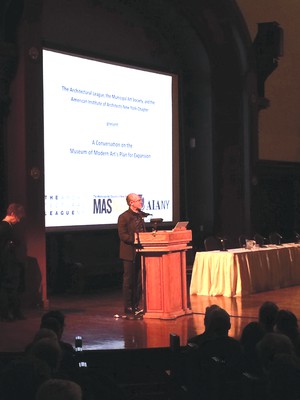
 
Photo © Architectural Record
Museum of Modern Art director Glenn Lowry defended the museum's expansion plans, which include demolishing the former American Folk Art Museum building, at Manhattan's Ethical Culture Society. The January 28 event was hosted by the the Architectural League of New York, the Municipal Art Society, and the American Institute of Architects New York Chapter.
 
Though the evening was billed as “A Conversation on the Museum of Modern Art’s Plan for Expansion,” it was largely a chance for MoMA to explain its thinking. Lowry kicked off the evening by asserting that MoMA needs to expand; that it can’t expand anywhere else (“we’re a midtown museum”); and that it must expand on continuous floor plates—floor plates that would be interrupted if the Folk Art building were allowed to stand between it and a new Jean Nouvel-designed tower to be built on the western part of the block. He was joined by MoMA curator Ann Temkin, who described the imperative to house “ever-expanding art.”
 
Holding the floor longest was Elizabeth Diller, whose firm is responsible for the master plan that calls for the destruction of the Folk Art building. Diller made the case that to connect the east and west portions of MoMA’s expanded campus—while creating a circulation loop that would allow visitors to flow efficiently through the Nouvel tower—would require altering so much of the Folk Art building that it would be better to sacrifice the structure altogether. At times, she seemed to blame Williams’ and Tsien’s architecture. “It’s a damn shame that the building is so obdurate,” she said, adding, “I hate to be the logical person here.”
 
But she seemed not to question the museum’s basic premises, which gave an opening to panelist Karen Stein, a freelance architectural advisor. In perhaps the most impassioned speech of the evening, Stein said, “It’s really about how you frame the problem. To me, one of the early basic assumptions is problematic, which is that circulation is more important than anything else.” Stein pointed out that MoMA says it must be able to create a circulation loop—except that, before it acquired the Folk Art building, it was planning to go ahead with an expansion in which no such loop was contemplated.

There was talk of saving the diminutive building’s bronze façade, and, a bit less seriously, of preserving its odor. “I’m interested in the building’s olfactory signature,” said Jorge Otero-Pailos, a Columbia architecture professor and panelist.

In a private discussion, Lowry was skeptical of the suggestion that the Folk Art Museum be used to display items from the Frank Lloyd Wright archive, consisting of thousands of drawings and models that MoMA (in partnership with Columbia University) acquired last year. “How are you going to get the people in?” asked Lowry. During the public forum, he was asked whether MoMA would treat a site-specific artwork the way it plans to treat the Folk Art building. “We don’t collect buildings,” Lowry said. He added that “we take architecture seriously, but it isn’t art. Architecture is tied to function.”

Panelist Cathleen McGuigan, Architectural Record editor-in-chief, said she was “concerned about the speed with which this has happened.” (MoMA has said it will demolish the building in the next five months, though it may not build on the site until 2018 or later.) “Everything being discussed tonight, McGuigan said, “is a reason to stop and reconsider.”


Letter to the Editor

January 30, 2014
By Alexander Gorlin, FAIA

Glenn Lowry's statements during the January 28 "Conversation" regarding the intended demolition of the adjacent Folk Art Museum—that "we don't collect buildings" and that "we take architecture seriously, but it isn't art."—are not only outrageous and inflammatory, but also incorrect, and a sad lifting of the veil on what was once a meaningful institution that supported the essence of contemporary architecture.

In fact MoMA's Department of Architecture & Design DOES collect architecture as drawings, models, and fragments of buildings, since Philip Johnson began the department in 1932. Historically MoMA even commissioned full size modern houses, such as Marcel Breuer’s House in the Museum Garden (1949) and a series of pre-fab houses ironically built in the parking lot adjacent to the Folk Art Museum for Home Delivery: Fabricating the Modern Dwelling (2008).

Also, in the past 30 years, architects from Frank Gehry to Zaha Hadid have very consciously blurred the distinction between architecture and sculpture, making Lowry's words seem nothing less than those of a cultural Philistine.

In addition, Elizabeth Diller of DS+R, has until now been one of the foremost proponents of architecture as an art. Their website states they are an "interdisciplinary design studio that integrates architecture, the visual arts, and the performing arts." It appears that they clearly failed in their own stated mission of integrating not even a smidgen of the Folk Art Museum, erasing in the most simplistic modern manner any vestige of history. If only Philip Johnson was around to call the architects’ bluff and state the obvious as he often did, that not only "would he work for the Devil himself," but architecture is "the world's second oldest profession."


KEYWORDS: Folk Art Museum New York City Tod Williams Billie Tsien Architects

Share This Story

Looking for a reprint of this article?
From high-res PDFs to custom plaques, order your copy today!

Fred Bernstein studied architecture at Princeton and law at NYU and writes about both subjects.

Post a comment to this article

Report Abusive Comment

Subscription Center
  • Create an Account
  • Start a Subscription
  • Manage My Account
  • Sign Up for Newsletters
  • Visit Customer Service
  • Update Preferences

More Videos

Sponsored Content

Sponsored Content is a special paid section where industry companies provide high quality, objective, non-commercial content around topics of interest to the Architectural Record audience. All Sponsored Content is supplied by the advertising company and any opinions expressed in this article are those of the author and not necessarily reflect the views of Architectural Record or its parent company, BNP Media. Interested in participating in our Sponsored Content section? Contact your local rep!

close
  • TAMLYN XtremeTrim Exterior Trim
    Sponsored byTamlyn

    Designing Cleaner Panel Facades: Why Exterior Trim Details Matter

  • Building with Vapor Barriers
    Sponsored byReef Industries, Inc.

    Vapor Barriers Help Control Moisture in Tighter Building Designs

  • Duct Interior with Prodeq System
    Sponsored byHenry, a Carlisle Company

    Designing Resilient Water Containment Systems

DESIGN:ED Podcast
Listen to Architectural Record’s DESIGN:ED Podcast

Events

June 10, 2026

Rethinking Stormwater – The Power of Porous Paving

Credits: 1 AIA LU/HSW; 1 AIBD P-CE; 0.1 ICC CEU

Learn how porous paving systems support stormwater management, reduce heat island effects, and enhance sustainable site design performance.

June 11, 2026

Very Early Warning Fire Detection for Mission-Critical Facilities

Credits: 1 AIA LU/HSW; 1 AIBD P-CE; 0.1 ICC CEU

Examine advanced fire detection strategies that support uptime and enhance safety in data centers and other mission-critical facilities.

View All Submit An Event

Products

2026 Architect's Square Foot Costbook

2026 Architect's Square Foot Costbook

See More Products

Popular Stories

Coronado Bridge

The Architect’s Guide to San Diego

Practice Matters illustration

What’s in a (Firm’s) Name? Thinking About Succession and Legacy

Practice Matters illustration

By the Numbers: Counting America's Architects

Inward House

Inward House by VeeV Design Studio

Riverdale House by Studio Lau

Riverdale House by Studio Lau

Broader Sustainability of CMU - Free Webinar - May 21, 2026

Related Articles

  • MoMA's Architecture Curator Speaks Up About Decision to Raze Folk Art Museum

    See More
  • UPDATE: Architectural Community Speaks Out Against MoMA's Plan to Raze Tod Williams Billie Tsien's Folk Art Museum

    See More
  • MoMA Begins Demolition of Folk Art Museum Building

    See More
×

The latest news and information

#1 Source for Architectural Design, News and Products

SUBSCRIBE
  • RESOURCES
    • Advertise
    • Contact Us
    • Submit
    • Store
  • ACCOUNT CENTER
    • Create an Account
    • Start a Subscription
    • Manage My Account
    • Sign Up for Newsletters
    • Visit Customer Service
    • Update Preferences
  • PRIVACY
    • PRIVACY POLICY
    • TERMS & CONDITIONS
    • DO NOT SELL MY PERSONAL INFORMATION
    • PRIVACY REQUEST
    • ACCESSIBILITY
  • SERVICES
    • Marketing Services
    • Reprints
    • Market Research
    • List Rental
    • Survey/Respondent Access
  • STAY CONNECTED
    • Linkedin
    • Facebook
    • Instagram
    • YouTube
    • X (Twitter)

Copyright ©2026. All Rights Reserved BNP Media, Inc. and BNP Media II, LLC.

Design, CMS, Hosting & Web Development :: ePublishing