Architectural Record
search
cart
facebook twitter linkedin youtube
  • Sign In
  • Subscribe
  • Sign Out
  • My Account
Architectural Record
  • NEWS
    • Latest News
    • Awards
    • Interviews
    • Obituaries
    • Podcasts
      • Design:Ed Podcast
      • Sponsored Podcasts
  • OPINION
    • Book Reviews / Excerpts
    • Exhibition Reviews
    • Forum
  • EXCLUSIVES
    • Videos
    • Design Vanguard
    • Top 300 Firms
    • Sponsored Content
    • Sponsored eBooks
    • From the Archives
  • CONTINUING ED
    • Editorial Continuing Ed
    • CE Center
    • CE Academies
  • PROJECTS
    • Buildings By Type
    • Reuse & Renovation
    • Museums & Arts Centers
    • Colleges & Universities
    • Multifamily Housing
    • Interiors
    • Lighting
    • Kitchen & Bath
  • HOUSES
    • Record Houses
    • House of the Month
    • Featured Houses
  • PRODUCTS
    • Products by Category
    • Record Products of the Year
    • Latest Products
  • EVENTS
    • Dates & Events
    • Record on the Road
    • Innovation Conference
    • Sustainability in Practice
    • Women In Architecture
    • Webinars
    • Ad Excellence Awards
    • Submit an Event
  • CONNECT
    • Ask RECORD AI
    • Newsletters
    • Contact
    • Advertise
    • Editorial Calendar
    • Store
    • Customer Service
  • SUBMIT
    • Submission Guidelines
    • RECORD Competitions
  • MAGAZINE
    • Subscribe
    • My Account
    • Digital Edition
    • Current Issue
    • Firm Pass
    • Historic Archive
Architecture News

Less is More to Restore at Mies' Tugendhat Villa
By Russell Fortmeyer
Tugendhat Villa

Tugendhat Villa

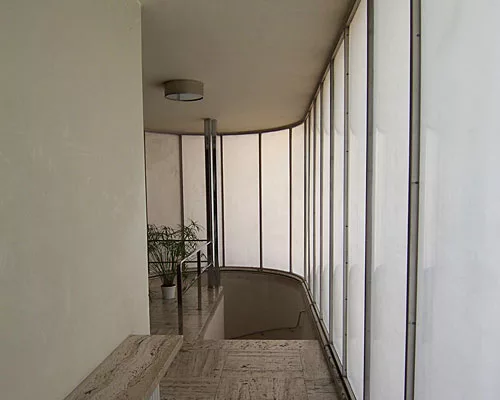
The first floor corridor of the Tugendhat Villa, built in 1930 and designed by Ludwig Mies van der Rohe for Brno, Czech Republic, includes more recently installed translucent glass panels that replaced the original design’s larger panels. A planned restoration would address such inaccuracies of previous restorations.
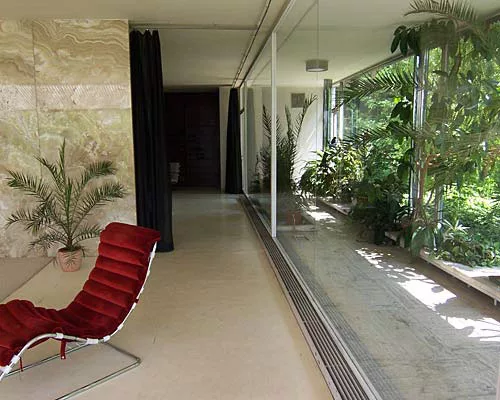
Photo: © Russell Fortmeyer
Tugendhat Villa

Tugendhat Villa

The lower floor’s conservatory frames one end of the main living spaces. Damage to the integrated heating system—a pipe for hot water running along the glass expanses to reduce condensation—is not as extensive as the villa’s structural problems.
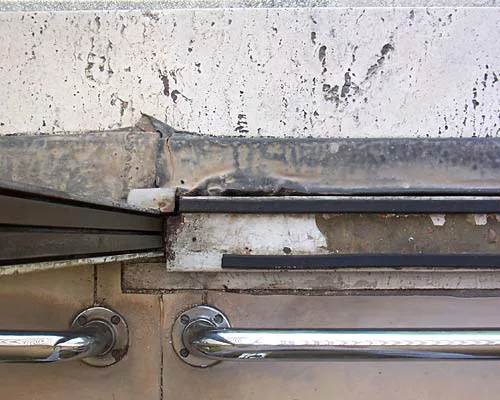
Photo: © Russell Fortmeyer
Tugendhat Villa

Tugendhat Villa

The living and dining rooms on the lower level include sliding pocket glass window walls that automatically lower into the floor. The glass wall in the living room is not original, but still requires extensive renovation.
Link to story

Photo: © Russell Fortmeyer
Tugendhat Villa

Tugendhat Villa

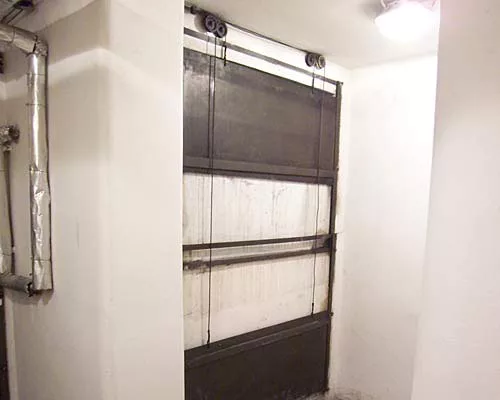
The basement of the Tugendhat Villa reveals a progressively designed mechanical ventilation system that allows for a so-called “economizer mode,” where untreated fresh air is pulled in from outdoors during good weather. The system can be shifted from cooling and heating mode to all outdoor air through a mechanical switch (not shown). Even by today’s standards, the system would be considered radical for residential architecture.
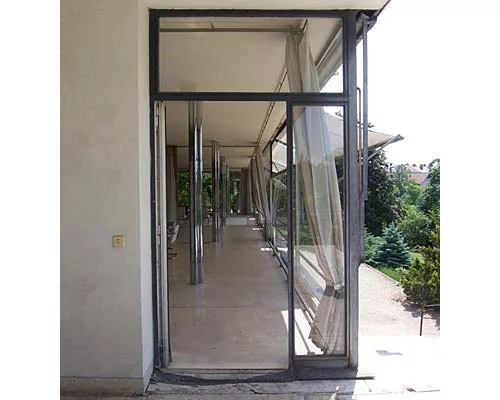
Photo: © Russell Fortmeyer
Tugendhat Villa

Tugendhat Villa

Although in need of extensive repairs, the lower level of Mies’ Tugendhat Villa still impresses with its open expanses of space and glass.
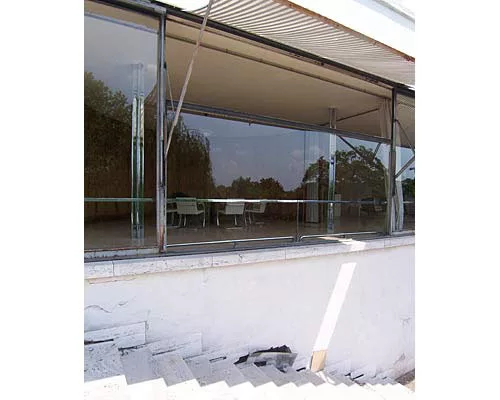
Photo: © Russell Fortmeyer
Tugendhat Villa

Tugendhat Villa

The lower level’s rear outdoor stair, leading to the sloped garden, reveals extensive damage. Furthermore, the travertine steps were clumsily replaced during a previous restoration, departing from Mies’ strict Modernist details.
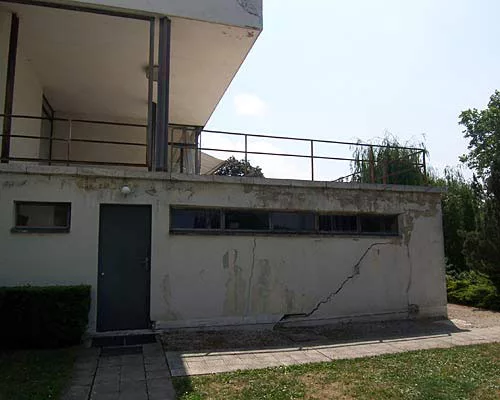
Photo: © Russell Fortmeyer
Tugendhat Villa

Tugendhat Villa

An exterior elevation reveals the extent of the Tugendhat Villa’s disrepair, as the sloped site has caused the celebrated house to slowly pull away from its foundations.

Photo: © Russell Fortmeyer
Tugendhat Villa
Tugendhat Villa
Tugendhat Villa
Tugendhat Villa
Tugendhat Villa
Tugendhat Villa
Tugendhat Villa
September 27, 2007
After three years of contentious negotiations, the Czech Republic city of Brno has agreed to restore the Tugendhat Villa, a landmark of early Modernism designed by Ludwig Mies van der Rohe and completed in 1930. The house, which currently operates as a museum, will close October 31.
 
Historians and critics widely regard the Tugendhat Villa as Mies’ finest residence in Europe. It features several elements that became hallmarks of early Modernism including an open plan; flat roof; embrace of new technology, such as electronically actuated pocket windows; and a restrained, white stucco exterior. The extent of surviving documentation of the house’s construction and furnishing also sets it apart from other examples of the architect’s work.
 
This latest restoration follows several previous conservation efforts, many of dubious quality and historical accuracy. Although it was announced in 2004, the project was delayed after Daniela Hammer-Tugendhat, a daughter of the villa’s original clients, demanded that the house be returned to her family as war reparations.
 
The Tugendhats, who were Jewish, were forced to flee Czechoslovakia in 1938. Their residence was occupied first by the Nazis and then the Russians, who used it as a dance academy and later a hospitality facility. The city took charge of the villa in 1989 and, earlier this year, announced plans to return it to the Tugendhat heirs. It soon reversed this decision, though, after the family sold at auction a sculpture that the city had returned to it as a goodwill gesture. That move effectively left ownership of the villa to the Museum of the City of Brno, which has administered its maintenance and operation since 1994.
 
“It’s a difficult story,” observes Ivan Walha, an architect in Brno who has been involved in earlier conservation efforts at the house. “I think this process is finally successful, but it’s not entirely clear how well the reconstruction project will go.”
 
A team of local architects calling itself the Association for the Reconstruction of the Tugendhat Villa won the restoration job in 2004 from a pool of less than a dozen architects. The start of construction was delayed until now after a runner-up filed a lawsuit to protest the competition. Work is scheduled to take two to four years at an estimated cost of $10 million in city funds.
 
Many local observers are skeptical about whether or not this latest effort will prove definitive, particularly given that it must correct a careless and haphazard Russian restoration during the 1980s. They also wonder if the new preservation team can remain sensitive to Mies’ original intentions while also honoring the age of the house. Basing the restoration on Mies’ original drawings is tricky, for example, since he made many changes in the field.
 
Osamu Okamura, an architect and the editor of Brno’s architecture magazine, era 21, believes that the State’s preservation agencies will provide necessary oversight. But he also has doubts about the project. “They have decided to put the house back to the state of the 1930s, but is this a good decision? The house is aging and you want to show the process of aging, which also has its own value. This is a shift in thinking,” he says.
 
That view was shared by many participants in an April 2006 conference in Brno about the restoration of European Modernist buildings, according to published papers. “The house certainly doesn’t lack for attention,” Okamura notes, somewhat dryly, “but the general public in Brno knows very little about contemporary architecture, let alone the 1930s.” That may change once the Tugendhat’s restoration is complete and the villa re-opens as a public museum.


Share This Story

Looking for a reprint of this article?
From high-res PDFs to custom plaques, order your copy today!

Russell fortmeyer
Russell Fortmeyer, a contributing editor to RECORD, is a Los Angeles-based sustainability principal at Arup and adjunct professor at the University of Southern California School of Architecture.

Post a comment to this article

Report Abusive Comment

Subscription Center
  • Create an Account
  • Start a Subscription
  • Manage My Account
  • Sign Up for Newsletters
  • Visit Customer Service
  • Update Preferences

More Videos

Sponsored Content

Sponsored Content is a special paid section where industry companies provide high quality, objective, non-commercial content around topics of interest to the Architectural Record audience. All Sponsored Content is supplied by the advertising company and any opinions expressed in this article are those of the author and not necessarily reflect the views of Architectural Record or its parent company, BNP Media. Interested in participating in our Sponsored Content section? Contact your local rep!

close
  • cold storage facility
    Sponsored byCarlisle SynTec Systems

    How Architects Can Design More Continuous Cold Storage Envelopes

  • TAMLYN XtremeTrim Exterior Trim
    Sponsored byTamlyn

    Designing Cleaner Panel Facades: Why Exterior Trim Details Matter

  • Building with Vapor Barriers
    Sponsored byReef Industries, Inc.

    Vapor Barriers Help Control Moisture in Tighter Building Designs

DESIGN:ED Podcast
Listen to Architectural Record’s DESIGN:ED Podcast

Events

June 23, 2026

Enhancing Fire Resistance with Advanced PVC Solutions

Credits: 1 AIA LU/HSW; 1 AIBD P-CE; 0.1 ICC CEU; 1 IIBEC CEH

Evaluate advanced PVC solutions that improve fire resistance, support WUI compliance, and enhance resilience in residential and commercial building design.

June 25, 2026

Designing Glass Railing Systems that Enhance Aesthetics and Meet Code

Credits: 1 AIA LU/HSW; 1 AIBD P-CE; 0.1 ICC CEU

Upon course completion, participants will possess a deeper understanding of glass railings to help ensure that safety, aesthetic, and performance objectives are achieved.

View All Submit An Event

Products

2026 Architect's Square Foot Costbook

2026 Architect's Square Foot Costbook

See More Products

Popular Stories

Lorcan O' Herilhy

California Architect Lorcan O’Herlihy Has Died, Age 66

Obama Presidential Center, Chicago

The Obama Presidential Center Opens on Chicago’s South Side

Spoonbill Ranch

Johnsen Schmaling Architects Integrates Spoonbill Ranch into a Pristine Landscape

Image of Bruce Springsteen Center for American Music

The CookFox-designed Bruce Springsteen Center for American Music Opens in New Jersey

Three Courtyards House

Design Vanguard 2026: Balsa Crosetto Piazzi

Enhancing Fire Resistance with Advanced PVC Solutions - Free Webinar - June 23, 2026

Related Articles

  • When More Is Less

    See More
  • Albina One, Portland

    Lever Architecture’s Albina One Housing Complex Begins to Restore a Fragmented Portland Community

    See More
  • NCARB

    NCARB Adds More Schools to Accelerated Architecture Licensure Initiative

    See More

Related Products

See More Products
  • book3.jpg

    If Architecture is a Language, Then a Building is a Story

  • bim design firms.jpg

    BIM for Design Firms: Data Rich Architecture at Small and Medium Scales

  • GlobalData_logo_blue_header.png

    Construction in the US - Key Trends and Opportunities to 2023

See More Products
×

The latest news and information

#1 Source for Architectural Design, News and Products

SUBSCRIBE
  • RESOURCES
    • Advertise
    • Contact Us
    • Submit
    • Store
  • ACCOUNT CENTER
    • Create an Account
    • Start a Subscription
    • Manage My Account
    • Sign Up for Newsletters
    • Visit Customer Service
    • Update Preferences
  • PRIVACY
    • PRIVACY POLICY
    • TERMS & CONDITIONS
    • DO NOT SELL MY PERSONAL INFORMATION
    • PRIVACY REQUEST
    • ACCESSIBILITY
  • SERVICES
    • Marketing Services
    • Reprints
    • Market Research
    • List Rental
    • Survey/Respondent Access
  • STAY CONNECTED
    • Linkedin
    • Facebook
    • Instagram
    • YouTube
    • X (Twitter)

Copyright ©2026. All Rights Reserved BNP Media, Inc. and BNP Media II, LLC.

Design, CMS, Hosting & Web Development :: ePublishing