Architectural Record
search
cart
facebook twitter linkedin youtube
  • Sign In
  • Subscribe
  • Sign Out
  • My Account
Architectural Record
  • NEWS
    • Latest News
    • Awards
    • Interviews
    • Obituaries
    • Podcasts
      • Design:Ed Podcast
      • Sponsored Podcasts
  • OPINION
    • Book Reviews / Excerpts
    • Exhibition Reviews
    • Forum
  • EXCLUSIVES
    • Videos
    • Design Vanguard
    • Top 300 Firms
    • Sponsored Content
    • Sponsored eBooks
    • From the Archives
  • CONTINUING ED
    • Editorial Continuing Ed
    • CE Center
    • CE Academies
  • PROJECTS
    • Buildings By Type
    • Reuse & Renovation
    • Museums & Arts Centers
    • Colleges & Universities
    • Multifamily Housing
    • Interiors
    • Lighting
    • Kitchen & Bath
  • HOUSES
    • Record Houses
    • House of the Month
    • Featured Houses
  • PRODUCTS
    • Products by Category
    • Record Products of the Year
    • Latest Products
  • EVENTS
    • Dates & Events
    • Record on the Road
    • Innovation Conference
    • Sustainability in Practice
    • Women In Architecture
    • Webinars
    • Ad Excellence Awards
    • Submit an Event
  • CONNECT
    • Ask RECORD AI
    • Newsletters
    • Contact
    • Advertise
    • Editorial Calendar
    • Store
    • Customer Service
  • SUBMIT
    • Submission Guidelines
    • RECORD Competitions
  • MAGAZINE
    • Subscribe
    • My Account
    • Digital Edition
    • Current Issue
    • Firm Pass
    • Historic Archive
Architecture News

The Guggenheim celebrates 50 with a Frank Lloyd Wright show
By William Hanley
The Guggenheim Celebrates 50

The Guggenheim Celebrates 50

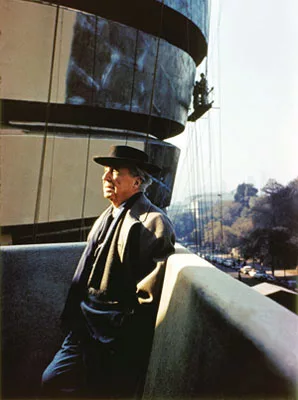
Frank Lloyd Wright.

Photo © The Solomon R. Guggenheim Foundation/William Short
The Guggenheim Celebrates 50

The Guggenheim Celebrates 50

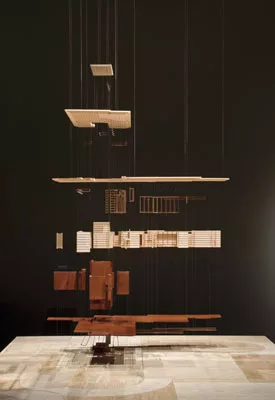
A model of the Herbert Jacobs House by Situ Studio is suspended in a gallery of residential work.

Photo © David Heald
The Guggenheim Celebrates 50

The Guggenheim Celebrates 50

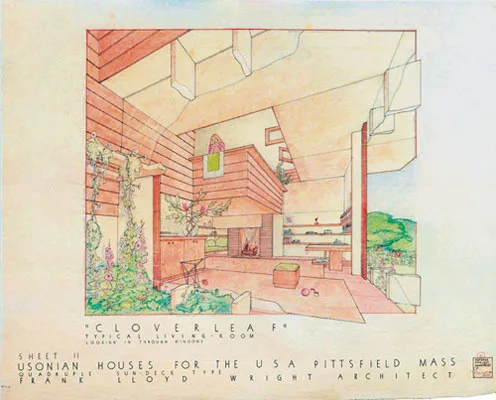
A perspective drawing for the Cloverleaf Quadruple Housing project.

Photo © 2009 The Frank Lloyd Wright Foundation
The Guggenheim Celebrates 50

The Guggenheim Celebrates 50

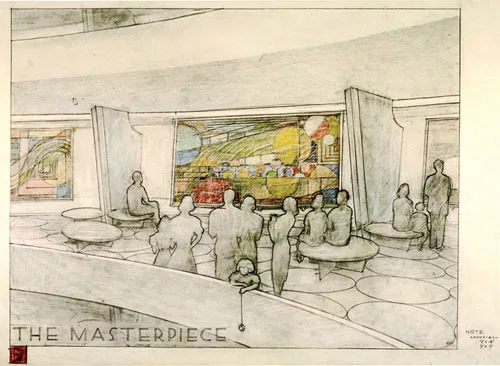
In The Masterpiece, art viewing is more cocktail party than contemplation.

Photo © 2009 The Frank Lloyd Wright Foundation
The Guggenheim Celebrates 50

The Guggenheim Celebrates 50

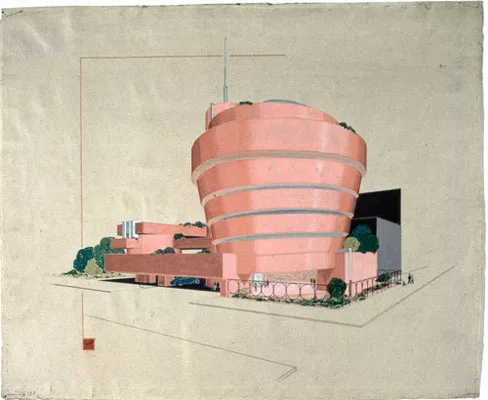
One of Wright’s studies for the Solomon R. Guggenheim Museum shows its familiar form with a car parked in the present-day museum store. Wright died six months prior to the Guggenheim’s October 21, 1959, opening.

Photo © 2009 The Frank Lloyd Wright Foundation
The Guggenheim Celebrates 50

The Guggenheim Celebrates 50

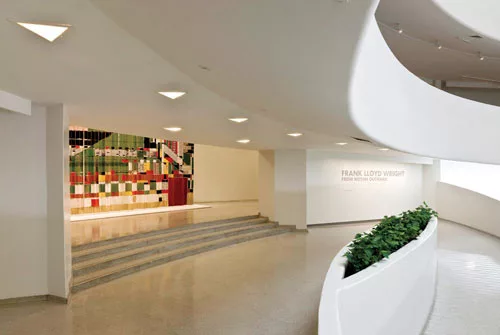
At the entrance to the exhibition, a theater curtain  from Taliesin III is a surprisingly three-dimensional patchwork of thread and fabric squares that mimic the Wisconsin countryside.

Photo © David Heald

The Guggenheim Celebrates 50
July 16, 2009
In Bilbao, the Guggenheim Museum invented the contemporary strain of iconic, even city-defining, museum buildings, where the architecture threatens to outshine the artwork. But the struggle between collection and container dates back even further to the museum’s flagship building in New York City. From its 1959 opening, critics of Frank Lloyd Wright’s design — the Guggenheim’s then-director James Johnson Sweeney among them — complained that the spiraling ramp swallowed the art displayed on its perimeter. But for all the resistance that the design imposed on showing art, Wright’s museum took a building type formerly defined by warrens of galleries and, with open sight lines across a light-filled rotunda, turned it into a dramatic public space that put the experience of viewing art on equal footing with the work.
 
Frank Lloyd Wright during construction of the Solomon R. Guggenheim Museum, New York, ca. 1959.
 
With that history in mind, it is fitting that the museum is marking the recently restored building’s 50th anniversary (and the 50th anniversary of Wright’s death, just six months prior to the museum’s opening) with an exhibition that privileges the architect’s public and commercial buildings. Frank Lloyd Wright: From Within Outward shows Wright using light as well as compressed and expanding spaces to transform places where people congregate — for work, for worship, for education, for fun.
 
The curatorial team behind the show includes former Solomon R. Guggenheim director and current curator and senior adviser of international affairs Thomas Krens, assistant curator of architecture and design David van der Leer, and curatorial assistant Maria Nicanor from the museum. They worked with Bruce Brooks Pfeiffer, director of the Frank Lloyd Wright Archives; Margo Stipe, curator and registrar of collections for the archives; assistant director of the archive Oskar Muñoz; and Mina Marefat, a Wright historian and designer. The group sifted through the foundation’s immense holdings to produce a rotunda-filling, but tightly edited show of drawings, renderings, photographs, models, and other materials.
 
The exhibition flows more or less chronologically up the museum’s ramp, pausing in three ancillary galleries along the way. In the first of these hangs a curtain (1952, fabricated 1955) that Wright created for a theater inside Taliesin III, the compound he developed on his family’s Wisconsin homestead.
 
Moving up the ramp, Wright’s early triumphs appear in a progression of drawings and tempera renderings placed in angled display cases abstracted from drafting tables, a reminder of the objects’ origin in the days of a hand-drawn design process. A narrow perspective drawing for the now-demolished Larkin Company Administration Building (1902—06) in Buffalo, shows Wright playing with openness and luminosity as he plots the vertical volume rising above a desk-filled atrium and creating sight lines in between tiers of perimeter offices. A newly created model of the Unity Temple (1905—08) in Oak Park, Illinois, encloses an interior that not only opens up to light and air but allows worshipers, like Larkin office workers, views to one another.
 
The exhibition makes the strongest case for Wright as a designer of great communal spaces when it looks at his urban work. Off the rotunda, a gallery groups together plans for civic centers, high-rises, and other urbanistic projects. They show the famously density-opposed designer attempting to escape the disorder of the city with centers of activity distributed across the countryside.
 
His Broadacre City project presents a sprawling series of campuses connected by America’s then-emergent car culture or even saucer-shaped helicopters. In the same gallery, renderings for a civic complex in Pittsburgh illustrate sweeping public plazas stacked in layers along one of the city’s rivers. The unbuilt but influential design has echoes in contemporary work. The tentlike mast rising over the upper plaza could be the progenitor of Helmut Jahn’s Sony Center in Berlin, while an aquarium enclosed in two subterranean orbs presages Renzo Piano’s California Academy of Sciences.
 
The show supplements the urban schemes with digital animations, interpretations of drawings — complete with whirling helicopters — by Harvard University Graduate School of Design students. The curators took a risk by reimagining the work as sexy fly-through renderings. Executed differently, the video could have distracted from the static and comparatively quiet drawings, but the LCD screens are no more than roughly 10 inches wide and always slightly removed from the drawings. Perfectly tailored to the size and orientation of the installations, the animations add an enlivening sense of depth to the presentation.
 
While the main thread of the exhibition follows Wright’s public spaces, the curators have arranged a survey of his residential projects in one of the auxiliary galleries. Among Wright’s most influential work, his houses benefit most from the newly commissioned models designed and fabricated for the show by Brooklyn’s Situ Studio. For example, a model of the Herbert Jacobs House (1936—37) in Madison, Wisconsin, exploded into constituent parts and suspended above a plan etched into a wooden base, reveals its radiant heating system and organic materials composed into clean geometries.
 
The penultimate section of the exhibition shows Wright working with public space on a grand scale with his master plan for Baghdad, Iraq (1957). A selection from the hundreds of drawings that he produced for a constellation of cultural and civic buildings straddling the Tigris River include large, vivid tempera renderings of an opera house, university campus, and a monument to the 8th-century caliph Haroun al-Rashid. The lateral, barrier-free city plan circulates people and cars through spirals of roads, pedestrian ramps, and circular plazas stacked in ziggurat-inspired forms.  We see the wide-open vistas surrounding towers, campuslike plazas, and other social spaces seen in Wright’s earlier urban work evolve into a network of public temples.
 
The show concludes with Wright’s best-known (albeit inverted) ziggurat, the Guggenheim itself. At the top of the rotunda, studies for the museum show Wright working out its smooth facade in multiple colors.
 
With a series of drawings, the exhibition makes clear that not only does Wright’s architecture create a novel space for viewing art, it opens the traditionally didactic configuration of the gallery to turn viewing into a public, social experience. In one interior perspective titled The Masterpiece (1943—59), people congregate around a painting hung along the ramp, while a child unspools a yo-yo over the side and into the rotunda.
 
Over five decades, artists and curators have contended with the museum’s idiosyncratic spaces with varying results. But since Bilbao’s success, the Guggenheim’s administrators have seemed to look beyond the New York building, proposing a string of franchise museums in locations from Brazil to Abu Dhabi that boast equally attention-grabbing forms. For the Wright building’s 50th anniversary, it is heartening to see the institution going back to the original museum and examining not only how it functions as a historically innovative form and a New York icon, but also its success as a public space — even if that success still tends to compete with the art.


Share This Story

Looking for a reprint of this article?
From high-res PDFs to custom plaques, order your copy today!

Post a comment to this article

Report Abusive Comment

Subscription Center
  • Create an Account
  • Start a Subscription
  • Manage My Account
  • Sign Up for Newsletters
  • Visit Customer Service
  • Update Preferences

More Videos

Sponsored Content

Sponsored Content is a special paid section where industry companies provide high quality, objective, non-commercial content around topics of interest to the Architectural Record audience. All Sponsored Content is supplied by the advertising company and any opinions expressed in this article are those of the author and not necessarily reflect the views of Architectural Record or its parent company, BNP Media. Interested in participating in our Sponsored Content section? Contact your local rep!

close
  • TAMLYN XtremeTrim Exterior Trim
    Sponsored byTamlyn

    Designing Cleaner Panel Facades: Why Exterior Trim Details Matter

  • Building with Vapor Barriers
    Sponsored byReef Industries, Inc.

    Vapor Barriers Help Control Moisture in Tighter Building Designs

  • Duct Interior with Prodeq System
    Sponsored byHenry, a Carlisle Company

    Designing Resilient Water Containment Systems

DESIGN:ED Podcast
Listen to Architectural Record’s DESIGN:ED Podcast

Events

June 10, 2026

Rethinking Stormwater – The Power of Porous Paving

Credits: 1 AIA LU/HSW; 1 AIBD P-CE; 0.1 ICC CEU

Learn how porous paving systems support stormwater management, reduce heat island effects, and enhance sustainable site design performance.

June 11, 2026

Very Early Warning Fire Detection for Mission-Critical Facilities

Credits: 1 AIA LU/HSW; 1 AIBD P-CE; 0.1 ICC CEU

Examine advanced fire detection strategies that support uptime and enhance safety in data centers and other mission-critical facilities.

View All Submit An Event

Products

2026 Architect's Square Foot Costbook

2026 Architect's Square Foot Costbook

See More Products

Popular Stories

Practice Matters illustration

What’s in a (Firm’s) Name? Thinking About Succession and Legacy

Practice Matters illustration

By the Numbers: Counting America's Architects

House on a Hill

Design Vanguard 2026: Forma

Crane Cove, ONO

Design Vanguard 2026 Winners

KRESA by DLR

In Kalamazoo, DLR Group Completes a Mass-Timber Hub for Career and Technical Education Programs

Broader Sustainability of CMU - Free Webinar - May 21, 2026

Related Articles

  • A Frank Lloyd Wright Landmark Gets a Modern Pavilion by Mori

    See More
  • Frank Lloyd Wright Exhibition Opens at the Guggenheim

    See More
  • Buyer Sought for Threatened Frank Lloyd Wright House in Phoenix

    See More

Related Products

See More Products
  • 047177751X.gif

    Sustainable Urbanism: Urban Design With Nature

See More Products
×

The latest news and information

#1 Source for Architectural Design, News and Products

SUBSCRIBE
  • RESOURCES
    • Advertise
    • Contact Us
    • Submit
    • Store
  • ACCOUNT CENTER
    • Create an Account
    • Start a Subscription
    • Manage My Account
    • Sign Up for Newsletters
    • Visit Customer Service
    • Update Preferences
  • PRIVACY
    • PRIVACY POLICY
    • TERMS & CONDITIONS
    • DO NOT SELL MY PERSONAL INFORMATION
    • PRIVACY REQUEST
    • ACCESSIBILITY
  • SERVICES
    • Marketing Services
    • Reprints
    • Market Research
    • List Rental
    • Survey/Respondent Access
  • STAY CONNECTED
    • Linkedin
    • Facebook
    • Instagram
    • YouTube
    • X (Twitter)

Copyright ©2026. All Rights Reserved BNP Media, Inc. and BNP Media II, LLC.

Design, CMS, Hosting & Web Development :: ePublishing