Architectural Record
search
cart
facebook twitter linkedin youtube
  • Sign In
  • Subscribe
  • Sign Out
  • My Account
Architectural Record
  • NEWS
    • Latest News
    • Awards
    • Interviews
    • Obituaries
    • Podcasts
      • Design:Ed Podcast
      • Sponsored Podcasts
  • OPINION
    • Book Reviews / Excerpts
    • Exhibition Reviews
    • Forum
  • EXCLUSIVES
    • Videos
    • Design Vanguard
    • Top 300 Firms
    • Sponsored Content
    • Sponsored eBooks
    • From the Archives
  • CONTINUING ED
    • Editorial Continuing Ed
    • CE Center
    • CE Academies
  • PROJECTS
    • Buildings By Type
    • Reuse & Renovation
    • Museums & Arts Centers
    • Colleges & Universities
    • Multifamily Housing
    • Interiors
    • Lighting
    • Kitchen & Bath
  • HOUSES
    • Record Houses
    • House of the Month
    • Featured Houses
  • PRODUCTS
    • Products by Category
    • Record Products of the Year
    • Latest Products
  • EVENTS
    • Dates & Events
    • Record on the Road
    • Innovation Conference
    • Sustainability in Practice
    • Women In Architecture
    • Webinars
    • Ad Excellence Awards
    • Submit an Event
  • CONNECT
    • Ask RECORD AI
    • Newsletters
    • Contact
    • Advertise
    • Editorial Calendar
    • Store
    • Customer Service
  • SUBMIT
    • Submission Guidelines
    • RECORD Competitions
  • MAGAZINE
    • Subscribe
    • My Account
    • Digital Edition
    • Current Issue
    • Firm Pass
    • Historic Archive
ProjectsBuildings by TypeMuseums & Art Centers

Fondation Louis Vuitton

Sacré Bleu!: High over the treetops in the Bois de Boulogne, Frank Gehry’s contemporary art museum for a French luxury magnate is an astonishing work of architectural couture.

By Cathleen McGuigan
Fondation Louis Vuitton
The main entrance, surrounded by canopies that were inspired by glass pavilions such as Joseph Paxton’s Crystal Palace and the Grand Palais.
 
Photo © Iwan Baan
Fondation Louis Vuitton
Anchored in a water feature above the cascade to the east, the building shows off the elaborate web of steel and wood elements that hold the curving glass canopies aloft.
 
Photo © Iwan Baan
Fondation Louis Vuitton
The base of the building, below grade, is French limestone, the same stone used for the lobby floor.
 
Photo © Iwan Baan
Fondation Louis Vuitton
The building shows off the elaborate web of steel and wood elements that hold the curving glass canopies aloft.
 
Photo © Iwan Baan
Fondation Louis Vuitton
Louis Vuitton in Paris is a complex building—actually, two structures in one. The museum building is a concrete-and-steel structure largely clad in 19,000 white concrete panels. Surrounding it are 12 curving translucent canopies, or sails, made of 3,600 glass panels supported by steel and wood members—the second structure. To complete this tour de force of building technology, the project team coordinated the design, engineering, fabrication, and construction using Gehry Technologies Digital Project software. Four hundred users shared information from the same 3-D model to create efficiencies, speed delivery, and cut waste.

The superstructure is concrete and steel, with concrete floor slabs and walls, and also employs steel girders, trusses, and columns. Steel and wood members, dubbed “the tripods,” are attached to the building’s superstructure to support the glass canopies or sails.
 
Photo © Iwan Baan
Fondation Louis Vuitton
Louis Vuitton in Paris is a complex building—actually, two structures in one. The museum building is a concrete-and-steel structure largely clad in 19,000 white concrete panels. Surrounding it are 12 curving translucent canopies, or sails, made of 3,600 glass panels supported by steel and wood members—the second structure. To complete this tour de force of building technology, the project team coordinated the design, engineering, fabrication, and construction using Gehry Technologies Digital Project software. Four hundred users shared information from the same 3-D model to create efficiencies, speed delivery, and cut waste.

The superstructure is concrete and steel, with concrete floor slabs and walls, and also employs steel girders, trusses, and columns. Steel and wood members, dubbed “the tripods,” are attached to the building’s superstructure to support the glass canopies or sails.
 
Photo © Iwan Baan
Fondation Louis Vuitton
Nineteen thousand white fiber-reinforced high-performance concrete panels—about 60 percent of them unique—clad the forms called the icebergs. Some panels are flat, some slightly curved, others folded or creased. They were cast in silicone molds at a factory in France and installed on an armature of welded steel that is curved and bent to form the contours and shapes of the icebergs’ design.
 
Photo © Iwan Baan
Fondation Louis Vuitton
A secondary structure of steel and wood elements, curving and straight, to support the glass sails, is attached to the tripods. All wood members are glue-laminated Austrian larch, with embedded stainless-steel rods and steel connection plates.
 
Photo © Iwan Baan
Fondation Louis Vuitton
Three thousand six hundred curving glass panels—each unique—make up the 12 sails or canopies. The laminated-glass panels are fritted for translucency and to reduce the solar gain. The glass was fabricated in Italy and installed on a tertiary structure of stainless steel, which was then attached to the secondary structure of wood and steel members.
 
Photo © Iwan Baan
Fondation Louis Vuitton
The Lobby.
 
Photo © Iwan Baan
Fondation Louis Vuitton
Each of the largely orthogonal, lofty galleries is somewhat different, with unique softly sculpted light wells.
 
Photo © Iwan Baan
Fondation Louis Vuitton
Each of the largely orthogonal, lofty galleries is somewhat different, with unique softly sculpted light wells.
 
Photo © Iwan Baan
Fondation Louis Vuitton
Each of the largely orthogonal, lofty galleries is somewhat different, with unique softly sculpted light wells.
 
Photo © Iwan Baan
Fondation Louis Vuitton
In one gallery, half the ceiling soars from nearly 30 feet to 55 feet high.
 
Photo © Iwan Baan
Fondation Louis Vuitton
One staircase'inside the steel armature that supports the exterior fiber cement panels'feels like being inside a battleship.
 
Photo © Iwan Baan
Fondation Louis Vuitton
The view from a terrace toward the city beyond, where Gehry designed one other project, the American Center (1994), now the Cinémathèque Française.
 
Photo © Iwan Baan
Fondation Louis Vuitton
The view from a terrace toward the city beyond, where Gehry designed one other project, the American Center (1994), now the Cin'math'que Fran'aise.
 
Photo © Iwan Baan
Fondation Louis Vuitton
1) Entrance
2) Lobby
3) Auditorium
4) Café
5) Bookstore
6) Gallery
7) “Chapel”
8) Loading dock
9) Open to below
10) Terrace
 
Photo © Iwan Baan
Fondation Louis Vuitton
1) Entrance
2) Lobby
3) Auditorium
4) Café
5) Bookstore
6) Gallery
7) “Chapel”
8) Loading dock
9) Open to below
10) Terrace
 
Image courtesy Gehry Partners
Fondation Louis Vuitton
1) Entrance
2) Lobby
3) Auditorium
4) Café
5) Bookstore
6) Gallery
7) “Chapel”
8) Loading dock
9) Open to below
10) Terrace
 
Image courtesy Gehry Partners
Fondation Louis Vuitton
1) Entrance
2) Lobby
3) Auditorium
4) Café
5) Bookstore
6) Gallery
7) “Chapel”
8) Loading dock
9) Open to below
10) Terrace
 
Image courtesy Gehry Partners
Fondation Louis Vuitton
October 16, 2014

Architects & Firms

Gehry Partners

Paris

Video

People/Products

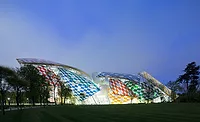
The Fondation Louis Vuitton (FLV), designed by Frank Gehry, may appear transparent, but it is a building that doesn’t easily give up its secrets. Encountering it for the first time—huge and billowing, as if the vast, curving glass sails that wrap the exterior are tilting into the wind—is amazing and a little confounding. Without a surrounding cityscape against which to gauge the scale of this surprise of a building, it looms above the leafy treetops of the Bois de Boulogne in western Paris as if it were a garden folly made for giants.

Paris resists change, and this unusual project sparked controversy along the way, not least because it was a large, privately built structure planned within the city’s beloved 2,000-acre public park. The client, Bernard Arnault, chairman and CEO of the consortium of luxury companies LVMH Moët Hennessey-Louis Vuitton, acquired the concession to the 50-acre Jardin d’Acclimatation, inside the northern edge of the Bois, as part of a business deal, and was allowed to create a museum there, on the footprint of a defunct bowling alley. Over the protests of some Parisians, FLV eventually won approval for a higher building—just under 160 feet—so long as the design was considered suitable for the site. “It had to be a kind of garden building,” says Gehry, referring to such glass structures as Joseph Paxton’s Crystal Palace or the Grand Palais in Paris. “I know this doesn’t look anything like those, but the idea for doing something in the Jardin came from those antecedents.”

But you can’t put paintings under glass, so the building is actually composed of two discrete parts. The multilevel 126,000-square-foot museum, with a concrete-and-steel structure, is largely clad in 19,000 fiber-reinforced highperformance concrete panels (its white, irregular jutting and curving shapes have been dubbed “the icebergs”). Surrounding it is “an ephemeral dress,” as Gehry calls it, open to the air and composed of 12 large floating translucent glass sails, attached to the structure via an elaborate web of steel and wood members. Arnault fell in love with Gehry’s first design in 2006, and in the Beaux Arts tradition of the esquisse—a preliminary drawing that embodies the essence of the idea—it remained the basis of what was eventually created. This is not how the architect usually works; he and his team tend to develop a design over time, building model after model to test ideas. “Every time we varied from the first model,” says Gehry, “Bernard would say, ‘But, Frank, I love that one.’ Not that it was pushing me to do something I wasn’t happy with.”

Almost every news article about the fashion magnate terms him “the richest man in France,” and, with the FLV, he commissioned an extraordinary piece of architectural couture. Opening next month, the museum will be filled with contemporary art from Arnault’s personal collection and that of LVMH, and with a number of works created specifically for the building by artists such as Olafur Eliasson, Ellsworth Kelly, and Taryn Simon. (Ironically, the museum sits on the avenue du Mahatma Gandhi, named for the father of modern India who famously disavowed all worldly goods.)

Besides the idea of a garden pavilion, the architect was inspired by the 19th-century Bois de Boulogne itself, built under Napoleon III, with its man-made lakes and Grand Cascade. The glass-walled main entrance on the south side of the museum looks across the stone-floored lobby toward doors on the north that lead into the Jardin d’Acclimatation —the children’s park where, Gehry likes to think, the young Marcel Proust once played. Proust did write about walking around the Bois’s lakes, and the FLV is set in its own little pool of water, with a cascade that runs down tiled steps to the east of the building, outside the auditorium, one level below the lobby. The auditorium, which can seat up to 350 people in a flat or raked configuration, has glass walls on three sides; Ellsworth Kelly created paintings for the space, as well as a screen of colorful vertical stripes. The lower level also contains two large, flexible galleries and one small one, with poured resin floors (as in all the museum’s galleries); those rooms, like the auditorium, allow glimpses of the reflecting pool outside.

Off the main lobby is another big gallery, as well as a café and bookstore. Above the ground floor, in plan and section, the interior becomes particularly complex, with varied levels and half-levels and a number of circulation options (as well as dedicated fire stairs). The numbers of the floors sound like couture sizes: an elevator lists its stops as -1, -0, 0, +0.

One main stair is west of the entrance; another stair to the east is enclosed in a tower that exposes the gray steel armature supporting the exterior concrete panels—a backstage look at the building’s construction that feels like being inside a battleship. A glassed-in escalator on the north side of the museum provides close-up views of the exuberant exterior— onto a chunk of an iceberg, or inside a taut, curving glass sail, braced by the enormous steel and wood structural elements.

Up the stairs or escalator, seven more large and small galleries jockey for position on mezzanine and full-floor levels. The white, mostly orthogonal rooms were empty when this writer visited but will be filled with works by such artists as Christian Boltanski and Jeff Koons. They are not standard white boxes but designed so that no galleries are identical; several odd-shaped, intimate rooms are referred to as “chapels.” On the upper levels, the lofty galleries have a special grandeur; each features a skylight tucked up into an even higher softly sculpted cove, which casts beautifully diffused daylight. “We didn’t want to MoMA-ify it,” says Gehry, of the austerely regular galleries of New York’s Museum of Modern Art. In one spectacular space, half the gallery ceiling is nearly 30 feet high while the other half soars to 55 feet, with indirect light spilling down from a light well.

For some visitors, the peak experience may come upon leaving the upper galleries to emerge onto one of the multilevel terraces that top the museum. Here the sculptural forms surrounding the skylight coves pop up, and a visitor is enveloped by the ballooning glass sails—12 canopies composed of 3,600 unique panels of curved, laminated, fritted glass, mounted in stainless-steel frames, and supported by the elegantly joined steel and laminated-wood members. It provides one more close-up of the building’s luxurious, highly refined custom-crafting, without revealing all the mysteries of its construction. The elaborate placement of the sails’ supports—and the decision to include wood “for its humanity,” says Gehry—is expressive as well as structural.

Thanks to the ever-changing skies of Paris, the glass sails are constantly transformed—one moment transparent, and, the next, silvery opaque and reflecting the passing clouds. The steel and wood elements cast a network of shadows. And finally, from high on a terrace, the architecture becomes “a frame for the city,” says Gehry. The building opens up not only to the sky and the treetops but beyond, to Paris itself.


Watch video of the Fondation Louis Vuitton under construction.


People

Formal name of building:
Fondation Louis Vuitton

Location:
8, Avenue du Mahatma Gandhi, Paris

Completion Date:
October, 2014

Gross square footage:
11,700 square meters / 125,938 square feet

Owner:
Fondation Louis Vuitton

Architect Firm:
Gehry Partners, LLP
12541 Beatrice Street
Los Angeles, CA 90066
310-482-3000
310-482-3006 (f)

Personnel in architect's firm who should receive special credit:
Frank Gehry *
Meaghan Lloyd, Chief of Staff
Edwin Chan, Craig Webb, Design Partners *
Larry Tighe, Managing Partner *
Thomas Kim, Project Architect *

Norihito Toyama
Richard Horth *
Geoffrey Von Oeyen
Cyril Desroche
Caroline Binachon
Alejo Paillard
Laura Bachelder
Charalambos Kannavias
David O'Brien
Christoph Groth
Jessica Voigt
Paola Vezzulli
Guvenc Ozel
Frank Mahan
Marc Salette *
Stanley Su
Taek Kim
Paul Davis
Lizbeth Barcena
Vartan Chalikian *
Terry Bell*
Edwin Liu
Shridhar Rao
Andrew Galambos
Fernando Olvera
Jarod Poenisch
Charles Jones
Eizaburo Kibayashi
Joshua Morales
Lukas Raeber
Morwarid Nabi

* registered architects

Architect of record:
Studios Architecture, Paris office

Engineer(s):
Fa'ade engineering: RFR + T.E.S.S.
Primary Structure and MEP: Setec Batiment

Consultant(s):
Landscape:
Atelier Lieux Et Paysages

Lighting:
L'Observatoire International
Ingelux

Acoustical:
Nagata Acoustics ' Auditorium
LAMOUREUX ' base building

Other:
Theater/AV ' DUCKS SCENO
Sustainable building consultants ' S'PACE/TERAO
Building Maintenance - TAW

General contractor:
VINCI Construction

CAD system, project management, or other software used:
Gehry Technologies ' Digital Project

Size:

125,900 square feet

Completion date:

October 2014


Products

Structural system
Primary:
Concrete ' VINCI Construction
Steel ' Urssa

Canopy Structure:
Wood Glulam ' Hess Timber
Steel - Eiffage Construction Metallique

Exterior cladding
Masonry:
Stone Cladding ' Rocheron Dore supplied by Rocamat
Installer ' EDM, Ateliers de France

Metal/glass curtain wall:
Glass Enclosure by SIPRAL

Rainscreen (terra cotta, composite, etc.):
Glass Canopy (Verriere) by Eiffage Construction Metallique

Other cladding unique to this project:
Ductal Cladding on 'Icebergs' ' LaFarge product;
Contractor ' Hofmeister Roof Engineering

 
KEYWORDS: Fondation Louis Vuitton Paris

Share This Story

Looking for a reprint of this article?
From high-res PDFs to custom plaques, order your copy today!

Mcguigan

Cathleen McGuigan served as editor in chief of Architectural Record from 2011 to 2022.

Post a comment to this article

Report Abusive Comment

Subscription Center
  • Create an Account
  • Start a Subscription
  • Manage My Account
  • Sign Up for Newsletters
  • Visit Customer Service
  • Update Preferences

More Videos

Sponsored Content

Sponsored Content is a special paid section where industry companies provide high quality, objective, non-commercial content around topics of interest to the Architectural Record audience. All Sponsored Content is supplied by the advertising company and any opinions expressed in this article are those of the author and not necessarily reflect the views of Architectural Record or its parent company, BNP Media. Interested in participating in our Sponsored Content section? Contact your local rep!

close
  • TAMLYN XtremeTrim Exterior Trim
    Sponsored byTamlyn

    Designing Cleaner Panel Facades: Why Exterior Trim Details Matter

  • Building with Vapor Barriers
    Sponsored byReef Industries, Inc.

    Vapor Barriers Help Control Moisture in Tighter Building Designs

  • Duct Interior with Prodeq System
    Sponsored byHenry, a Carlisle Company

    Designing Resilient Water Containment Systems

DESIGN:ED Podcast
Listen to Architectural Record’s DESIGN:ED Podcast

Events

June 11, 2026

Very Early Warning Fire Detection for Mission-Critical Facilities

Credits: 1 AIA LU/HSW; 1 AIBD P-CE; 0.1 ICC CEU

Examine advanced fire detection strategies that support uptime and enhance safety in data centers and other mission-critical facilities.

June 16, 2026

Focus on the Façade: Exploring Steel, Timber & Fire-Rated Curtain Walls and Channel Glass Systems

Credits: 1 AIA LU/HSW; 1 AIBD P-CE; 0.1 ICC CEU

Explore modern façade and glazing systems that enhance daylighting, fire safety, and thermal performance while expanding architectural design possibilities.

View All Submit An Event

Products

2026 Architect's Square Foot Costbook

2026 Architect's Square Foot Costbook

See More Products

Popular Stories

Coronado Bridge

The Architect’s Guide to San Diego

Practice Matters illustration

By the Numbers: Counting America's Architects

SanDiegoAirport

Top 300 Architecture Firms of 2026

Crane Cove, ONO

Design Vanguard 2026 Winners

House on a Hill

Design Vanguard 2026: Forma

Broader Sustainability of CMU - Free Webinar - May 21, 2026

Related Articles

  • Fondation Louis Vuitton Auditorium

    See More
  • "Observatory of Light" at the Fondation Louis Vuitton

    Daniel Buren's 'Observatory of Light' at the Fondation Louis Vuitton

    See More
  • Eliasson with his <em>Double Infinity</em>.

    Exhibition Review: Olafur Eliasson at Fondation Louis Vuitton

    See More

Related Products

See More Products
  • Architectural Record - December 2025

    Architectural Record Decvember 2025 Issue

See More Products
×

The latest news and information

#1 Source for Architectural Design, News and Products

SUBSCRIBE
  • RESOURCES
    • Advertise
    • Contact Us
    • Submit
    • Store
  • ACCOUNT CENTER
    • Create an Account
    • Start a Subscription
    • Manage My Account
    • Sign Up for Newsletters
    • Visit Customer Service
    • Update Preferences
  • PRIVACY
    • PRIVACY POLICY
    • TERMS & CONDITIONS
    • DO NOT SELL MY PERSONAL INFORMATION
    • PRIVACY REQUEST
    • ACCESSIBILITY
  • SERVICES
    • Marketing Services
    • Reprints
    • Market Research
    • List Rental
    • Survey/Respondent Access
  • STAY CONNECTED
    • Linkedin
    • Facebook
    • Instagram
    • YouTube
    • X (Twitter)

Copyright ©2026. All Rights Reserved BNP Media, Inc. and BNP Media II, LLC.

Design, CMS, Hosting & Web Development :: ePublishing