Inner-City Arts, Phase III
Michael Maltzan designs a place of hope and creativity for Inner-City Arts in Los Angeles.
Architects & Firms
Los Angeles, California
Walls and courtyards have defined much of Southern California’s architecture since the Spanish built the first missions in the 18th century. These elements shape and inform Inner-City Arts, a 1-acre oasis for at-risk kids surrounded by the dull gray boxes of Los Angeles’s Skid Row. Like those early mission buildings, Inner-City Arts balances demands for protection and learning, connection and individual identity. And like its religious predecessors, it has grown over time, getting spatially and programmatically richer with each expansion.
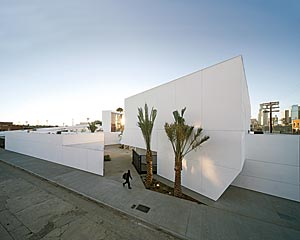

“I wanted to create a compressed urbanism,” states Michael Maltzan, FAIA, who took on the project as his first job in 1993 after leaving Frank Gehry’s office and has worked on each of the three phases since then. “The idea was to craft an urban village with a series of indoor and outdoor spaces,” explains Maltzan, who collaborated with Marmol Radziner and Associates on the first phase and with landscape architect Nancy Goslee Power and the graphic-design firm Ph.D on all three. From the beginning, the design team emphasized the visitor’s experience walking through the campus—catching partial views of a building or yard just around the corner and enjoying a range of sunny or shaded outdoor rooms.
A nonprofit organization, Inner-City Arts provides education in ceramics, visual arts, theater, dance, and animation to about 10,000 K-12 students each year from L.A. public schools and trains their teachers to teach art. The great majority of the students come from very poor families, many of whom are homeless. “Our primary goal is to increase graduation rates and keep kids in school,” says Cynthia Harnisch, president and C.E.O. of Inner-City Arts, explaining how training in art can have a profound effect on children’s lives. According to a five-year study by the U.S. Department of Education, the organization’s program indeed boosts graduation rates and improves general academic performance as well.
The project began with the organization buying an 8,000-square-foot auto-repair shop on Kohler Street in one of the worst parts of town. Maltzan and Marmol Radziner converted the building by exposing its graceful bow-string roof trusses, carving out raw spaces given character by simple materials, and opening interiors to an outdoor plaza with industrial roll-up doors [record, February 1996, page 78]. Walls along the street, a palm-dotted plaza, and a freestanding ceramics pavilion with a sculptural tower imbued the little project with a campuslike feeling. A few years later, the organization acquired an adjacent warehouse on Seventh Street and hired Maltzan to convert it into a visual arts building and develop a master plan for future growth. His plan envisioned new buildings on Seventh and Merchant Streets and a set of courtyards and paths within the confines of the complex.
Maltzan’s plan has now been realized, with Phase III opening in October. Although bigger and more sophisticated in its forms and detailing, the new construction is of one piece with the earlier work—held together by Power’s landscaping, a limited palette of white exteriors and orange accents inside, and a vocabulary of simple geometric forms spiked with the occasional iconic element. The design dates from the late 1990s, when Maltzan drew up the master plan, but he decided to stick with it. “I felt comfortable with where I had been, so I only adjusted the designs rather than start over,” he explains. The key elements of the latest phase include a performing arts building with a 99-seat black-box theater, a library/resource center, an administration building, and a new ceramics tower to go along with the existing ceramics pavilion. The campus will now be able to accommodate up to 20,000 students each year.
While the first phase emphasized security, Maltzan used the latest buildings to open the campus more to its surroundings. A large gate near the corner of Seventh and Merchant Streets and another one farther down on Merchant can swing open and provide view corridors into and from the central courtyard. “I felt it was important to create some cracks between the buildings and let the city flow in,” says Maltzan.
By filling out most of a city block and offering new entrances on Merchant Street, Phase III turns the complex’s original beachhead into a real campus. For the new administration building, the resource center, and the ceramics tower, Maltzan used steel-frame construction with pressure-treated wood joists; for the performing arts building, he used a steel frame with concrete-block infill to acoustically isolate the theater. Simple materials such as exposed-wood structural members, concrete floors, and drywall express an important message: “The materials are just as humble as those found on the street,” explains Maltzan. “It’s how you use them that counts.”
When Maltzan painted the original buildings white, he made a striking statement—marking the complex as a place of hope, a clean slate for troubled kids. Although treated with an antigraffiti coating, the buildings have rarely been defaced, says the architect. Local people have embraced the campus as a critical part of the community, and homeless men often act as unofficial crossing guards and tour guides, says Harnisch.
While the Phase III buildings mostly extend the architectural DNA of their predecessors, the new ceramics tower and an outdoor stair serve as sculptural mutations anchoring the center of the campus. Maltzan, though, makes sure these gestures also work on a practical level—wrapping one corner of the tower, for example, with a band of floor-level glass so kids can see out when they work on their small potting stools, and designing the stair’s landing as a “speaker’s platform” for public announcements and theater productions. Such concern for both the symbolic and quotidian reflects the ethos of Inner-City Arts as it helps change society one child at a time.
Looking for a reprint of this article?
From high-res PDFs to custom plaques, order your copy today!