Record Interiors 2016
The Beekman Hotel in New York City
A project of Gerner Kronick + Valcarcel and Martin Brudnizki Design Studio

Newly renovated, the atrium has a curated art program displayed in the court, honoring figures such as Edgar Allen Poe, who spoke at an earlier building on the site.
Photo © Bjorn Wallander for The Beekman

The twin-turreted office building was completed in 1883. Its skylit atrium was completely walled in, hidden for more than 60 years.
Image courtesy The Beekman

The skylit atrium was completely walled in, hidden for more than 60 years.
Photo © Teddy Wolff

Glass-enclosed bookcases screen the elevators from the main atrium, where vintage-look inlaid wood floors echo the original border pattern of the balcony floor tiles above.
Photo © Teddy Wolff
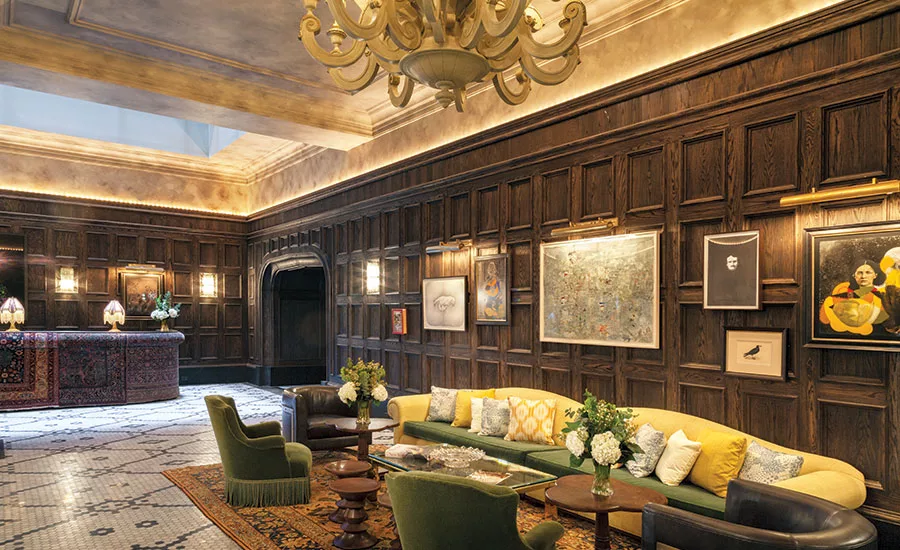
A 20-foot-long sofa is part of the lobby’s whimsical decor.
Photo © Richard Barnes

The hotel features casual sitting areas in the grand court, along with two high-end restaurants.
Photo © Bjorn Wallander for The Beekman

The guest rooms have a residential character, with stylishly mismatched yet compatible furnishings from different periods.
Photo © Richard Barnes

The newly restored elevator dials were salvaged from a building of the same era.
Photo © Teddy Wolff

The atrium balconies have original iron ceiling panels, dragon brackets, and guardrails, as well as encaustic floor tiles (partially covered here with a custom runner).
Photo © Bjorn Wallander for The Beekman

Image courtesy Gerner Kronick + Valcarcel

Image courtesy Gerner Kronick + Valcarcel

Image courtesy Gerner Kronick + Valcarcel
Buildings can hide secrets, but at the core of New York’s Temple Court was a truly spectacular one. For more than 60 years, the structure’s nine-story atrium—with ornate ironwork railings and a great pyramidal skylight—remained walled in, so completely removed from public view that most tenants were unaware of its existence. But this 19th-century office building, rechristened the Beekman, has just reopened as a hotel. And its central court has been restored and unveiled, inspiring new interior design that plays against the vintage landmark and its historical saga.
In 1883, when architect Farnsworth & Silliman completed the building, with an adjoining annex added seven years later, it ranked among Manhattan’s tallest. Twin-turreted and lavishly decorated, this nine-story proto-skyscraper at the corner of Beekman and Nassau streets was clad in brick, sandstone, and granite, combining Queen Anne, Renaissance Revival, and Neo-Grec motifs. And like Chicago’s Rookery and Los Angeles’s Bradbury buildings—its close contemporaries—Temple Court translated the indoor shopping arcade into an emerging genre: the office tower. Here, on Lower Manhattan’s booming Publishers’ Row, storefronts for lawyers, accountants, and other businesses supporting the newspaper industry were in high demand. So the design capitalized on that need by offering premium “street-front” (really atrium-front) space on nine levels, giving each office a glazed, balcony-accessed entry door and windows (in addition to exterior fenestration). But by the late 1940s, the neighborhood had declined, and fire-code changes, most likely, prompted the complete enclosure of the atrium. And so it remained, even after the exterior attained landmark status in 1998.
Meanwhile, tenancy was waning. The last remaining occupants moved out in 2001 in the wake of the 9/11 attacks—leaving Temple court vacant for more than a decade. During that time, various developers (who knew about the atrium) jockeyed to find an economically viable solution that would balance the demands for preservation and adequate revenue-generating space. Finally, in 2012, GFI Development hired Gerner Kronick + Valcarcel Architects (GKV), whose solution involved converting the existing buildings into a boutique hotel with an adjoining 51-story condominium tower. Continuous with the vintage floor plates, the new building’s lowest stories would house 80 guest rooms, giving the luxury Beekman, a Thompson Hotel, a total of 287 keys and 199,000 square feet. The tower would also hold, as GKV principal Randolph Gerner puts it, “the brains and guts” (or major mechanical units for the complex), enabling the architects to retain the original roofscape’s purity, uncompromised by equipment. “In many ways,” he muses, “Temple Court’s history reads like a romantic novel: great success at the beginning, downfall in midlife, and, finally, rebirth.”
Since the typical office size here (about 250 square feet) suited guest rooms, GKV retained that basic division. But the team relocated the main entrance to a quieter side street, leading into the annex instead of the grand court. “We didn’t want to give away the spectacular atrium so soon after you crossed the threshold,” says Gerner. “The idea was to compress and release, to delight and surprise.”
While “accidental preservation” saved the atrium, the street-level facades had seen significant alterations. GKV restored their integrity using granite from the same Maine quarry as the original. Now interior vestibules with curving glass and brass mullions lead inside.
There, a whimsical front desk—upholstered in draping antique oriental rugs—introduces the interiors strategy of Martin Brudnizki Design Studio (MBDS). “It’s playful, with a layering of materials and styles that makes the building’s rich eclecticism even more decadent,” says MBDS’s Amy Cann, who oversaw the project. The reception floors evoke the hexagonal penny-tiles so familiar in classic New York bathrooms, yet with a twist: exaggerated in scale and made of polished Carrara marble. Similarly, the lobby sofa is quasi-old-fashioned, but in bright two-toned velvet and 20 feet long, functioning socially like a communal table. Throughout the hotel, quirky fringed or tasseled Victorian furnishings, and modern riffs on them, brush against pieces from other periods. “The interiors are meant to feel as if they’d evolved like a world traveler’s home, with collections from different places and times,” explains Cann. “But we avoided nostalgia about the building’s first period,” adds MBDS principal Martin Brudnizki. “Instead, we wanted to evoke an atmosphere—a moody, sexy, partly dimly lit one, with pools of light and layering of high and low, grit and glamour, raw with polished, rough with smooth.”
Architectural feats make it all appear effortless. Though only the facades were landmarked, the owners obtained a tax credit for the building’s preservation, including its interiors. GKV’s restoration is faithful, with modern systems threading imperceptibly behind patinaed surfaces. “But where elements were completely missing, we didn’t try to replicate them,” says Gerner, who worked with preservationists Higgins Quasebarth & Partners and restorers from EverGreene. “Instead, we replaced them with modern interpretations that honor the design intent.” So etched glass panels—patterned like the 1880s ironwork—border a long stretch where balcony guardrails were absent. But where the decorative encaustic floor tiles merely needed patching, the team matched existing ones.
The atrium once had interior storefronts flanking it at grade. While the space is more dramatic without them, floor inlays now acknowledge the missing walls. Two high-end restaurants will open in the hotel, one with a long bar within this soaring gathering space.
But if fire-safety standards once closed the court, they needed to be addressed now. GKV’s solution included an automatically deployed system of glass-fiber smoke curtains surrounding the central space, coatings over the ironwork, and extensive sprinklers.
Upstairs, the balconies regained the original rhythm of mahogany-framed doors and windows. But adapted to hotel needs, those illuminated windows are now blind, backed with fire-rated partitions, and the mahogany-veneer doors are solid wood, without translucent glass panes. Inside, MBDS gave the rooms and suites an intentionally residential feel, stylishly mismatching lamps, bedside tables, and chairs. In the twin turrets, duplex penthouse suites with private outdoor spaces await completion.
In the thick of Manhattan, this extraordinary building’s dormancy seems unimaginable. But its tale parallels the district’s vagaries. The newspaper companies decamped long ago (and many are now defunct). Decades later, the 9/11 attacks took a toll here. But the neighborhood is making a comeback—and through all the changes Temple Court has seen, its long narrative lives on in its latest incarnation.
PeopleArchitect: Gerner Kronick + Valcarcel, Architects, DPC
Personnel in architect's firm who should receive special credit: Randolph Gerner, AIA - Design Principal
Architect of record: GKV
Interior designer: Martin Brudnizki Design Studio Martin Brudnizki
Consultants Lighting Design: Brian Orter Lighting Design, LLC
General contractor: Broadway Construction Group LLC |
ProductsStructural System New Building: Cast in place concrete Manufacturer of any structural components unique to this project: Exterior Cladding Masonry: Existing Building: Deer Isle Granite base, Philadelphia Red Brick ornamented with tan dorchester and unglazed terra cotta Metal panels: Perforated metal panels in between the X-Bracing custom by Crowne Architectural Systems Curtain wall: New Building: Window wall system by Wausau Roofing Built-up roofing: Siplast IRMA Roof Tile/shingles: Existing Building: Restoration of Slate shingles at Mansard and Turret Roof by Smith Restoration Inc., Zalmag panels at stair and elevator bulkhead Windows Wood frame: Existing Building: Single hung wood frame windows by Caoba Metal frame: Existing Building: Lightwell aluminium windows by Quaker Glazing Skylights: Existing Building: Existing skylight restored by Smith Restoration Inc. Doors Entrances: Custom by INA Building Shop Inc. Metal doors: Custom by INA Building Shop Inc. Wood doors: Maiman custom doors natural wood and painted some fire-rated Sliding doors: Wood barn doors by Ecco Doors LLC Fire-control doors, security grilles: Smoke Curtain by US Smoke and Fire Hardware Locksets: Hotel Doors: VingCard System (Assa Abloy) Closers: Norton Other special hardware: Besam operator for 1st floor select windows and doors tied to fire alarm and used as smoke exhaust Interior Finishes Demountable partitions: Custom by INA Building Shop Inc. Cabinetwork and custom woodwork: Atrium: Millwork by Trim Master Builders Inc. Paints and stains: Atrium: Specialty Paint Finishes by Evergreen Architectural Arts Wall coverings: Robert Allen, Stark Paneling: Wood Paneling by Trim Master Builders Carpet: ABC Carpets, Brintons Furnishings Reception furniture: A mixture of bespoke, McClaren and Credible Upholstery Tables: A mixture of bespoke, McClaren and Credible Upholstery Upholstery: A mixture of bespoke, McClaren and Credible Upholstery Lighting Interior ambient lighting: iWorks, Chelsom |
Looking for a reprint of this article?
From high-res PDFs to custom plaques, order your copy today!