Architectural Record
search
cart
facebook twitter linkedin youtube
  • Sign In
  • Subscribe
  • Sign Out
  • My Account
Architectural Record
  • NEWS
    • Latest News
    • Awards
    • Interviews
    • Obituaries
    • Podcasts
      • Design:Ed Podcast
      • Sponsored Podcasts
  • OPINION
    • Book Reviews / Excerpts
    • Exhibition Reviews
    • Forum
  • EXCLUSIVES
    • Videos
    • Design Vanguard
    • Top 300 Firms
    • Sponsored Content
    • Sponsored eBooks
    • From the Archives
  • CONTINUING ED
    • Editorial Continuing Ed
    • CE Center
    • CE Academies
  • PROJECTS
    • Buildings By Type
    • Reuse & Renovation
    • Museums & Arts Centers
    • Colleges & Universities
    • Multifamily Housing
    • Interiors
    • Lighting
    • Kitchen & Bath
  • HOUSES
    • Record Houses
    • House of the Month
    • Featured Houses
  • PRODUCTS
    • Products by Category
    • Record Products of the Year
    • Latest Products
  • EVENTS
    • Dates & Events
    • Record on the Road
    • Innovation Conference
    • Sustainability in Practice
    • Women In Architecture
    • Webinars
    • Ad Excellence Awards
    • Submit an Event
  • CONNECT
    • Ask RECORD AI
    • Newsletters
    • Contact
    • Advertise
    • Editorial Calendar
    • Store
    • Customer Service
  • SUBMIT
    • Submission Guidelines
    • RECORD Competitions
  • MAGAZINE
    • Subscribe
    • My Account
    • Digital Edition
    • Current Issue
    • Firm Pass
    • Historic Archive
Architecture News

240 Central Park South Completes Columbus Circle
By Stephen Zacks
240 Central Park

Photo courtesy Douglas J. Lister, Architect
240 Central Park

Photo © Mark Dye

240 Central Park

Photo © Mark Dye

240 Central Park

Photo courtesy Douglas J. Lister, Architect
240 Central Park

Photo © Trix Rosen

240 Central Park

Image courtesy 240 Central Park South 

240 Central Park
240 Central Park
240 Central Park
240 Central Park
240 Central Park
240 Central Park
June 1, 2009

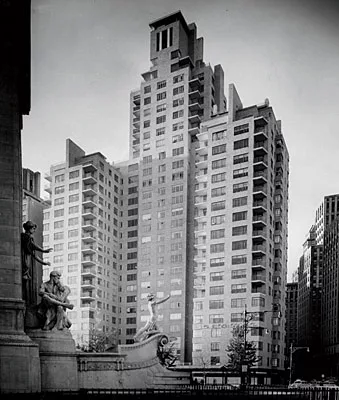
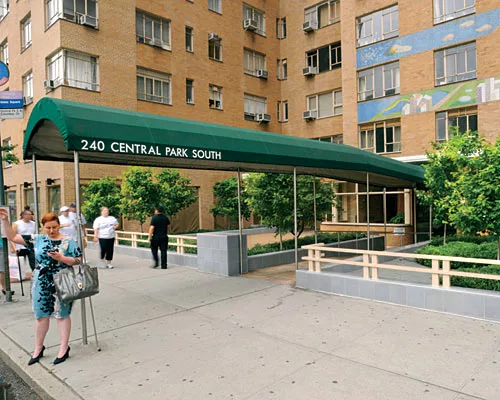
It was state-of-the-art green architecture before the term was coined: a 325-unit luxury apartment building across from Manhattan’s Central Park occupying less than half of its site and punched with planters meant to extend the foliage of the park into the high-density development. Completed in 1940 by Albert Mayer and Julian Whittlesey—known for Modern, middle-class apartments that self-consciously vied with the emergence of suburban housing—240 Central Park South featured two towers (the larger one arranged in a horseshoe plan to maximize airflow and views), cantilevered balconies, and generous steel casement windows to reinforce a connection to the landscaped pathways, fields, and ponds across the street.

Over the years, everyone from Lewis Mumford to Robert Stern had praised the building as one of the period’s best examples of high-density housing [record, January 1941, page 68]. In 2002—a year before the competition to renovate Edward Durell Stone’s 2 Columbus Circle made the area a preservationist battleground—it was designated a New York City landmark. Today, 240 Central Park South is the only fully restored landmark on Columbus Circle, and with the help of an artfully landscaped green roof by Balmori Associates and some loving updates by architect Douglas J. Lister, its ideas remain as current as when it was built.

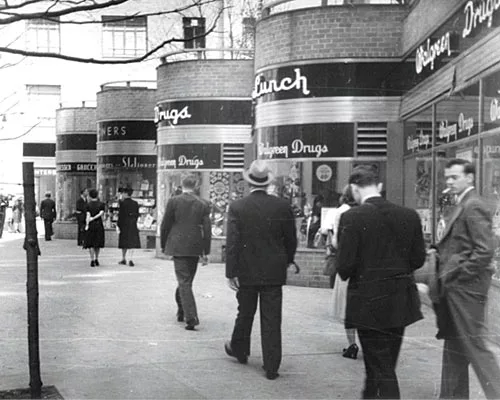
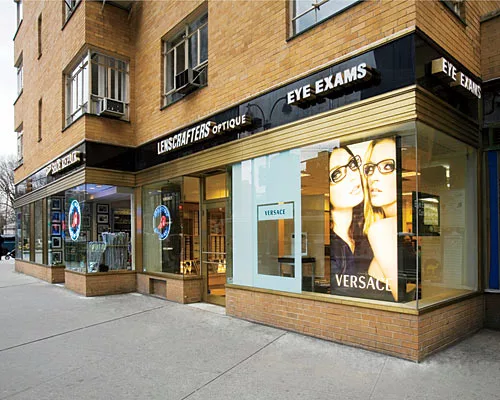
When Lister was hired in 2001, the yellowish-orange brick facade had been badly discolored by previous waterproofing efforts, and he quietly began working with the original manufacturer, Belden Brick, to match the former bright hues of the brick. They spent a year calibrating current gas-fired technologies to allow for the color variations that coal-fired factories once produced, eventually reskinning much of the towers’ main facades. Lister also had to upgrade electrical service to the apartments to accommodate today’s IT needs, running new lines through hallways and decorating them with historic Art Deco carpet patterns. On the street level, Bronx-based Diversified Glass replaced the custom-fabricated curving storefronts projecting onto Broadway with a thicker, more resilient black spandrel glass and substituted white LEDs above the bronze sign-bands for the original neon tubes.

But the biggest chance for a contemporary upgrade was on the ground-floor rooftops, where gigantic planters above the storefronts expressed the original marketing motto of the building, “Where the Park is Part of the Plan.” The roof was engineered to support an ample load of 150 pounds per square foot—four to six times the strength required for most green-roof installations—but over the years, ginkgo trees in the planters had grown to a height of 30 feet and overwhelmed the structure. The repair became an opportunity to introduce a true green-roof system that would absorb rainwater, reduce heat, and provide an aesthetic boost to residents.

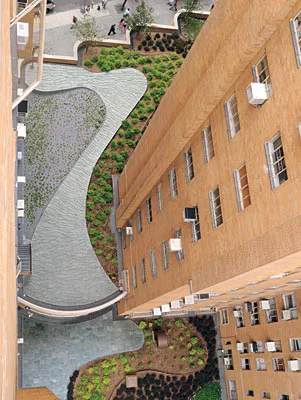
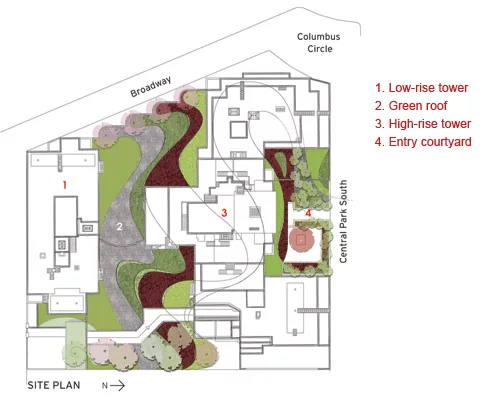
Balmori composed a three-dimensional rolling landscape of barbary, spirea, and slate quarried upstate, using polystyrene foam underneath the drainage mat and soil layer to vary its slope. The rooftop is not accessible to residents, but from the towers it appears as gently curling bands of green, purple, and gray that form continuous swaths across several levels of the building and extend into the courtyard. In place of the hardy ginkgoes, cherry trees in the curved bastions above the storefronts connect the rooftop landscape to the street, supplemented by a garden at the entrance featuring red and Japanese maples.

Preserving the building while reconciling it with contemporary standards is an ongoing project: Lister is currently studying how to improve its mechanical systems to reduce energy consumption. The owners also plan to eventually replace the steel casement windows with better-insulated replicas, which would vastly improve the building’s efficiency—a process delayed by the need to do in-frame rather than the more ideal brick-to-brick installation, difficult when a building is occupied. For now, its restoration is a great reference point for condo designers and advocates of sustainability alike, currently squaring off over what architecture should look like in a period of economic retrenchment.

Looking for quick answers on architecture and design topics?
Try Ask RECORD, our new smart AI search tool.
Ask RECORD →

KEYWORDS: historic preservation

Share This Story

Looking for a reprint of this article?
From high-res PDFs to custom plaques, order your copy today!

Post a comment to this article

Report Abusive Comment

Subscription Center
  • Create an Account
  • Start a Subscription
  • Manage My Account
  • Sign Up for Newsletters
  • Visit Customer Service
  • Update Preferences

More Videos

Sponsored Content

Sponsored Content is a special paid section where industry companies provide high quality, objective, non-commercial content around topics of interest to the Architectural Record audience. All Sponsored Content is supplied by the advertising company and any opinions expressed in this article are those of the author and not necessarily reflect the views of Architectural Record or its parent company, BNP Media. Interested in participating in our Sponsored Content section? Contact your local rep!

close
  • TAMLYN XtremeTrim Exterior Trim
    Sponsored byTamlyn

    Designing Cleaner Panel Facades: Why Exterior Trim Details Matter

  • Building with Vapor Barriers
    Sponsored byReef Industries, Inc.

    Vapor Barriers Help Control Moisture in Tighter Building Designs

  • Duct Interior with Prodeq System
    Sponsored byHenry, a Carlisle Company

    Designing Resilient Water Containment Systems

DESIGN:ED Podcast
Listen to Architectural Record’s DESIGN:ED Podcast

Events

June 10, 2026

Rethinking Stormwater – The Power of Porous Paving

Credits: 1 AIA LU/HSW; 1 AIBD P-CE; 0.1 ICC CEU

Learn how porous paving systems support stormwater management, reduce heat island effects, and enhance sustainable site design performance.

June 11, 2026

Very Early Warning Fire Detection for Mission-Critical Facilities

Credits: 1 AIA LU/HSW; 1 AIBD P-CE; 0.1 ICC CEU

Examine advanced fire detection strategies that support uptime and enhance safety in data centers and other mission-critical facilities.

View All Submit An Event

Products

2026 Architect's Square Foot Costbook

2026 Architect's Square Foot Costbook

See More Products

Popular Stories

Practice Matters illustration

What’s in a (Firm’s) Name? Thinking About Succession and Legacy

Coronado Bridge

The Architect’s Guide to San Diego

Practice Matters illustration

By the Numbers: Counting America's Architects

House on a Hill

Design Vanguard 2026: Forma

Crane Cove, ONO

Design Vanguard 2026 Winners

Broader Sustainability of CMU - Free Webinar - May 21, 2026

Related Articles

  • In Manhattan, a Bittersweet Grand Opening at Columbus Circle

    See More
  • Community Forum Questions Crop of Tall Buildings Around Central Park

    See More
  • One Central Park

    See More

Related Products

See More Products
  • Architectural Record - August 2025

    Architectural Record August 2025 Issue

See More Products
×

The latest news and information

#1 Source for Architectural Design, News and Products

SUBSCRIBE
  • RESOURCES
    • Advertise
    • Contact Us
    • Submit
    • Store
  • ACCOUNT CENTER
    • Create an Account
    • Start a Subscription
    • Manage My Account
    • Sign Up for Newsletters
    • Visit Customer Service
    • Update Preferences
  • PRIVACY
    • PRIVACY POLICY
    • TERMS & CONDITIONS
    • DO NOT SELL MY PERSONAL INFORMATION
    • PRIVACY REQUEST
    • ACCESSIBILITY
  • SERVICES
    • Marketing Services
    • Reprints
    • Market Research
    • List Rental
    • Survey/Respondent Access
  • STAY CONNECTED
    • Linkedin
    • Facebook
    • Instagram
    • YouTube
    • X (Twitter)

Copyright ©2026. All Rights Reserved BNP Media, Inc. and BNP Media II, LLC.

Design, CMS, Hosting & Web Development :: ePublishing