Maslak Tower No. 1 by Emre Arolat Architecture
Istanbul

Mies van der Rohe’s early, unbuilt skyscraper designs, including his curvilinear one of 1922, continue to influence architects today. The 20-story Maslak Tower No. 1 in Istanbul renders the modernist prototype in fritted and clear glass.
Photo © Thomas Mayer

Its biomorphic outer wall is connected to the interior concrete-and-glass curtain wall structure by an exoskeleton of steel and curving beams.
Photo © Thomas Mayer

At the ground level, the void between the exterior and interior enclosures provides space for the entrance lobby.
Photo © Thomas Mayer

Spaces between the fins allow air to enter the void located between the outer skin and the interior concrete structure.
Photo © Thomas Mayer

The exterior facade’s overlapping fish scale–like cladding covers the curvilinear facade.
Photo © Thomas Mayer

The offices within the concrete-and-glass inner structure open into the void.
Photo © Thomas Mayer

Offices are fitted with operable windows for natural ventilation.
Photo © Thomas Mayer

This space also allows for a café off the lobby.
Photo © Thomas Mayer

The interior is not revealed on the outside, which is enclosed with fritted and transparent glass.
Photo © Thomas Mayer

Image courtesy Emre Arolat Architecture

Image courtesy Emre Arolat Architecture

Image courtesy Emre Arolat Architecture
Architects & Firms
Jump to credits & specifications
Sidebar: A Thicker Skin
“The client was looking for an extravaganza, something distinct from the others,” Arolat says, “but the business partners didn’t have a site on which it was possible to do a grandiose or powerful-looking building. I told them that it’s not easy, when everyone is shouting, to make yourself heard. To distinguish oneself, it’s better to be very, very quiet.” It turned out that, although regulations restricted the building’s floor area, there was no limitation on the volume of the building. “We realized that if we created a void inside, it wouldn’t count in the regulation’s numbers,” explains Arolat’s partner, Gonca Paşolar, “but the building would look much bigger than it really was.”
The architects decided to build a rather ordinary, inexpensive, reinforced- concrete building with a double-glazed curtain wall inside an outer, strikingly unique, curvilinear facade. This facade would have overlapping laminated, fritted, and clear glass panels. Its undulating exterior wall stands apart from the basic inner box for office space, so that an airy void is created between the two. This peripheral interior space contains 66-foot-high vertical gardens facing southeast with planters on every fourth floor, and metal grate walkways on the north, which can be accessed by the occupants. The void has its own natural microclimate: it is warmer in winter and cooler in summer, providing ventilation and lower energy consumption while filtering light, cutting street noise by 70 percent, and shielding the offices from wind and dust.
The biomorphic facade hides an explicitly industrial exoskeleton that anchors the outer skin to the inner structure. The architects left these columns and curving beams exposed within the cavity to preserve sight lines from the ground to the roof.
The building’s spatter-shaped plan consists of 12 folds or extrusions from the face of the building that generate a variety of views in and out. “There are very fast roads around the building,” Arolat says, “so when you see it, it always appears at a different angle and in a different color or light.”
Security is a priority in Istanbul, where political coups, shootings, and bombings occur, and new sections of the city are characterized by gated communities. One of the resulting failings of Maslak’s neighborhood is its lack of public or green space. Access, controlled by guards and X-ray monitors, is limited to employees, which makes the ground floor of most towers impermeable. To mix security and porosity, exclusivity and inclusivity, Arolat designed indoor and outdoor spaces for a café (called Prototype No. 1) at street level. Only employees can enter upper floors—there are no floor-selection buttons in the elevators because staff IDs admit them only to the levels they work on—but the eatery is open to any passerby.
And that, not coincidentally, is where the void begins. Those sitting on the café’s island-like inner terrace, surrounded by a shallow pool of water and its reflections, can look up through the building’s industrial filigree and feel the sun filtering through onto their faces. Not far from security, it is a manifestly peaceful space.
Back to Continuing Education: Tall Buildings
Looking for quick answers on architecture and design topics?
Try Ask RECORD, our new smart AI search tool.
Ask RECORD →
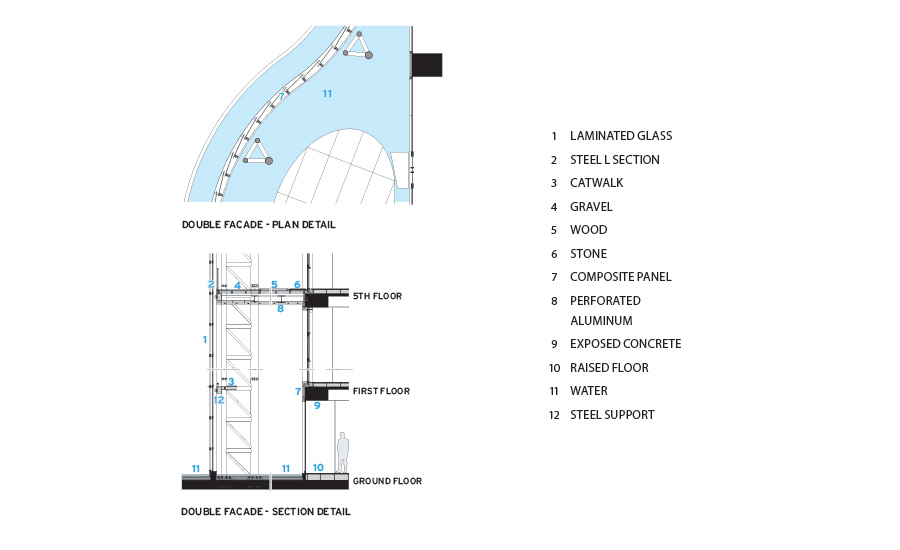
To create the outer skin, data describing the climatic conditions affecting the tower were modeled in three dimensions. The resulting curvilinear facade is comprised of 3,792 rectangular, tempered, laminated-glass modules that are 43 inches wide by 52 inches high, spaced 4 inches apart. Those on the west and south facades are fritted with translucent enamel in various opacities and mapped strategically onto the building. The inner skin is insulated glass with a low-E coating. The outer facade is anchored to the inner building’s structure at every fourth floor, creating levels with vertical “gardens” on the southeast—though these are just a few large planters and can only be accessed by opening interior windows. On the north face, however, employees can open glass doors onto metal-grate walkways that extend the length of every floor and provide lounges. To connect the outer glass skin to the concrete building, structural engineer Altineller used three-dimensional vertical trusses on the wider facades facing north. These are the ones fastened to the main structure every fourth floor via a 27-by-27-foot grid of steel beams. The trusses support curving steel beams— dubbed “snail beams.” They follow the form of the undulating outer skin, resting on steel supports that coincide with every glass module. Each of these modules are attached to the inner building by four steel U-profiles. The exposed structure keeps sight lines open. Arolat says, “I consider the structural engineer one of the architects of this building.”
CreditsArchitect: Emre Arolat, EAA – Emre Arolat Architecture, Nispetiye Mah. Aytar Cad. No:24 Kat: 3-4, 1. Levent 34340, Istanbul, Turkey, http://www.emrearolat.com
Personnel in architect's firm who should receive special credit: Deniz Kösemen
Architect of record: Emre Arolat
Interior designer: EAA – Emre Arolat Architecture (Common Spaces; Entrance Hall & Circulation Areas)
Engineers: Electrical: Aykar Engineering Mechanical: Tanrivoer Engineering Structural: Altineller Engineering Landscape: Marka Interior and Landscape Consultants Fire safety: Prof. Dr. Abdurrahman Kiliç, Istanbul Technical University, Faculty of Mechanical Engineering Facade system: CWG Consultancy
General contractor: Alsar Reic
Photographer: Thomas Mayer
|
SpecificationsStructural System Manufacturer of any structural components unique to this project: Exterior Cladding Masonry: Aerated concrete building blocks: Nuh Gzebeton Company Metal panels: Erbay Aluminum Metal/glass curtain wall: Erbay Aluminum Rainscreen: Erbay Aluminum Precast concrete: Boğaziçi Concrete Roofing Elastomeric: BASF Polyrea: Detay Yapi Windows Metal frame: Schüco: Erbay Aluminum Glazing Glass: Laminated Glass & Tempered Glass: Trakya Glass Doors Entrances: Automatic swing doors: Dorma Metal doors: Doorataur Fire-control doors, security grilles: Doorataur Hardware Locksets: Dorma Closers: Dorma Exit devices: Dorma Pulls: Dorma Security devices: Dorma Interior Finishes Paints and stains: Filli Boya (Betek Boya Kimya ve Sanayi A.Ş.) Wall coverings: Painted glass panel & stainless steel: Mot Design Floor and wall tile: Natural Stone - Basalt Raised flooring: Calcium sulphate access flooring sytem: Altay Group Furnishings Reception furniture: Nurus Lighting Exterior: Fiberli Lighting Conveyance Elevators/escalators: Otis Elevator Plumbing: Vitra Energy Energy management or building automation system: Matriks Other unique products that contribute to sustainability: Main volumetric composition of the building depends on a simple reinforced concrete office block and a porous envelope that controls the general climate of the building. While letting air flow through the glass panels arranged as fish-scale, the envelope filters direct effects of the climate. The in-between buffer zone provided the design of the office framing dependent on simplest parameters technically; low wind loads and least amount of UV control. The envelope also provides acoustic comfort, made natural ventilation possible at suitable seasons by operable windows which also decrease the sense of working in a plaza effect on employees. The existence and density of the dots on the film coating on these glass panels are designed parametrically according to the movement of the sun in order to decrease solar gain and to provide shade control while at the same time letting panoramas at eye level. |
Looking for a reprint of this article?
From high-res PDFs to custom plaques, order your copy today!