Architectural Record
search
cart
facebook twitter linkedin youtube
  • Sign In
  • Subscribe
  • Sign Out
  • My Account
Architectural Record
  • NEWS
    • Latest News
    • Awards
    • Interviews
    • Obituaries
    • Podcasts
      • Design:Ed Podcast
      • Sponsored Podcasts
  • OPINION
    • Book Reviews / Excerpts
    • Exhibition Reviews
    • Forum
  • EXCLUSIVES
    • Videos
    • Design Vanguard
    • Top 300 Firms
    • Sponsored Content
    • Sponsored eBooks
    • From the Archives
  • CONTINUING ED
    • Editorial Continuing Ed
    • CE Center
    • CE Academies
  • PROJECTS
    • Buildings By Type
    • Reuse & Renovation
    • Museums & Arts Centers
    • Colleges & Universities
    • Multifamily Housing
    • Interiors
    • Lighting
    • Kitchen & Bath
  • HOUSES
    • Record Houses
    • House of the Month
    • Featured Houses
  • PRODUCTS
    • Products by Category
    • Record Products of the Year
    • Latest Products
  • EVENTS
    • Dates & Events
    • Record on the Road
    • Innovation Conference
    • Sustainability in Practice
    • Women In Architecture
    • Webinars
    • Ad Excellence Awards
    • Submit an Event
  • CONNECT
    • Ask RECORD AI
    • Newsletters
    • Contact
    • Advertise
    • Editorial Calendar
    • Store
    • Customer Service
  • SUBMIT
    • Submission Guidelines
    • RECORD Competitions
  • MAGAZINE
    • Subscribe
    • My Account
    • Digital Edition
    • Current Issue
    • Firm Pass
    • Historic Archive
SNAP

The Big Breezy

By Braulio Agnese
The Big Breezy

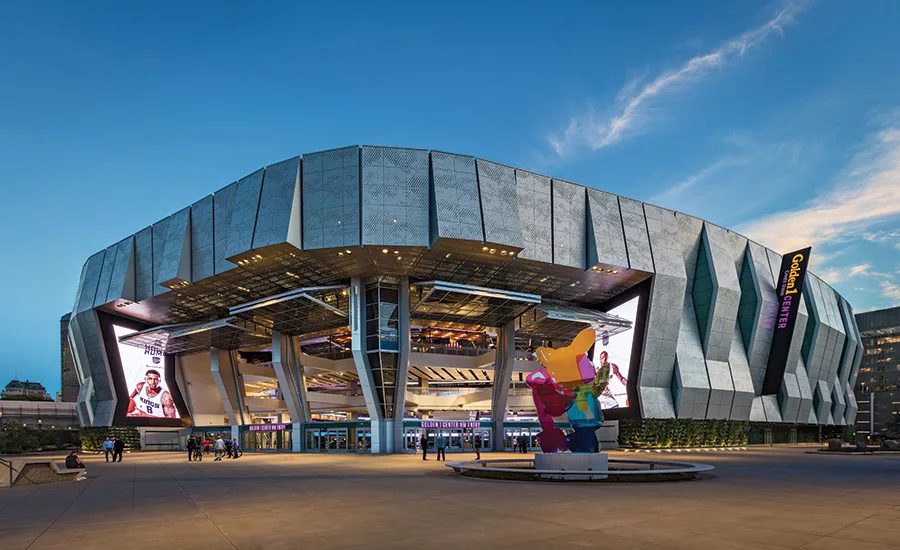
Schweiss developed five custom canted doors to allow for natural ventilation at the LEED Platinum Golden 1 Center arena in Sacramento, California.

Photo © Sharrin Rees

March 1, 2017

Sacramento, California, benefits from a temperate cli­mate that encourages outdoor living. Expansive, operable openings are common in the buildings and homes as everyone—the local NBA team included—wants to take advantage of the region’s cooling Delta Breeze. To that end, design and engineering firm AECOM added five lift-strap bifold doors from Schweiss to the primary entrance of Golden 1 Center, a 17,500-seat arena that serves as the home base of the Golden State Warriors.

Sidebar: A Different Shade

Each door weighs about 28,000 pounds and measures 41 1⁄2 feet high by at least 29 feet wide. Three lean from the build­ing at an 11-degree angle, allowing them to provide shade and prevent glare. When closed, the doors don’t reach the ground; rather, they sit atop a permanent, conventionally scaled turnstile entryway system.

Figuring out how to produce the canted doors required eight months of effort and numerous customizations.

Where openings of this size would normally require at least 10 straps per door, the architects insisted on only five, says Schweiss owner Mike Schweiss. The client also requested that the fasteners be spaced so they would disappear behind the doors’ vertical mullions when viewed from the exterior. To achieve both aims, the fabricators extended the straps to six inches—double the normal size—and reengineered the lift widgetry to accommodate the larger spans. Glaziers Bagatelos Architectural Glass also added a three-inch-deep aluminum curtain wall to accommodate the doors’ massive expanses of steel-tube framing.

The copious light, fresh air, and natural cooling provided by the Schweiss entryways are some of many reasons that Golden 1 received a LEED Platinum rating, a first for an enclosed arena. Says Schweiss of the project: “It took us out of our comfort zone and tested us in every which way.”


A Different Shade
The Big Breezy

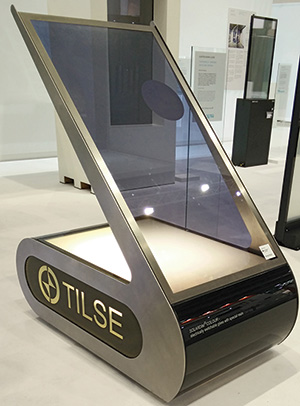
Germany’s Fraunhofer Institute of Polymer Research worked with yacht glazing specialist Tilse Formglas to develop a method of producing electro-chromic glass that allows for pane colors other than the standard blue.

Photo © Fraunhofer IAP

Looking for quick answers on architecture and design topics?
Try Ask RECORD, our new smart AI search tool.
Ask RECORD →

Electrochromic glass is a modern marvel. It goes from translucent to opaque when a charge is added, offering privacy and minimizing solar heat gain, thus eliminating the need for blinds or drapes. This optic effect has historically been created by coating two panes with tin oxide—which makes the glass electrically conductive—and then adding a layer of tung­­- sten oxide to one of them. When voltage is applied, the oxide’s ions undergo a chemical reaction, temporarily turning dark blue. Since tungsten is always used, all activated electrochromic glass is blue. But that might soon change.

In early January, Germany’s Fraunhofer Institute for Applied Polymer Research (Fraunhofer IAP) announced a manufacturing method for electrochromic glass that could allow for multiple color options. The new process replaces the reactive oxide coating with a mixture of organic monomers, resin, and electrochromic molecules. Alter the par­tic­ular monomer, the researchers discovered, and you alter the color of the glass.

Monomers have advantages beyond aesthetics. According to Fraunhofer IAP scientist Volker Eberhardt, they require less energy than oxides to react; their reaction time is also up to 30 times faster. (This new process turns a 13-square-foot pane of glass totally dark in 20 to 30 seconds, rather than the 10 minutes it now takes.) Furthermore, the resin fortifies the electrochromic glass, making it sturdier than current iterations. “A pane comprising just two layers can be used as overhead glazing or in surfaces meant to be walked upon,” says Eberhardt of the new formulation, noting it now takes three or four panes to achieve similar strength. Using less material means cost savings. That’s some shady business we all can get behind. —BA

Share This Story

Looking for a reprint of this article?
From high-res PDFs to custom plaques, order your copy today!

Post a comment to this article

Report Abusive Comment

Subscription Center
  • Create an Account
  • Start a Subscription
  • Manage My Account
  • Sign Up for Newsletters
  • Visit Customer Service
  • Update Preferences

More Videos

Sponsored Content

Sponsored Content is a special paid section where industry companies provide high quality, objective, non-commercial content around topics of interest to the Architectural Record audience. All Sponsored Content is supplied by the advertising company and any opinions expressed in this article are those of the author and not necessarily reflect the views of Architectural Record or its parent company, BNP Media. Interested in participating in our Sponsored Content section? Contact your local rep!

close
  • TAMLYN XtremeTrim Exterior Trim
    Sponsored byTamlyn

    Designing Cleaner Panel Facades: Why Exterior Trim Details Matter

  • Building with Vapor Barriers
    Sponsored byReef Industries, Inc.

    Vapor Barriers Help Control Moisture in Tighter Building Designs

  • Duct Interior with Prodeq System
    Sponsored byHenry, a Carlisle Company

    Designing Resilient Water Containment Systems

DESIGN:ED Podcast
Listen to Architectural Record’s DESIGN:ED Podcast

Events

June 10, 2026

Rethinking Stormwater – The Power of Porous Paving

Credits: 1 AIA LU/HSW; 1 AIBD P-CE; 0.1 ICC CEU

Learn how porous paving systems support stormwater management, reduce heat island effects, and enhance sustainable site design performance.

June 11, 2026

Very Early Warning Fire Detection for Mission-Critical Facilities

Credits: 1 AIA LU/HSW; 1 AIBD P-CE; 0.1 ICC CEU

Examine advanced fire detection strategies that support uptime and enhance safety in data centers and other mission-critical facilities.

View All Submit An Event

Products

2026 Architect's Square Foot Costbook

2026 Architect's Square Foot Costbook

See More Products

Popular Stories

Practice Matters illustration

What’s in a (Firm’s) Name? Thinking About Succession and Legacy

Practice Matters illustration

By the Numbers: Counting America's Architects

House on a Hill

Design Vanguard 2026: Forma

Crane Cove, ONO

Design Vanguard 2026 Winners

KRESA by DLR

In Kalamazoo, DLR Group Completes a Mass-Timber Hub for Career and Technical Education Programs

Broader Sustainability of CMU - Free Webinar - May 21, 2026

Related Articles

  • Middle East Airport.

    Continuing Education: The Big Carbon Drawdown and Negative Emissions

    See More
  • The Big Squeeze

    See More

Related Products

See More Products
  • Architectural Record - October 2025

    Architectural Record October 2025 Issue

See More Products
×

The latest news and information

#1 Source for Architectural Design, News and Products

SUBSCRIBE
  • RESOURCES
    • Advertise
    • Contact Us
    • Submit
    • Store
  • ACCOUNT CENTER
    • Create an Account
    • Start a Subscription
    • Manage My Account
    • Sign Up for Newsletters
    • Visit Customer Service
    • Update Preferences
  • PRIVACY
    • PRIVACY POLICY
    • TERMS & CONDITIONS
    • DO NOT SELL MY PERSONAL INFORMATION
    • PRIVACY REQUEST
    • ACCESSIBILITY
  • SERVICES
    • Marketing Services
    • Reprints
    • Market Research
    • List Rental
    • Survey/Respondent Access
  • STAY CONNECTED
    • Linkedin
    • Facebook
    • Instagram
    • YouTube
    • X (Twitter)

Copyright ©2026. All Rights Reserved BNP Media, Inc. and BNP Media II, LLC.

Design, CMS, Hosting & Web Development :: ePublishing