Commentary: If We Act Together Now, We Change the World
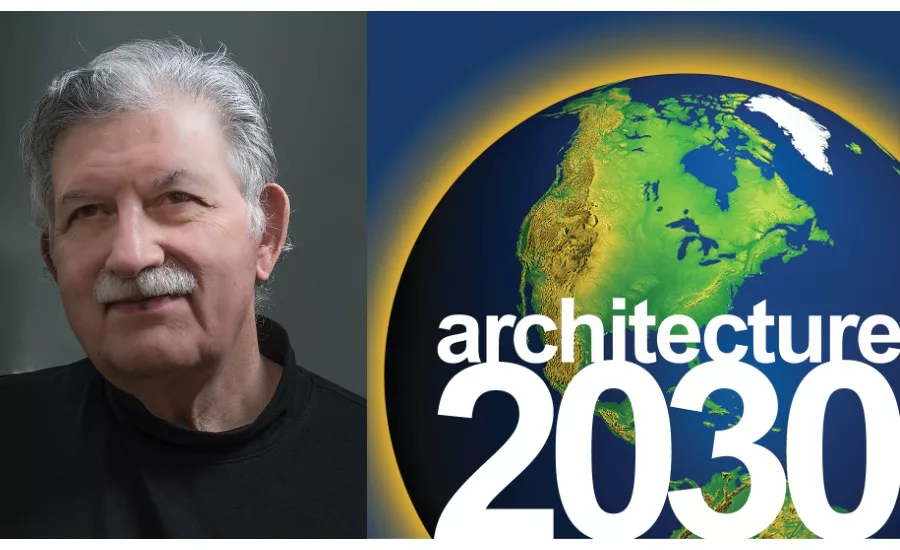
Photo of Edward Mazria © Roberto E. Rosales
Editor's note: Edward Mazria, founder of nonprofit organization Architecture 2030 and recipient of the AIA's 2021 Gold Medal, has penned an open letter urging designers to cut carbon in response to the Intergovernmental Panel on Climate Change (IPCC)'s recent 6th Assessment report on climate science.
“The time for half measures and outdated targets is over if we are to stop the irreparable destruction of our cities, towns, and natural environments," Mazria tells RECORD. "How difficult is designing to zero carbon? Not difficult at all. Here are the three steps to a zero carbon built environment.”
Read Mazria's full letter below:
Architecture 2030 is calling on all architects, planners, engineers, and those responsible for designing and constructing the built environment worldwide, to design all new buildings, renovations, landscapes, cityscapes, and infrastructure to be zero carbon beginning right now.
If we act together today, we prevent the worst effects of climate change. Our calling is, and has always been, to make the world a better place. Now we get the chance to do it on a global scale and help protect life on the planet.
Almost 15 years ago, in 2007, I was sitting next to Dr. James Hansen at the Architecture 2030 Global Emergency Teach-in and asked him, “When will we begin to see the actual effects of global warming?” He leaned over and whispered, “At about 1oC warming”. Today, I checked NASA’s “Vital Signs of the Planet” website and sure enough, the planet is currently at 1.02oC warming above pre-industrial levels.
As I write this, the IPCC just released an alarming report on the state of the climate crisis, and brutal heat waves, droughts, deadly flooding, and fires are shattering records all over the planet and currently ravaging Europe, North America, China, and India—the regions currently responsible for 58% of all global CO2 emissions. These events have driven home two essential facts: we’re all in this together and must all act quickly and boldly. The time for half measures and outdated timelines is over if we are to prevent irreparable destruction of our cities, towns, and natural environments.
As architects and design professionals, we have a unique and critically important role to play. Buildings alone account for about 40% of total annual global CO2 emissions, and with building interiors, sitework, landscapes, cityscapes, and infrastructure, that percentage is much, much greater. If the world is to meet the 1.5oC carbon budget set out in the Paris Agreement, our community must provide the leadership necessary and reduce CO2 emissions in the entire built environment by 65% by 2030 and to zero by 2040.
Looking for quick answers on architecture and design topics?
Try Ask RECORD, our new smart AI search tool.
Ask RECORD →
We directly shape and influence the built environment worldwide and are the one industry across all political and geographic boundaries with the design and planning freedom to affect global emissions immediately. In other words, we can decide to design and build to zero carbon today.
How difficult is it to design to zero carbon? Not difficult at all.
ZERO Carbon in Three Steps:
1. DESIGN TO THE LATEST CODE STANDARDS
Design all new buildings, major renovations, and developments to the most current energy code standards – ASHRAE 90.1 2019 and IECC 2021, their equivalent, or better. In other words, design energy efficient buildings that use little energy to operate.
Local building energy codes only set minimum energy efficiency requirements and do not prevent architects, engineers and building sector professionals from designing to the most current code standards or producing energy efficient buildings.
Designing to current standards has several advantages – they are evaluated to be cost effective, reduce occupant energy burdens, and include ready-to-use energy modeling compliance tools, checklists, and trade-off options such as COMcheck and REScheck. In the developing world, free EDGE software can be used to design energy-efficient commercial or residential buildings in over 160 countries. EDGE will pinpoint least-cost options, calculate utility savings, payback periods, and a building’s carbon footprint.
2. DESIGN ALL-ELECTRIC + RENEWABLES
Design all new buildings, major renovations, and developments to use no on-site fossil fuels – no gas, oil, or propane – and to be 100% powered by on-site and/or new off-site renewable energy.
Burning fossil fuels directly in buildings accounts for about 5.4% of total worldwide greenhouse gas emissions, and burning gas, oil, and propane in buildings accounts for 35% percent of all U.S. building sector CO2 emissions. To meet the 1.5oC carbon budget, buildings must be designed all-electric, with the electricity supplied by on-site and/or new off-site renewable energy (see the Zero Code and 2021 IECC Zero Code Appendix). The health, economic, and environmental benefits of all-electric buildings are well documented. This will also further lay the groundwork for new renewables to decarbonize the power sector and, in turn, the existing building sector.
3. ZERO OUT EMBODIED CARBON
While steps #1 and #2 will produce zero-carbon building operations, it is also critical that we confront the embodied carbon of construction and building materials if we hope to phase out CO2 emissions by the year 2040.
Architects, planners, and designers can minimize the embodied carbon emissions from all new buildings, major renovations, infrastructure, and construction by adopting the following:
a. REUSE – Repurpose and upgrade urban areas and renovate existing buildings instead of constructing new buildings whenever possible; use local and recycled materials when available; design buildings so that they can be deconstructed, and their materials reused at the end of life.
b. REDUCE – Infill and densify urban areas to utilize existing infrastructure; reduce material use by optimizing structural designs; specify low- to zero-carbon materials using comparative tools such as the Embodied Carbon in Construction Calculator (EC3), among many others.
c. SEQUESTER – Use mass timber and glue/cross-laminated wood from existing sustainably managed forests; use bamboo structural members and panels where available; specify materials that sequester CO2 in their manufacture or application; plan and design carbon sequestering sites, parks, and urban landscapes.
Twenty years ago, when I founded Architecture 2030 and issued the 2030 Challenge, achieving zero carbon buildings seemed a far-off aspiration. Today, thanks to many years of creativity and ingenuity on the part of the global design and building community, we have the knowledge, standards, tools, and technologies readily available to achieve zero carbon buildings in all climates.
The global architecture, planning, engineering, and building community has an extraordinary opportunity to lead efforts to solve the climate crisis. This is the ultimate design project; this is our legacy.
Looking for a reprint of this article?
From high-res PDFs to custom plaques, order your copy today!