Architects on Architects
Karamuk Kuo’s First U.S. Building Unites the Rice School of Architecture
Houston

Architects & Firms
The venerable and verdant campus of Rice University in Houston began in 1910 with a Beaux-Arts master plan by Cram, Goodhue and Ferguson of Boston. Over the next two decades, architect Ralph Adams Cram began to fill this axial arrangement of lawns, courtyards, and quadrangles with a series of handsome brick-and-stone buildings, distinguished by arcades and spires, in a fanciful variation on the Byzantine Revival style.
In 1947, Anderson Hall, designed by Staub and Rather of Houston, provided a new home for the School of Architecture in a prominent location on the main academic quad. John Staub had been Cram’s student at the Massachusetts Institute of Technology, and, even though Modernism was on the rise, he chose to emulate his teacher’s eclectic historicism, albeit with more abstract and planar detailing. In 1981, British architects James Stirling and Michael Wilford completed an addition so modest and unassuming in its adherence to this idiom that Philip Johnson, peering from the window of his limousine in mock bewilderment, quipped “I came to see Jim [Stirling]’s building but couldn’t find it.”
The newest addition is Cannady Hall, named after professor emeritus William T. Cannady and inaugurated last month. Zurich-based Karamuk Kuo took an altogether different approach with this expansion. “Rice was keen on having a forward-looking image that would also be timeless,” says Jeannette Kuo, who designed the building with her husband and partner, Ünal Karamuk. “They wanted a project that would distinguish the school, giving it new visibility while respecting its legacy. We all felt that to respect the context was not to mimic it but to be in dialogue with it, to acknowledge the value of both its time and our own.”
1
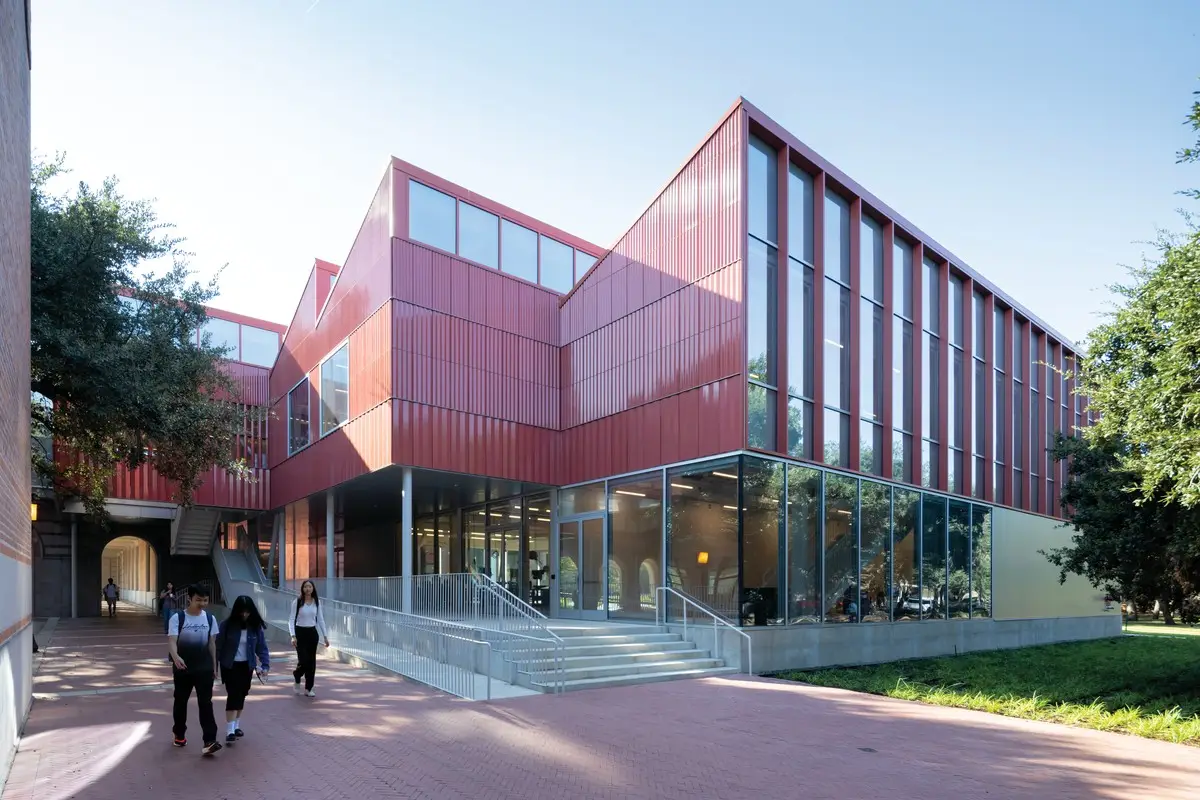
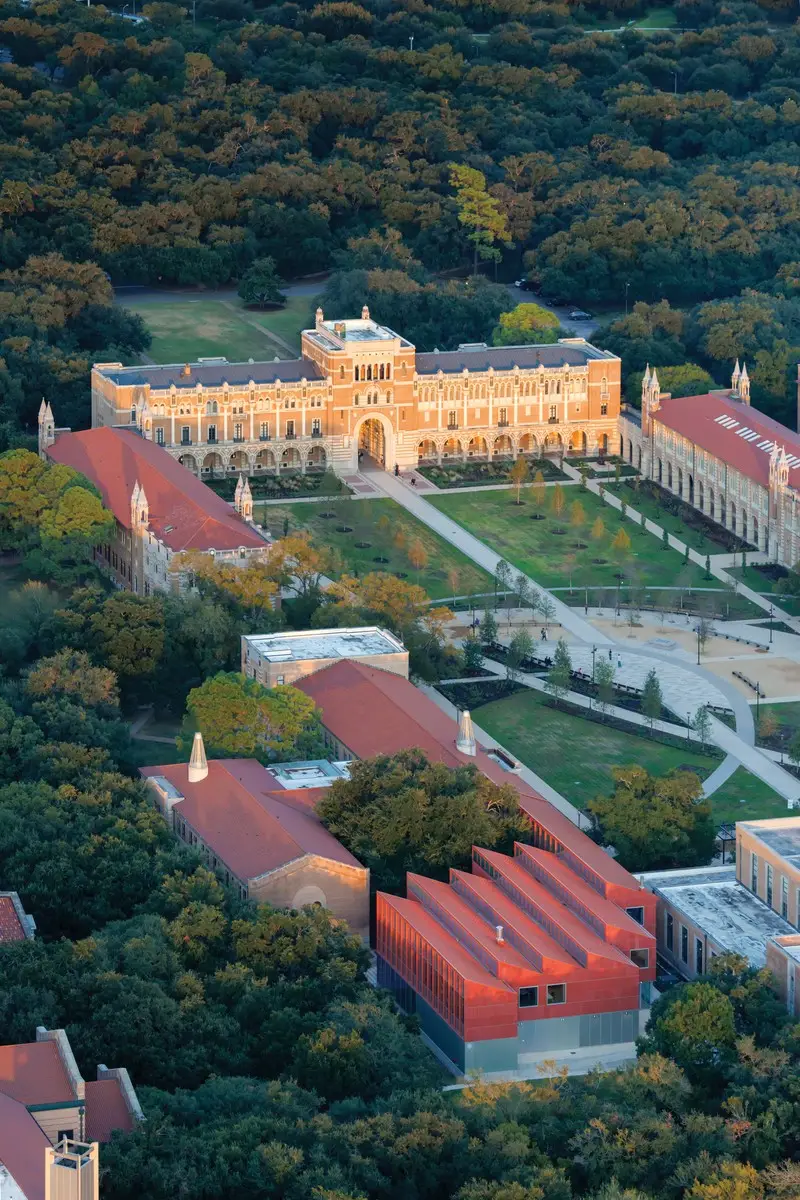
The building stands apart, with its sawtooth roof (top of page) and expansive glazing (1), while remaining in conversation with its neighbors (2). Photos © Iwan Baan, click to enlarge.
2
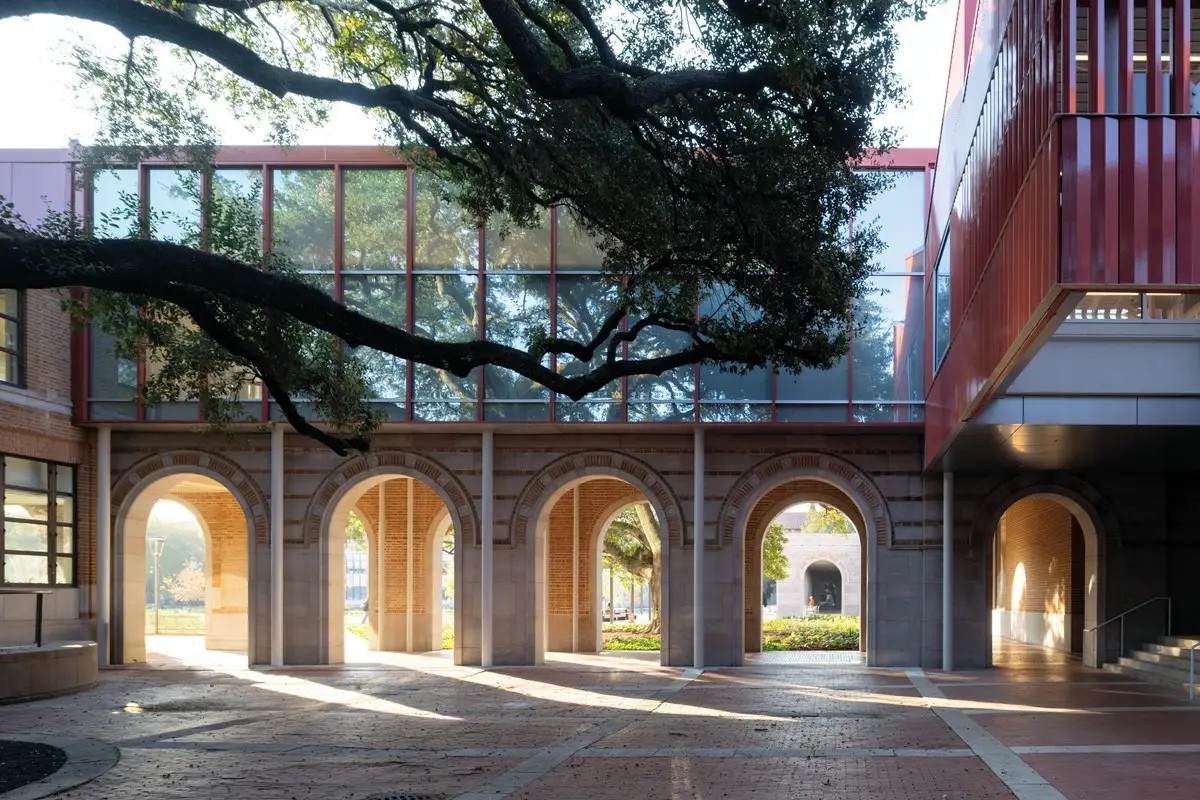
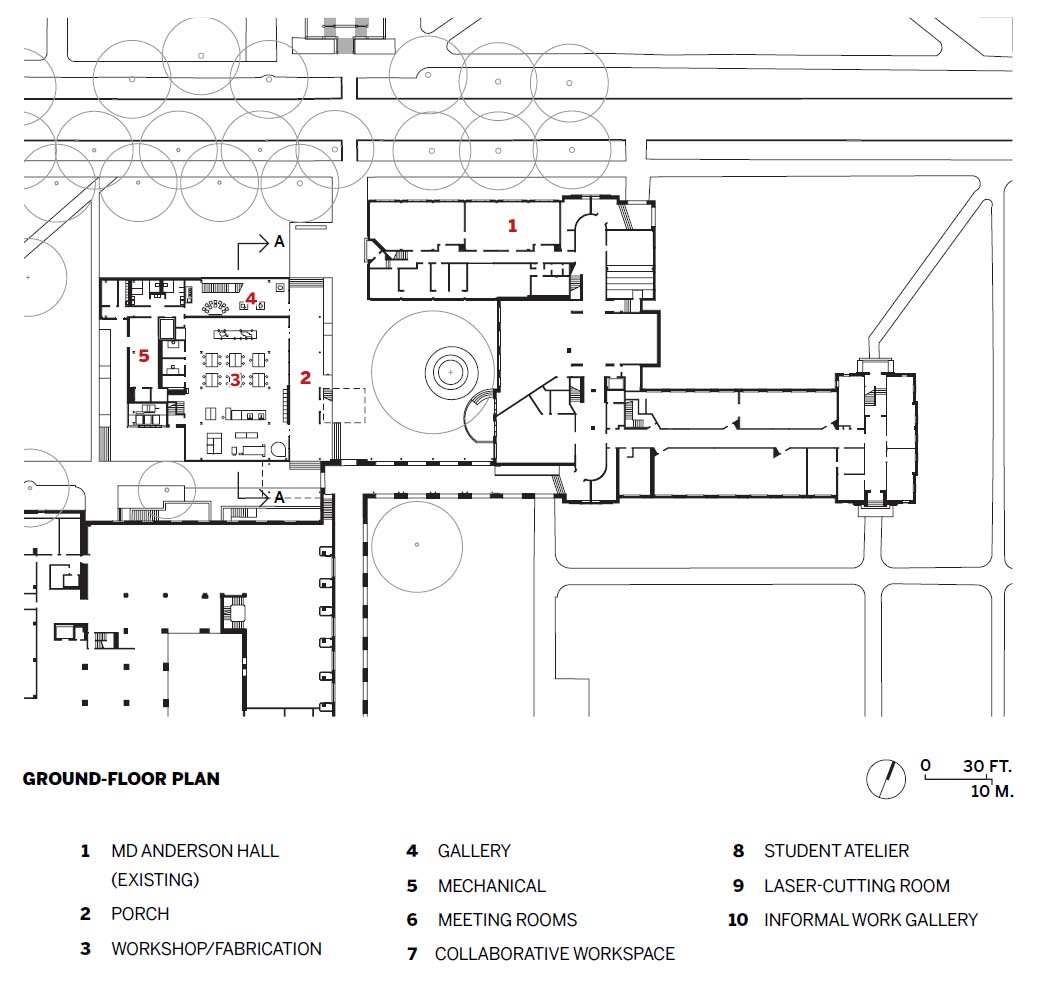
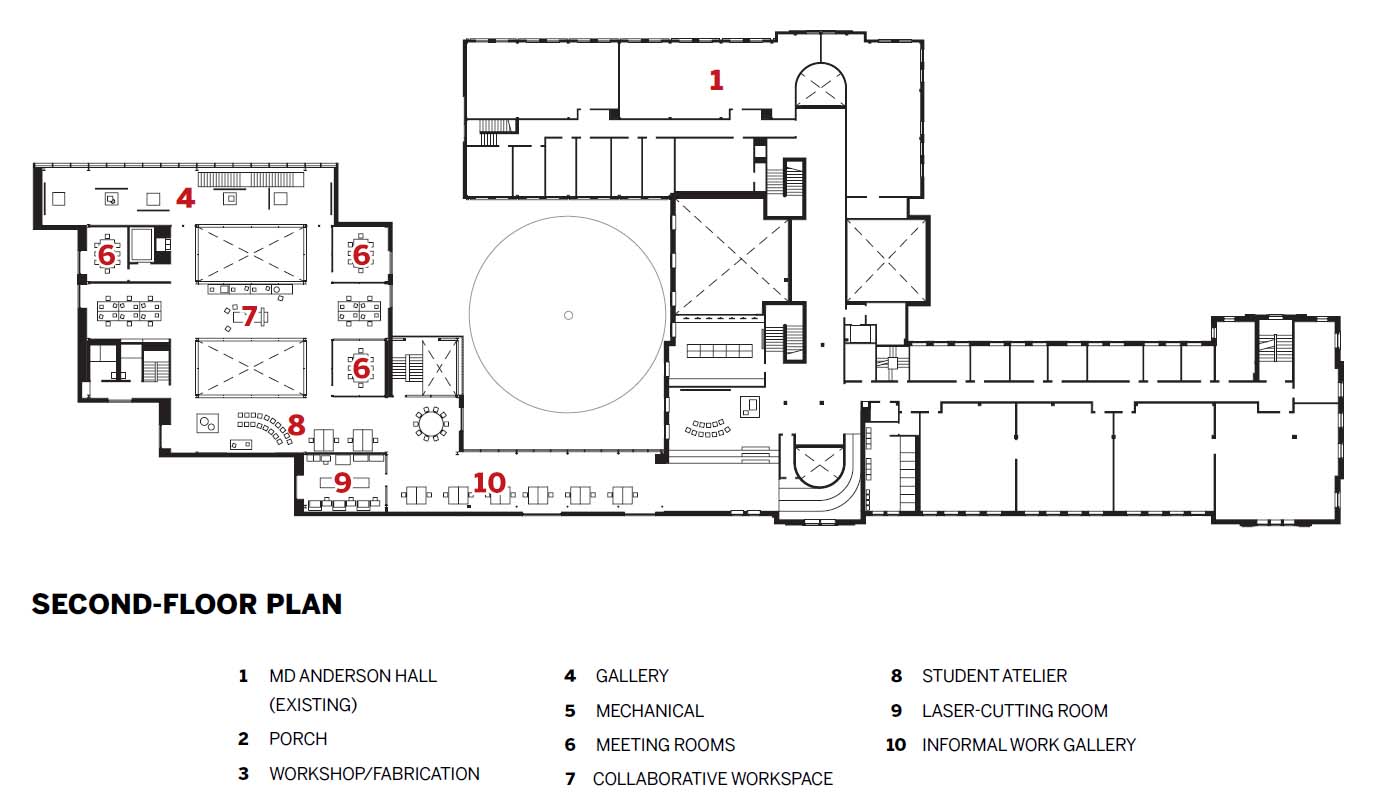
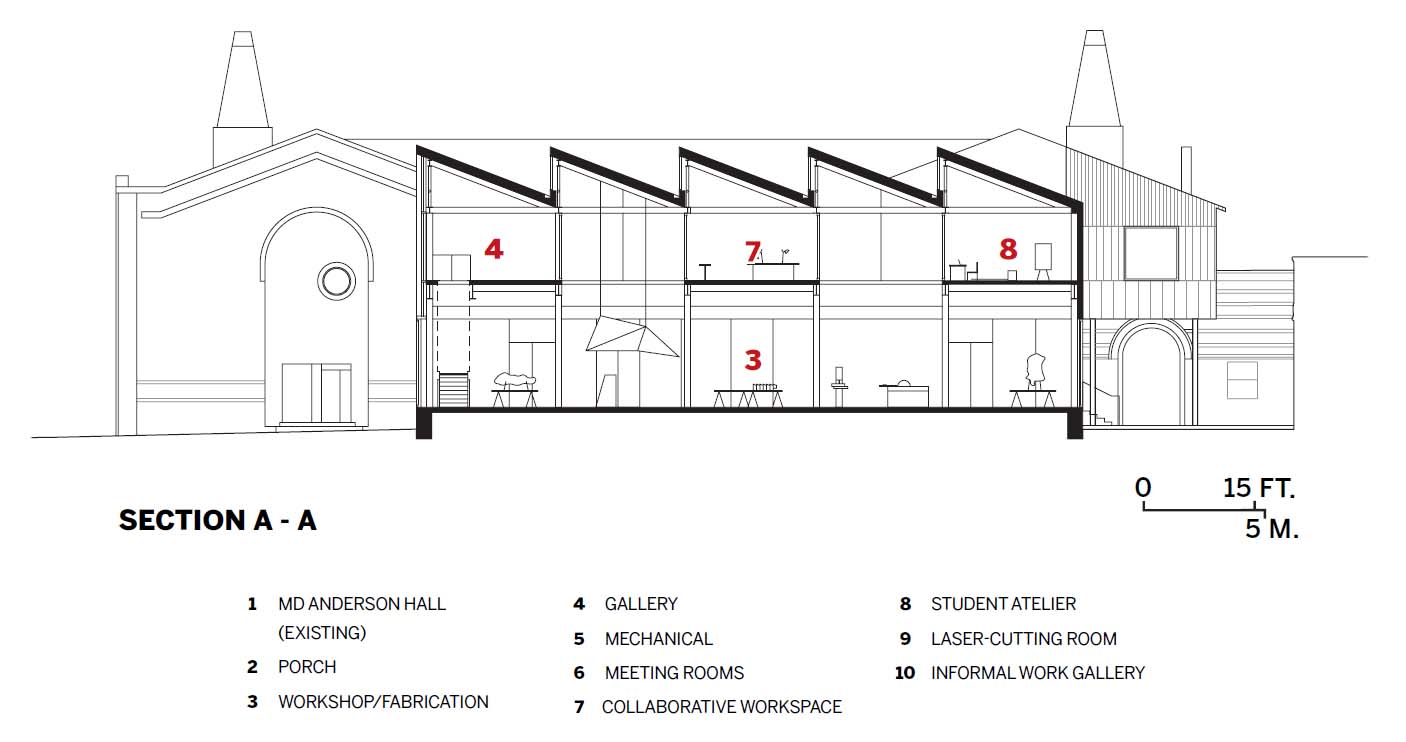
A courtyard dominated by a century-old oak tree precluded a direct ground-level connection to Anderson Hall (recently renovated by Chicago-based Kwong Von Glinow). Karamuk Kuo responded to this constraint with an ingenious parti. They created a long, linear connector by adding a second floor above and beyond an existing one-story arcade of stone and brick, which sits to the west of Anderson Hall at the courtyard’s southern edge. Enclosed at the front by an extension of Anderson’s brick wall and sloped clay-tile roof, this appendage continues the material language of the quad. But it’s more than just a contextual circulation device; it’s also a planning module, a long, narrow bar approximately 18 feet wide, which is repeated in five additional parallel bars of varied lengths to the north. These shift progressively to the west and combine to form a new 22,000-square-foot volume, topped by a sawtooth roof that in section articulates the modules and provides north-facing clerestories.
3
4
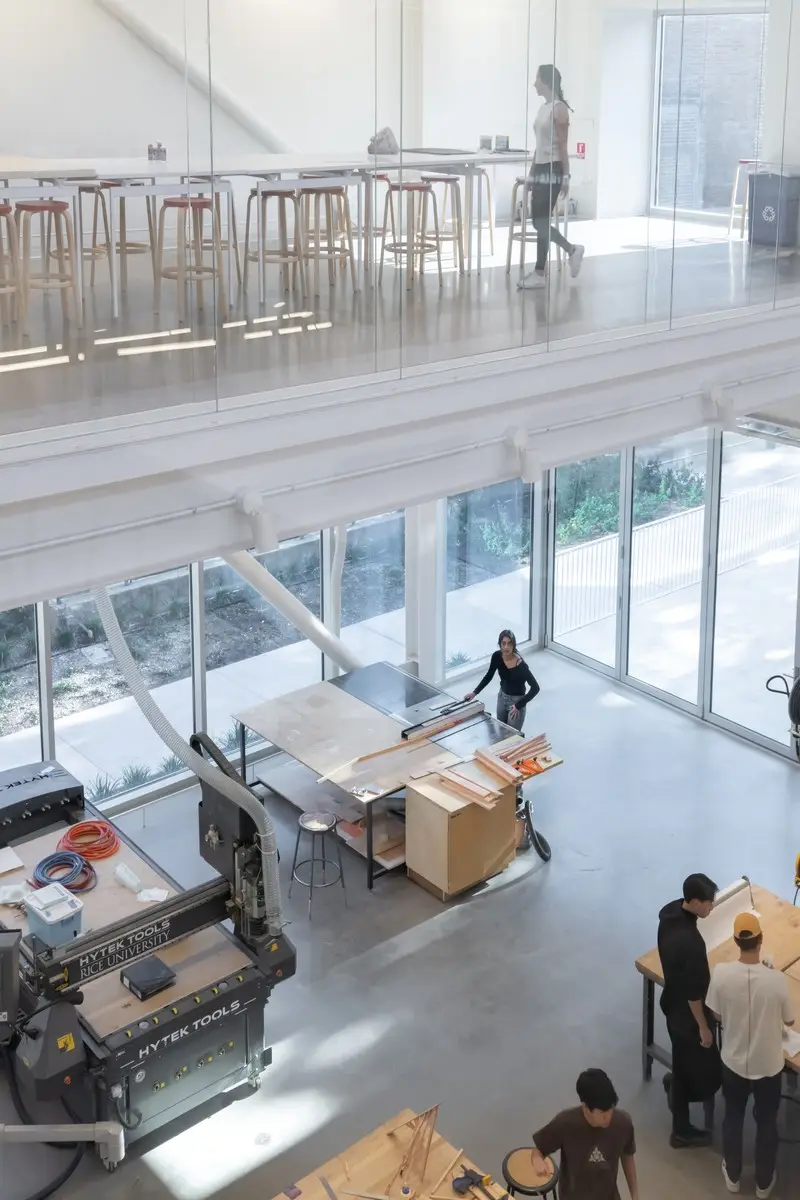
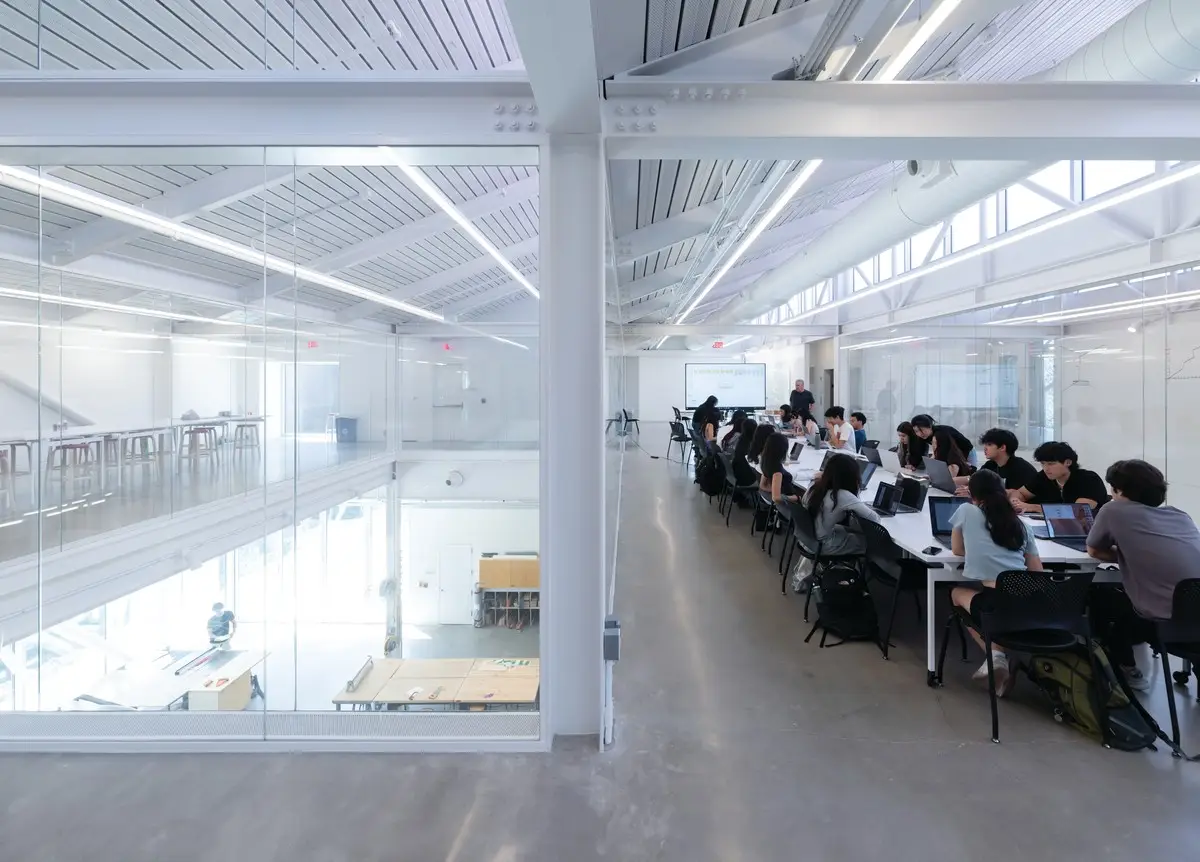
The light-filled interior includes a double-height fabrication workshop (3) with collaborative-study areas above (4). Photos © Iwan Baan
The parallel bars establish a rigorous structural grid that facilitates a rational organization of program elements, with clear circulation between them. On the first floor, a large fabrication hall opens to an outdoor work terrace to the west and a porch overlooking the courtyard to the east. On the second floor, surrounded by tree canopies, are spaces for research, meetings, and casual pin-ups, along with galleries for more formal exhibits, all softly daylit by the clerestories. Two double-height volumes allow for construction of tall models while connecting the levels visually. The artfully layered spaces are luminous, functional, and easily navigated.
5
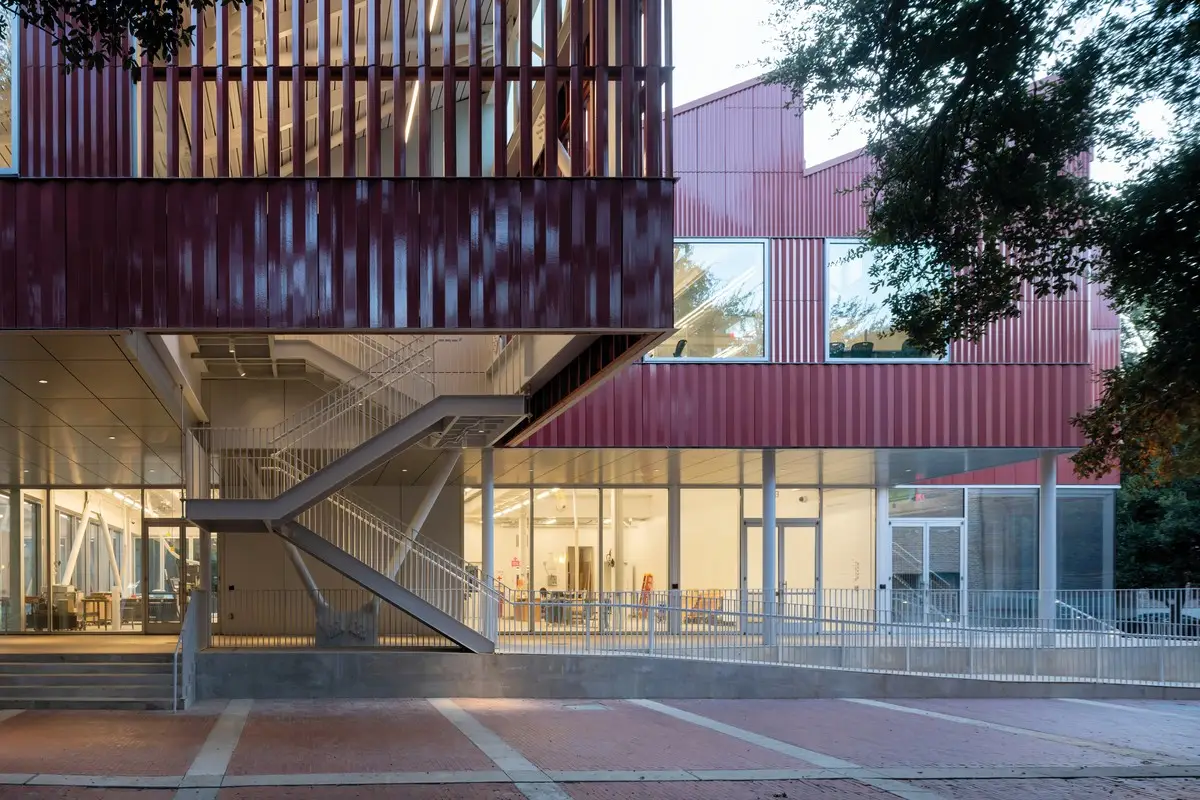
A porch and exterior stair (5) face into an oak tree–shaded courtyard where an arcade (6) has been topped with a connector between buildings. Photos © Iwan Baan
6
The new construction is framed in steel that is bolted rather than welded together, to allow for the possibility of disassembly in the future to accommodate changes. On the inside, this frame is exposed. Except at service areas tucked into the northwest corner, most partitions are glass, which provides an astonishing degree of transparency. Floors are polished concrete, ducts and pipes are exposed, and just about everything is painted white. “The interior has an industrial character that promotes physical experimentation, stripping away any preciousness in the architecture,” says Kuo. “The building celebrates the users, and its visual transparency builds community. The learning environment becomes one of not only formal instruction but also informal exchanges where students can be inspired by the work of their peers.”
On the exterior, much of the lower level is glazed, while the upper level is mostly clad with a rainscreen system of glazed terra-cotta panels in three different profiles, held in place by concealed clips. “It’s a sustainable, biodegradable material that needs no maintenance,” Kuo explains. “With its color and changing cadences, it references the surrounding brick buildings and their decorative friezes while presenting a new image.” Unlike Cram’s, Staub’s, and Stirling’s monumental masonry masses, which hug the ground, Karamuk Kuo’s clay-toned geometric modules seem to hover in midair.
Looking for quick answers on architecture and design topics?
Try Ask RECORD, our new smart AI search tool.
Ask RECORD →
“The transparency of the building makes design visible in a way that it was not before,” says Igor Marjanović, dean of the School of Architecture. But, given that there’s no shortage of local architects well suited to that task, why did Rice choose a firm based in Switzerland? “We’re an international school with global reach,” explains Marjanović, whose own path to Texas began in Serbia. To say that Karamuk Kuo’s principals are cosmopolitan or peripatetic would be an understatement. Jeannette was born in Indonesia and met Ünal—a student of Turkish heritage from the ETH Zürich—at Harvard. After working separately for several high-profile firms in New York, they decided their chances of success with a firm of their own were better in Switzerland, where an open system of public competitions gives young practices access to significant projects. This is their first major commission in the U.S.
Rice faculty were deeply engaged in the design process. “We protected the parti,” says Marjanović. How did Kuo feel about having architects as clients? “It was great,” she replies with a laugh. “I didn’t have to explain everything.”
Click plan to enlarge
Click plan to enlarge
Click section to enlarge
Read our entire January 2025 “Architects on Architects” series.
Credits
Architect:
Karamuk Kuo
Architect of Record:
Kendall/Heaton Associates
Engineers:
Ensight Haynes Whaley (structural); Collaborative Engineering (m/e/p); Walter P. Moore (civil)
Consultants:
Tillotson Design Associates (lighting); NV5 (sustainability); Lauren Griffith Associates (landscape); Shen Milsom Wilke (acoustics); Morrison Hershfield (envelope)
General Contractor:
Linbeck Group
Client:
Rice University School of Architecture
Size:
22,000 square feet
Completion Date:
June 2024
Sources
Cladding:
Alpolic (metal panels); Boston Valley Terra Cotta (rainscreen)
Roofing:
Berridge Manufacturing Company (metal); Ludowici (tile)
Acoustical Ceilings:
Armstrong
Paint:
Sherwin-Williams
Lighting:
Creative Systems Lighting, Lucifer (downlights); Alphabet (exterior)
Elevators:
Canton Elevator
Building Automation:
Distech Controls
Looking for a reprint of this article?
From high-res PDFs to custom plaques, order your copy today!