Industry
A Gensler-Designed Training Facility Prepares the Next Generation of Chicago’s Ironworkers
Broadview, Illinois
Architects & Firms
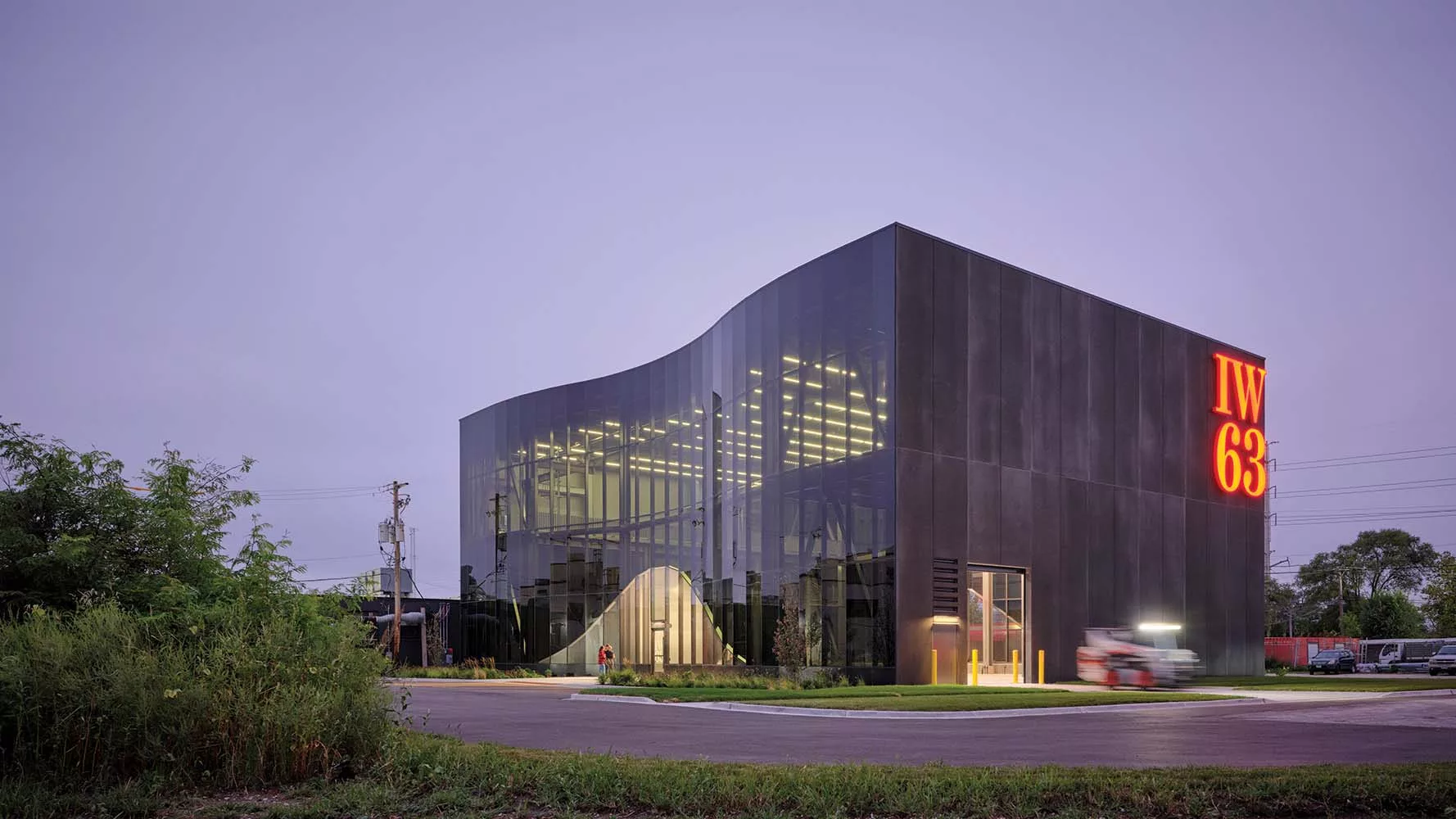
Just outside Chicago, in the western suburb of Broadview, the sleek new training center of Ironworkers Local 63 stands out within the industrial landscape. The Gensler-designed building, conspicuously clad in black-tinted glass and tapered at its center, resembles a well-executed weld bead. “Our goal for the project was to provide a platform for the ironworkers of Local 63 to expand on Chicago’s legacy as a leader in steel construction and innovation,” says Scott Hurst, Gensler design director and principal.

Panes of vision glass form an arc on both the east and west elevations to offer direct sight lines into the facility for passersby. Photo © Tom Harris, click to enlarge.

The building tapers at its center. Photo © Tom Harris
The Windy City has long been synonymous with steel construction, having rebuilt its downtown with the material in the decades following the Great Fire of 1871 that destroyed more than three square miles. Since 1903, Local 63, replete with experts in curtain wall installation, has represented tradespeople performing construction of architectural and ornamental ironwork in Chicagoland. Some 10 miles east of Broadview, just over the horizon, the silhouettes of successive generations of skyscrapers, from the Art Deco Board of Trade Building (1930) to the International Style Willis Tower (1970), stand as monuments to the workers’ hard labor.

The building is over 10 miles from downtown Chicago. It is connected to the union headquarters and an existing training facility. Photo © Tom Harris
Local 63’s new building adjoins its existing classrooms and decades-old training facility, which experienced growing pains soon after opening in 2003. It isn’t easy to make room for curtain wall panels and structural steel framing, hoses and racks for spray testing, tools for welding, and other large, heavy materials and equipment. The union decided to ameliorate their cramped conditions by separating ironwork and curtain wall tutoring into discrete facilities. Following a request for proposals, Local 63 commissioned Gensler in 2022. The firm’s Chicago studio has some experience in the typology, having designed the Plumbers Local 130 UA Training Center (2017) in the West Loop neighborhood.
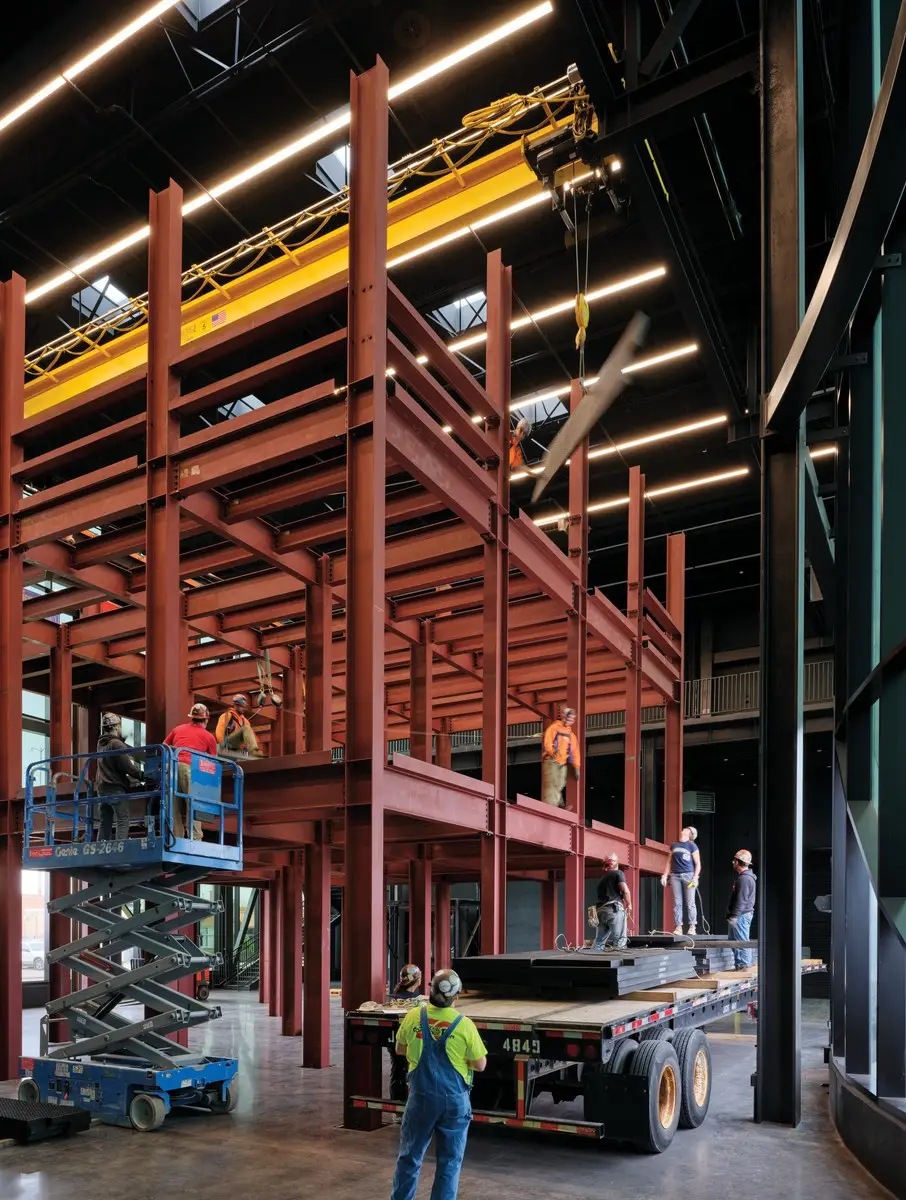
A multistory steel frame is used for training within the center. Photo © Tom Harris
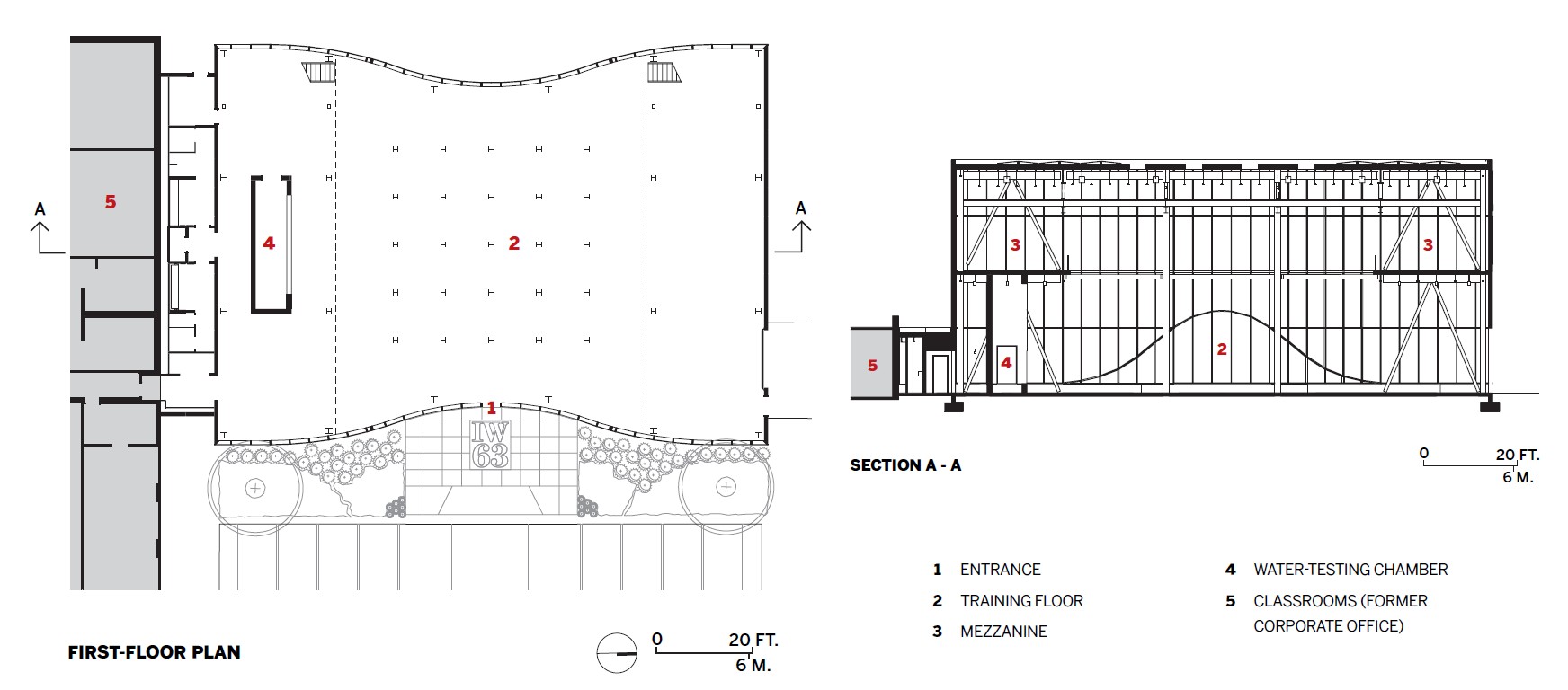
The primary entrance to the 13,500-square-foot facility is located on the east elevation, though the building can also be accessed from the south via the union’s classrooms. The obviously steel-framed structure is largely composed of a single open space, with a 50-foot-tall ceiling, in which a temporary multistory steel structure is utilized to run trials of curtain wall installs. Mezzanines to the north and south with foot-thick concrete floors are used to store panels and other materials. The heavy loads are carted in through a roll-up door on the ground floor, and a 5-ton bridge crane located just below the ceiling lifts those items up for storage and test installations. Local 63 is wrapping up the fit-out of a 20-foot-tall vacuum chamber for curtain wall water-testing, which should be completed by the end of summer.

A bridge crane lifts items, like steel beams and curtain wall panels, for training and storage. Photo © Tom Harris
Gensler conceived the structure as something of a jewel box, with expanses of glazing on its curved east and west sides to broadcast the dynamic workings within and provide ample daylight for trainees and instructors. However, the scheme posed challenges in terms of thermal heat gain and structural design. To solve the former, most unitized panels are tinted black to absorb sunlight and reduce heat transfer, while operable skylights and destratification fans naturally ventilate the interior. The design team also closely scrutinized how the bridge crane interacts with the unitized glass curtain wall. Too much vibration would cause the panels to pop out en masse, so the crane was outriggered up to 13 feet from the superstructure to mitigate its effect.
Although Local 63 had initially hoped to clad all four elevations in glass, that would have proved costly without providing much benefit to the overall program. Instead, the north and south elevations are built of precast-concrete panels, with an aggregate composed of recycled coal slag, typically used at steel mills for sandblasting, mixed with black pigments. Together, the contrast between the structure’s sinuous glazing and the monolithic, obsidian-like concrete is eye-catching, especially to the thousands of commuters cruising by daily from the adjacent expressway.
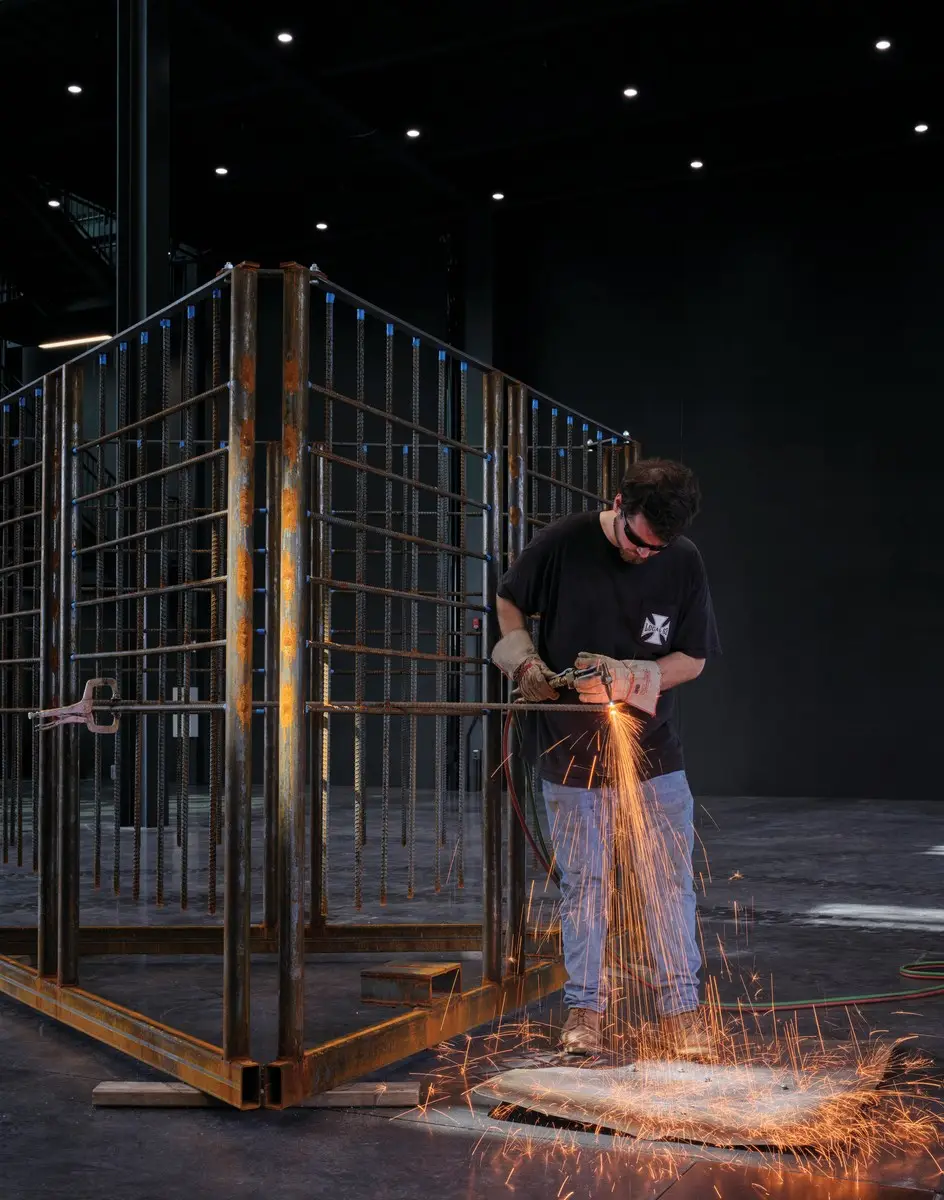
The space can be used for welding and other processes. Photo © Tom Harris
Since opening in June 2024, the training facility has functioned as something of a public forum for the metropolitan region. The union has hosted numerous community meetings with local politicians within the space, led several tours of the facility with the Chicago Architecture Center, and provided room (when available) to other Ironworkers chapters and sister trade unions.
Looking for quick answers on architecture and design topics?
Try Ask RECORD, our new smart AI search tool.
Ask RECORD →
“You are seeing this laboratory of learning in action, with steel beams and curtain wall panels flying,” says Gensler project architect Sean McGuire. “It is exciting, and prospective ironworkers can experience the trade’s camaraderie firsthand, while seeing that this is a solid career path.”
While Gensler and the union hope the facility encourages future workers to pick up the trade, those currently using it have quickly come to appreciate it. During my visit, Dave Murray, a third-generation member of Local 63, stood with me atop the mezzanine. Overlooking the trainees at work, he said, “It fills you with pride.”
Click drawings to enlarge
Read about other industrial projects from our June 2025 issue.
Credits
Architect:
Gensler — Scott Hurst, principal in charge; Jason Pugh, project manager; Sean McGuire, project architect; Ryan DePersia, technical director
Engineers:
Nayyar & Nayyar International (structural); IMEG (m/e/p); Terra Engineering (civil and landscape)
General Contractor:
Skyline Construction
Client:
Ironworkers Local 63
Size:
13,600 square feet
Cost:
Withheld
Completion Date:
June 2024
Sources
Structural System:
Nick’s Metal Fabricating (structural steel and ornamental ironwork); Nucor Vulcraft (acoustical structural decking)
Exterior Cladding:
Lombard Architectural Precast Products (precast panels); W.R. Meadows (moisture barrier)
Glazing:
Prelco (fabricator); Pilkington (tinted glass); Guardian (vision glass)
Bridge Crane:
Sievert
Looking for a reprint of this article?
From high-res PDFs to custom plaques, order your copy today!

