Industry
Barkow Leibinger’s Mass-Timber Training Center Buzzes with Activity
June 2, 2025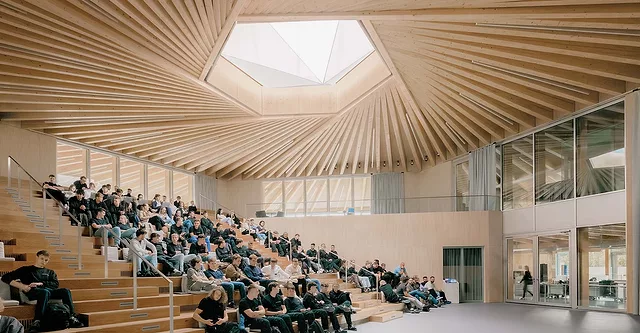
Industry
Barkow Leibinger’s Mass-Timber Training Center Buzzes with Activity
June 2, 2025If machines built themselves a home, would it be made of wood? Outside Stuttgart, Germany, near the northern edge of the fabled Black Forest, Barkow Leibinger has built a mass-timber Education Center for the company that makes machines—or, rather, for the machines that create even more machines. Trumpf is one of the world’s largest producers of the drills, mills, and shears of contemporary industrial manufacturing. They also make lasers that cut, etch, and weld. Although Trumpf’s headquarters in the village of Ditzingen is easy to miss while speeding down the Autobahn, hidden as it is behind a thick row of trees, the new Education Center has created a focal point for the campus under a radial timber roof.
Along with hosting workshops necessary to onboard employees, the center serves another important purpose: Trumpf needed something of a showroom for a new kind of workplace. By now, the spaces that house high-tech desk jobs are familiar—Google’s are playful, Apple’s austere—but what about the facilities that make these giants’ devices? How should they look and feel? Manufacturing is having a moment in today’s tariff-driven geopolitical landscape, but the sector seems to be transforming so fast that it is difficult to make sense of what we are seeing. Fully automated factories in China don’t even keep their lights on.

This problem of legibility confronted Berlin-based Barkow Leibinger in its latest addition to the Trumpf campus. The company, founded by Christian Trumpf in 1923, initially grew as a producer of flexible drive shafts, but workers traded in their grease-marked coveralls long ago. Trumpf shifted early into the digital era following a breakthrough in the development of computer-numerical-control technology by its head of engineering, Berthold Leibinger, who became Trumpf’s technical director in 1966 and subsequent majority owner. Berthold’s daughter, Regine, who cofounded Barkow Leibinger with her husband Frank Barkow in 1993, is now a co-owner of Trumpf with her siblings. As the company became a global powerhouse in the late 20th century and a leader in laser technology in the first decades of the 21st, the architect couple had a stake in the change and was well positioned to update its image.
The firm has completed several buildings on the Ditzingen campus since the mid-1990s. For Trumpf, timber was not the first choice of material. “They resisted it,” Barkow says, adding that “sheet metal is what their machines work on.” And so sheet metal was put on spectacular display in the architects’ earliest buildings for the company, as in the pixelated folded-aluminum facade of an addition to a laser factory, or in a production and exhibition space in Chicago topped by artful laser-cut steel trusses. Still, these earlier buildings evoke a self-sufficient world replete with heavy machinery and not the deeply intertwined relationship between people and their devices that has come to represent contemporary high-tech. In more recent projects, the architects turned to other materials that could suggest a more human touch. As Trumpf built production facilities around Germany and demonstration facilities across Europe, it experimented with various material combinations—and timber, long ago dismissed, began to check all the boxes. It is a renewable resource, it performs well, and “we can fabricate it to a high level of precision,” Barkow says. Barkow Leibinger’s first such building for Trumpf, a campus restaurant, was built in 2008, next to the site where the Education Center has sprung up, and it conveyed just the right big-picture message for the moment: that “Germany is at the forefront for sustainable engineering,” says Barkow.
The Ditzingen campus master plan clicked into place with a large production hall completed last year, which established an axis that culminates in the Education Center’s auditorium. Visitors arrive at a parking structure, but employees are more likely to enter through the campus tunnel network—a rhizomatic underground infrastructure from which buildings spring like mushrooms. The first thing to pop up on the center’s site was a crane, which assembled the Education Center around its mast. “We kept the basement and sitework to a minimum,” Barkow says, “and put it together as a kit of parts.” The biggest components are the 96 beams that comprise the roof structure, radiating around a central hexagonal oculus, which was enclosed after the crane was disassembled. Made of glue-laminated timber, they were fabricated by Holzbau Amann, a company located at the edge of the Black Forest to the south, which also fabricated the roof structure of the eatery next door.

1
The hexagonal Education Center (1) features exposed mass timber (2) that is visible through a glazed curtain wall (3). Photos © Laurian Ghinitoiu (1), Simon Menges & Nino Tugushi (2 & 3), click to enlarge.

2

3
Compared to the campus restaurant, the Education Center reflects a change in ethos. The earlier project’s morphing weblike ceiling and flexible floor plan attest to turn-of-the-21st-century optimism about the transformations being wrought by digital technology. The new building employs more conventional post-and-lintel tectonics, although the way the beams cantilever inward, toward the oculus, lends plenty of spatial drama to the auditorium at the core. Surrounding it are six hexagonal spaces that, on the ground floor, accommodate an entrance foyer, workshops, and a double-height machine hall, and, on the second, include seminar rooms, lounges, and offices that overlook the spaces below. Spruce beams and columns are complemented by finely milled wood panels, a concrete floor, and ceiling panels in a similar tone. The translucence of the glazing on a few of the building’s chamfered corners gives off a gauzy glow that further softens the wood. Outside, the roof and exposed beams overhang these facets, and the timber tilts diagonally in a gesture to the traditional half-timbered construction of the region. It also evokes the feeling of a forest thicket.

4
A double-height machine hall houses large manufacturing equipment (4) and shares a glazed wall with the central auditorium (5). Photos © Simon Menges & Nino Tugushi

5
All this warmth reflects onto the final major element of the interiors—the machines, many of them the size of small cars. They haven’t gone anywhere, and they sit in the Education Center’s spacious hall with an enigmatic air. Because it feels as if so many vital aspects of contemporary life have been sublimated into the virtual realm, the architects’ choice to house these instruments in a carefully crafted wood box amounts to an attempt to tame them. Amid a reassuringly symmetrical canopy and under a radiating sun, Barkow Leibinger invokes a renewed humanism to remind us that we still control the robots, and not the other way around.
Click section to enlarge

Click graphic to enlarge

Read about other industrial projects from our June 2025 issue.
Credits
Architect:
Barkow Leibinger — Frank Barkow, Regine Leibinger, principals; Tobias Wenz, Robert Tzscheutschler, Frederic Lilja, Annette Wagner, project team
Engineers:
Drees & Sommer (construction management, HVAC); Holzbau Amann (timber); Schlaich Bergermann Partner (structural); P&H Hönes (electrical); Horstmann und Berger (building physics); Breinlinger Ingenieure (civil); Kucharzak Fassaden (facade)
Consultants:
Capattistaubach (landscape); Studio Dinnebier (lighting); Peter Stanek (fp)
Client:
Trumpf
Size:
40,040 square feet
Cost:
Withheld
Completion Date:
January 2024
Sources
Structure:
Leonhardt Weiss Bauunternehmung (shell); Holzbau Amann (timber)
Curtain Wall:
Rossmanith, Raico
Cladding:
Haller Gabele Dachtechnik, Bauder (roofing); Warema (awning)
Doors:
Rossmanith, Hörmann
Hardware:
FSB, Kaba
Interior Finishes:
Troldtekt, Lindner (acoustical ceilings); Nuesing, Kemmlit (partitions); Heinrich Schmid (wallcoverings); Swiss Krono (laminate); Corian (solid surfacing); Agrob Buchtal Loop (tile); Noraplan (flooring)
Lighting:
Intra Lighting Trix, Lux Glender, Reggiani, iGuzzini (ambient); Flos (downlights); Jung (dimming)
Looking for a reprint of this article?
From high-res PDFs to custom plaques, order your copy today!
Looking for quick answers on architecture and design topics?
Try Ask RECORD, our new smart AI search tool.
Ask RECORD →