Industry
CookFox Transforms a 19th Century Manhattan Storehouse into a Modern Workplace
New York

Architects & Firms
In a New York that still glowed amber-gold after dark from sodium streetlamps, the Tunnel nightclub distinguished itself for a seediness that appears, in retrospect, almost incredible. From 1986 to 2001, the Chelsea hot spot played host to drugged-out Club Kids (including convicted murderer Michael Alig), tax evaders (most notably its owner, Peter Gatien), and psychos both real and fictional (Bret Easton Ellis’s Patrick Bateman was a regular) before finally being forcibly closed by the city. While a number of commercial tenants have occupied portions of the space in the intervening years, much of it has remained empty, a reminder of a colorful if somewhat disreputable era in Manhattan’s history.
But the structure that housed the Tunnel is actually linked to a far different, and rather more distant, age. “Stanford White kept the stuff here that he imported from Europe,” says Rick Cook, founding partner of New York firm CookFox Architects. Constructed in 1891, and stretching an entire city block, from Eleventh Avenue to the West Side Highway, the Terminal Warehouse Central Stores Building (commonly called the Terminal Warehouse) was once a key node in an infrastructural web that connected the 19th-century city to the country at large. Long obscured, the fortresslike building’s remarkable origins are put on dramatic display in CookFox’s just-completed renovation—an impressive seven-year-long overhaul intended to usher in the building’s next chapter as a bustling office and retail hub.
“There’s that torque to the archway,” says Cook, gesturing at the wide, curiously slanted portal on the eastern facade. As first conceived, the Terminal was a wonder of industrial efficiency: freight trains, running along an at-grade rail line down Eleventh Avenue, could proceed directly into the building, facilitated by this curved opening; when ready for shipping, the goods they brought could then be pushed right out the western side, onto waiting car floats that carried them across the Hudson River to New Jersey and beyond. In the interim, merchandise could be held inside the cavernous fireproofed vaults while deferring tariffs—an oddly appealing arrangement in today’s economy. “We might need to bring that back,” jokes Cook.
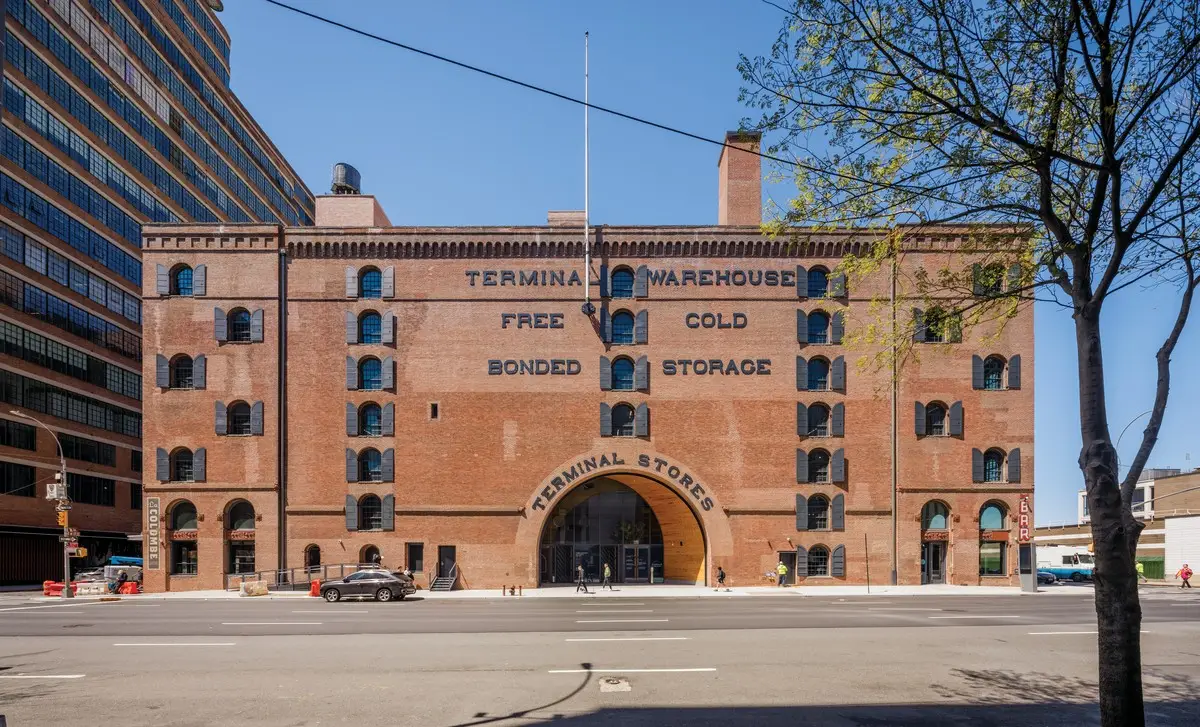
The curved entry arch allowed trains to turn in to the warehouse. Photo © Alex Ferrec, click to enlarge.
The designers’ scheme began by exposing the remarkable through-floor arrangement, removing a glazed retail facade that obscured its unusual train-friendly configuration as well as the “incredible depth of the building skin,” as Cook puts it, referring to the 28-inch thickness of the lower-floor masonry facade. Once inside the central corridor, further hints of the Terminal’s ancient function are visible in the floor, where the architects have embedded a pair of decorative pseudo tracks that trace the exact trajectory of the originals; these are followed by two small segments of the actual rails, restored more or less to their former condition, and placed below glazed panels underfoot. From the rough brick walls with their rounded archways (their spacing, and the building’s spatial module, based on boxcar lengths) to the solid wood piers that sprout massively in the adjoining rooms (the trees that the timbers came from have been dated back to 1512, notes Cook), everything in the revived 700-foot-long concourse speaks to the building’s hard-working past.
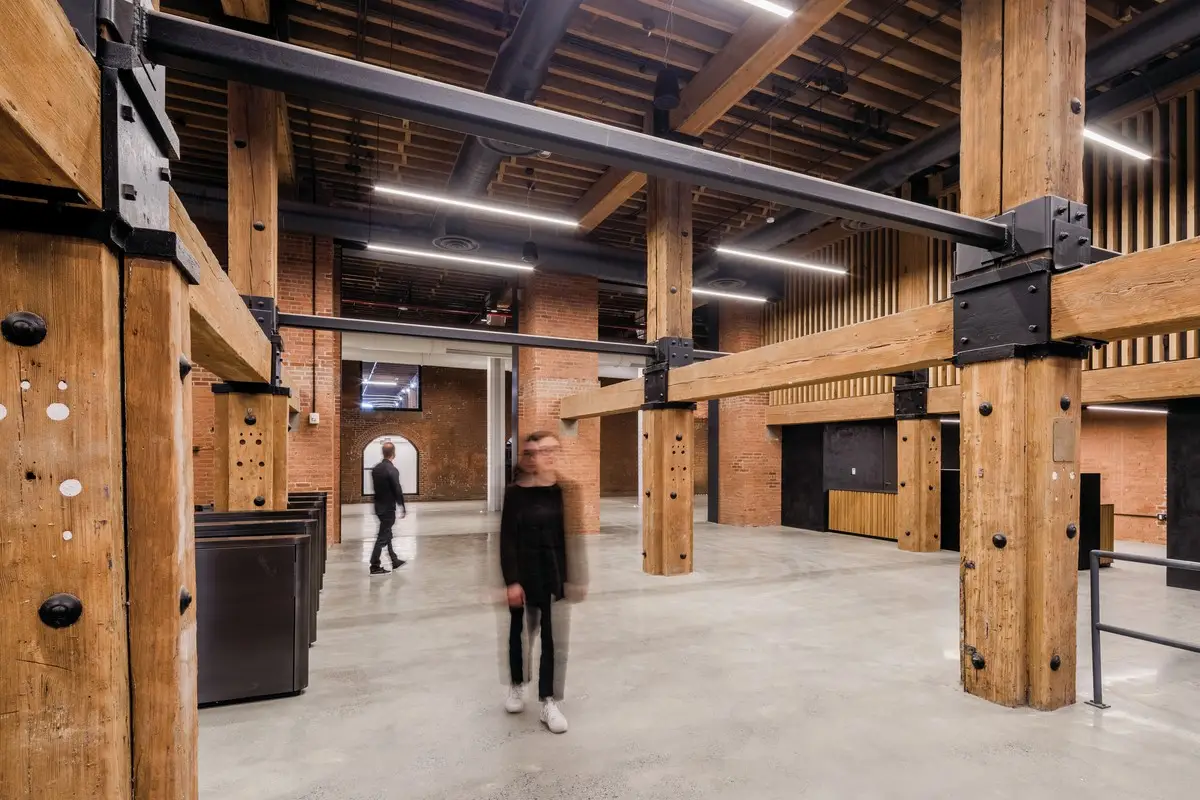
The trees that the original timber columns and beams came from date back to the 16th century. Photo © Alex Ferrec

A landscaped courtyard was cut from the warehouse’s volume. Photo © Alex Ferrec
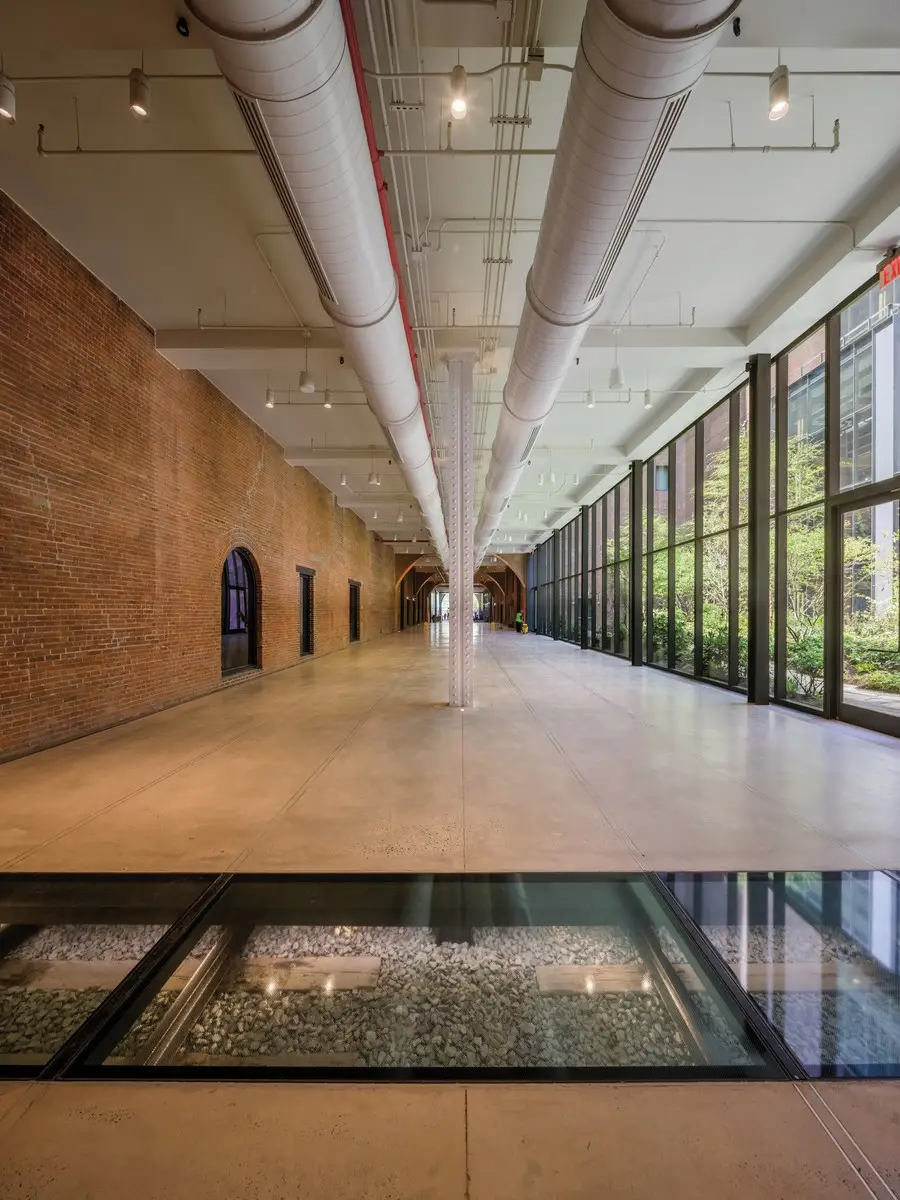
A segment of rail line has been preserved below glass. Photo © Alex Ferrec
Its future becomes apparent only as visitors make their way through the complex. Just beyond the halfway point, the solid enclosure of the eponymous tunnel suddenly gives way to what firm partner Darin Reynolds calls “a transept,” with new entrances from 27th and 28th streets to either side, as well as a broad window looking out to a new open-air courtyard. Sitting between the primary corridor and a street-front space to the north, the enclosed greensward is landscaped with a gently variable topography, covered in native plants, and surrounded by seating—most of it reclaimed wood from the building itself. As Cook observes, “Getting daylight into the center of the plan was critical”; to do it, the architects literally cut the leafy quad directly out of the existing structure’s fabric, opening it up to provide the offices above with attractive views and cross ventilation.
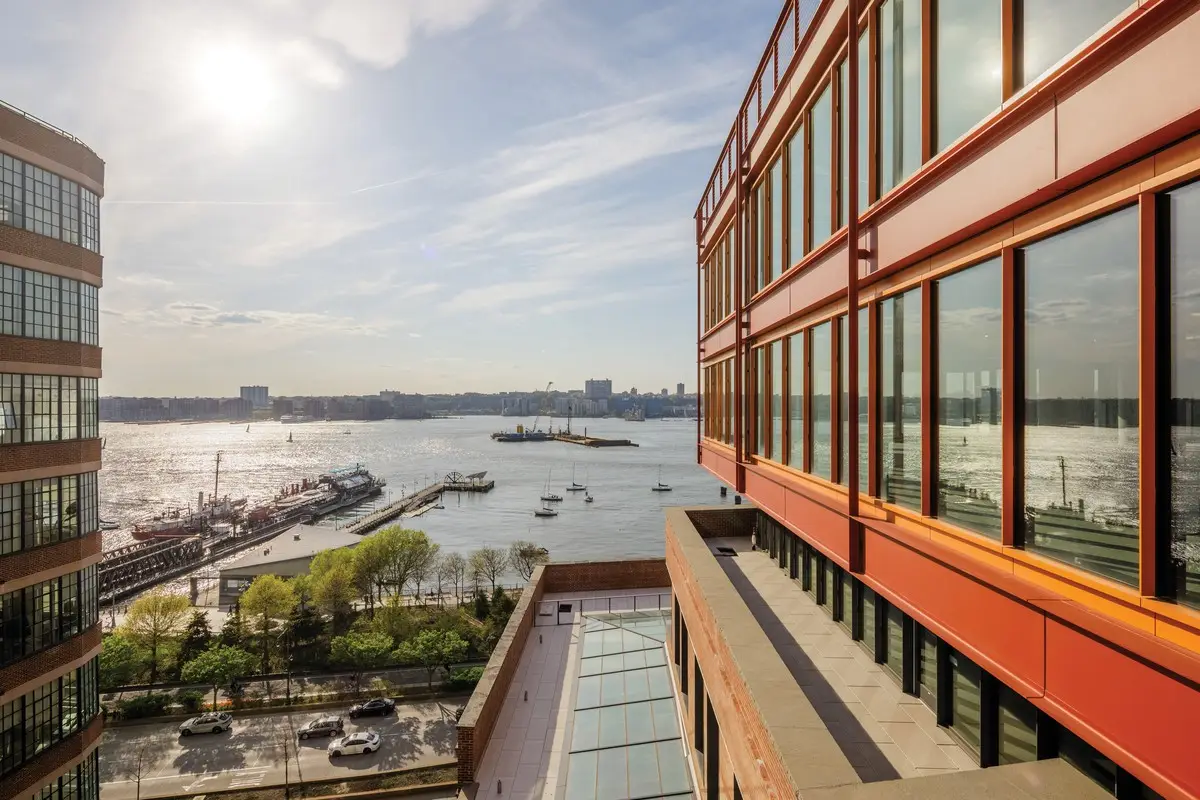
The excised square footage didn’t simply disappear. “In concept, the floor area is relocated,” says Cook: atop its seven-story western flank, the old building now sports a six-story addition, a miniature high-rise with a complementary though identifiably contemporary exterior of red metal. The addition was no mean feat logistically, requiring the insertion of a discrete structural system of concrete columns into the lower levels of the warehouse. Coupled with another, lattice-like frame that now girds a portion of the aging envelope, the intervention allowed the building to maintain a grandfathered interior area that would no longer be legally permissible on the site.
1
A six-story addition (1 & 2) sits atop the warehouse’s western flank. Photos © Alex Ferrec

2
All this was achieved with limited alterations to the body of the historic warehouse. That much was by necessity: “The building accounts for about a quarter of the West Chelsea Historic District,” says Reynolds. In designing the new vertical addition, the team was mindful of the viewshed between the top of the High Line (two blocks away and a couple of hundred feet below) and the roofline of the famous Starrett-Lehigh Building (1931) next door; they succeeded, placing the water towers on their building exactly so as to avoid blocking their neighbor. The former storage spaces that now comprise the primary office floors have been accorded similar respect, the only substantive changes being the removal of select floor sections to create double-height spaces that emphasize the amplitude of the interior. No word yet on who the tenants are likely to be—though whoever they are, they’d be foolish to throw up more than a few partitions and clutter up the vast interiors or mask the parade of arched windows around the perimeter.

The architects have created several double-story spaces within the office areas. Photo © Alex Ferrec
Of the Tunnel, nothing much remained to preserve: during the nightclub’s reign, a gaping hole in the passageway ceiling was covered in corrugated metal and acoustical material; CookFox has removed it, allowing the space to feel airier and more open. When the reported $2 billion refurbishment opens to the public later this year, few of its erstwhile patrons are likely to recognize their former after-hours haunt. Of course, their memories may be a bit cloudy in any case.
Click plans to enlarge

Click section to enlarge

Read about other industrial projects from our June 2025 issue.
Credits
Architect:
CookFox Architects — Richard A. Cook, founding partner; Darin Reynolds, partner in charge; Bethany Borel, associate partner; Simon Willett, project manager; Zach Goldstein, Gaurav Sardana, Sandra Berdick, Kate Ives, Zach Grzybowski, Giacomo Vischi, Miha Brezavšček, Daniel Palma, Arno Adkins, Hanxing Zu, Zach Kern, Walker Smith-Williams, Jeff Shiozaki, project team
Consultants:
Derive Engineers (m/e/p); Jensen Hughes (fp/life safety); DeSimone Consulting Engineering (structural)
General Contractor:
New Line Structures
Client:
L&L Holding Company, Columbia Property Trust, Cannon Hill Capital Partners
Size:
1.3 million square feet
Cost:
Withheld
Completion Date:
June 2025 (projected)
Sources
Masonry:
Kansas Brick
Structural Steel:
Nucor
Cold-Formed Framing:
ClarkDietrich
Composite Deck:
New Millennium, Vulcraft
Built-Up Roofing:
Owens Corning, Greenguard, Securock, Paradiene
Metal Panels:
Saray Aluminum
Curtain Wall:
Fabbrica USA
Entrances:
Ellison, Dormakaba, YKK, Kawneer, CRL
Glazing:
Interpane, Vitro Architectural Glass, Prelco, Tvitec, Press Glass, Pilkington
Skylights:
Acurlite
Looking for quick answers on architecture and design topics?
Try Ask RECORD, our new smart AI search tool.
Ask RECORD →
Looking for a reprint of this article?
From high-res PDFs to custom plaques, order your copy today!