Design Vanguard 2025: Ozaeta-Fidalgo
Madrid
Architects & Firms
Arantza Ozaeta and Álvaro M. Fidalgo, partners in life and work, belong to a generation of Spanish architects marked by the economic crisis that began in 2008, the year both graduated from Madrid’s Polytechnic School of Architecture. Like most of their peers, many of whom emigrated, they found their first commissions outside Spain—in this case, in the small German town of Selb, winning a prestigious European competition for young practitioners before they had even graduated. Also like many of their contemporaries, the pair has sought to break with the form-driven architecture of the preceding decades of prosperity, exploring instead the ways that nonhierarchical, collaborative methods of decision-making might be used to open the design process to the fuller participation of clients, users, and communities, as well as accommodating unforeseen future uses and broader environmental and political concerns. Fidalgo, 45, credits former teachers such as Iñaki Ábalos and Federico Soriano for this methodologically experimental orientation, and more generally the couple’s early exposure to Dutch architecture when Fidalgo apprenticed with MVRDV in Rotterdam.
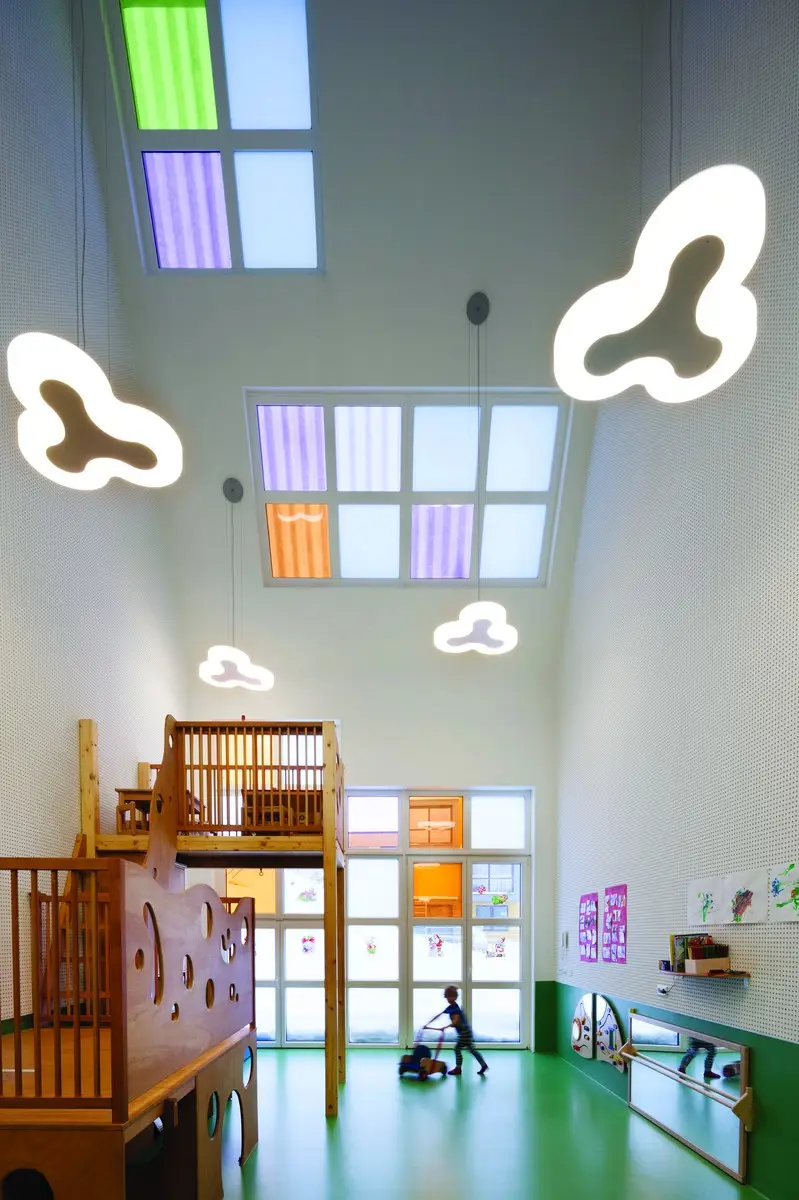
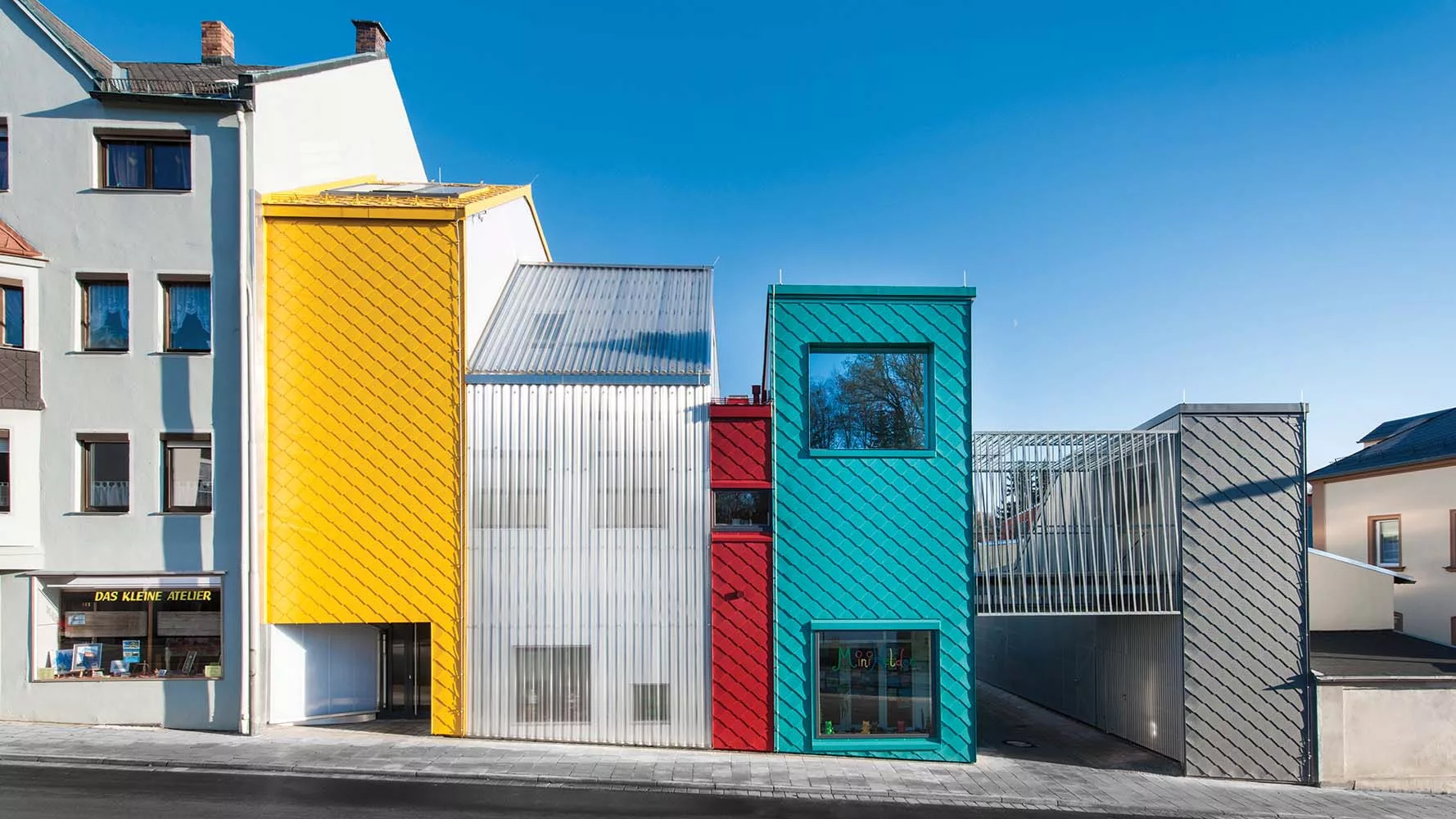
Haus der Tagesmütter (Above and top of page)
Won in an international design competition, this project aims to regenerate the shrinking Bavarian town of Selb by providing a children’s daycare center in a set of six colorful units joined like rowhouses. The firm calls its approach “regeneration acupuncture.” Photo © Fernando Alda
While their designs are lively and creative in formal terms, their explorations of process are built into the projects’ strategies. Ozaeta, 43, explains that for their Childcare Center in Selb, which is divided into vividly colored units like rowhouses, “we assigned a program to every band, and organized a specific series of conversations around each one.” Parents, teachers, municipal managers, and technical consultants met in workshops focused on different units to develop the design. In the POP-UP House, a private apartment renovation, the couple divided program elements—closets, appliances, even bathroom fixtures—into discrete spatial units that could be pushed around the plan like the pieces of a board game, allowing the client to arrange and rearrange the apartment, as well as breaking down preconceptions about conventional layouts. The design “becomes a system of communication,” Ozaeta comments. Fidalgo adds, “It’s like open-source code.”
1
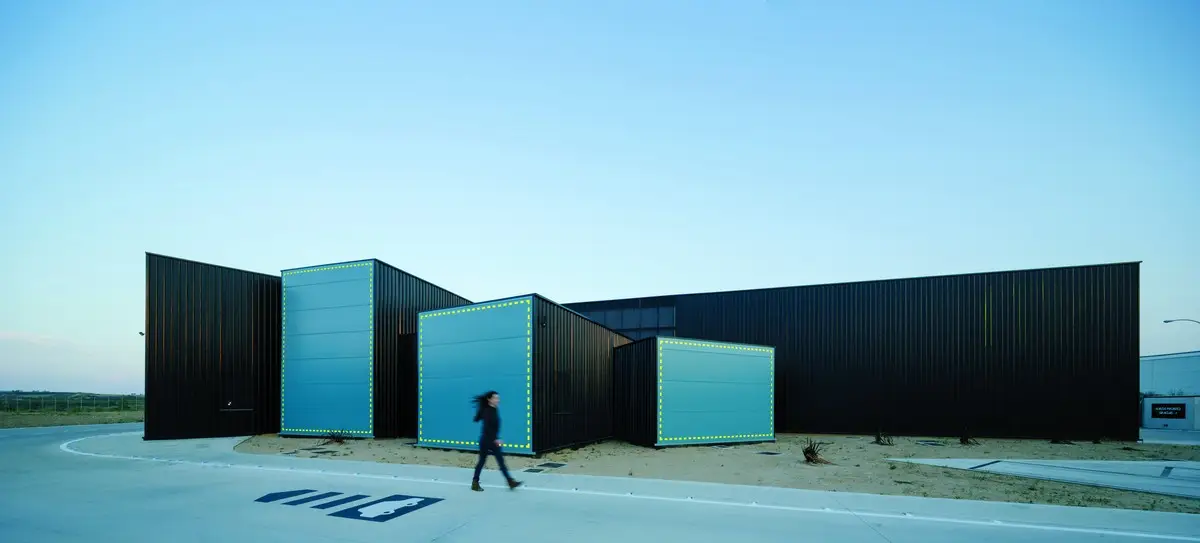
Kinetic MOT-TO (1 & 2)
A hybrid industrial-and-office facility, this project in Haro, Spain, provides space for a technical inspection station for motor vehicles as well as for offices and training. The architects played with the notion of scale, sizing metal containers as large, medium, and small elements. Photos © Imagen Subliminal

2
The two architects often reflect on the rapid obsolescence of building programs and how projects might be designed to accommodate new, future uses, the subject of Ozaeta’s doctoral thesis. They put these concerns to the test in Selb, where the couple also designed a Youth Hostel and Social Center that they later helped adapt as a temporary shelter for Syrian refugees and then in its reversion to a community center. Fidalgo notes that the narrow bays of their design facilitated this process, which involved, for example, inserting lightweight timber lofts as bedrooms in individual family spaces.
3
4
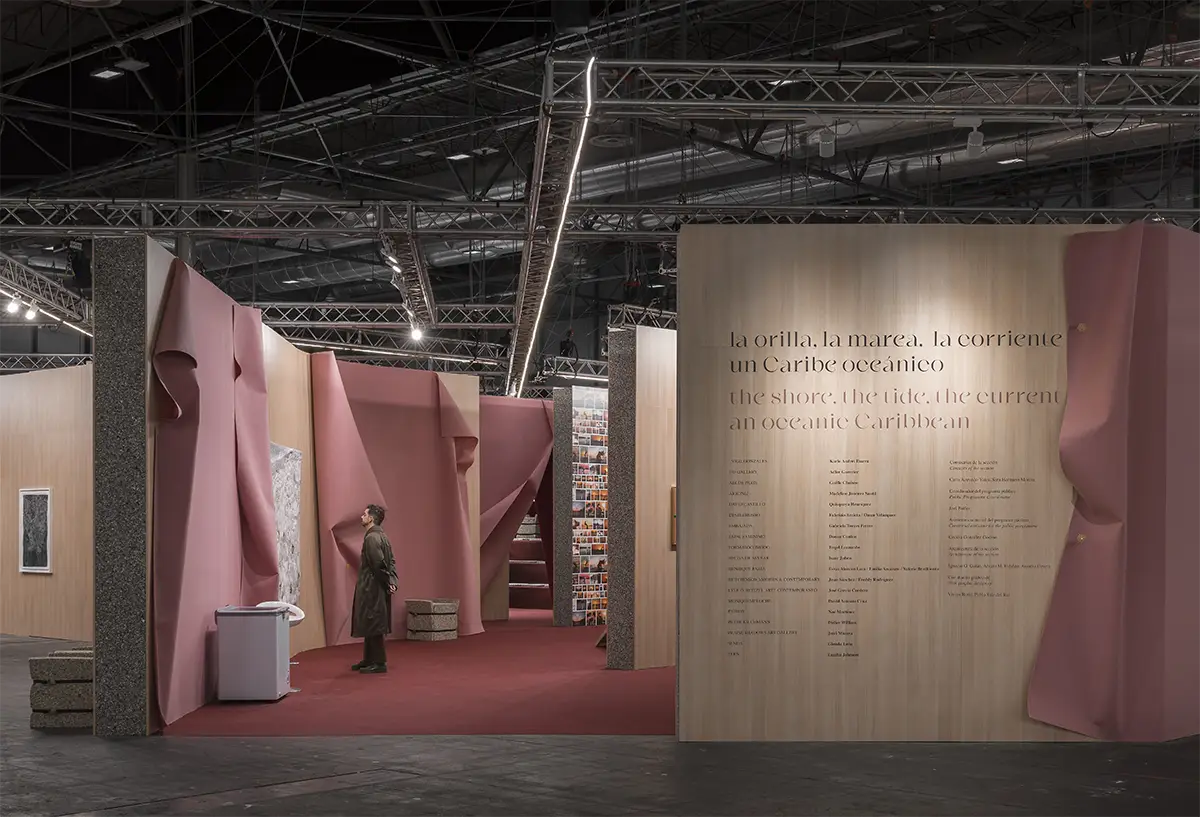
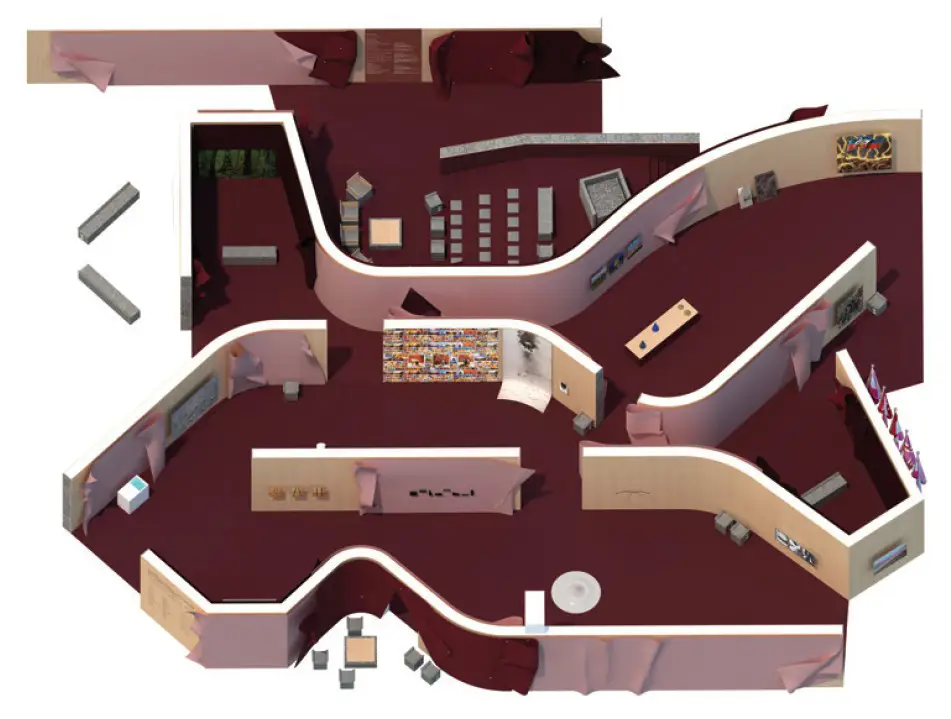
ARCO (3 & 4)
For an exhibition in Madrid titled the shore, the tide, the current: an oceanic Caribbean, Ozaeta-Fidalgo configured, with collaborator Ignacio G. Galán, a fluid floor plan that initiates conversations between the works of the 23 artists on display. The walls are partially clad with pieces of pink carpeting that are cut, folded, and twisted. Photo © Imagen Subliminal

LOW(do)TECH
Ozaeta-Fidalgo converted a small block of teacher’s housing into a children’s play center. In addition to opening up the interiors with larger spaces, the firm designed a garden with a curving pergola in the backyard for use as an outdoor classroom and recreation area. The architects used color to identify various parts of the design: red for structural members, green for infrastructure, and orange for elements of repair and renovation. Photo © Imagen Subliminal
Although the pair maintains a small studio, Fidalgo and Ozaeta team up with other colleagues to pool intellectual curiosity and experience for more complex projects and, more practically, to qualify for restricted competitions. For a large house in a pine forest north of Madrid, they collaborated with Ignacio G. Galán, a former classmate based in New York, and the landscape architecture firm Ambienta, to address the poor biodiversity there. Again, their approach is horizontal, challenging larger firms with the agility inherent to the gig economy. “We’re part of a network of very specialized, experienced microstudios,” Ozaeta maintains. “When we join forces, we become stronger.”
This way of thinking and these bottom-up tactics arose from the post-crisis social and political upheavals of 2011 that produced Spain’s anti-austerity 15-M encampment in Puerta del Sol—which attracted many young architects—and the subsequent Occupy Wall Street demonstrations in New York. While the left-wing political parties that emerged from this broad movement have struggled in recent years, studios like Ozaeta-Fidalgo, which have sought to reinvigorate architectural practice in the face of new challenges, may prove to be one of its lasting legacies.
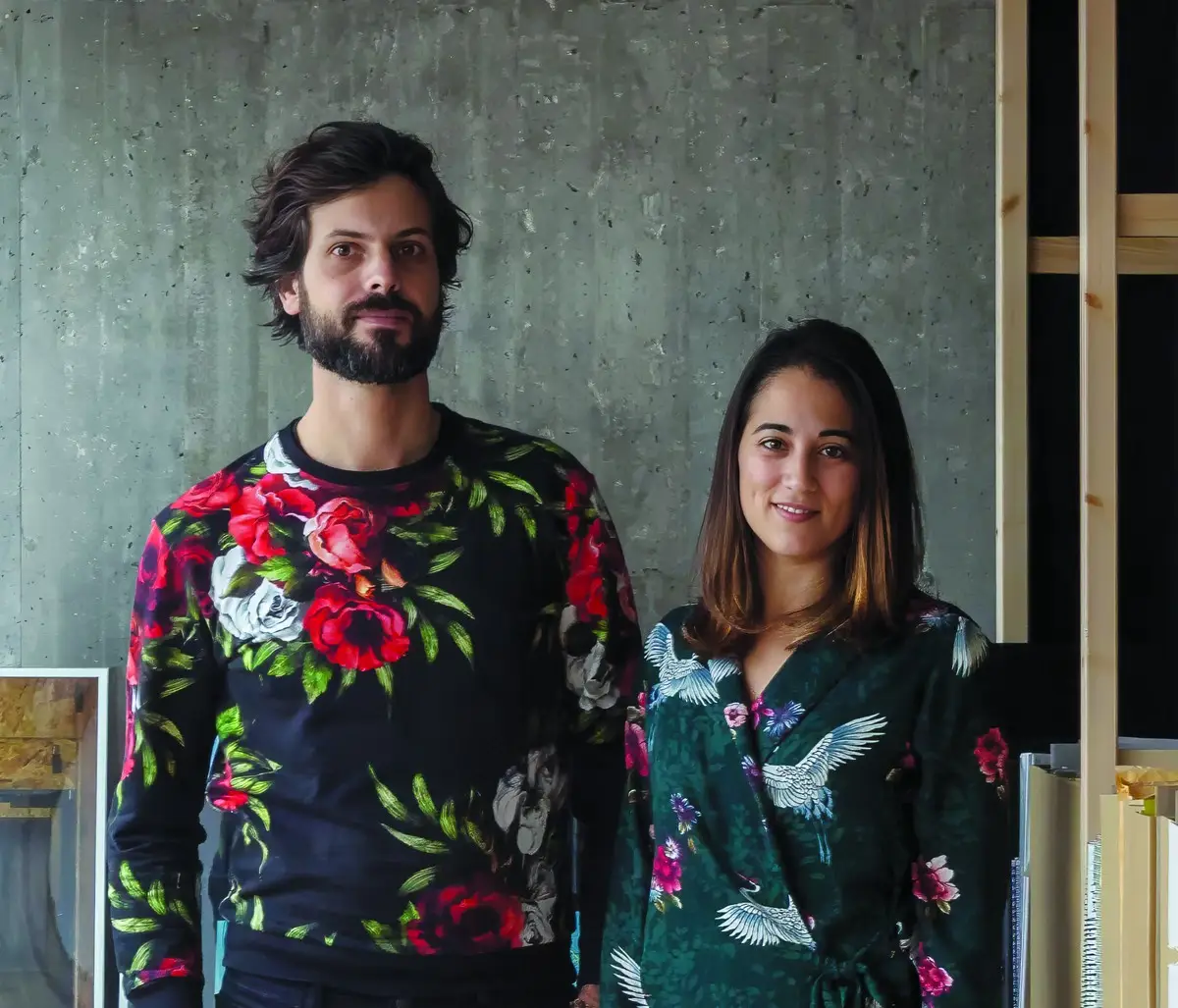
Arantza Ozaeta and Álvaro M. Fidalgo. Photo © Marc Goodwin
FOUNDED: 2013
DESIGN STAFF: 5-7
PRINCIPALS: Arantza Ozaeta, Álvaro M. Fidalgo
EDUCATION:
Ozaeta: Polytechnic School of Architecture of Madrid, M.Phil., 2013; Polytechnic School of Architecture of Madrid, M.Arch., 2008
Fidalgo: Polytechnic School of Architecture of Madrid, M.Phil., 2013; Polytechnic School of Architecture of Madrid, M.Arch., 2008; TU Delft Faculty of Architecture and the Built Environment, 2005
WORK HISTORY:
Ozaeta: Hochschule Coburg, 2014; Pasajes de Arquitectura y Crítica, 2006–08
Fidalgo: Soriano & Asociados, 2005–08; MVRDV, 2005–06
KEY COMPLETED PROJECTS:
ARCO, 2024; Beyond-the-Family Kin, 2023; POP-UP House, 2014 (all in Madrid); LOW(do)TECH, 2024; Stellar tents, 2020; Kinetic MOT-TO, 2019 (all in Haro, Spain); Cabinet of Curiosities, 2021 (Villarrín, Spain); IQ-Experimental Subsidized Housing, 2017; Jugend & Kulturzentrum, 2016; Haus der Tagesmütter, 2013 (all in Selb, Germany)
KEY CURRENT PROJECTS:
Campalliances, Ciudad Ducal; Arturo Soria Retrofit, Madrid; House Z, Anguciana; Complex for Astronomical Tourism, Gimileo (all in Spain)
Looking for quick answers on architecture and design topics?
Try Ask RECORD, our new smart AI search tool.
Ask RECORD →
Looking for a reprint of this article?
From high-res PDFs to custom plaques, order your copy today!