Ney & Partners Suspends a Scenic Footbridge from a 19th-Century Rail Viaduct in Southern France

Architects & Firms
Perched high above the River Tarn, the small French city of Albi is famed for its fortified red-brick cathedral and its medieval center, a UNESCO World Heritage Site since 2010. Included in the UNESCO listing is the 13th-century Pont Vieux, which, until the 1860s, was the only bridge over the river. In 1864, the railroad arrived, carried on a splendid brick viaduct that crosses the Tarn well downstream from the Pont Vieux; and, in 1867, the equally handsome Pont Neuf, a road bridge, opened upstream from the historic crossing. Unlike the Pont Vieux, located at the bottom of the narrow valley, the viaduct traverses at the level of the bluffs on either side, soaring to an impressive 100 feet above the water. In 2013, seeking to reduce traffic on the Pont Neuf and improve connections between the historic center and the suburbs, the city commissioned a new pedestrian and cycle crossing suspended from the rail viaduct.

Photo © Vincent Boutin
Under the rules of the design competition, entrants could choose which side of the viaduct to hang this new footbridge. For its winning proposal, Ney & Partners, a Brussels-based firm of engineers and architects, selected the downstream elevation, a choice with several advantages and one significant drawback. On the positive side, it minimized the footbridge’s visual impact when seen from the historic city, took advantage of more ample access where the viaduct meets the suburbs, framed views of the old town through the viaduct’s arches, and breathed new life into the Place du Calvaire, a rather forlorn public space that, like the viaduct itself, is located just outside the UNESCO-designated area. The hitch concerned access from the old town, since the Place du Château, which meets the viaduct on the UNESCO side, was cut off from the Place du Calvaire by the railroad (until the tracks split them apart, these two public spaces were one). To resolve the problem, Ney created a new link that cantilevers out from the bluff and passes under the first arch of the viaduct.
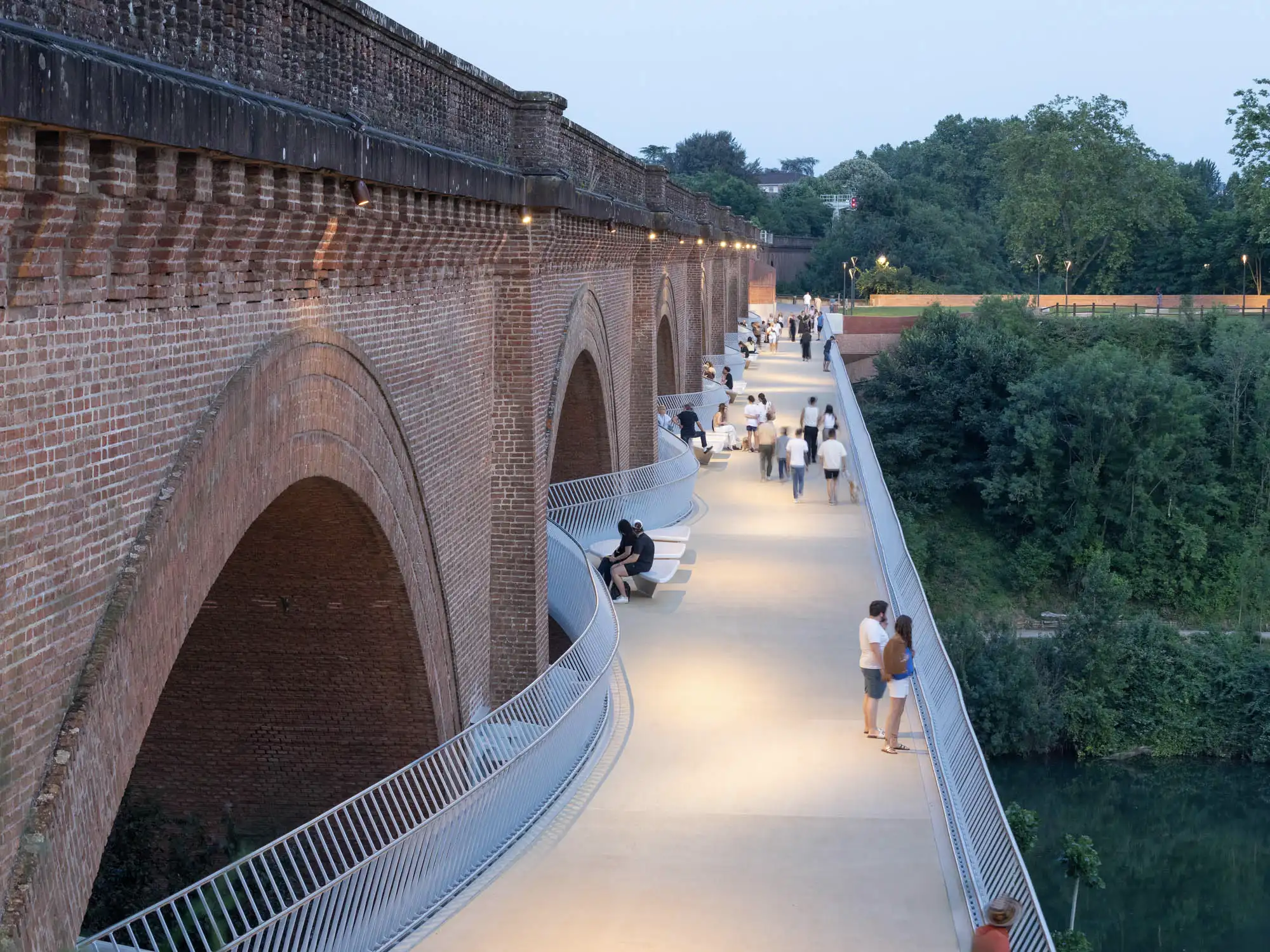
Photo © Vincent Boutin
Suspended between the springing point and the summit of the viaduct’s arches, the 600-foot-long footbridge proper, realized in lightweight steel, attaches to the brickwork via articulated brackets. Rather than a simple straight line, Ney designed a structure that undulates both vertically and horizontally. By spilling out laterally into each arch, the footbridge provides a series of urban belvederes overlooking the old town; and by rippling slightly in its vertical plane, the bridge deck synchronizes with the arch cadence and renders the crossing physically palpable, particularly to cyclists. The ripple’s subtle effect is particularly evident in the elegant handrails.
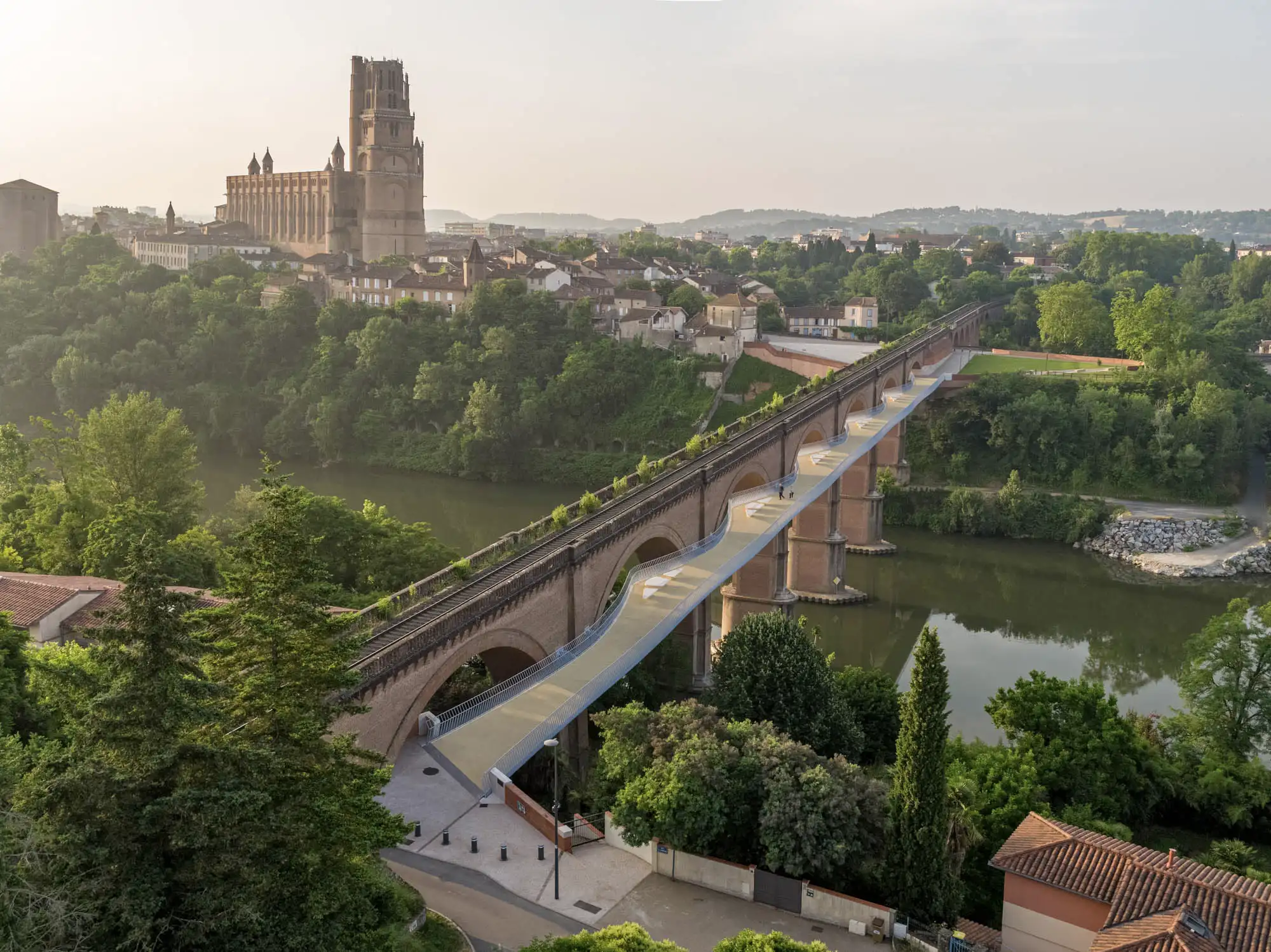
Photo © Vincent Boutin
Where construction was concerned, each prefabricated section arrived on site on a crane-equipped barge and was winched onto temporary supports cantilevered from the piers. Once all had been mounted and bolted in place, the sections were welded together and the temporary supports removed. An unlikely series of procurement setbacks, as well as COVID and the war in Ukraine, delayed completion until May of this year, but the result was very much worth the wait.
Looking for quick answers on architecture and design topics?
Try Ask RECORD, our new smart AI search tool.
Ask RECORD →
Looking for a reprint of this article?
From high-res PDFs to custom plaques, order your copy today!