Sustainability in Practice Summer 2025
An Adaptive Reuse Project by Lever Architecture Makes the Grade at the University of Oregon’s New Portland Campus
Portland, Oregon

Architects & Firms
When the Eugene-based University of Oregon bought the defunct Concordia University to house its Portland campus in 2022, department directors had to puzzle their programs into a dozen mostly 1970s and ’80s-era buildings. The College of Design’s Portland architecture school decided to take the building widely regarded as the runt of the litter: a 1950s gymnasium converted into a theater three decades ago. “Nobody really wanted it,” says Justin Fowler, director of UO Portland Architecture, but he and his colleagues saw potential.
1
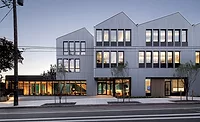
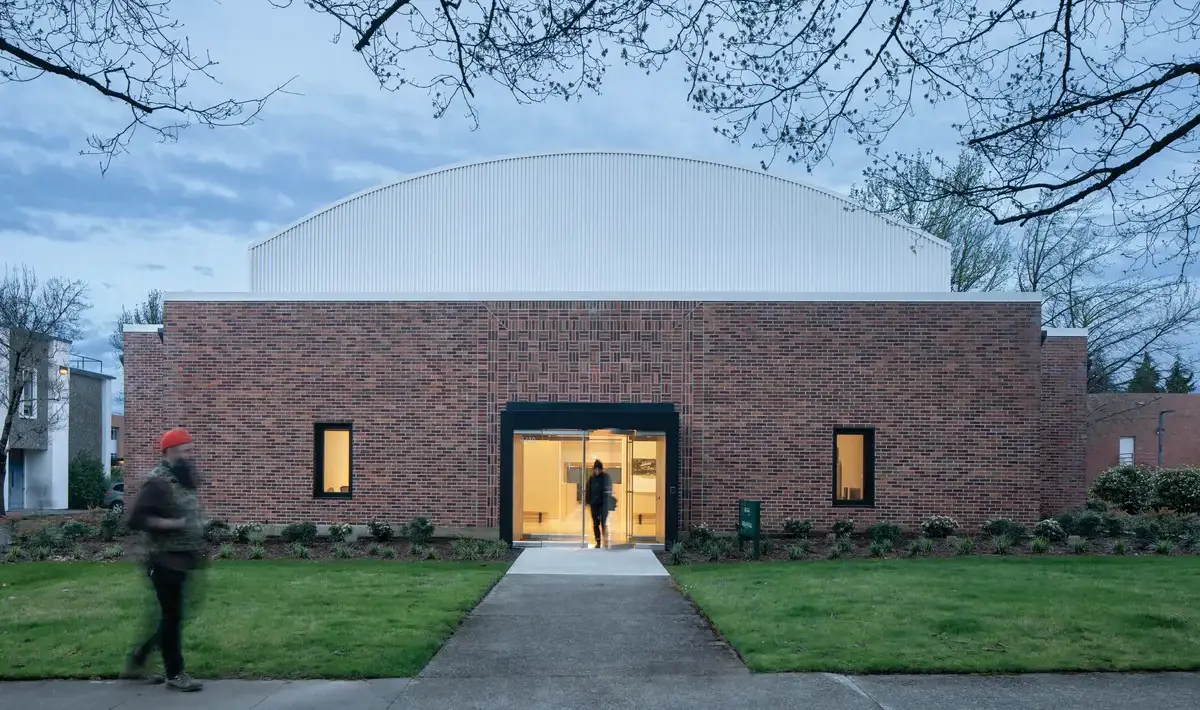
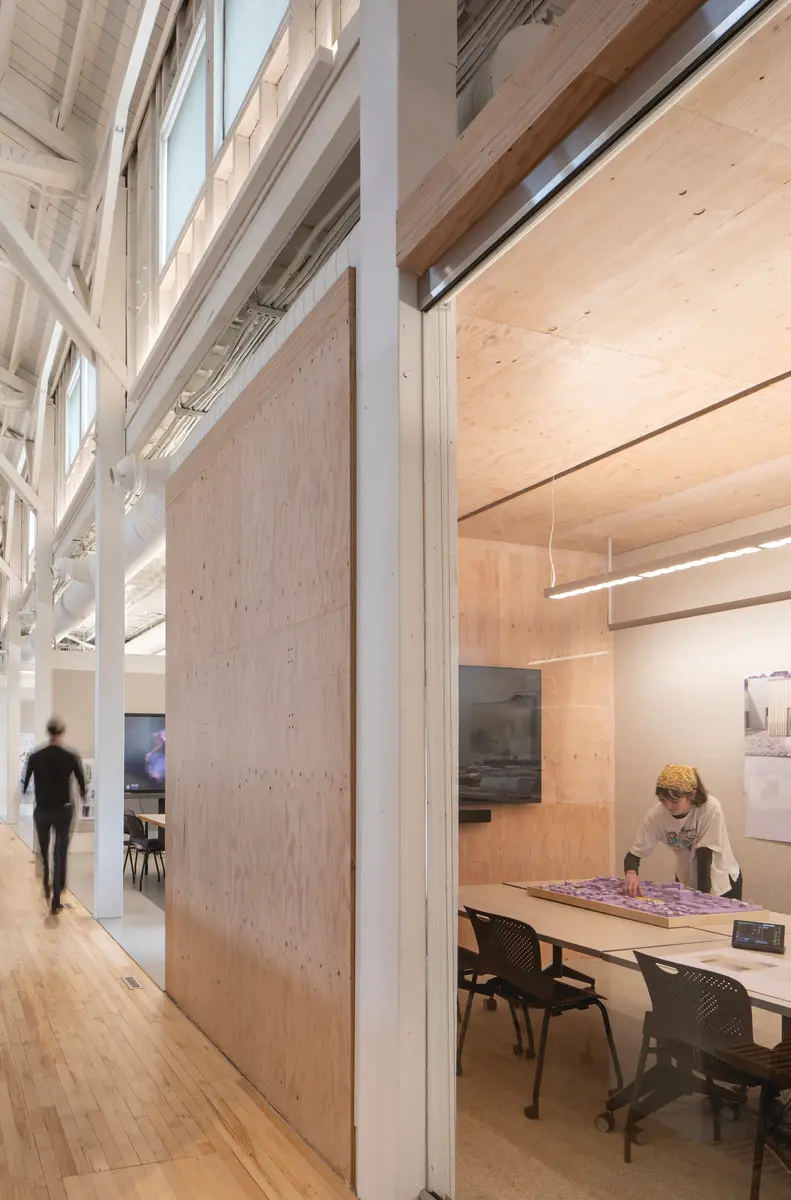
Glazed entrances and windows inserted into the brick facade (1) flood the interior with daylight (top of page and 2). Photos © Lara Swimmer, click to enlarge.
2
UO tapped Portland’s Lever Architecture to transform the building. Upon first sight, the old gym-turned-theater’s proscenium stage, green rooms, and overall darkness, “reminded me of my junior high school auditorium,” says Lever founding principal Thomas Robinson. But when the team punched through the dropped ceiling and scraped away a patch of the floor’s black paint, a “diamond in the rough” emerged in rustic timber bow trusses, long-covered clerestory windows, and maple floors.
Now reclaimed and renewed, the program’s new home—called Highland Hall—is a study in reuse, restraint, and economy.
With a deadline of one year for design and construction and a tight budget, “we couldn’t afford to design too much,” Robinson says, “but we could spend a lot of time thinking about the design we were doing.”
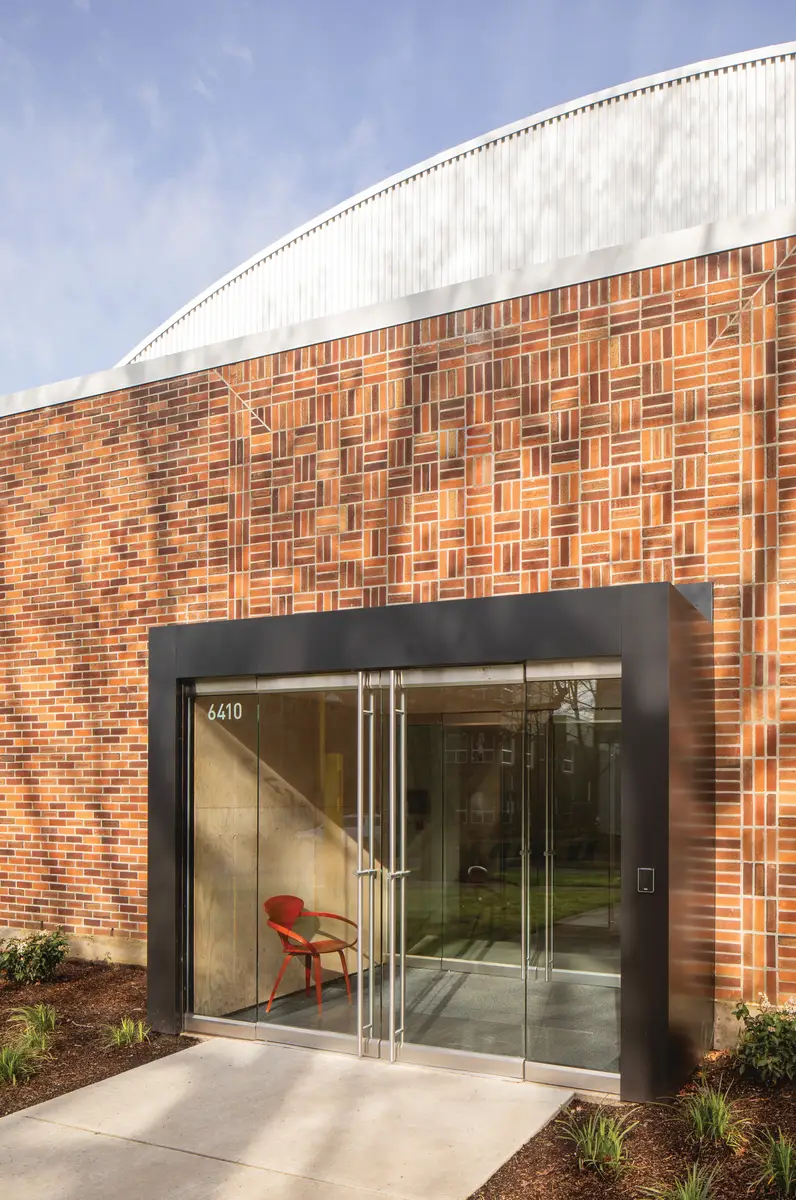
At ground level, the 8,640-square-foot building was an almost windowless brick box, but also one of the few campus structures directly facing an adjacent residential neighborhood in Northeast Portland. With simple insertions of glass entries at each end, the unassuming midcentury structure now provides gracious front doors to the neighbors and the campus behind it while serving as a visual portal between them.
3
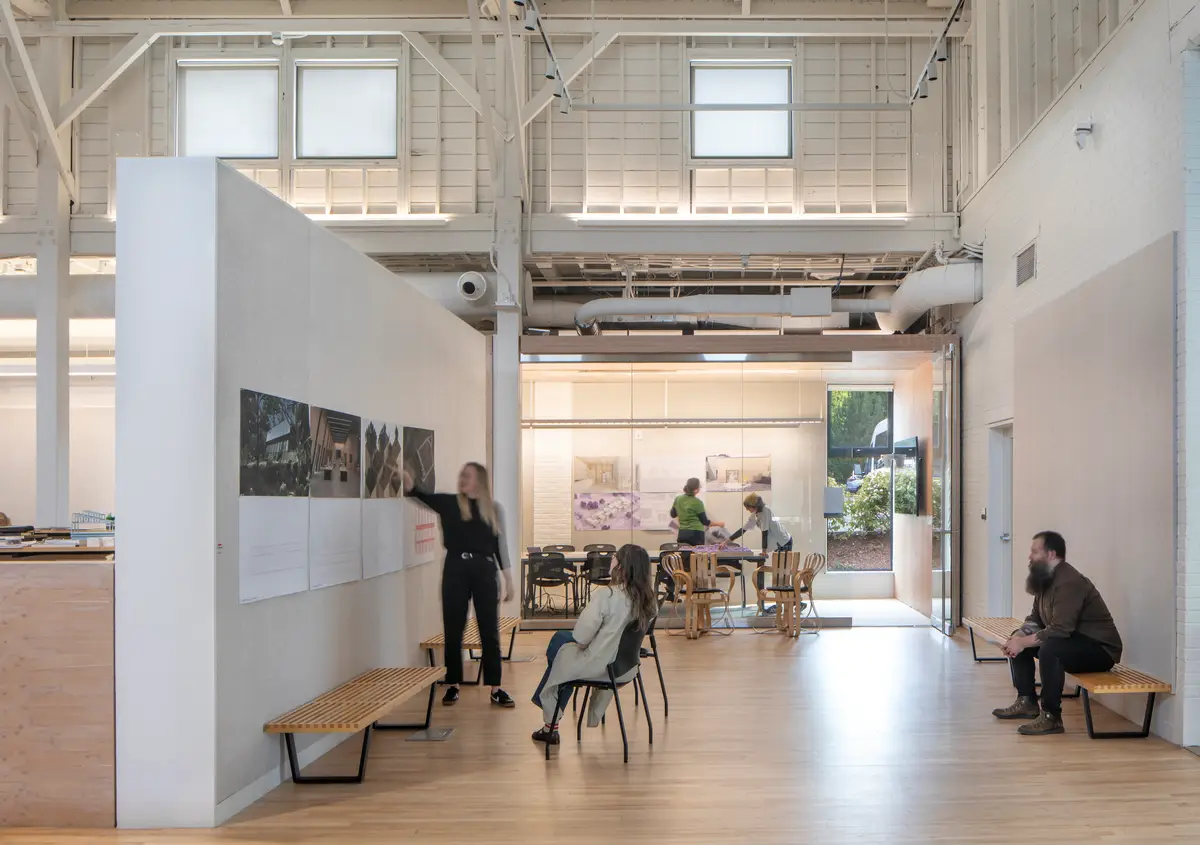
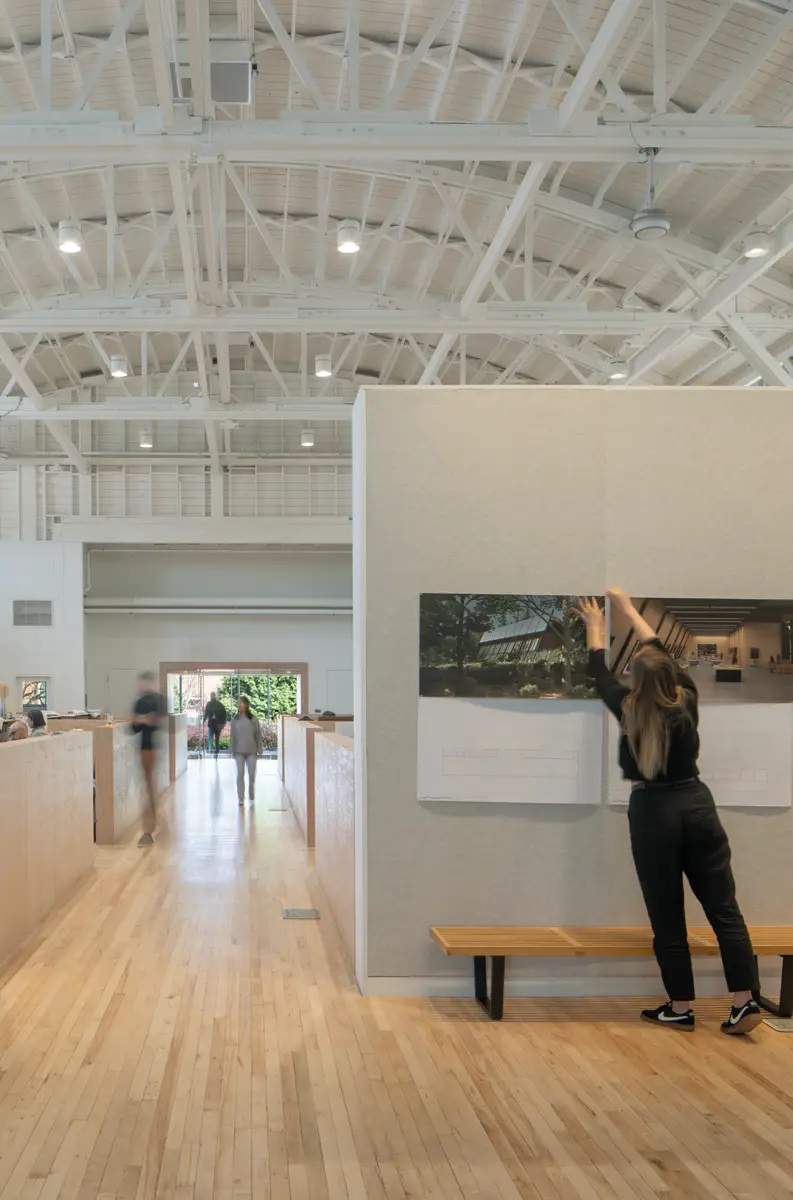
Facing an adjacent neighborhood, the building emphasizes transparency inside (3 & 4) and out (5). Photos © Lara Swimmer
4
5
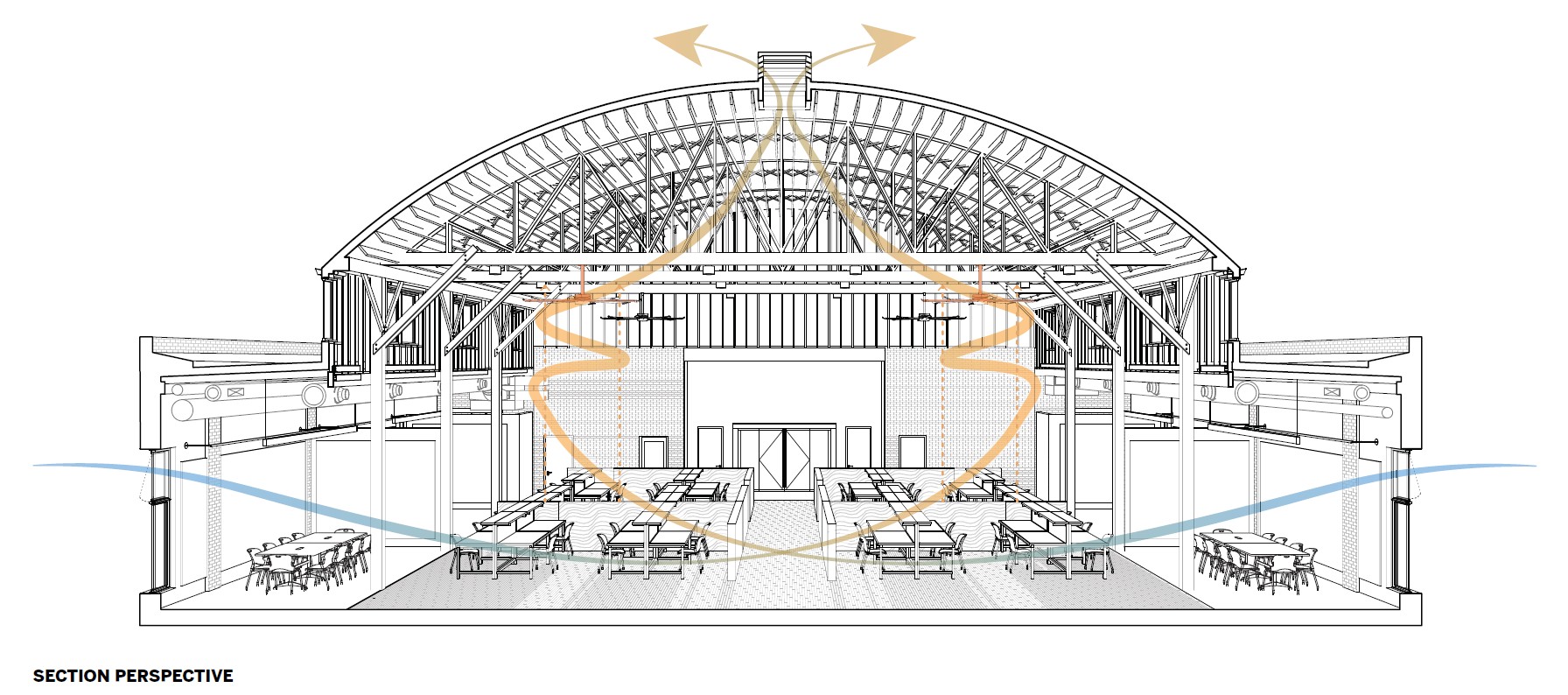
Lever replaced the boarded-over clerestories with a glazing system that bathes the space in sunlight. Eleven new ground-level windows provide additional light, anchor the interior experience to its surroundings, and, for the tiny faculty offices, offer a sense of greater space. Reversible fans and ceiling vents draw air in or expel it, to moderate temperatures.
Now exposed and steel-reinforced, the bowstring trusses shape a barrel-vaulted ceiling, 32 feet high at the peak. Seminar rooms, spaces for pinups, restrooms, and a kitchenette are neatly tucked into the perimeter. A gallery positioned just inside the front entrance buffers studios from faculty and provides a gathering spot for lectures and reviews. “We didn’t want to be hovering over the students,” Fowler says.
Looking for quick answers on architecture and design topics?
Try Ask RECORD, our new smart AI search tool.
Ask RECORD →
The most notable architectural insertion is a series of 7-inch-thick mass-plywood slabs that frame the vestibules around the front and rear entrances. They also serve as partial-height partitions to divide the four studios and enclose the seminar rooms. The slabs lived their first life as floor panels used for seismic testing by the TallWood Design Institute’s Emmerson Advanced Wood Products Laboratory at Oregon State University. Robinson discovered that an enterprising UO student had catalogued the remnants. Testing stresses precluded any structural reuse, so he convinced the Institute to donate the materials and the cost of CNC machining. “We reused something that would have just been thrown away,” he says.
Fowler’s overriding aim was “to serve the students.” Both he and Robinson favor schools that gather studios in one space. Indeed, the 36 workstations take center stage. Lever sized them so that tables from the program’s former home could be reused. The mass-plywood panels surround and divide the cubicles into pods, forming a grid that gives the space architectural muscle.
Highland Hall’s good bones and Lever’s light touch imbue the old gym with a near-ecclesiastical air. White paint applied to the trusses, exposed wood, and masonry structural elements (the ply panels were treated with a whitewash sealer) unifies the overall space. The rooms and pinup spaces symmetrically arranged on each side recall the side chapels lining the nave of a church, and the thick studio partitions, pews.
“By surgically removing and revealing and bringing material character to the space, we created a place that we hope is inspiring to the students,” says Robinson.
Some lamented the program’s move five miles from downtown’s historic White Stag Block, a structure adapted to become the university’s Portland satellite campus only 17 years ago. Fowler and his colleagues, however, observe a stronger camaraderie among students at UO Portland Architecture’s new home, which has become a first stop on donor tours of the former Concordia campus’s reinvention.
While missing the cafés and bars and views of the bustling downtown location, students generally agree on the success. “We had apprehensions about the move,” says Nicole Stout, a recent grad who studied at both Highland Hall and its predecessor space. “I picked the downtown-campus program to be in an urban space, but Highland accomplished a lot of things in terms of community.”
“It’s very concise and straightforward,” says Robinson of Highland Hall. “It amplifies what’s happening inside. I think it’s important for architects to demonstrate the value of what they do, and architecture school should be the first place to do that.”
Click drawing to enlarge
Credits
Architect:
Lever Architecture — Thomas Robinson, principal in charge; Timothy Cooke, project architect; Cecily Ryan, interior designer; Flynn Casey, designer
Engineers:
Valar Consulting Engineering (structural); Arris Consulting (mechanical); Reyes Engineering (electrical)
Consultants:
O-LCC Lighting Design; Soderstrom Architects (roof design and masonry restoration)
General Contractor:
Howard S. Wright
Client:
University of Oregon
Size:
8,640 square feet
Cost:
Withheld
Completion Date:
September 2024
Sources
Helical Wall Ties:
Simpson Strong-Tie
Mass Ply Panels:
Freres Engineered Wood
Roofing:
Carlisle, Siplast
Glass:
Guardian
Entrances:
Assa Abloy
Interior Finishes:
Armstrong (acoustical ceilings); Wilsonart (plastic laminate); USG (suspension grid)
Hardware:
Schlage (locksets, pulls); LCN (closers); Von Duprin (exit devices)
Looking for a reprint of this article?
From high-res PDFs to custom plaques, order your copy today!