Sustainability in Practice Summer 2025
Herzog & de Meuron Designs a Timber-Framed Swiss Office Building with Ambitious Sustainability Goals
Allschwil, Switzerland

Architects & Firms
In terms of construction culture, Switzerland can appear a paradoxical place. On the one hand, it has some of the strictest codes anywhere with respect to building performance and energy expenditure, while on the other, the tiny Alpine country consumes vast amounts of carbon-heavy concrete. Indeed, its annual per-capita production is twice that of neighboring France, according to figures released by the Federal Office of Topography in 2020. With this in mind, it seems quite the paradigm shift when a renowned Swiss firm such as Herzog & de Meuron (H&dM), whose back catalogue includes all-concrete projects such as the Blue House (1980), the House in Leymen (1997), or the Schaulager (2003), sets out to construct a 150,000-square-foot office building using almost no concrete at all. But this was precisely the challenge H&dM took up when developer Senn tasked it with designing the multi-occupant rental project Hortus, located in a life-sciences business park in the Basel suburb of Allschwil. In fact, as project lead Alexander Franz explains, Senn asked for nothing less than “the most sustainable office building in Switzerland.”

1
The five-story timber building (top of page) hovers just above grade and features lush plantings (1 & 2). Photos © Maris Mezulis, click to enlarge.

2
“Instead of a classic program, they gave us sustainability goals,” Franz continues, an approach that entirely upended H&dM’s usual design process. “Normally you look first at the urban scale, the massing, etc., and at the very end you start to consider building components. Here, we started off with the building components, which had to be renewable and recyclable.” Though the architects could not avoid concrete entirely, they used it with extreme parsimony for the foundations, which comprise 6.5-foot-deep footings beneath each column. Above that, timber takes over, with a sturdy frame in locally sourced, engineered beechwood that is cross-braced diagonally to satisfy seismic code. The facade structure, meanwhile, is in spruce, a faster-growing softwood that can be felled much younger than the 100-year-old trees required for the principal frame.
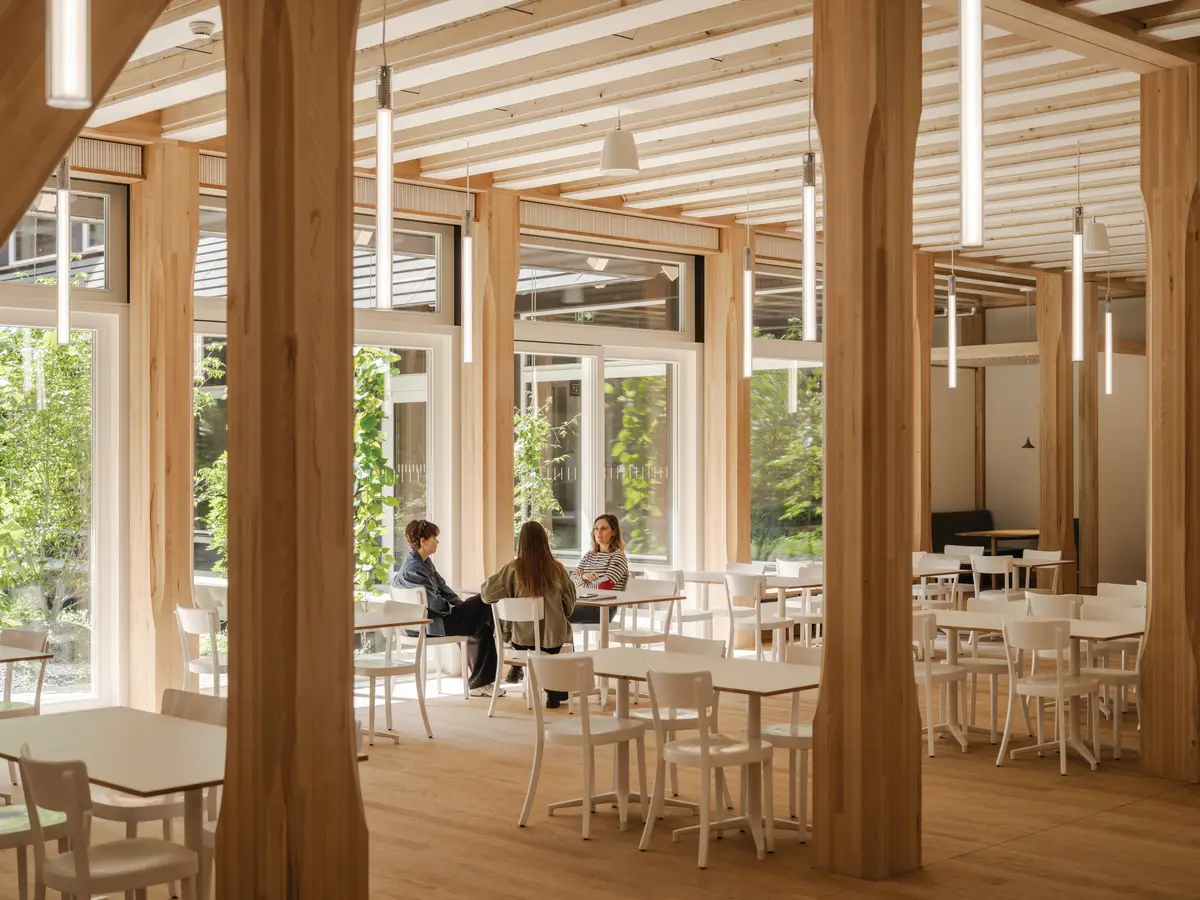
The airy ground floor and its covered wooden veranda are accessible to visitors. Photos © Maris Mezulis
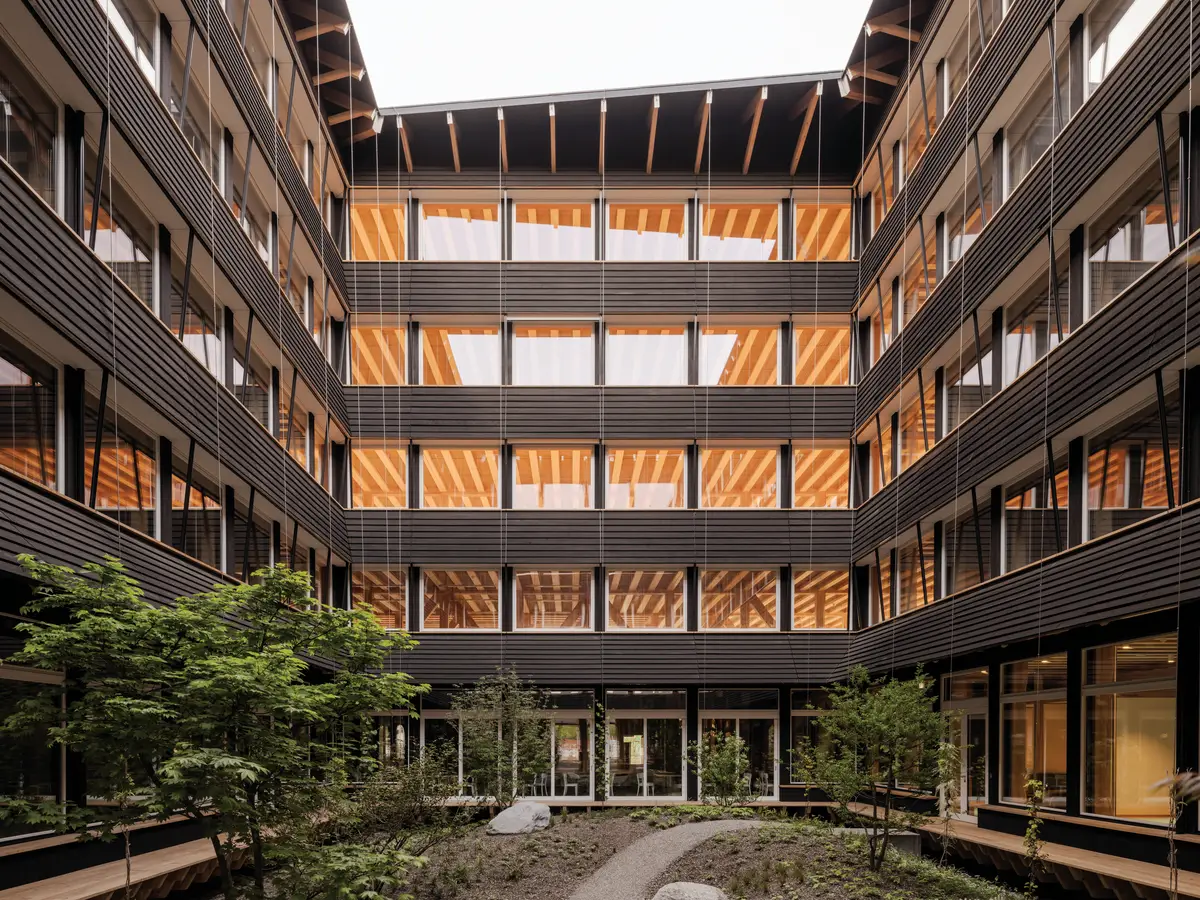
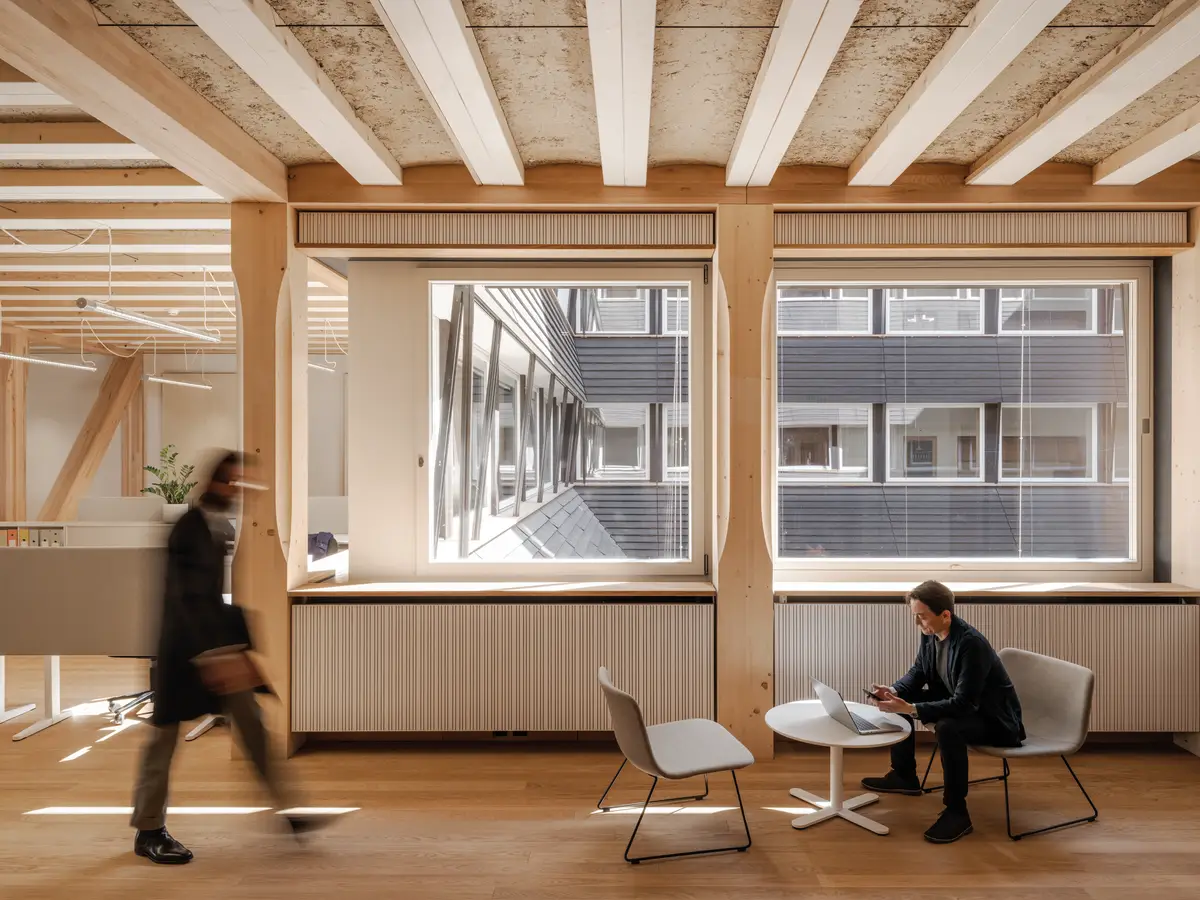
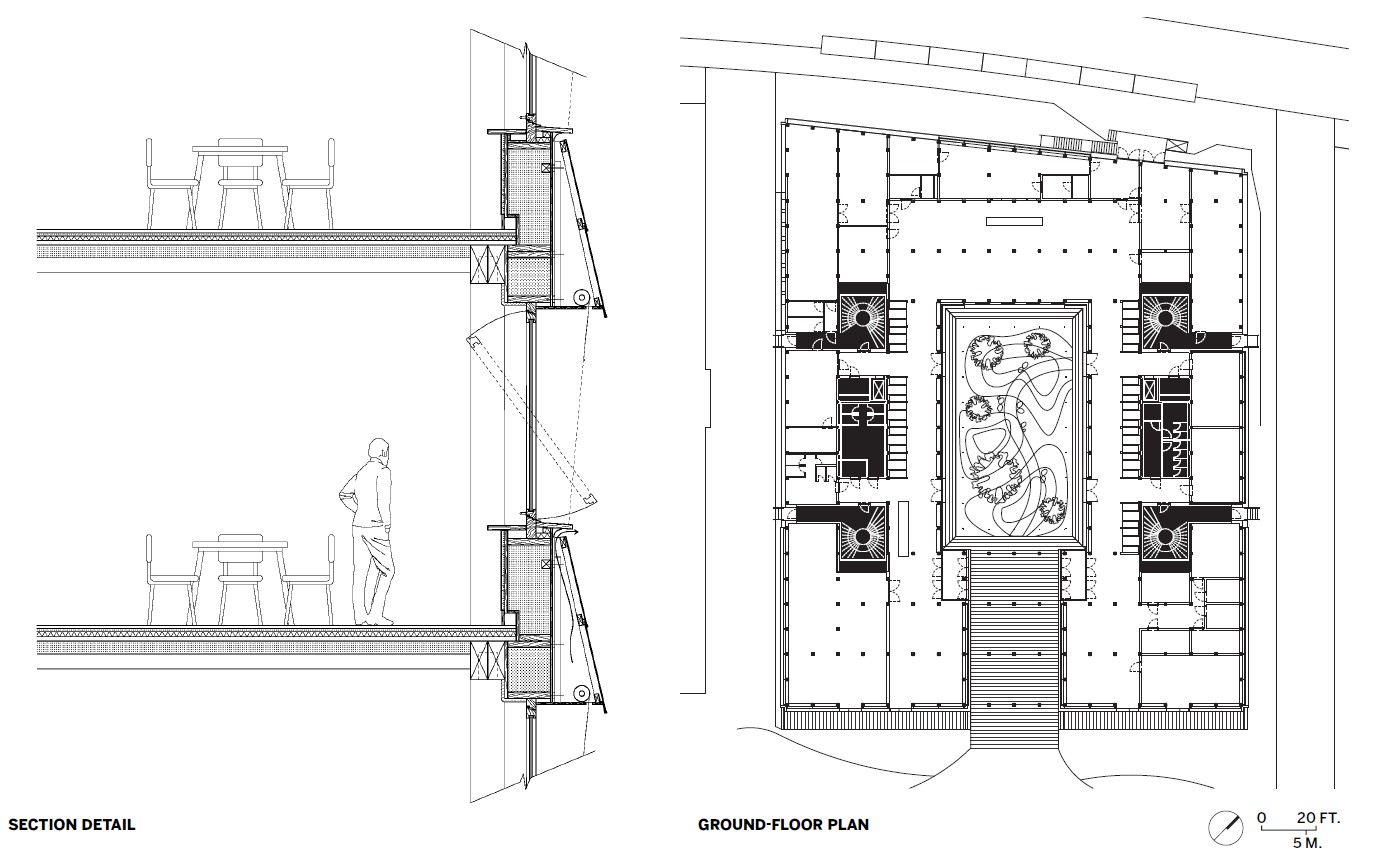
Filling its plot to the perimeter, Hortus wraps around a central courtyard planted by Piet Oudolf to create a cooling microclimate. To ensure plentiful indoor daylight, five airy stories rise in place of the six that code allowed. Since wood might rot in contact with the ground, the first floor hovers just above grade, avoiding the need for any masonry. By eschewing floor-to-ceiling windows—for which Swiss code stipulates triple glazing—Hortus saves 33 percent in glass; instead, openable double-glazed units take their place in elevations that are half solid half void. Initially, H&dM planned to abandon mechanical ventilation, but the developer later backtracked, so the building includes forced-air columns that automatically shut off when tenants open the windows. Since Senn’s ambitions included counterbalancing the energy used to construct the building within a generation, the outer facades and the roof sport locally sourced solar panels; the electricity they generate more than meets daily needs, and the surplus is channeled to neighboring buildings run by Senn. In this way, claims H&dM, Hortus will achieve operational and embodied carbon neutrality by 2056.
3
4
The building wraps around a courtyard (3 & 4). Photos © Maris Mezulis
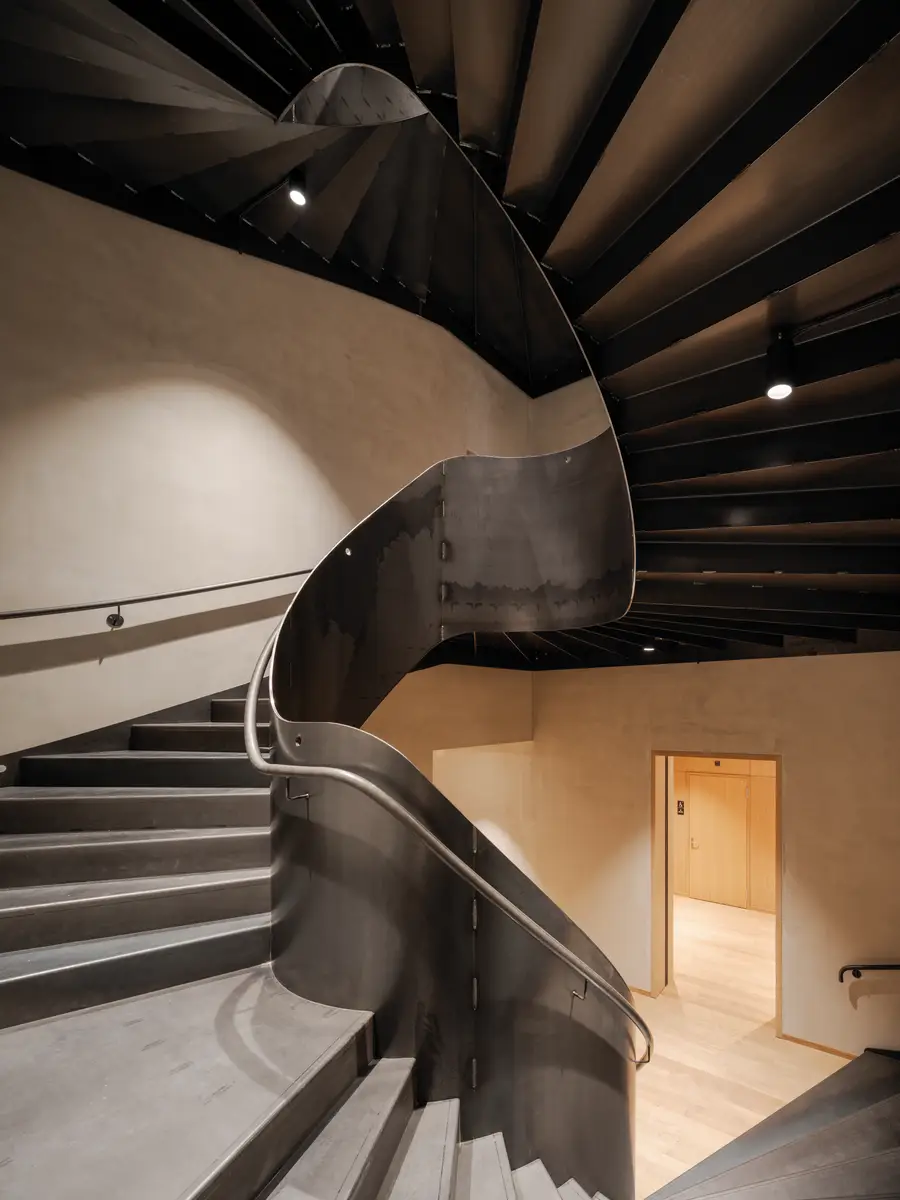
The fire stairs are made from folded steel left entirely untreated. Photo © Maris Mezulis
Given its longstanding interest in materials and techniques, the firm could only delight in a brief like this. In lieu of screws, nails, and metal brackets, H&dM’s timber frame uses gravity and old-fashioned joinery to hold together, which will make for simplified disassembly at the end of the building’s life. Likewise, the fire stairs, which cannot be in a flammable material, are made from beautifully milled and folded steel, which is left entirely untreated—no paint or flooring—to facilitate recycling. Thermal insulation consists of cellulose, 85 percent of which comes from recycled newspapers; there is no carbon-heavy gypsum, since the building’s plaster is made from clay; and dry fill is crushed brick waste rather than the sand that usually soundproofs Swiss floors. But the big innovation at Hortus is the vaulted floor slabs, which combine timber formwork with rammed earth sourced on site. The architects claim that, as well as requiring ten times less carbon to construct than a conventional concrete floor, their system provides the thermal inertia that timber structures often lack, something that could not be achieved in the facades, which are 50-percent glazed, nor in the internal partitions, since the project’s speculative nature required open floor plans. After investing $1.25 million to develop the technology—a big gamble, since it could have failed to meet targets or satisfy code—Senn has made rents higher than average to recoup costs, hoping to woo tenants with Hortus’s environmental credentials and its attractive shared facilities, which include light-filled ground-floor meeting rooms, a spacious restaurant, and a fitness studio.
So what does H&dM’s take on a low-carbon future look like? For founding partner Jacques Herzog, the quest for sustainability “will result in unexpected and surprising architecture with a beauty of its own.” At Hortus, with its dark solar panels set on projecting eaves, the exterior has the air of a slate-clad pagoda; inside, where materials are mostly untreated, the ambiance is part galleon, part 19th-century mill. H&dM’s remit even included low-energy lighting, using only replaceable metal and glass components and incorporating sensors that will help determine if the building really does reach its operational-emissions goal of 5.5 kilograms of CO2/square meter per annum. But, given the obvious questions of reproducibility—the supply capacity of mature Helvetian beech forests, for example, or the ability of Swiss solar-panel suppliers to compete with China—it seems too early to proclaim this a definitive model. Instead, a life-sciences experiment unto itself, Hortus provides a valuable testing ground for the future.
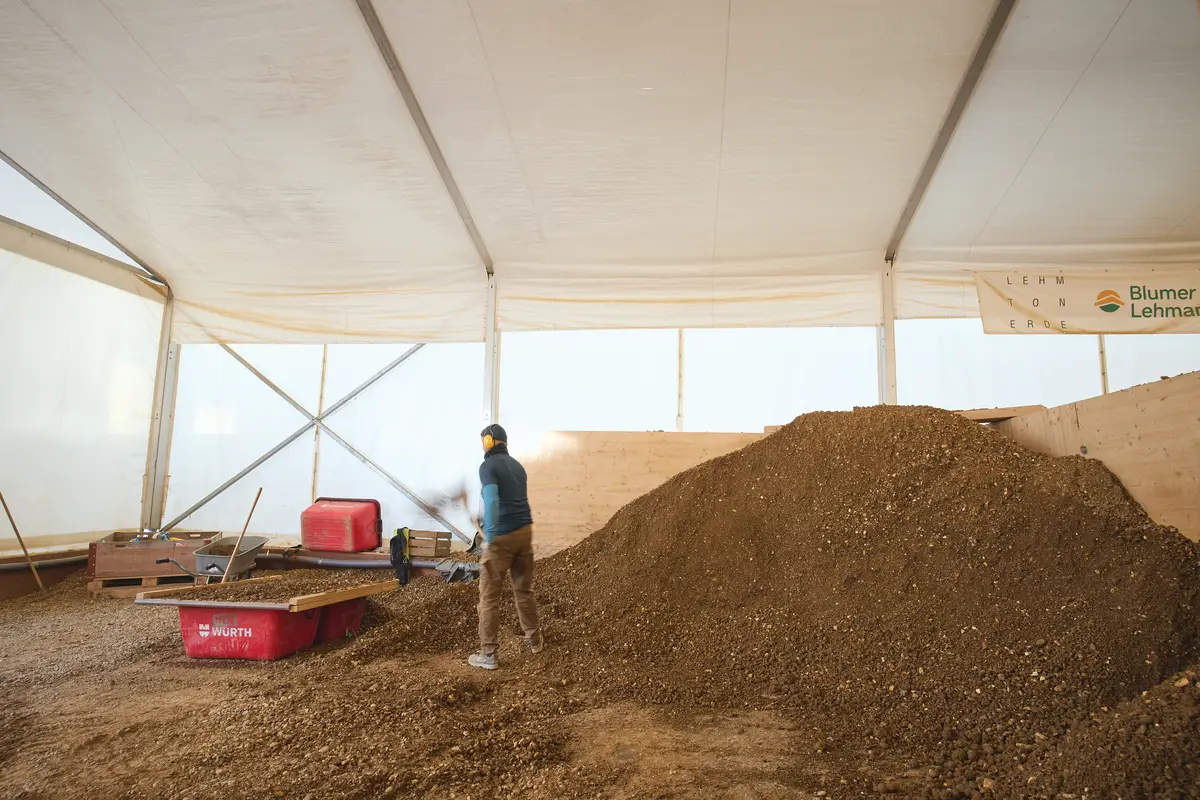
Photos © David Walter
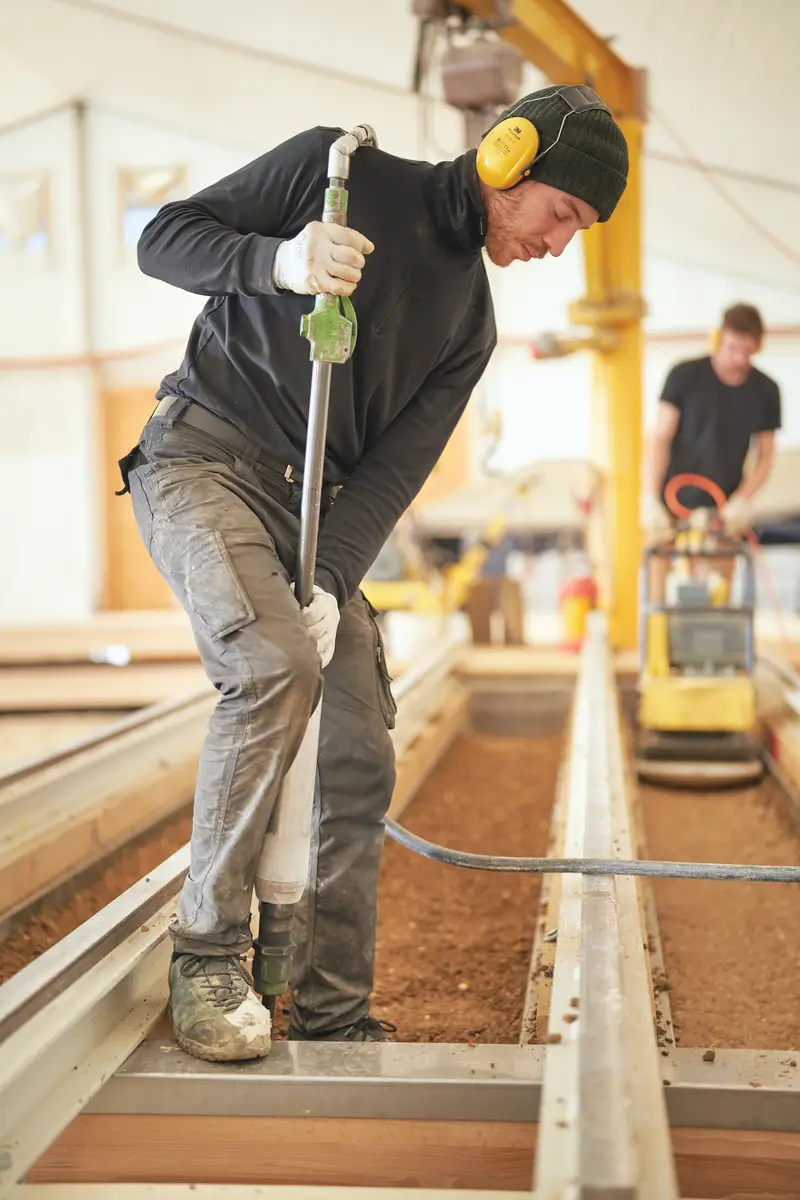
Hortus stands for House of Research, Technology, Utopia, and Sustainability. Its most innovative feature is the floor slabs. H&deM worked with ZPF Engineers to develop a hybrid floor system consisting of rectangular timber elements and clay that is compressed in the form of a vault between the inlaid wood beams. Using a process specially developed for Hortus by Lehm Ton Erde, the clay mixture was produced directly on-site, excavated during construction and shaped into the floor slabs in a field factory next to the building. The clay provides fire protection and serves as a thermal mass in the summer to absorb excess heat.
Click drawings to enlarge
Credits
Architect:
Herzog & de Meuron — Jacques Herzog, Pierre de Meuron, partners; Stefan Marbach, partner in charge; Alexander Franz, associate
Engineers:
ZPF Ingenieure (structural); Anima Engineering (mechanical)
Consultants:
Lehm Ton Erde (rammed earth); Christoph Etter Fassadenplanungen (facade); Planeco (solar); Aegerter & Bosshardt (fire safety); Reflexion (lighting); Kopitsis Bauphysik (building physics); Piet Oudolf, Stauffer Rösch (landscape)
Client:
Senn Resources
Size:
151,770 square feet
Cost:
Withheld
Completion Date:
May 2025
Sources
Timber Fooring:
Gashi
Joinery:
Häubi, Erne AG Holzbau
Metalwork:
Ferdinand Hasler
Lighting:
Zumtobel
Elevator:
Otis
Furniture:
Girsberger (fixed), Vitra
Looking for quick answers on architecture and design topics?
Try Ask RECORD, our new smart AI search tool.
Ask RECORD →
Looking for a reprint of this article?
From high-res PDFs to custom plaques, order your copy today!