RECORD Forum
Comic Strip Criticism
Architecture is, without question, a serious matter—and, over the centuries, some of the most serious voices in the field have endeavored rigorously to theorize about, define, and interpret it. But what happens when we confront this monumental gravitas through the levity? What if we momentarily set aside the lofty and arcane discourse of celebrated architects and professional critics, and instead turn our attention to satire, humor, irony, and parody? What if, rather than revisiting Palladio’s Four Books of Architecture, we explored the 4,000 or so cartoons that have ridiculed architecture through the ages?
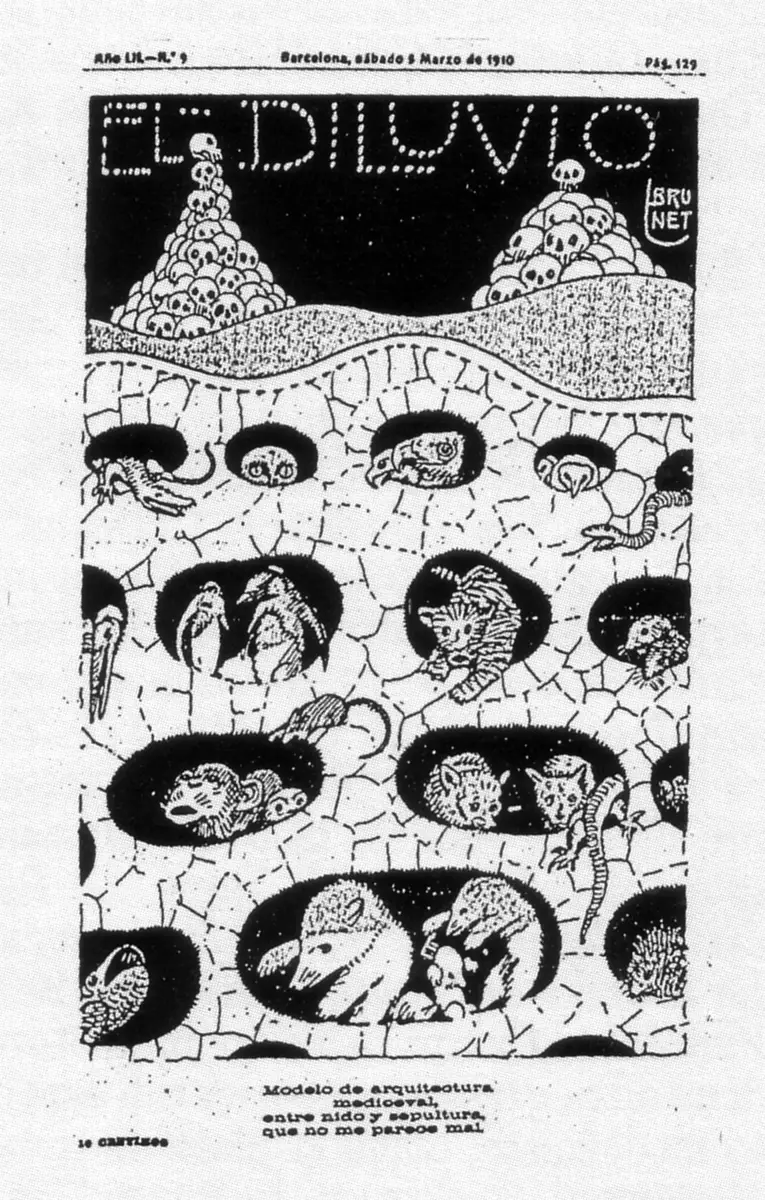
Llorenç Brunet depicted Gaudí’s work as a series of cavernous spaces. Image © El Diluvio, click to enlarge.
From the 18th century onward—albeit with notable antecedents in earlier periods—an abundant and unrelenting torrent of satirical imagery, including caricatures, cartoons, comic strips, photomontages, animated films, and, more recently, digital memes, has critically engaged with the transformation of the built environment. It proliferated, first, by the advent of illustrated periodicals and the rise of print culture, and then via broadcast television and the internet, thereby both reflecting the emergence of a mass audience and enhancing public debate about architecture. This heterogeneous corpus of visual material—varied in form, tone, and intent—can be seen as a formidable counterpoint to the history of architecture.
Some examples? In 1824, in London, an insolent caricature by the great artist George Cruikshank depicted the celebrated architect John Nash impaled on the spire of his own All Souls Church at Langham Place, guilty of having created “a disgrace,” as one member of the House of Commons called it. Still in London—but also in Paris, Rome, and elsewhere—numerous cartoonists anthropomorphized industrializing cities, showing them assaulted, violated, or “disemboweled” by the megalomania of urban planners and politicians. Not to mention New York, where satire on the skyscraper—from Thomas Nast to Saul Steinberg—first predicted and then exaggerated the debate around the “monstrous” skyline. In Barcelona, the masterpieces of Antoni Gaudí, due to their bizarre geometries, were portrayed as animal enclosures (and today those cartoons recall the meandering, cavernous interiors of the Gilder Center in Manhattan!). In Germany, during the Bauhaus years, many cartoons showed ultramodern yet uninhabitable houses: a family having supper with open umbrellas because their flat roof leaks, Breuer-inspired steel furniture needing to be hung on and warmed by radiators because it is freezing to the touch, and a total ban on any kind of decoration. If ornament is a crime, as Adolf Loos claimed, then it could be punishable by a prison sentence. In one chilling cartoon, artist Thomas Theodor Heine depicts a Bauhaus professor cutting off the ears of himself and his family—including the dog—since those appendages too could be deemed useless adornments.

Los von der Architektur (1911) implies that Adolf Loos’s inspiration for his Goldman & Salatsch building was a manhole cover. Image © Illustrirtes Wiener Extrablatt
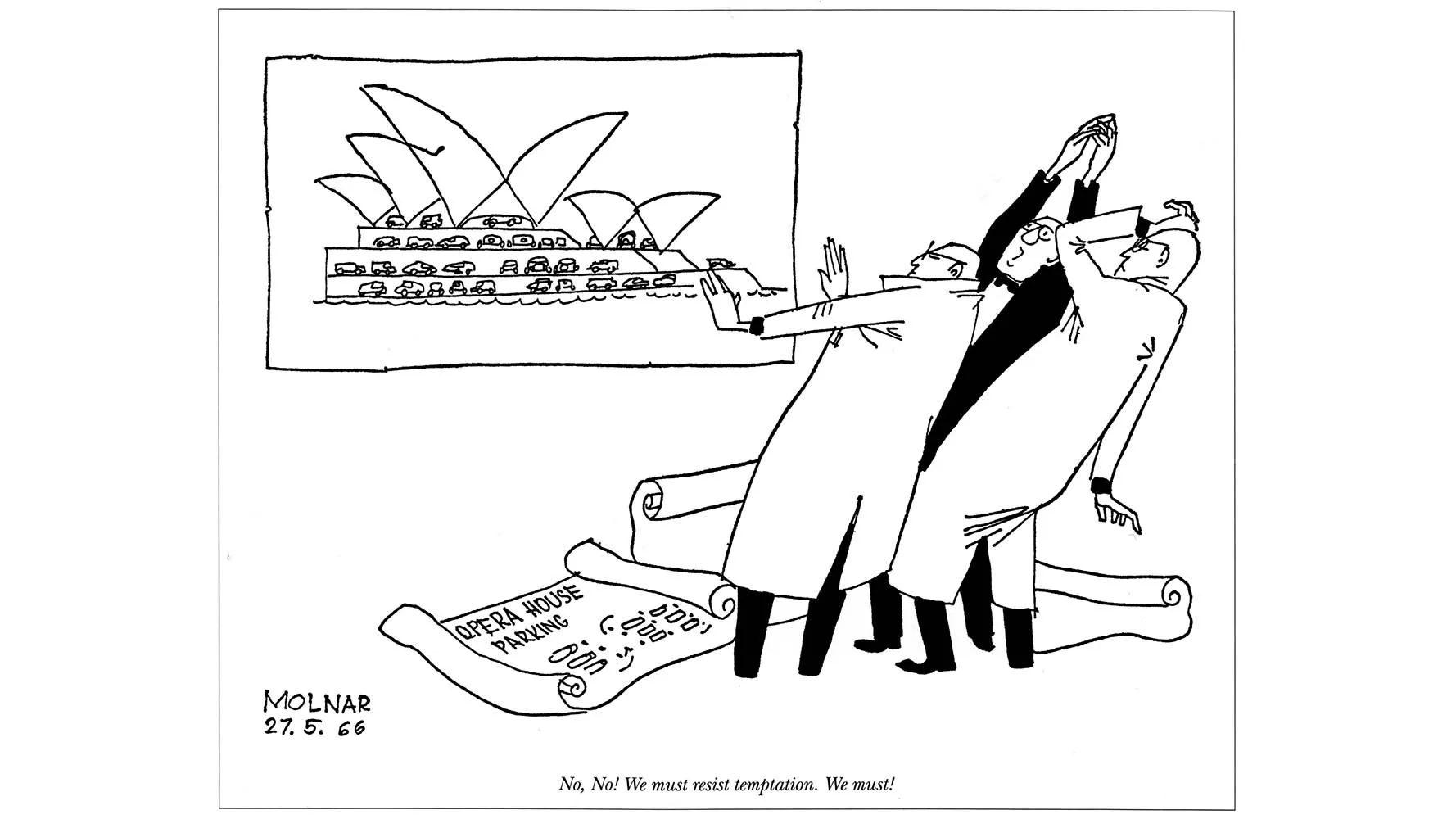
Loos, himself a skilled polemicist, was the subject of a famous caricature that portrayed him hunched over a humble manhole cover—implied by the cartoonist to be the inspiration for his Goldman & Salatsch Building (today known as Looshaus), which indeed appears rather bare and geometric compared to Fischer von Erlach’s ornate Hofburg just across the street. During the Fascist era, the Italian magazine Il Selvaggio mocked modern architecture by depicting a woman (Italy) in distress with a stomach full of boxlike buildings—she had suffered an “indigestion of rationalism.” If the Sydney Opera House looked like a turtle orgy, the Parisian Centre Pompidou resembled an oil refinery, and Breuer’s Whitney Museum evoked anything but what it actually was: “Why can’t they design a museum that doesn’t have to be explained?” asked the illustrator Alan Dunn, who generously contributed to The New Yorker but also to Architectural Record, where he published one cartoon every month for nearly 40 years. For his work, he was awarded the 1973 Architecture Critics’ Citation by the American Institute of Architects, formally sealing the bond between cartoon and criticism.

1
RECORD contributor Alan Dunn drew a cartoon every month for 40 years (1 & 2). Images © Architectural Record

2
Among the most enduring targets of architectural satire are modern houses: glass boxes that overexpose their occupants, lightweight dwellings blown away by the wind, prefab abodes that resemble tin cans, flat-pack structures that are seemingly impossible to assemble, and micro-units where the bed and the bathtub inhabit the same space. Placed beside the pompous declarations of architects and developers, the contrast is striking. However, satire and humor have manifested in many forms beyond cartoons, including cinema (Buster Keaton’s nightmarish kit house in One Week, Jacques Tati’s alienating urban landscape in Playtime) and literature (from Jonathan Swift’s written satire against the English architect and dramatist John Vanbrugh to J.G. Ballard’s High-Rise dystopia). And, of course, Flaubert: “Architects. All idiots. They always forget to put in the stairs.”
Indeed, the persona of the architect emerges as a recurring theme of derision, portrayed in multiple guises: the one who designs as a sculptor (in a famous episode of The Simpsons, Frank Gehry crumples a sheet of paper that becomes the form of a concert hall) or like an engineer (mass-producing bland, blocky buildings); the professional subordinated to market forces; or the lackey of power. In the hands of the cartoonist, the solemn figure of the architect—such as Paolo Veronese’s dignified portrayal of Vincenzo Scamozzi clutching a Corinthian capital—gives way to irreverent caricature. A striking example is Sean Delonas’s cartoon depicting Daniel Libeskind with a set square, ruler, and drawings inserted into his derrière—a scathing jab at the controversies surrounding his involvement in the rebuilding of Ground Zero.
Moreover, tiny drawings illuminate the many other stakeholders involved in the construction process—clients, inhabitants, laborers, and developers—offering alternative perspectives on architecture. They have also foregrounded broader societal issues, from the role of women in domestic space—oscillating between stereotype and emancipation—to considerations of public health, housing, and the environment. Through cartoons, architectural discourse opens itself to the realities of its social entanglements.
Looking for quick answers on architecture and design topics?
Try Ask RECORD, our new smart AI search tool.
Ask RECORD →
But what can a guffaw—or even a giggle—contribute to the holy verb of sacred architectural texts? The apparent simplicity of the cartoon belies its complexity. Through synthesis, ellipsis, and distortion, visual satire distills layered messages that are simultaneously visual, textual, and ideological. And, by weaving together popular and intellectual forms of critique, these images often reach an audience broader than the one in the ivory tower, playing a pivotal role in shaping society’s perception of architecture, then as now.
Of course, the perspectives offered by cartoons and caricatures are often ambiguous and contentious, since—as with any text or image—they are shaped by specific cultural dynamics and vested interests. A well-known case is the satire leveled against the Bauhaus: while it echoed genuine public dissatisfaction (as evidenced by the numerous lawsuits over leaking flat roofs and substandard materials in Frankfurt), it was also amplified by Nazi propaganda aimed at discrediting the entire project of Modernism. Beneath their apparent levity, such images have operated both as instruments of dissent and of propaganda—as seismographs of collective anxieties and as tools of institutional power; as irreverent critiques or, at times, complicit winks within the architectural elite.
Unlike architectural history and narrative chronicles written from within, cartoons reorient popular reception and dissent. Graphic satire allows us to trace a sort of counter-history of architecture, one that exposes the power dynamics, anxieties, and ironies produced by the sudden rise of an architectural modernity suspended between promise and threat, as Jean-Louis Cohen showed in the French Pavilion at the 2014 Venice Biennale, featuring a model of Villa Arpel from Tati’s movie Mon Oncle, a cutting-edge plastic house that turns against its inhabitants.
And today? Targets certainly abound, as do the means of expression and communication—from the now old-fashioned yet still effective cartoon to the many forms that have cropped up on social media. Nevertheless, architectural satire does not appear to be enjoying its finest hour, mirroring a public discourse on the built environment that, today—perhaps disoriented by a broader process of cultural and media realignment—often seems to be gasping for air. We urgently need to take humor seriously, and laugh a little, both as an antidote to and a relief from the many dire challenges posed by the profession, and that face it.
Looking for a reprint of this article?
From high-res PDFs to custom plaques, order your copy today!