From the RECORD Archives: ‘The Juilliard School’
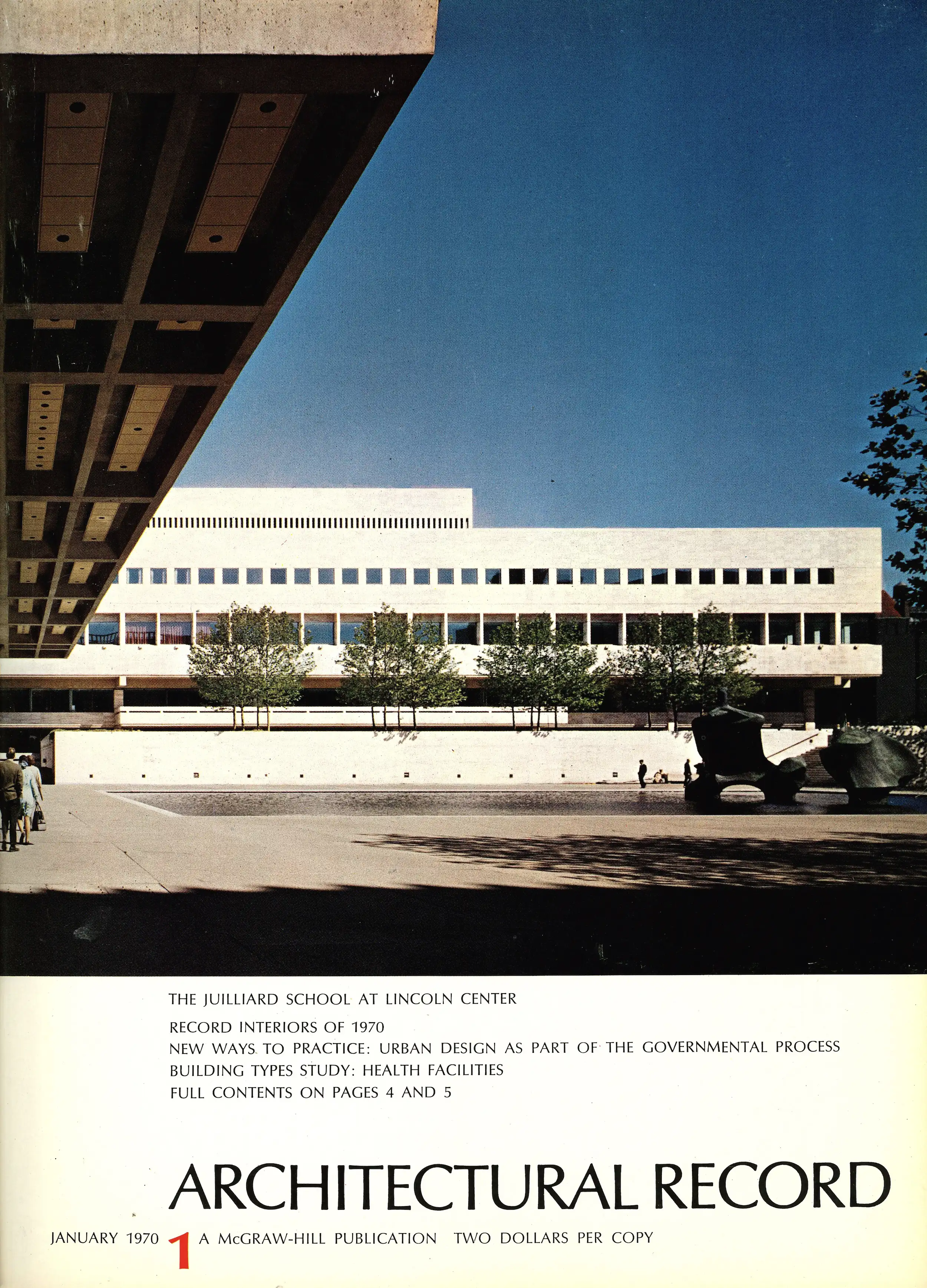
When the Juilliard School settled into its new home in 1969, the adjacent Lincoln Center was already regarded as something of a cultural acropolis. The 16‑acre performing arts campus hardly needed any additional appeal—architectural or otherwise: monumental theaters designed by the likes of Philip Johnson and Eero Saarinen were already hosting premier organizations. But that did not stop Pietro Belluschi from adding another jewel to this urban crown. His brawny Brutalist structure, which incorporates Juilliard’s Alice Tully Hall, gracefully accommodates a host of academic programs while offering a refreshing counterpoint to the slender columns and towering arches of its modern classical neighbors. The building appeared on the cover of RECORD’s January 1970 edition, in which former editor Mildred Schmertz lauded Belluschi’s ingenuity in navigating functional demands and engineering constraints. Decades later, following a six-year renovation by Diller Scofidio + Renfro and FXFOWLE, a more down-to-earth Juilliard—with a new transparent facade—returned to the pages of the February 2011 issue.
Editor’s note: This article has been condensed for ease of online reading but reflects the original text.
© Architectural Record, January, 1970
“The Juilliard School”
By Mildred F. Schmertz
Architectural Record, January 1970
A conservatory for the performing arts—and one of the most complicated buildings ever made—completes the construction of Lincoln Center.
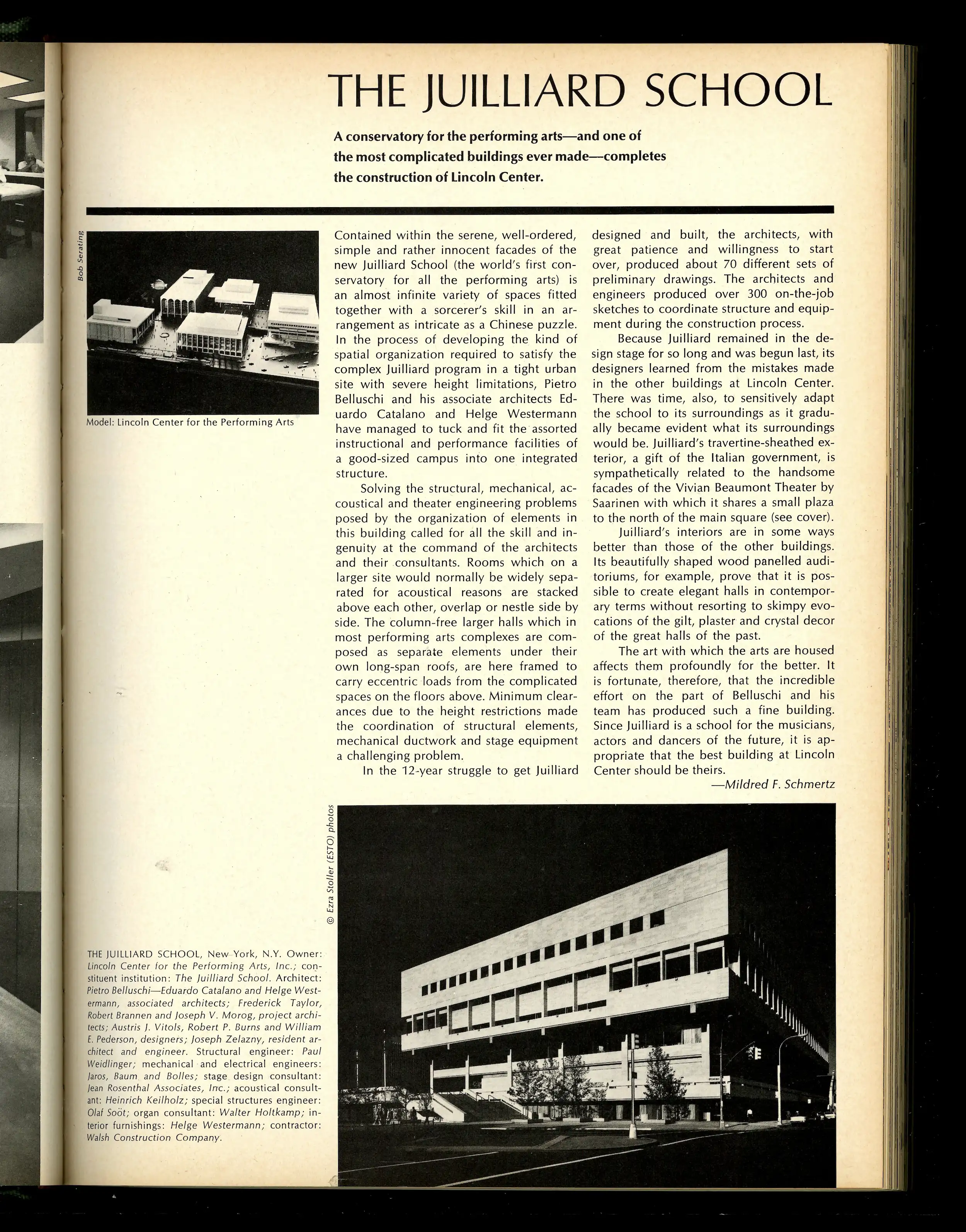
Contained within the serene, well-ordered, simple and rather innocent facades of the new Juilliard School (the world’s first conservatory for all the performing arts) is an almost infinite variety of spaces fitted together with a sorcerer’s skill in an arrangement as intricate as a Chinese puzzle. In the process of developing the kind of spatial organization required to satisfy the complex Julliard program in a tight urban site with severe height limitations, Pietro Belluschi and his associate architects Eduardo Catalano and Helge Westermann have managed to tuck and fit the assorted instructional and performance facilities of a good-sized campus into one integrated structure.
Solving the structural, mechanical, acoustical and theater engineering problems posed by the organization of elements in this building called for all the skill and ingenuity at the command of the architects and their consultants. Rooms which on a larger site would normally be widely separated for acoustical reasons are stacked above each other, overlap, or nestle side by side. The column-free larger halls which in most performing arts complexes are composed as separate elements under their own long-span roofs, are here framed to carry eccentric loads from the complicated spaces on the floors above. Minimum clearances due to the height restrictions made the coordination of structural elements, mechanical ductwork, and stage equipment a challenging problem.
© Architectural Record, January, 1970. Photos Bob Serating, Ezra Stoller/ESTO
In the 12-year struggle to get Juilliard designed and built, the architects, with great patience and willingness to start over, produced about 70 different sets of preliminary drawings. The architects and engineers produced over 300 on-the-job sketches to coordinate structure and equipment during the construction process.
Because Juilliard remained in the design stage for so long and was begun last, its designers learned from the mistakes made in the other buildings at Lincoln Center. There was time, also, to sensitively adapt the school to its surroundings as it gradually became evident what its surroundings would be. Juilliard’s travertine-sheathed exterior, a gift of the Italian government, is sympathetically related to the handsome facades of the Vivian Beaumont Theater by Saarinen with which it shares a small plaza to the north of the main square.
Juilliard’s interiors are in some ways better than those of the other buildings. Its beautifully shaped wood paneled auditoriums, for example, prove that it is possible to create elegant halls in contemporary terms without resorting to skimpy evocations of the gilt, plaster, and crystal décor of the great halls of the past.
The art with which the arts are housed affects them profoundly for the better. It is fortunate, therefore, that the incredible effort on the part of Belluschi and his team has produced such a fine building. Since Juilliard is a school for the musicians, actors and dancers of the future, it is appropriate that the best building at Lincoln Center should be theirs.
The Juilliard School: A complex program for a tight site, to be solved within the severe height restrictions of Lincoln Center.
Early in 1957 Juilliard voted to accept the invitation from Lincoln Center to move from Morningside Heights and relocate in a building to be constructed for the school by the Center. Great benefits were foreseen from having young artists in training at Lincoln Center.
Looking for quick answers on architecture and design topics?
Try Ask RECORD, our new smart AI search tool.
Ask RECORD →
© Architectural Record, January, 1970. Photo Mal Gurian Assoc.
The school’s requirement kept changing and expanding, however, as these plans developed. In the early design period the size of the site had not finally been decided upon. (The land upon which Juilliard is built was not part of the original Lincoln Square Urban Renewal Project and was acquired separately without the urban renewal write-down.) During the design process the Drama Division was added to the school and George Balanchine’s School of American Ballet was invited to function within Juilliard as an independent unit. At one time a multi-use complex was conceived which would have included shops and restaurants. The architects, further, had to adapt to changes in the administrative leadership of both Juilliard and Lincoln Center.
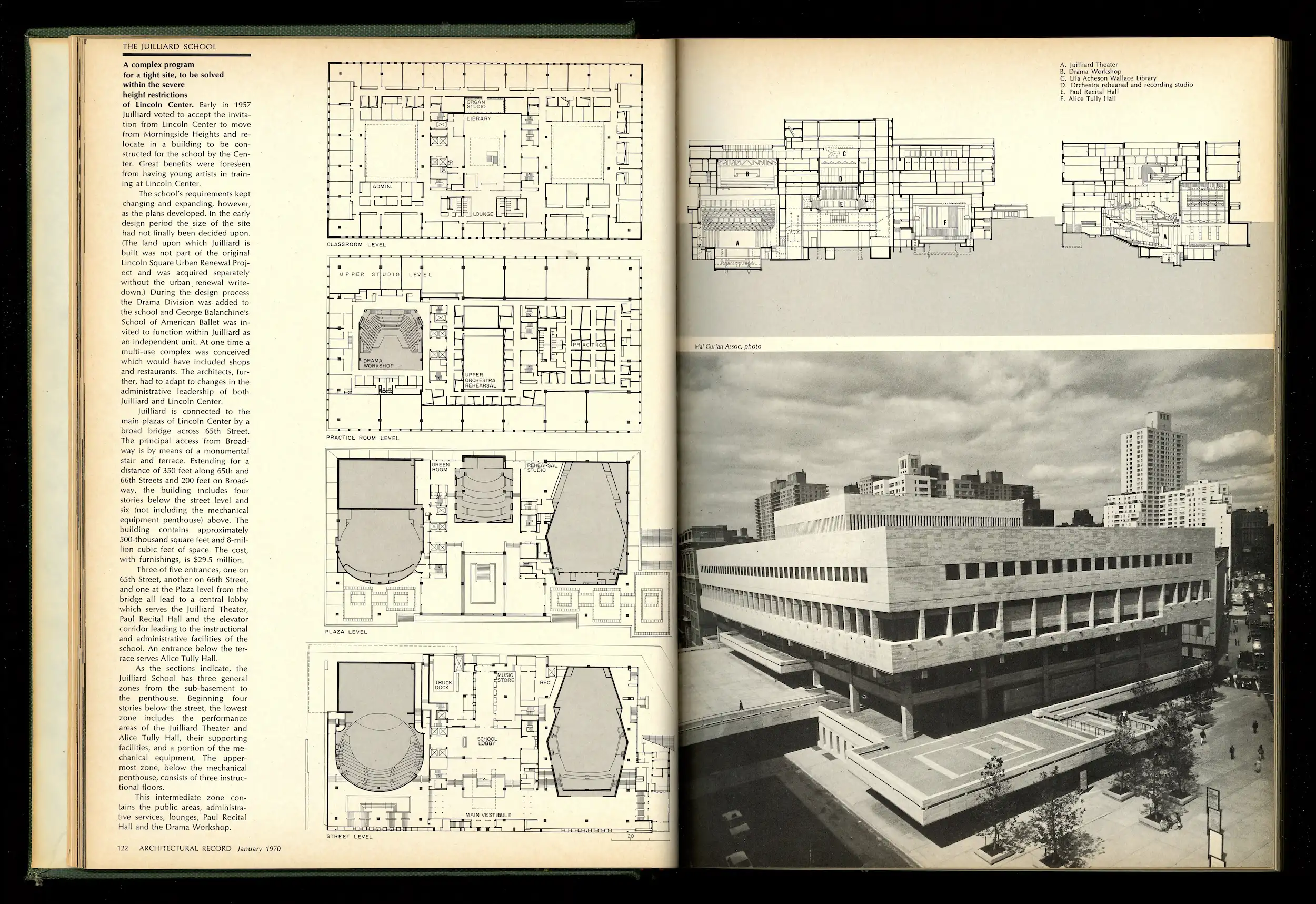
Juilliard is connected to the main plazas of Lincoln Center by a broad bridge across 65th Street. The principal access from Broadway is by means of a monumental stair and terrace. Extending for a distance of 350 feet along 65th and 66th Streets and 200 feet on Broadway, the building includes four stories below the street level and six (not including the mechanical equipment penthouse) above. The building contains approximately 500-thousand square feet and 8-million cubic feet of space. The cost, with furnishings, is $29.5 million.
Three of five entrances, one on 65th Street, another on 66th Street, and one at the Plaza level from the bridge all lead to a central lobby which serves the Juilliard Theater, Paul Recital Hall and the elevator corridor leading to the instructional and administrative facilities of the school. An entrance below the terrace serves Alice Tully Hall.
As the sections indicate, the Juilliard School has three general zones from the sub-basement to the penthouse. Beginning four stories below the street, the lowest zone includes the performance areas of the Juilliard Theater and Alice Tully Hall, their supporting facilities, and a portion of the mechanical equipment. The uppermost zone, below the mechanical penthouse, consists of three instructional floors.
The intermediate zone contains the public areas, administrative services, lounges, Paul Recital Hall and the Drama Workshop.
The Juilliard School: Terraces and lobbies both public and private are generous and well-scaled, but economical in materials and finish.
Although the facades are of travertine (a gift) and the floors are carpeted wall-to-wall (wherever appropriate to reduce noise levels) Juilliard is by no means luxurious. Because of rapidly rising costs, finishing details were simplified wherever possible throughout the structure and more expensive materials abandoned. The wood paneling, for example, which had been designed for the principal lobbies, was eliminated and the concrete left exposed.

© Architectural Record, January, 1970. Photos by Ezra Stoller/ESTO
A photo shows the bridge across 65th Street connecting Juilliard to the north plaza of Lincoln Center. The top row of windows provides light and views for the large private studios and classrooms for group teaching located on the top floor. The large windows directly below illuminate the large double-story rehearsal studios on the north and south sides of the building which have two levels of single-story supporting facilities in the interiors. Underneath the overhang is another level of double-story rehearsal studios and below these, at bridge level, are the principal administration offices. All the outside windows of the studios and classrooms are triple-glazed to keep out street noise.
The lobby of Alice Tully Hall has a purple carpet and gold accents. Miss Tully, the donor of the hall, took an active interest in its decor. The Juilliard Theater lobby is carpeted in crimson. The handsome globe-shaped lighting fixtures are of standard manufacture and are also used in Paul Recital Hall. The principal lobby interconnects the Juilliard Theater and Alice Tully Hall. Stairs lead to the Paul Recital Hall directly above.
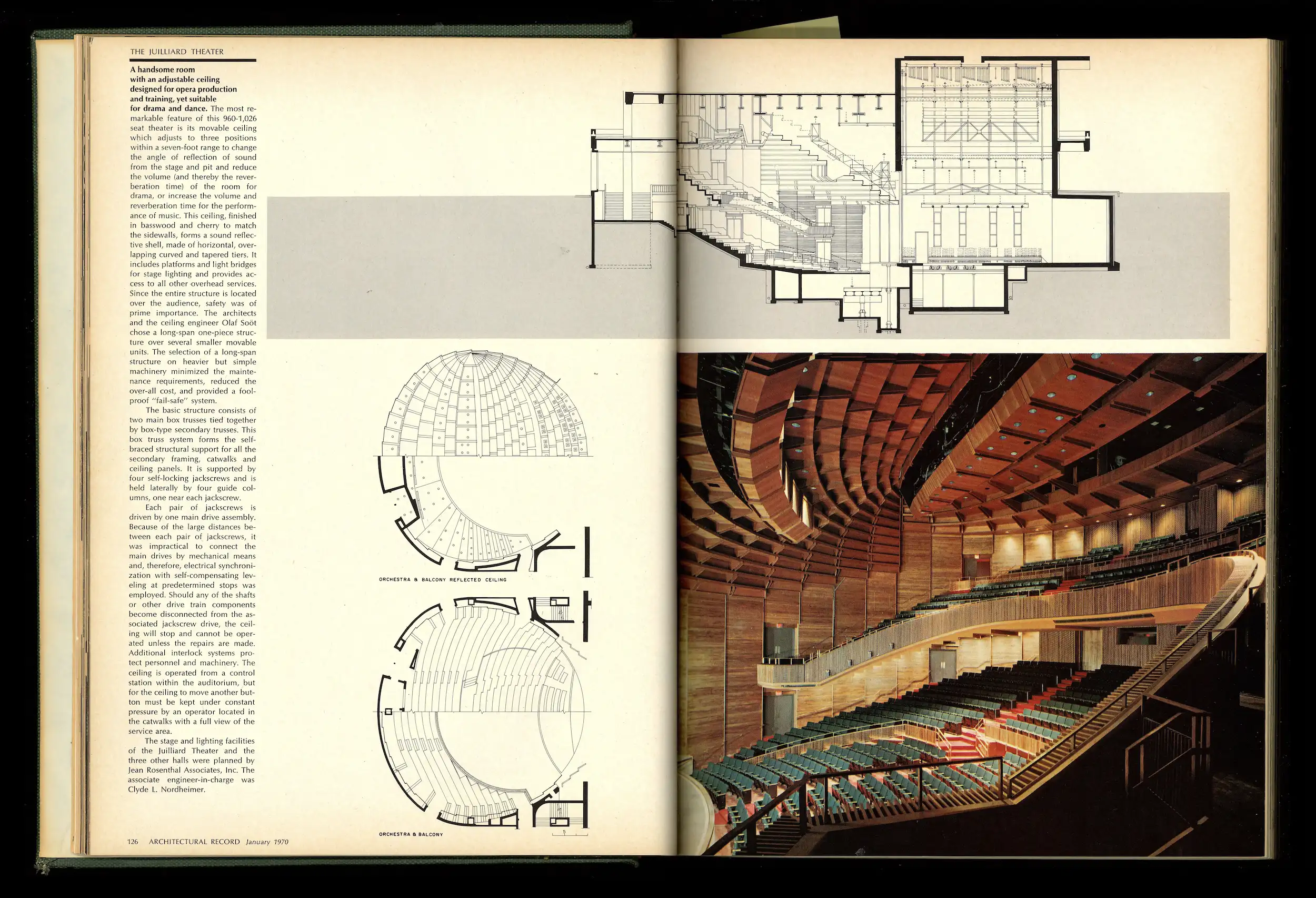
The Juilliard Theater: A handsome room with an adjustable ceiling designed for opera production and training, yet suitable for drama and dance.
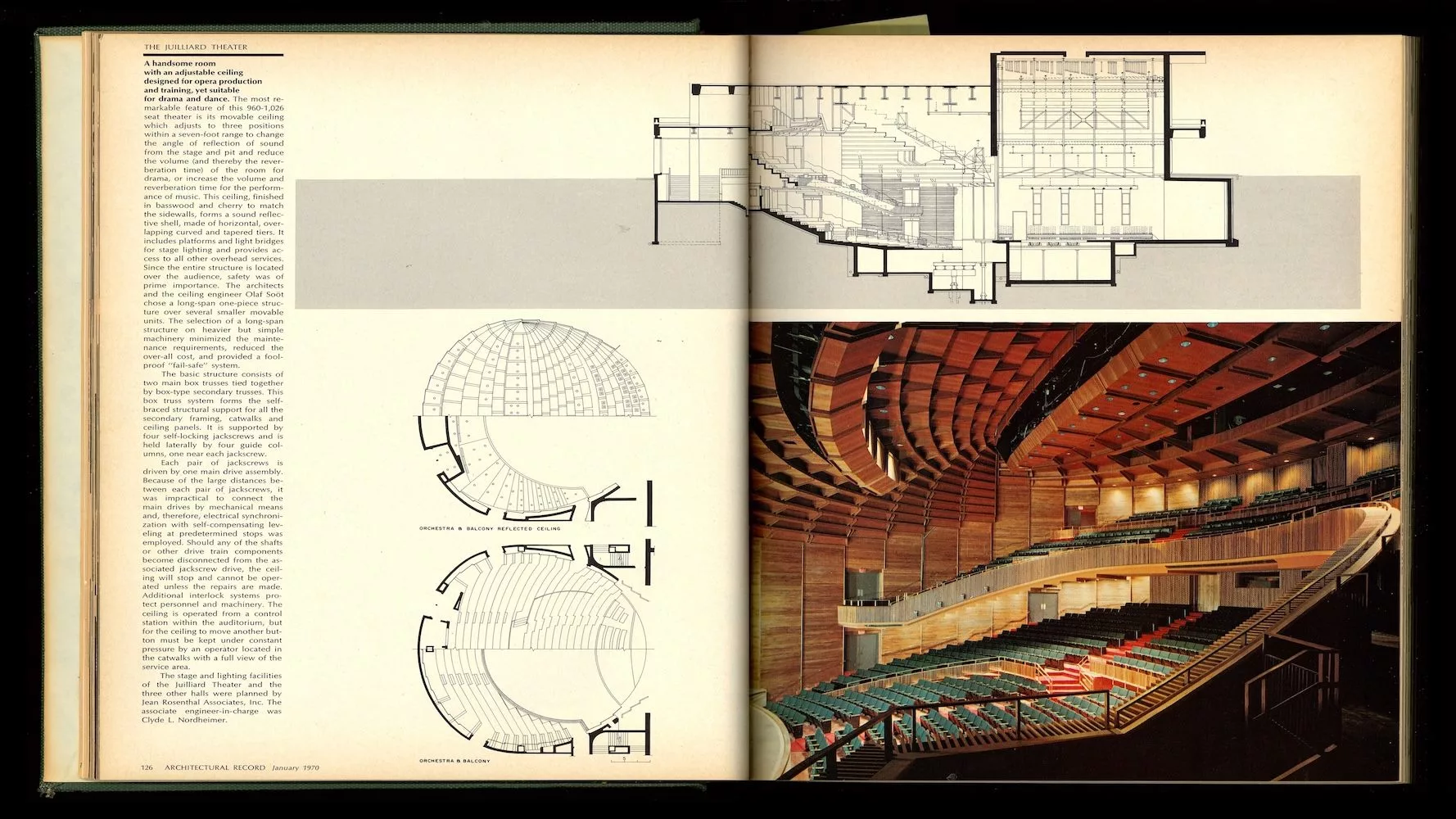
The most remarkable feature of this 960–1,026 seat theater is its movable ceiling which adjusts to three positions within a seven-foot range to change the angle of reflection of sound from the stage and pit and reduce the volume (and thereby the reverberation time) of the room for drama, or increase the volume and reverberation time for the performance of music. This ceiling, finished in basswood and cherry to match the sidewalls, forms a sound reflective shell, made of horizontal, overlapping curved and tapered tiers. It includes platforms and light bridges for stage lighting and provides access to all other overhead services. Since the entire structure is located over the audience, safety was of prime importance. The architects and the ceiling engineer Olaf Soot chose a long-span one-piece structure over several smaller movable units. The selection of a long-span structure on heavier but simple machinery minimized the maintenance requirements, reduced the over-all cost, and provided a fool-proof “fail-safe” system.
© Architectural Record, January, 1970. Photo by Ezra Stoller/ESTO
The basic structure consists of two main box trusses tied together by box-type secondary trusses. This box truss system forms the self-braced structural support for all the secondary framing, catwalks and ceiling panels. It is supported by four self-locking jackscrews and is held laterally by four guide columns, one near each jackscrew.
Each pair of jackscrews is driven by one main drive assembly. Because of the large distances between each pair of jackscrews, it was impractical to connect the main drives by mechanical means and, therefore, electrical synchronization with self-compensating leveling at predetermined stops was employed. Should any of the shafts or other drive train components become disconnected from the associated jackscrew drive, the ceiling will stop and cannot be operated unless the repairs are made. Additional interlock systems protect personnel and machinery. The ceiling is operated from a control station within the auditorium, but for the ceiling to move another button must be kept under constant pressure by an operator located in the catwalks with a full view of the service area.
The stage and lighting facilities of the Juilliard Theater and the three other halls were planned by Jean Rosenthal Associates, Inc. The associate engineer-in-charge was Clyde L. Nordheimer.
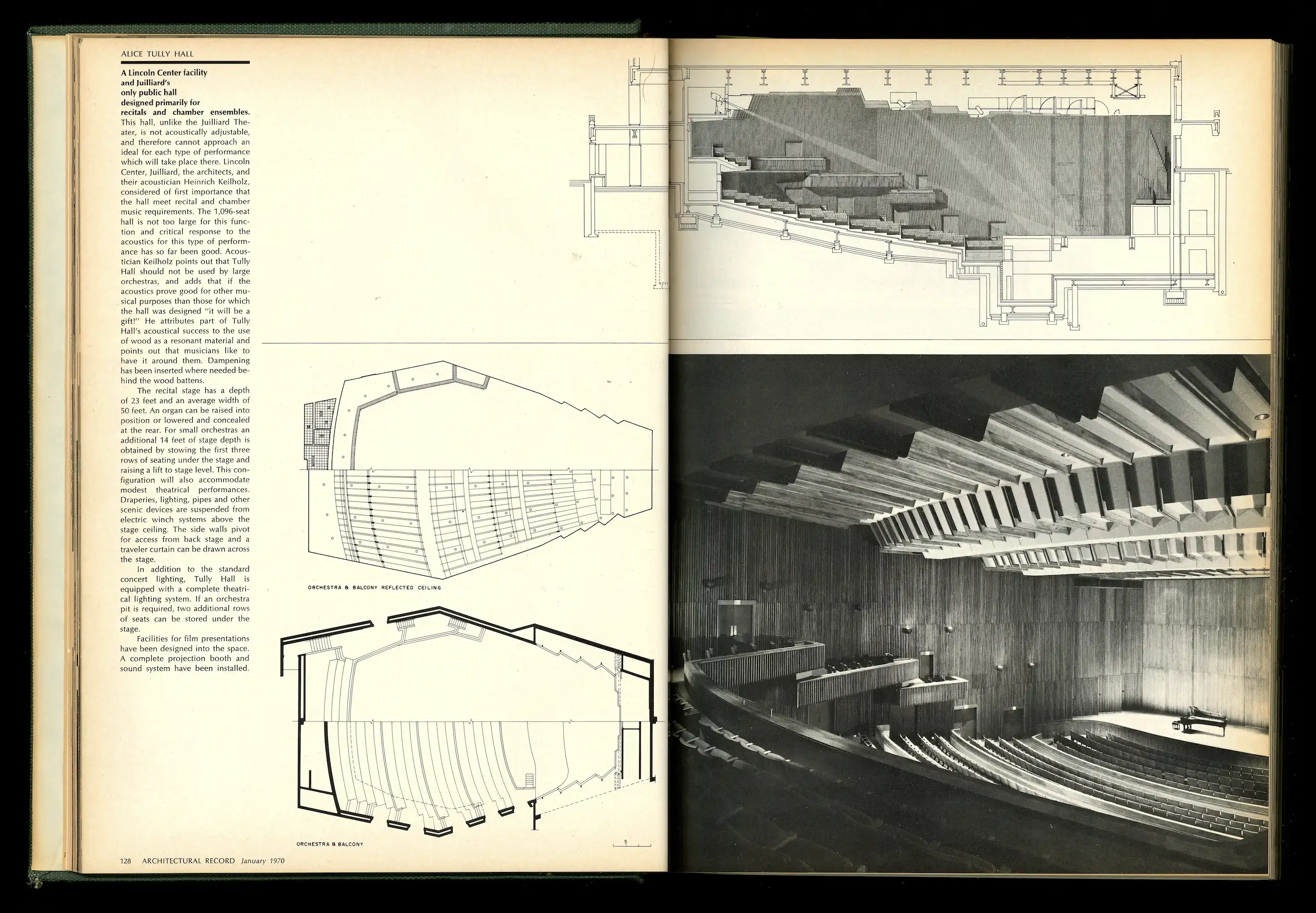
Alice Tully Hall: A Lincoln Center facility and Juilliard’s only public hall designed primarily for recitals and chamber ensembles.
This hall, unlike the Juilliard Theater, is not acoustically adjustable, and therefore cannot approach an ideal for each type of performance which will take place there. Lincoln Center, Juilliard, the architects, and their acoustician Heinrich Keilholz, considered of first importance that the hall meet recital and chamber music requirements. The 1,096-seat hall is not too large for this function and critical response to the acoustics for this type of performance has so far been good. Acoustician Keilholz points out that Tully Hall should not be used by large orchestras, and adds that if the acoustics prove good for other musical purposes than those for which the hall was designed “it will be a gift!” He attributes part of Tully Hall’s acoustical success to the use of wood as a resonant material and points out that musicians like to have it around them. Dampening has been inserted where needed behind the wood battens.
© Architectural Record, January, 1970. Photo by Ezra Stoller/ESTO
The recital stage has a depth of 23 feet and an average width of 50 feet. An organ can be raised into position or lowered and concealed at the rear. For small orchestras an additional 14 feet of stage depth is obtained by stowing the first three rows of seating under the stage and raising a lift to stage level. This configuration will also accommodate modest theatrical performances. Draperies, lighting, pipes and other scenic devices are suspended from electric winch systems above the stage ceiling. The side walls pivot for access from back stage and a traveler curtain can be drawn across the stage.
In addition to the standard concert lighting, Tully Hall is equipped with a complete theatrical lighting system. If an orchestra pit is required, two additional rows of seats can be stored under the stage.
Facilities for film presentations have been designed into the space. A complete projection booth and sound system have been installed.
The Juilliard School: Special purpose spaces require unique acoustic treatments and varying surfaces and particular volumes to challenge the structural engineers.
The Paul Recital Hall seats 277 people. Its side walls and ceiling are paneled in cherry wood. Ceiling coffers are sloped to create optimum diffusion of sound. It is used for instruction on the Holtkamp organ, for recitals and as a lecture hall and has been volumetrically sized for these purposes. Private teaching studios are carefully sound insulated, as are the practice rooms. These spaces had to be of minimum size to get as many as possible into the available space but large enough to provide proper sound diffusion and reflection. The organ practice roomsrequired special wall and ceiling treatments to prevent the organ sound from becoming too “hard.” The Lila Acheson Wallace Library is located directly above the orchestra rehearsal and recording studio, which floats free of the structure to inhibit the transmission of sound.

© Architectural Record, January, 1970. Photos by Ezra Stoller/ESTO
All major sound-producing spaces are insulated from the structure. Each has a unique volume and special wall, floor and ceiling treatments. As a result, no two floors of Juilliard are alike, and floor slab elevations constantly vary. The building has cavity walls, solid walls, walls with insulation and walls without. Because of the intricacy of the plan, there is no direct transfer of loads to the foundation. Floor loads are huge and range from 250 to 280 pounds per square foot, including the concrete slabs, secondary slabs and floor finishes. The dance rehearsal floors, for example, are 18 to 20 inches thick and include steel springs 20 inches on centers. Because the biggest column-free spaces are near ground level, structural members are quite large to handle the long spans and the loads from above. There are steel composite girders which are 104 feet in length. Joseph Zelazny and Matthys Levy, associates of Paul Weidlinger, the structural engineer for Juilliard, point out that in spite of these complications there is a structural module of sorts. At the east and west ends of the building over the two major halls are 93-foot spans. Between them the columns are 46 feet on center. Spans are 35 feet the opposite way.
Of special interest is the fact that the northeast corner of Tully Hall is only 20 feet from the IRT subway. A special envelope was made for the hall. The engineers inserted a one-inch thick asbestos pad lined with cork between the foundation and its solid rock bearing. The perimeter wall of the theater was isolated from the structural columns so that the subway vibrations would not be transmitted.
Looking for a reprint of this article?
From high-res PDFs to custom plaques, order your copy today!