Arts & Culture 2025
A Flemish Abbey Turned Museum Gets a Stark New Pavilion by Barozzi Veiga
Kortrijk, Belgium
Architects & Firms
With its Gothic town hall, art-filled churches of St Martin and Our Lady, UNESCO-listed belfry and begijnhof (a 17th-century laywomen’s community), and pronounced penchant for red and brown brick, the small Belgian city of Kortrijk is as Flemish as they come. Located barely six miles from today’s border with France, it was the site of the 1302 Battle of the Golden Spurs, when the farmers of Flanders routed the French king’s cavaliers—an event symbolically important for the Flemish nationalist movement. As elsewhere in the region, the Catholic Church was long a dominant power, and Kortrijk counted several religious houses, including Groeninge Abbey, founded by Cistercian nuns in the medieval period and later, in the 19th and 20th centuries, home to a community of Poor Clares.
This spring, Abby Kortrijk, a new, $14.8 million art museum, opened in what remains of the complex. Rather than a permanent display, Abby holds temporary exhibitions built around the rich municipal collections of fine art, furniture, and ceramics. Barcelona-based office Barozzi Veiga led the conversion, in association with Ghent firm Tab Architects and heritage specialists Koplamp Architecten.

Barozzi Veiga’s pavilion (top of page) is part of a contemporary museum housed in the former Groeninge Abbey (above). Photo © Simone Marcolin, click to enlarge.
When the city acquired Groeninge Abbey, in the late 1970s, the rather battered red-brick complex comprised three interlinked buildings: to the north, on Groeningestraat, the abbey church of 1593–95, which retained nothing of its original interior; to the south, running parallel to the church, the better-preserved dormitory (1597–98), giving onto Begijnhofpark, a green public space that was once the abbey’s grounds; and, linking the two perpendicularly, a wing containing the mid-19th-century chapel of the Poor Clares. In the 1980s and early ’90s, architect Erik J. De Meyere transformed the complex into Kortrijk 1302, a museum telling the story of the Battle of the Golden Spurs. Besides inserting a hefty metal structure inside the church to create new floors, he added a sizable new wing in the main, western courtyard, and another in the park.
Three decades later, in 2020, the city held a design competition for the future art museum, at the same time as creating a new 1302 exhibit in the nearby church of Our Lady (where the spurs captured from the French cavalry were originally displayed). “The general competition theme was Flemish identity,” recalls Fabrizio Barozzi, founding partner at Barozzi Veiga. The brief also specified that Abby Kortrijk should provide a “living room for the city” capable of hosting a diverse program of cultural events. “We liked the challenge of the old abbey,” continues Barozzi, “a relatively small project in a complex situation, rich in history and human issues.”

Visitors reach the addition through a glazed hallway. Photo © Simone Marcolin
The firm’s initial response was to remove all the 1980s additions, which Barozzi describes as “quite aggressive,” in order to restore full legibility to the historic fabric. Since the three abbey buildings did not provide anywhere near the required square footage, the architects’ next decision was to locate much of the gallery space underground, beneath the two courtyards to the east and west. In addition, a new stair and elevator core in the chapel wing ensures vertical access. Their other big intervention was construction of a new pavilion in the park, which offers a strong visual identity for the museum, signals its presence in the cityscape, and provides some of the required social space.
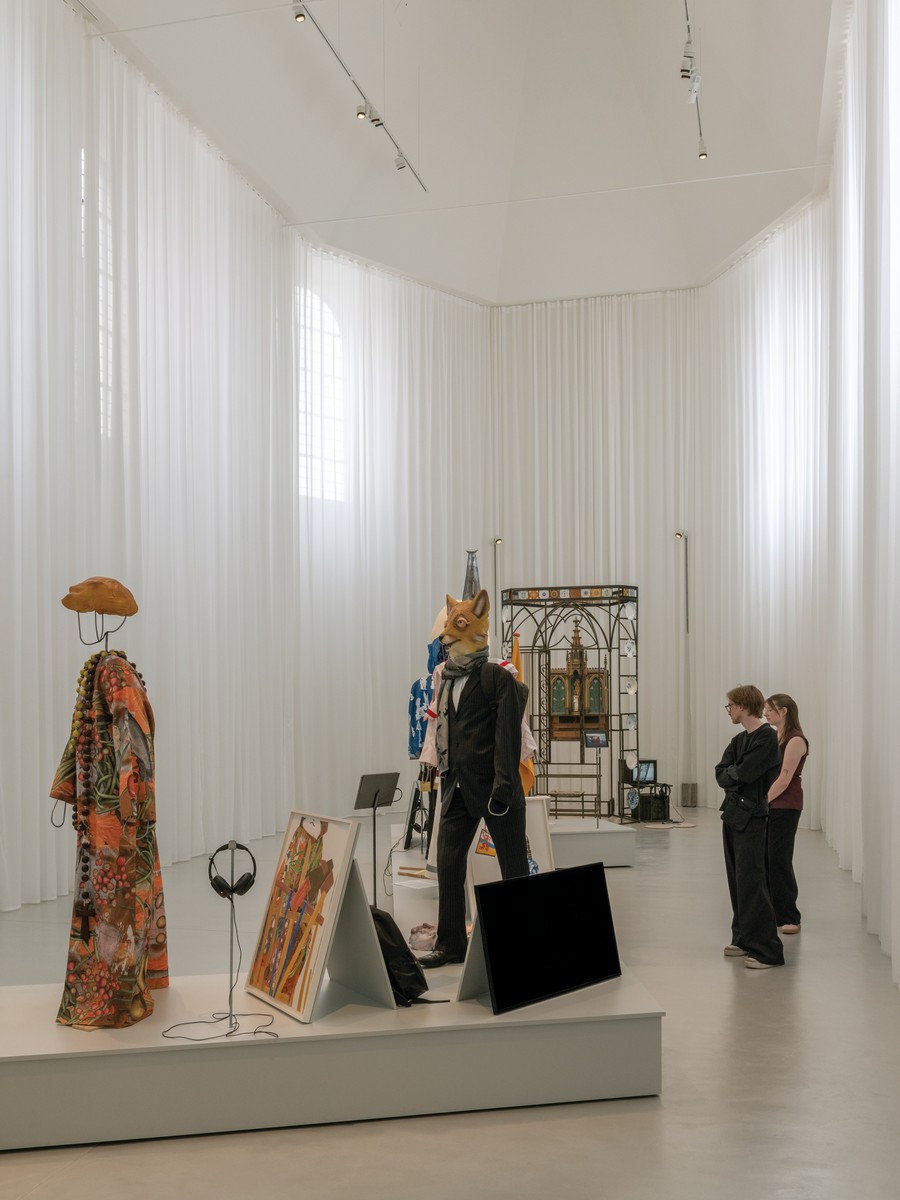
“Abby Kortrijk comprises a sequence of different rooms, each of which has its own character,” declares Barozzi. While that may be true with respect to volume and geometry, all the interiors except the new pavilion are dressed in the same aseptic uniform of immaculate whiteness. Large and impersonal, the underground galleries provide the kind of neutral space that curators adore, with sophisticated lighting and climate control. To save precious square feet within the historic buildings, Barozzi Veiga routed fire exits through the courtyard. Earmarked for large-scale installations, the church is just as neutral, only here daylight floods in, mitigated by giant white draperies (an inexpensive solution for a limited budget), with slender, barely noticeable tie-rods guaranteeing the structural integrity formerly provided by De Meyere’s metal frame.

1
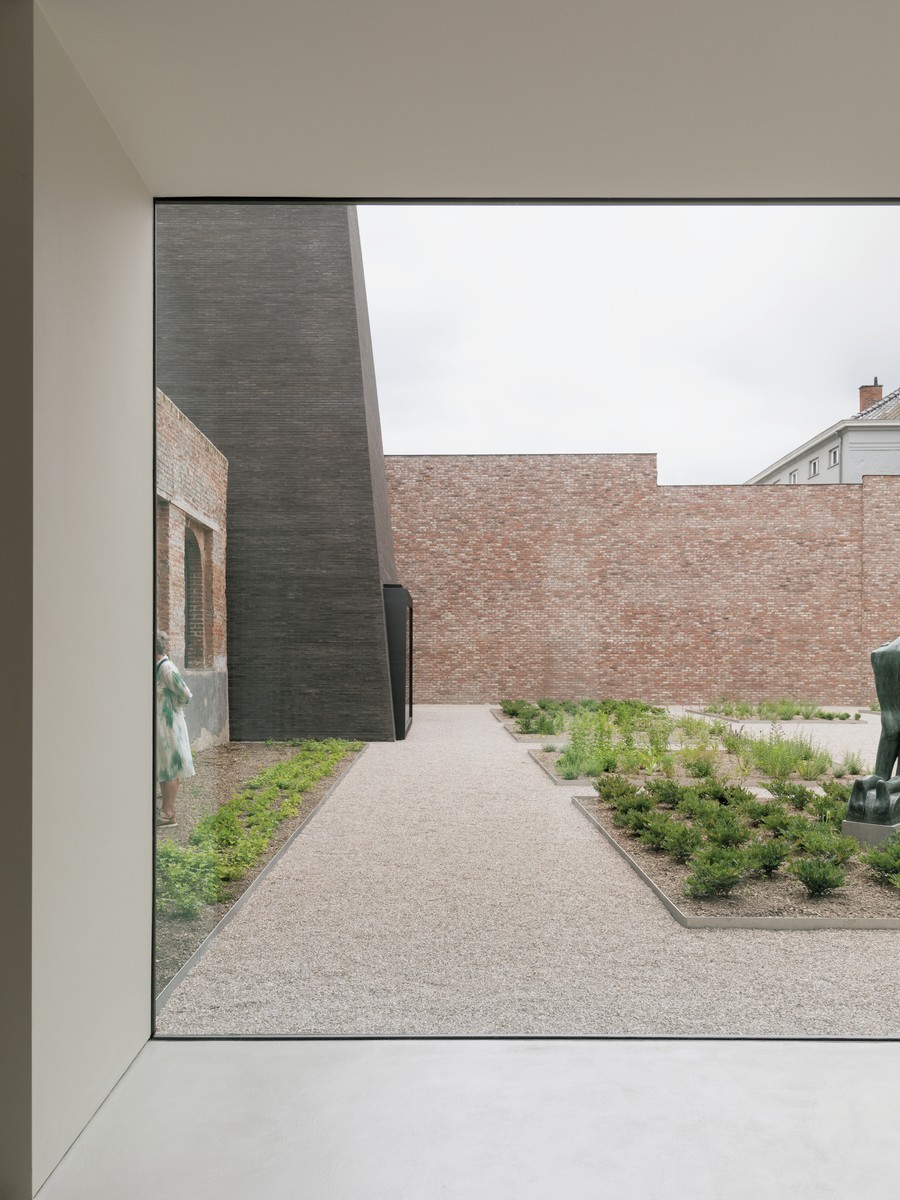
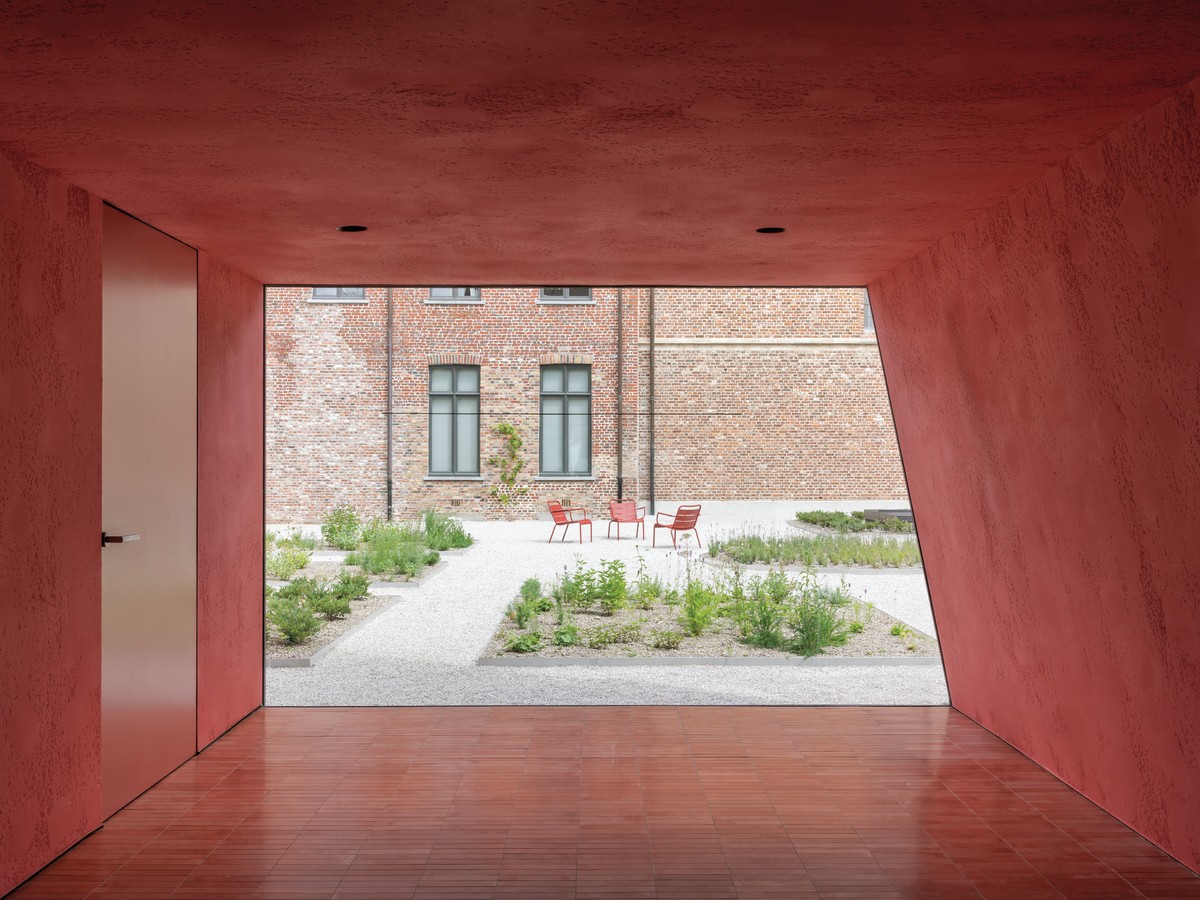
The renovated interiors (1 & 2) stand in contrast to the pavilion, situated in a garden (3 & 4). Photos © Simone Marcolin
2
3
4
In the perpendicular wing, the core is as clean and clinical as anything you might find in a hospital, as is the Poor Clares’ chapel, which now serves as Abby’s “salon,” a space for concerts, lectures, and workshops. Only the dormitory—the one fully landmarked building in the complex, which the architects treated as a restoration project—shows a little more personality, with its exposed beams and 16th-century terra-cotta floor tiles.
Looking for quick answers on architecture and design topics?
Try Ask RECORD, our new smart AI search tool.
Ask RECORD →
It falls, therefore, to Abby’s exterior and the new pavilion to express something of the “Flemish identity” specified in the competition. In contrast to the pristine interior, all the scars of a turbulent past are visible in the historic elevations, repaired where necessary with salvaged bricks, while, in the chapel wing, “surgical openings,” as Barozzi describes them, admit daylight to the west and allow for the arrival of artworks to the east.
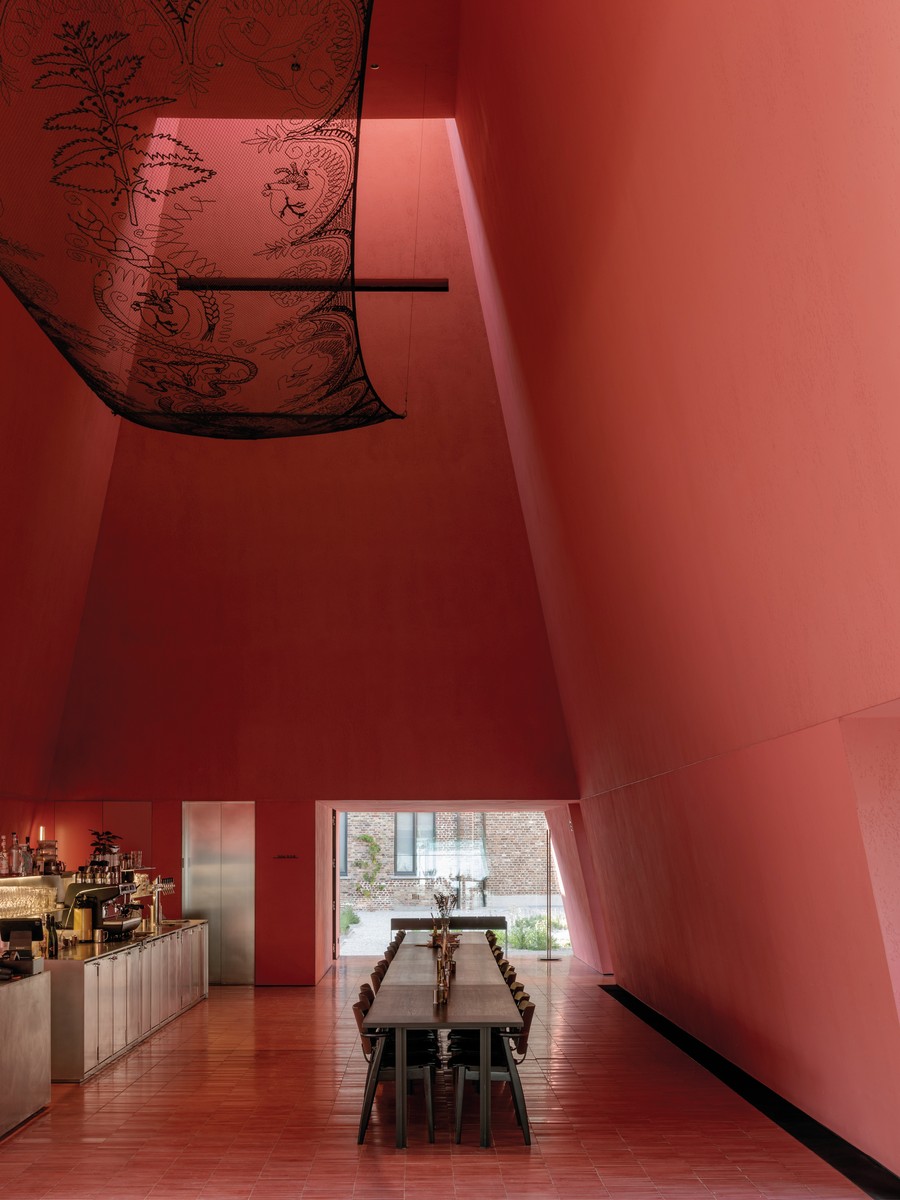
A skylight infuses the tapered pavilion’s red interior with a soft glow. Photo © Simone Marcolin
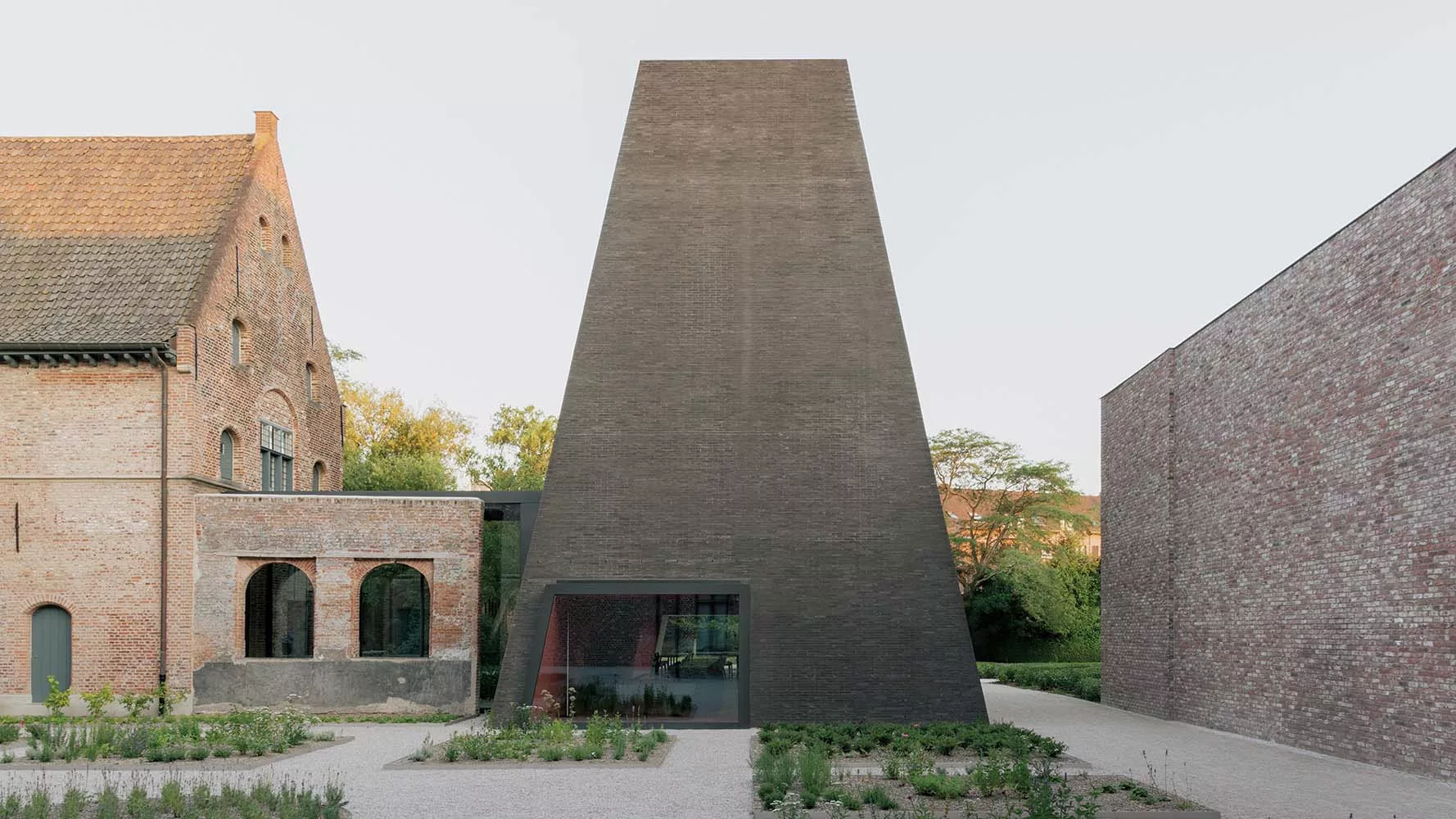
At the dormitory’s western end, a glass passageway links to the pavilion, whose imposing 40-foot-high mass runs north–south, giving onto the main courtyard at one end and projecting far out into the park at the other. A giant mansard and a belfry-like tower, the pavilion contains a soaring single volume lit by generous ground-level openings and a skylight at its northern tip. Inside, hospital white gives way to vivid red, a color that, for Barozzi, evokes Flemish history.
Composed of a steel-framed concrete-block system, the structure is dressed in very hard-wearing black bricks sourced from just over the Dutch border. Made from 60-percent demolition waste, much of it ceramic, they provide the necessary weather resistance for elevations that are at once facade and roof. Rather than mold the bricks to fit the nonorthogonal form, the architects cut them, thereby eliminating surface impurities and achieving, in combination with dark mortar, an even finish that resembles the slate that coifs the church and chapel. “A new step in the abbey’s story,” as Barozzi describes it, the pavilion serves as a restaurant and events space, with seating spilling out into the park. Whether there is anything inherently Flemish about this brooding mastaba is ultimately moot: packed with patrons all day long, it is an essential component in what has already proved to be a very popular museum.
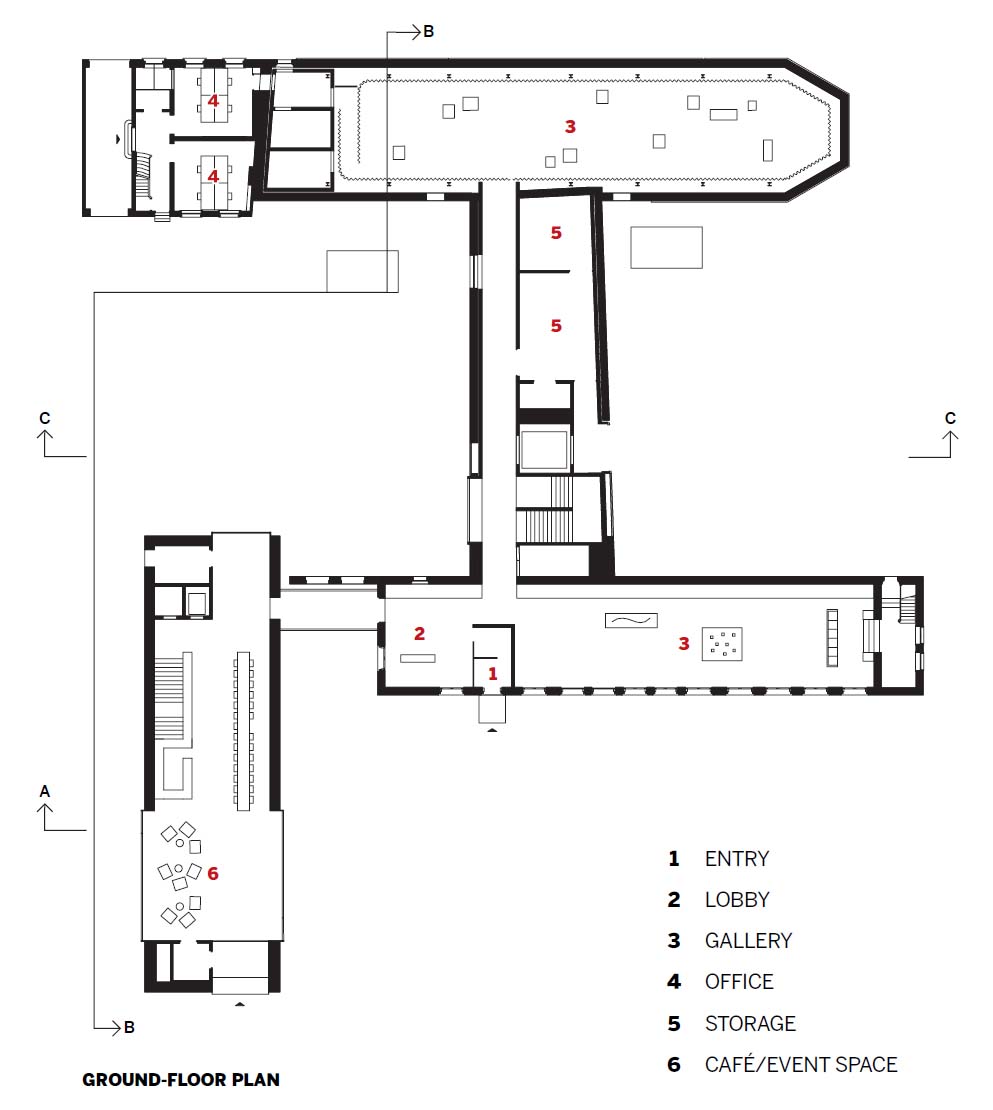
Image courtesy Barozzi Veiga
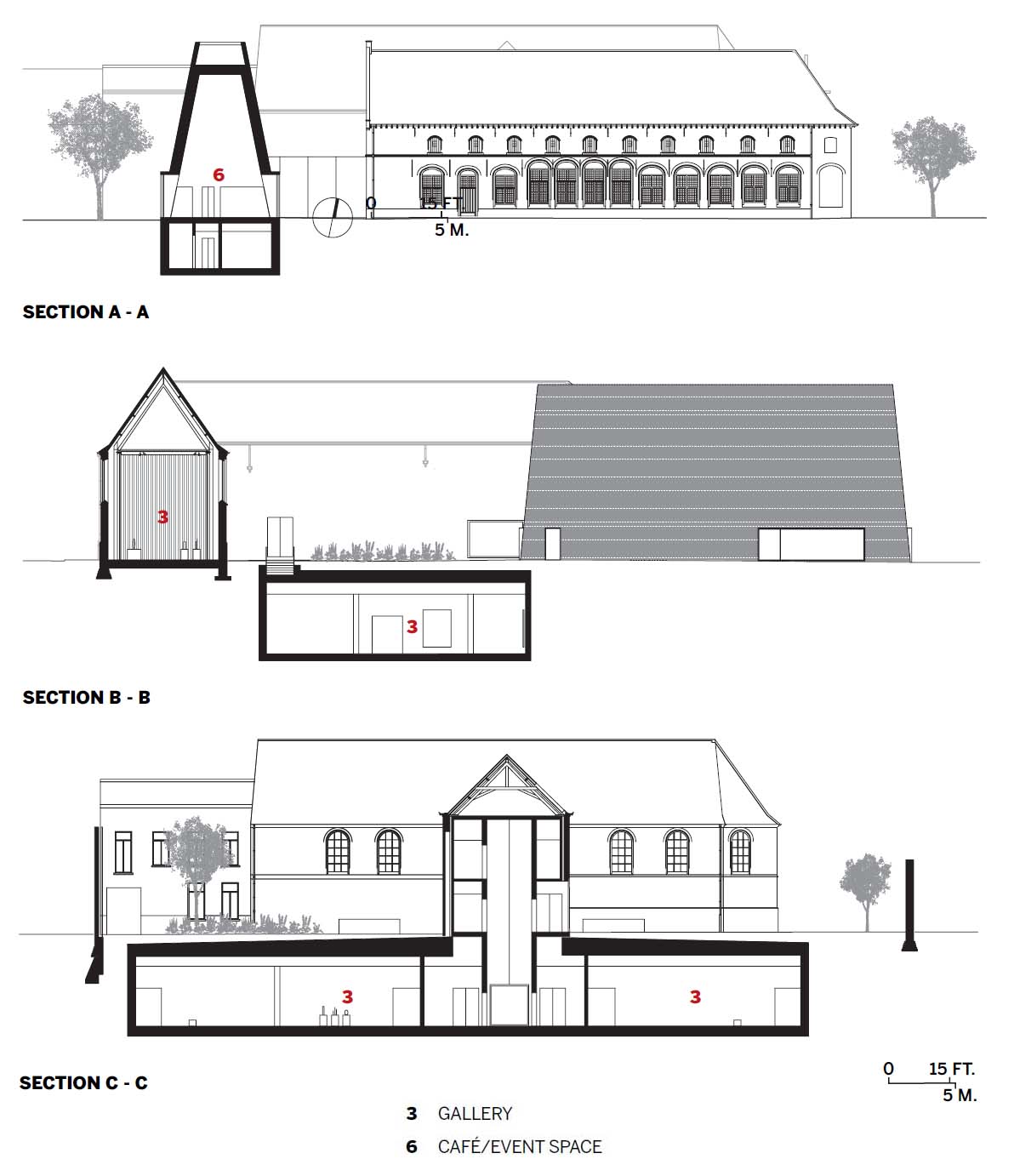
Image courtesy Barozzi Veiga
Credits
Architects:
Barozzi Veiga — Fabrizio Barozzi, Alberto Veiga, principals; Pieter Janssens; Chen-Hsin Chang, Tomás Mesquita, Ivanna Sanjuán, Guillermo Sidrach, Antonis Tasoulis, Maria Ubach, design team
Associate Architect:
Tab Architects — Tom Debaere, Bert Bultereys, principals; Jonathan Toye, Bert Lescouhier, Bert Devos, Pieter Frantzen, Ilja De Pelsmaeker, Lotte Engelborghs, Maxime Honoré, Luisa Soares, design team
Engineers:
Sileghem & Partners (structural); Studiebureau Boydens (services)
Consultants:
Koplamp (heritage); Daidalos Peutz bouwfysisch ingenieursbureau (acoustics, building physics); Xmade (facade); Paul Deroose (landscape)
Client:
Stad Kortrijk
Size:
43,500 square feet
Cost:
$14.8 million (construction)
Completion Date:
March 2025
Sources
Masonry:
Stonecycling (bricks)
Windows:
Jansen, Schüco, Reynaers
Lighting:
Flos, Erco
Interior Finishes:
Pandomo, Huguet
Looking for a reprint of this article?
From high-res PDFs to custom plaques, order your copy today!