Arts & Culture 2025
Wellington’s Te Rua Archives Integrates Māori Values and Seismic Resilience
Wellington, New Zealand
Architects & Firms
In November 2016, the 7.8-magnitude Kaikōura earthquake, spawned by multiple fault lines, rocked New Zealand’s capital city of Wellington. In its aftermath, the country, long familiar with the destructive force of seismic events, revised its building codes. The Te Rua Archives New Zealand, designed by Auckland-headquartered Warren and Mahoney Architects (WAM), offers a best-in-class demonstration on how to design for such exigencies, and honors the country’s Indigenous heritage through a contemporary interpretation of Māori motifs.
The new nine-story, 284,000-square-foot rectangular volume is located within Wellington’s parliamentary precinct and replaces the existing national archives building nearby that, with the incredible load of its collections, failed to meet the country’s new seismic standards. (There are plans for its adaptive reuse.) The archives had a construction budget of $170 million and broke ground in 2022 on the site of another government property, one irreparably damaged during the quake; its L-shaped basement was retained and incorporated into the present structure. The new building, completed in May, was developed by assets manager Dexus in partnership with New Zealand’s Department of Internal Affairs.
The parliamentary precinct, largely built in the early 1900s, displaced a Māori community predating European settlement. WAM addressed this specific history and contextualized the project within New Zealand’s broader decolonialization goals through consultation with the local Indigenous council. They brought on design agency Tihei, led by Rangi Kipa, a master tattooist and carver, as a consultant, to work alongside the Indigenous design unit (Te Matakīrea) embedded in WAM’s practice. Through this collaborative effort, the design team chose pātaka whakairo, ornately carved precolonial storehouses found throughout the country, as the project’s conceptual starting point.
“The site is rich in genealogy, with a number of tensions that we, as a firm, had to navigate,” says WAM associate Jahmayne Robin-Middleton, also senior associate of its Te Matakīrea. “The pātaka whakairo, as a repository of prized possessions, was a relevant precedent to explore further.”
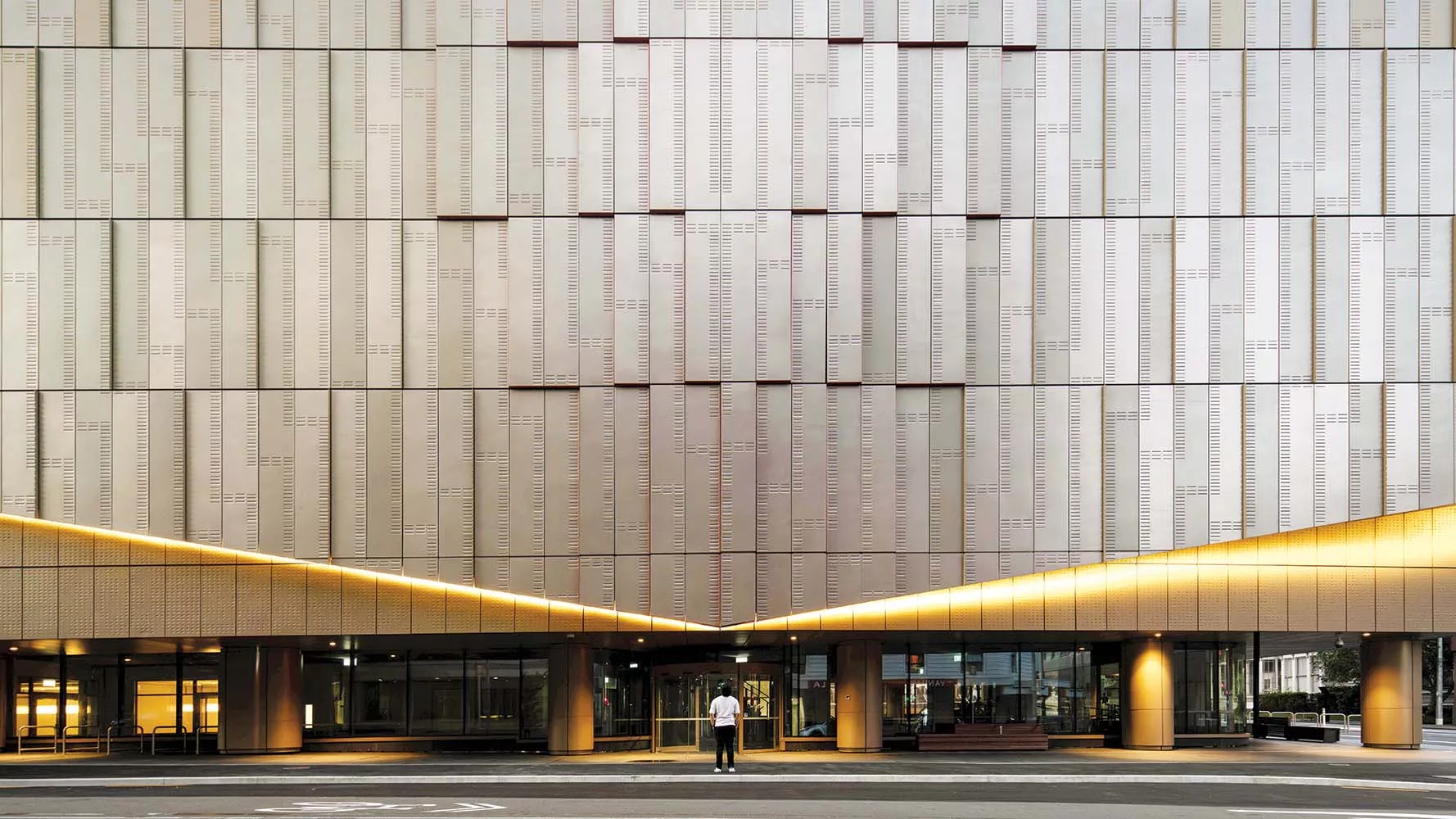
Translating this approach into a high-performing enclosure system relied heavily on WAM’s digital expertise, especially for the facade, the most conspicuous expression of Kipa’s ideas, says firm principal Rodney Sampson. The aluminum panels are debossed to resemble large-scale abstractions of the whakaniko patterns commonly found in Māori whalebone carvings and ink work. They are also treated with an iridescent champagne-colored finish that, in its sun-catching effect, is intended to represent the principle of ahikā, or the “burning fire” of multigenerational land tenure.
The ground floor is partially wrapped in storefront glazing and is accessed by two primary entrances. One is placed toward the eastern quadrant of the street-facing south elevation, and the other is adjacent to a newly opened plaza on the northeast section of the site. They lead to the public lobby and its seminar hall.

The ground floor includes seating, for the public lobby, and a seminar room. Photo © Jason Mann, click to enlarge.
The western and northern segments of the ground floor are clad in precast concrete. They are apportioned for a secure lobby, a staff-and-collections elevator bank, and mechanical systems, including two backup generators. A ramp skirting the north elevation leads to a subterranean loading dock and the archives’ processing and quarantine facilities.
Looking for quick answers on architecture and design topics?
Try Ask RECORD, our new smart AI search tool.
Ask RECORD →
A grand stairwell reaches from the public lobby to the second floor, which includes a reading room, a gallery, and collections space for artwork. A two-story bridge connects the archives to the adjacent National Library; the bottom level may be used by the public to reach the archives, and the top facilitates the transfer of collections between the two buildings.
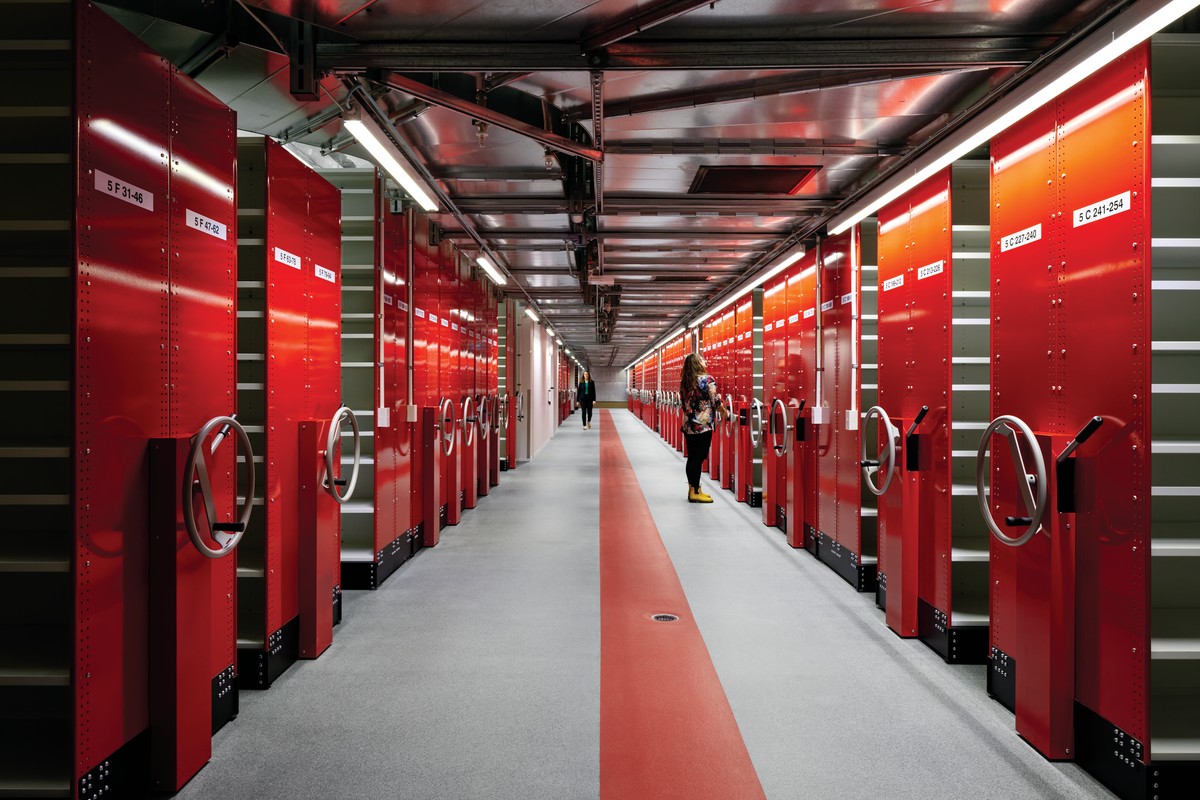
Archival stacks are housed between the second and sixth floors; their millions of documents are protected from UV exposure by the opaque facade. Digitization processes are stationed on the seventh level, and dry and wet labs used for document repair are found on the eighth floor. General workplaces and communal staff areas are positioned on the top level.
1
Each floor of the archival stacks is color coded; there are 56.5 linear miles of shelving (1). The opaque facade protects the collection from UV rays and helps keep internal temperatures steady (2). Photos © Jason Mann (1), Warren and Mahoney Architects (2)

2
It was paramount for the structural design to be able to protect the country’s heritage during a 1-in-1,800-year seismic event. The building—which, at nine floors has a mass equivalent to a 30-story commercial tower—rises from 38 concrete piles, the bulk of them being between 82 and 131 feet in length (the corner piles measure a whopping 180 feet).
The superstructure—a mix of concrete-filled steel columns, castellated and conventional steel beams, and composite floor decks—is separated from the building foundation by triple-pendulum, seismically isolated bearings located in the basement. Each circular brace is over 8 feet in diameter and weighs more than 10 tons; they allow the superstructure to move nearly 4½ feet horizontally and 1 foot vertically. A second array of smaller seismic joints is threaded throughout the building’s floor-to-floor partitions, and they are made easily accessible for inspection and repair through removable ceiling panels.
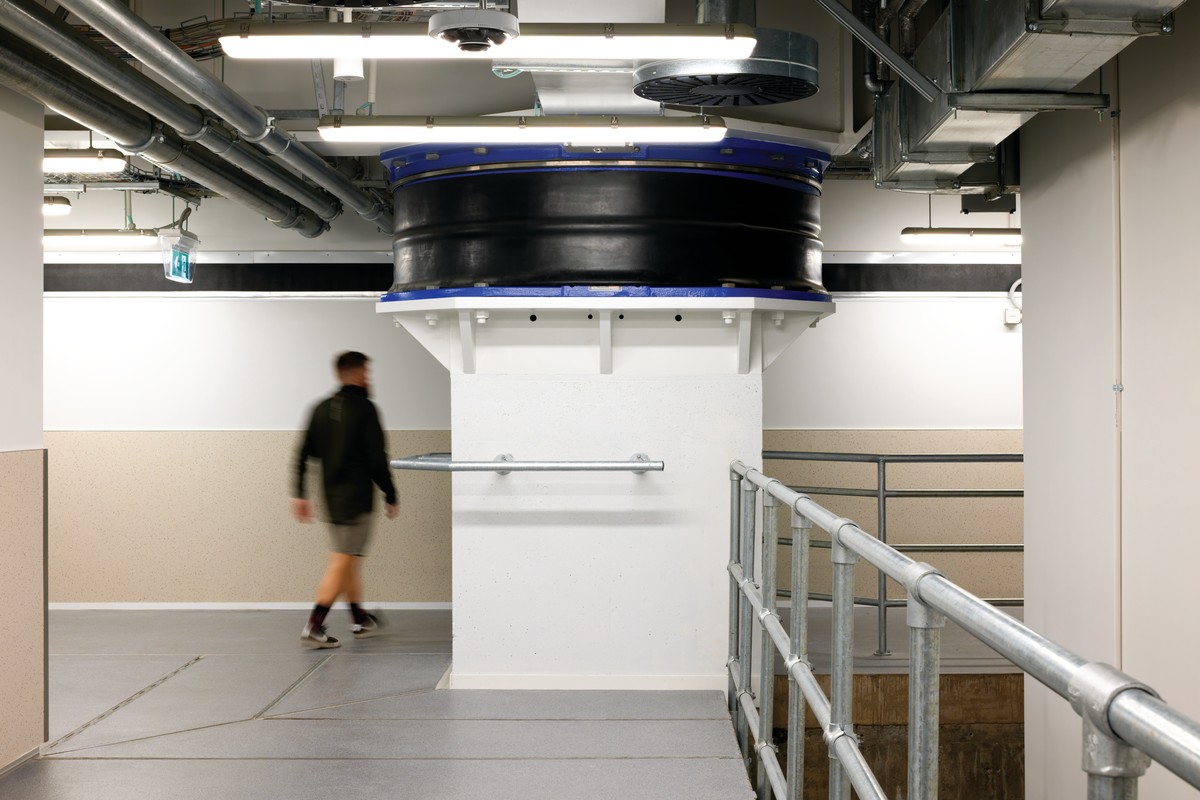
Dozens of multi-ton seismic dampers, 8 feet in diameter, are left visible in the basement, placed between the superstructure and building foundation. Photo © Jason Mann
Should the building’s mechanical systems falter and its backup generators fail, the unitized aluminum curtain wall panels, with an approximately 2-inch cavity and nearly 8 inches of insulation, will help keep internal temperatures steady for up to 48 hours.
On the top three floors, the unitized glass curtain wall has a 0.39 U-value, and the highly insulated roof assembly was designed to avoid thermal bridging. The project team estimates that the enclosure system performs at 300 percent above the airtightness required by building code. According to WAM senior associate Melissa Thompson, that success was achieved by bringing the facade subcontractor on to the job early and working closely with the company to develop the envelope, which was tested with full-size mock-ups and field assemblies.
Archival materials, innately flammable and susceptible to water damage, are further shielded from harm by two features here: each floor is broken into its own fire cell, and all the sprinklers use dry pipes—they only fill with water when activated by localized sensors.
The design team kept track of and rationalized this complex web of infrastructure and building systems through a comprehensively detailed building model, which passed to the general contractor’s hands during construction. The client is now using a full digital twin to manage long-term maintenance.
Through these many efforts, WAM has delivered a finely tuned and resilient repository for New Zealand’s written and artistic heritage that, on top of its technical achievements, successfully integrates Indigenous forms and motifs.

Courtesy Warren and Mahoney Architects, click to enlarge.

Courtesy Warren and Mahoney Architects, click to enlarge.
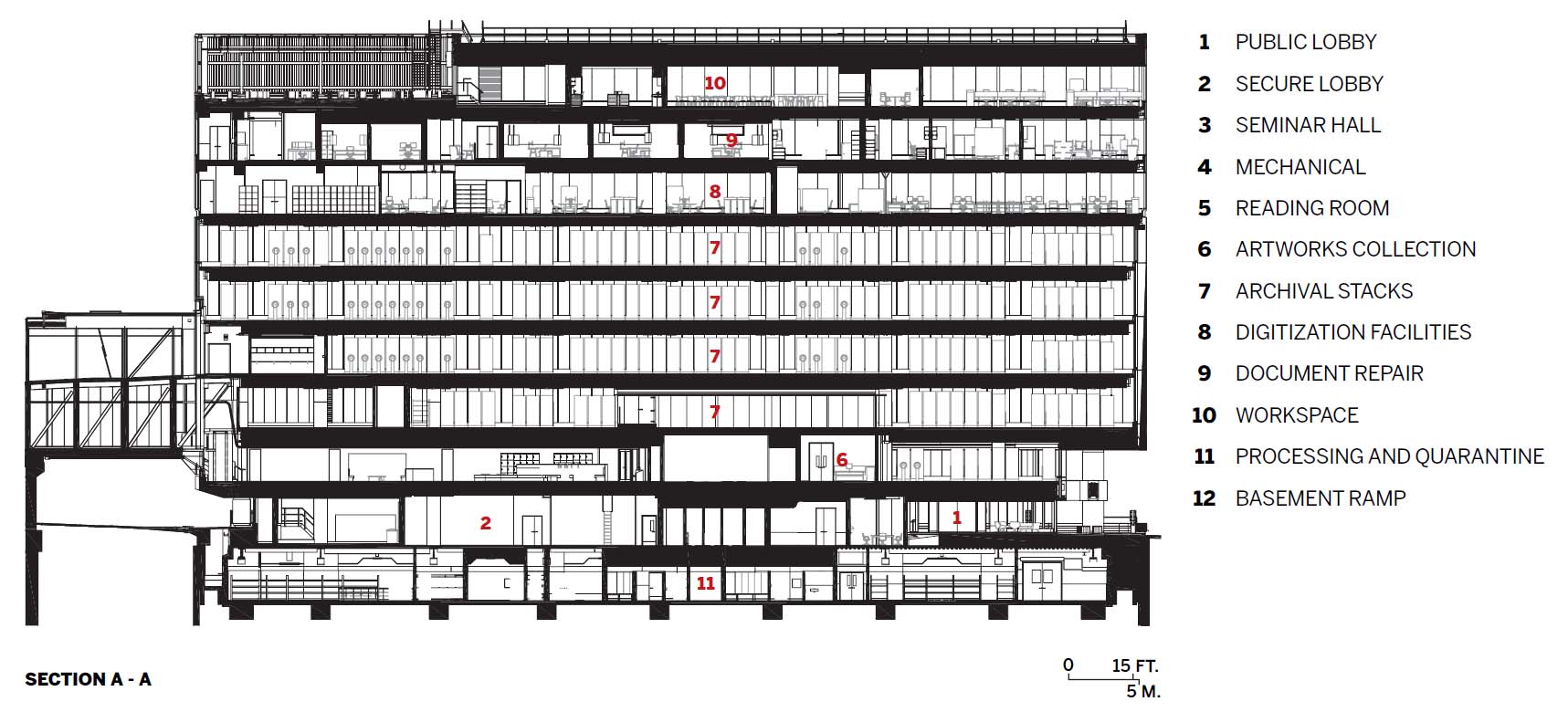
Courtesy Warren and Mahoney Architects, click to enlarge.
Credits
Architect:
Warren and Mahoney — Rodney Sampson, project principal; Melissa Thompson, project architect; Ralph Roberts, principal; Jahmayne Robin-Middleton, architect; Chiara Shim, architect
Engineers:
Aurecon (structural, civil, geotechnical); NDY (building services, acoustics, fire, sustainability); Arup (facade)
Consultants:
RJHA (technical); Tihei (Maori design lead); Boffa Miskell (landscape)
General Contractor:
LT McGuinness
Client:
Dexus/Department of Internal Affairs
Size:
284,200 square feet
Cost:
Withheld
Completion Date:
May 2025
Sources
Structural System:
MJH Engineering (steel); EPS (base isolators); MM Systems (seismic joints)
Building Envelope:
Thermosash (curtain wall); Alucolus (aluminum panels); Rockwool (insulation); Vaproshield (underlay); Proclima (membrane)
Roofing:
RoofLogic
Glazing:
Woods Glass
Fire-Control Doors:
Hallmark, Pacific, Greene Fire
Acoustical Ceilings:
SAS (mesh tiles); AMF (plasterboard)
Flooring:
Corian (solid surfacing); Tate (raised flooring)
Looking for a reprint of this article?
From high-res PDFs to custom plaques, order your copy today!