From the RECORD Archives: ‘Campus Center Designed to Provide Creative Arts Context for Social Activities’
© Architectural Record, December 1964
“Campus Center Designed to Provide Creative Arts Context for Social Activities”
By Mildred F. Schmertz
Architectural Record, December 1964
Hopkins Center
Dartmouth College
Hanover, New Hampshire
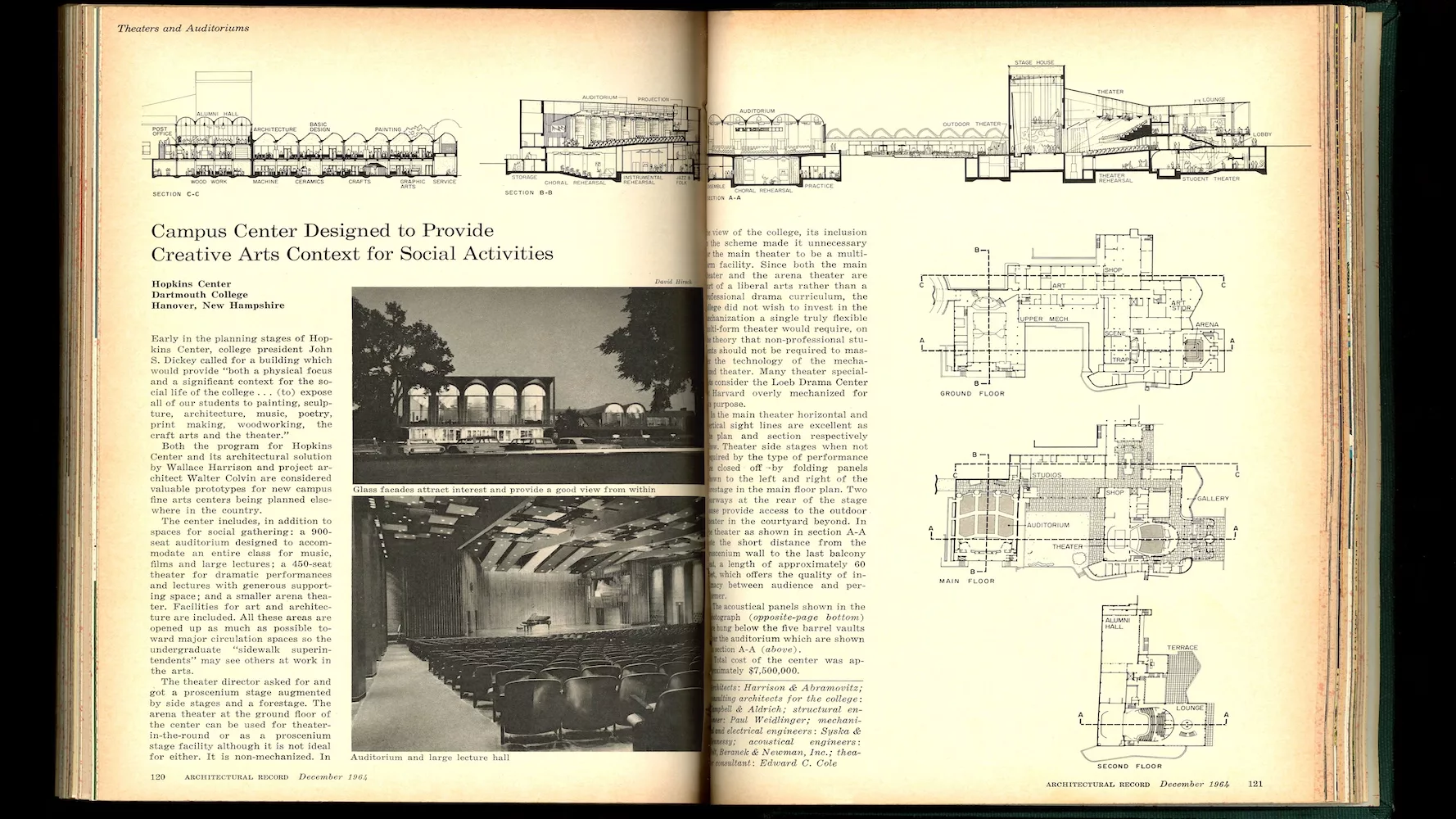
Early in the planning stages of Hopkins Center, college president John S. Dickey called for a building which would provide “both a physical focus and a significant context for the social life of the college . . . (to) expose all of our students to painting, sculpture, architecture, music, poetry, print making, woodworking, the craft arts and the theater.”
Both the program for Hopkins Center and its architectural solution by Wallace Harrison and project architect Walter Colvin are considered valuable prototypes for new campus fine arts centers being planned elsewhere in the country.
The center includes, in addition to spaces for social gathering: a 900-seat auditorium designed to accommodate an entire class for music, films and large lectures; a 450-seat theater for dramatic performances and lectures with generous supporting space; and a smaller arena theater. Facilities for art and architecture are included. All these areas are opened up as much as possible toward major circulation spaces so the undergraduate “sidewalk superintendents” may see others at work in the arts.
The theater director asked for and got a proscenium stage augmented by side stages and a forestage. The arena theater at the ground floor of the center can be used for theater-in-the-round or as a proscenium stage facility although it is not ideal for either. It is non-mechanized. In the view of the college, its inclusion in the scheme made it unnecessary for the main theater to be a multi-form facility. Since both the main theater and the arena theater are part of a liberal arts rather than a professional drama curriculum, the college did not wish to invest in the mechanization that a single truly flexible multi-form theater would require, on the theory that non-professional students should not be required to master the technology of the mechanized theater. Many theater specialists consider the Loeb Drama Center at Harvard overly mechanized for its purpose.
In the main theater horizontal and vertical sight lines are excellent as the plan and section respectively show. Theater side stages when not required by the type of performance are closed off by folding panels shown to the left and right of the forestage in the main floor plan. Two doorways at the rear of the stage house provide access to the outdoor theater in the courtyard beyond. In the theater as shown in section A-A, note the short distance from the proscenium wall to the last balcony seat, a length of approximately 60 feet, which offers the quality of intimacy between audience and performer.
Looking for quick answers on architecture and design topics?
Try Ask RECORD, our new smart AI search tool.
Ask RECORD →
Looking for a reprint of this article?
From high-res PDFs to custom plaques, order your copy today!