Spiritual Projects 2025
High Theory Meets High Holy Days in Preston Scott Cohen and BNIM’s Suburban Synagogue Expansion
Overland Park, Kansas
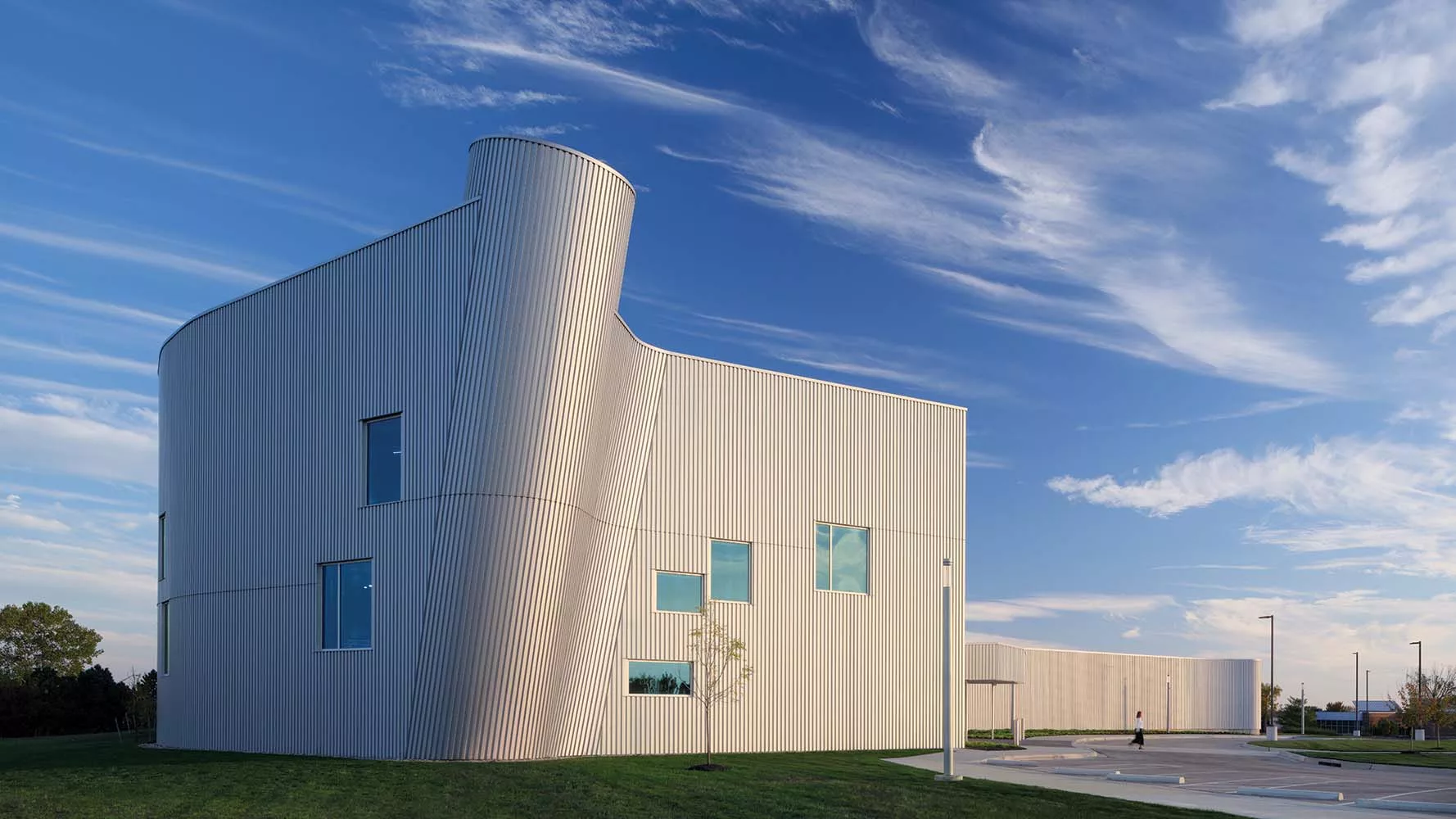
A windswept and wealthy suburb in the Kansas City metropolitan area might seem an unlikely setting for an architectural exploration of geometric concepts and the symbolic potential of form. But in Overland Park, Kansas, architect Preston Scott Cohen, a longtime professor at the Harvard Graduate School of Design, has translated these theoretical issues from the typical diagram, essay, and installation into a rare built work. In September 2024, his namesake firm, in collaboration with local architects BNIM, completed Congregation Beth Shalom, a synagogue expansion whose tilting, wrapping forms reinterpret the act of unrolling and reading the Torah.
The Conservative congregation relocated from Kansas City, Missouri, in 2006 and constructed a nondescript tan-brick school building. Shabbat services were held in its multipurpose room, which, while not particularly sacred, was adequate for the roughly 100 regular worshipers but insufficient for the High Holy Days, when attendance swells to around 500. In 2018, Cohen was commissioned to add a new sanctuary adjoining this hall, so the two spaces, perhaps divided by removable partitions, could be used together on holidays. This, however, proved not to work for both symbolic and practical reasons. Symbolically, any addition here would not allow the ark (the cabinet at the front of a synagogue where the Torah scrolls are kept) to face east toward Jerusalem, which is traditional, though not a strict requirement for this community. Functionally, an extension of the hall would have displaced the school’s pickup and drop-off zone and disrupted the building’s accessible route.
For Cohen, this conundrum was a blessing in disguise. “We were very pleased about the challenges posed by the site,” he says, “because they permitted us to design a coherent, architecturally autonomous sanctuary.” The extension takes the form of two 53-foot-tall scrolls wrapping around each other to create an oval space. The idea of the scrolled surface is the project’s unifying architectural language. An unfurling 19-foot-tall wall leads up to the double-height sanctuary, both to hide the existing brick building and to establish a lobby where the old and new meet. There is an entrance at one end of this space for those arriving by car and one at the other for the few who observe the Orthodox tradition of walking to Shabbat services.
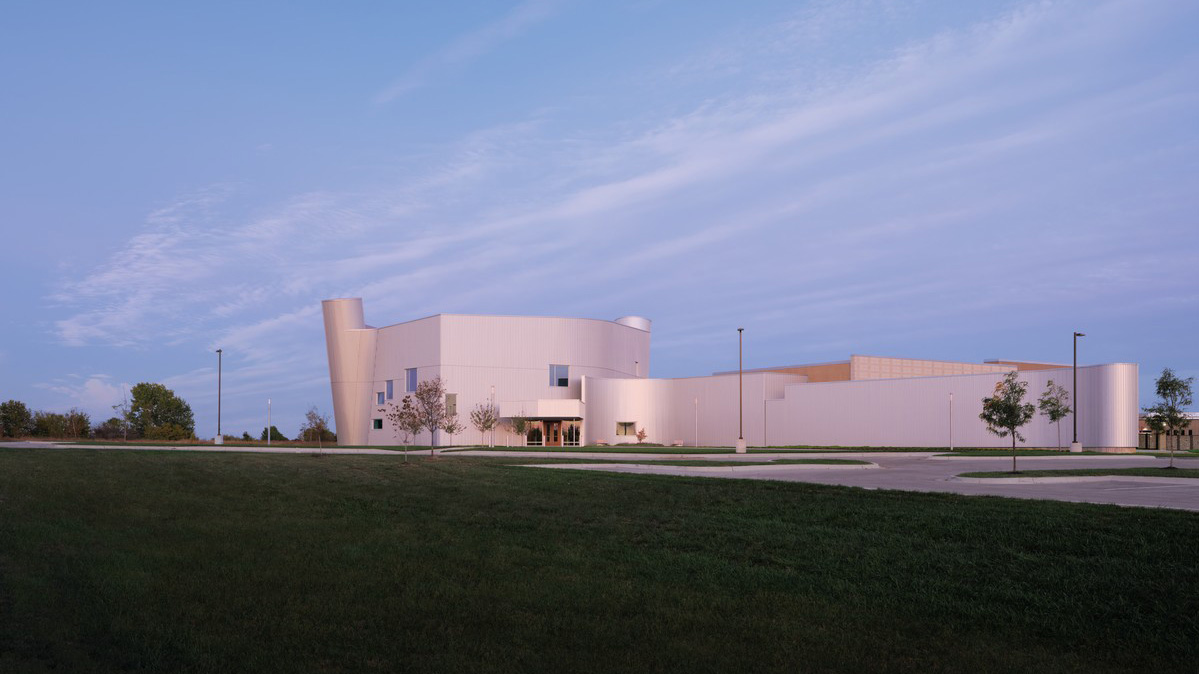
A tall furling wall conceals the view of the existing school building (above), leading to the scrolled sanctuary extension (top of page). Photo © Kendall McCaugherty, click to enlarge.
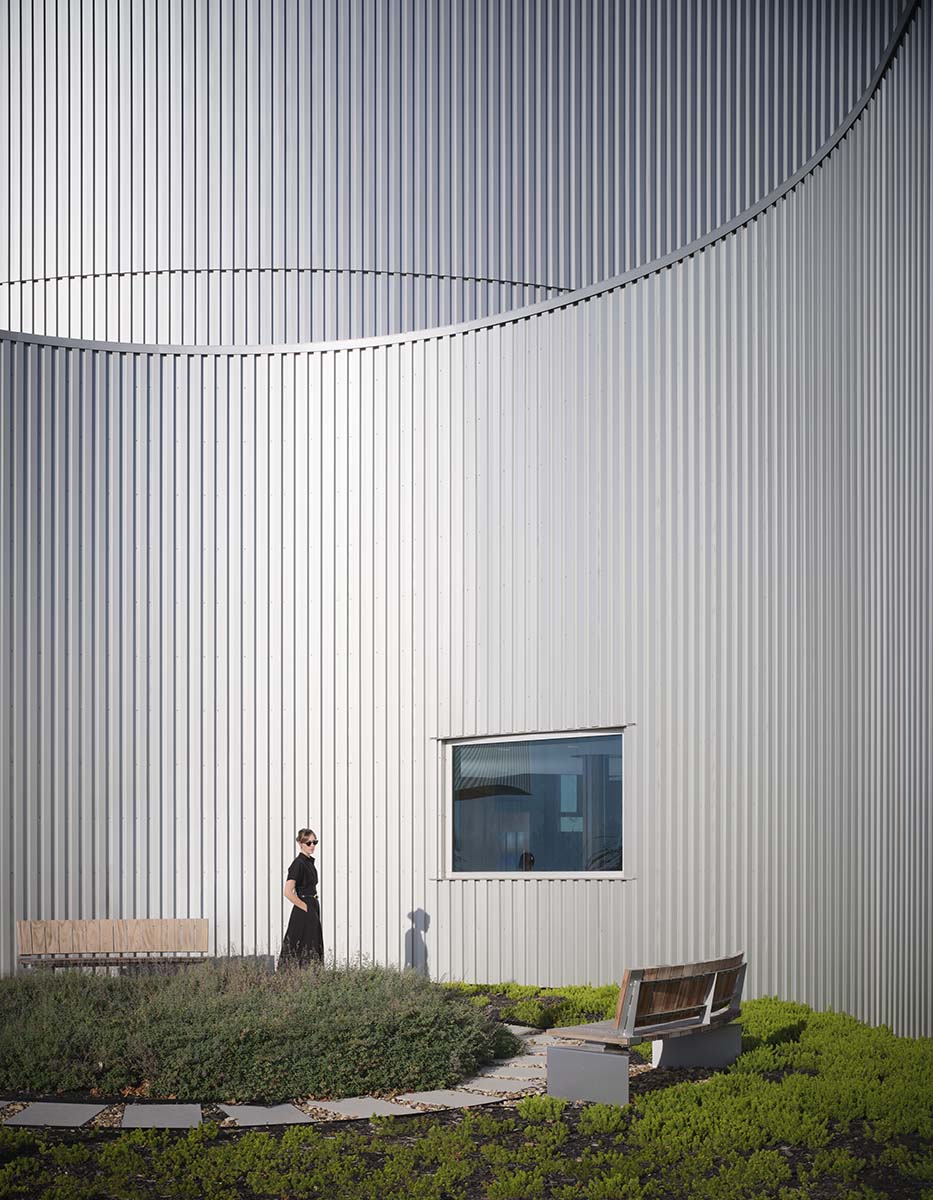
Near the parking entrance, the long wall wraps around to form the Memorial Garden. Photos © Kendall McCaugherty
A column in the center of the lobby supports the mezzanine in the sanctuary, which, in addition to a flexible seating plan, helps accommodate the holiday overflow. The prominence and singularity of this structural member, which is clad in walnut and slips through an opening in the ceiling, reads as a theoretically loaded gesture that taps into discourse—from Vitruvius to Robert Venturi—on architectural semiotics. In this context, the column also serves symbolically as one of the eitz chayim (wood rollers at the end of a Torah scroll) around which the procession into the synagogue unfurls.
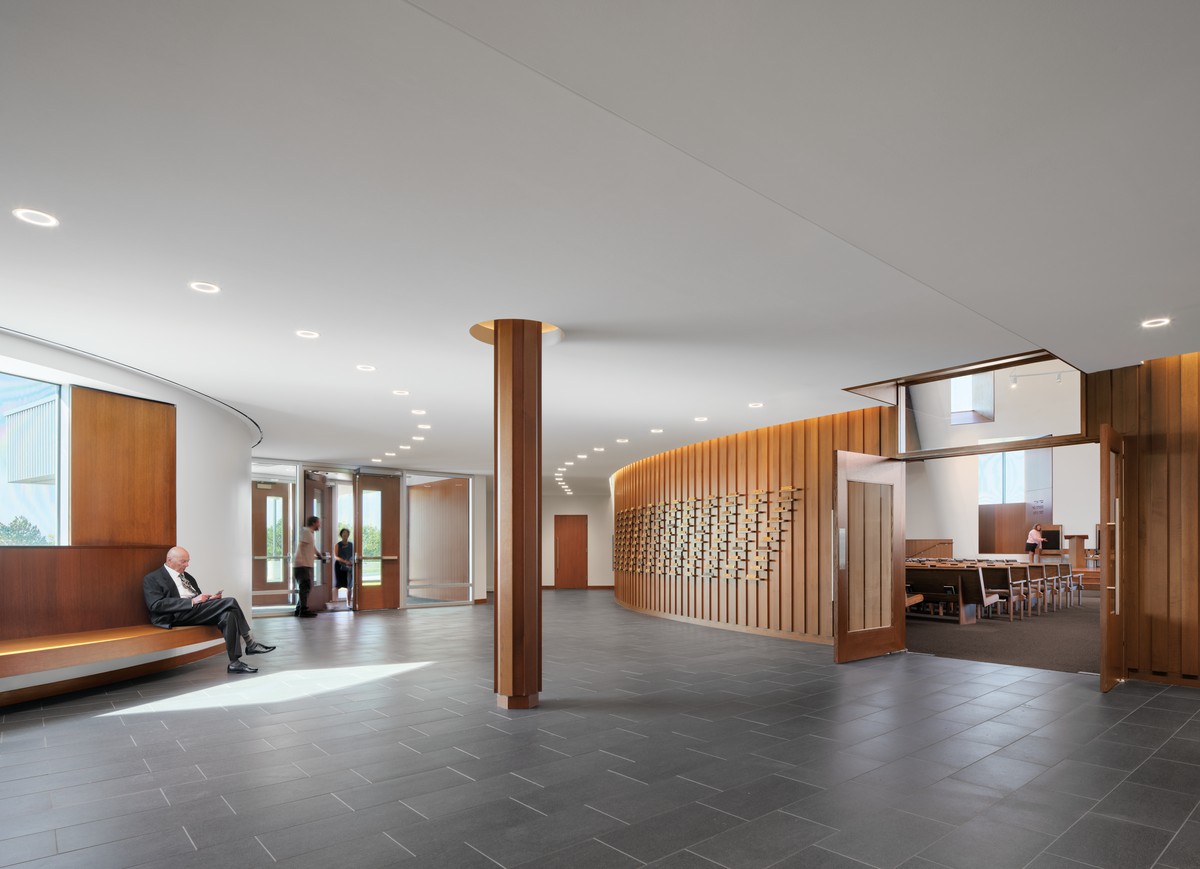
1
A lone column in the lobby supports a mezzanine for overflow seating (1), which is also accommodated by flexible seating in the sanctuary (2). Photo © Kendall McCaugherty
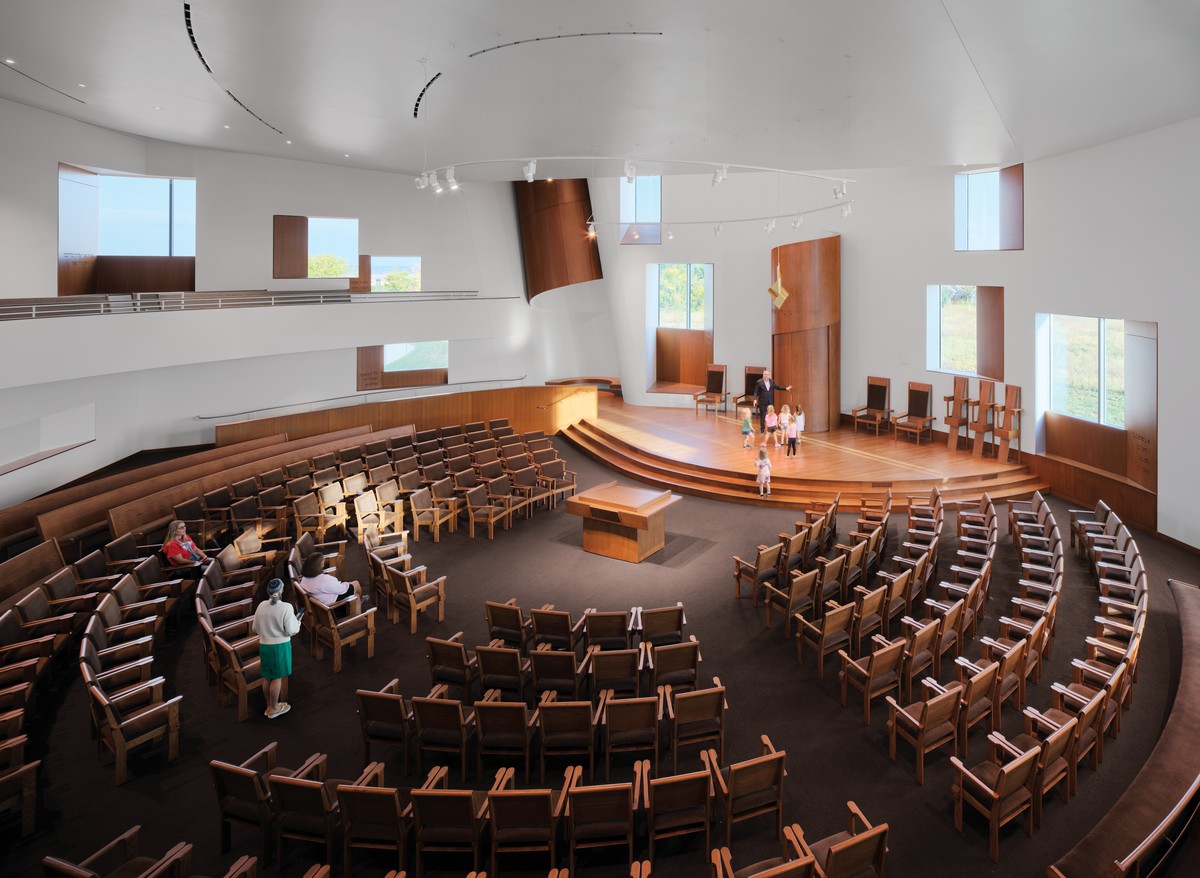
2
In the main sanctuary, one of the building’s tilting, unraveling scrolls anchors the bimah (stage area), becoming a light cannon—dark and intimate during the day but illuminated at night—and serving as what could be called a side chapel, where the rabbi can meet with families before a bar/bat mitzvah or pray a silent Amidah. The other scroll houses a stair, accessible from the lobby, leading to the mezzanine. Around the space are rectangular embrasures, punched into the curving surfaces and lined in walnut inscribed with excerpts from the Torah. For security reasons—there was a fatal neo-Nazi shooting at a nearby Jewish community center in 2014—the glazing within these deep-set openings is entirely above head height.
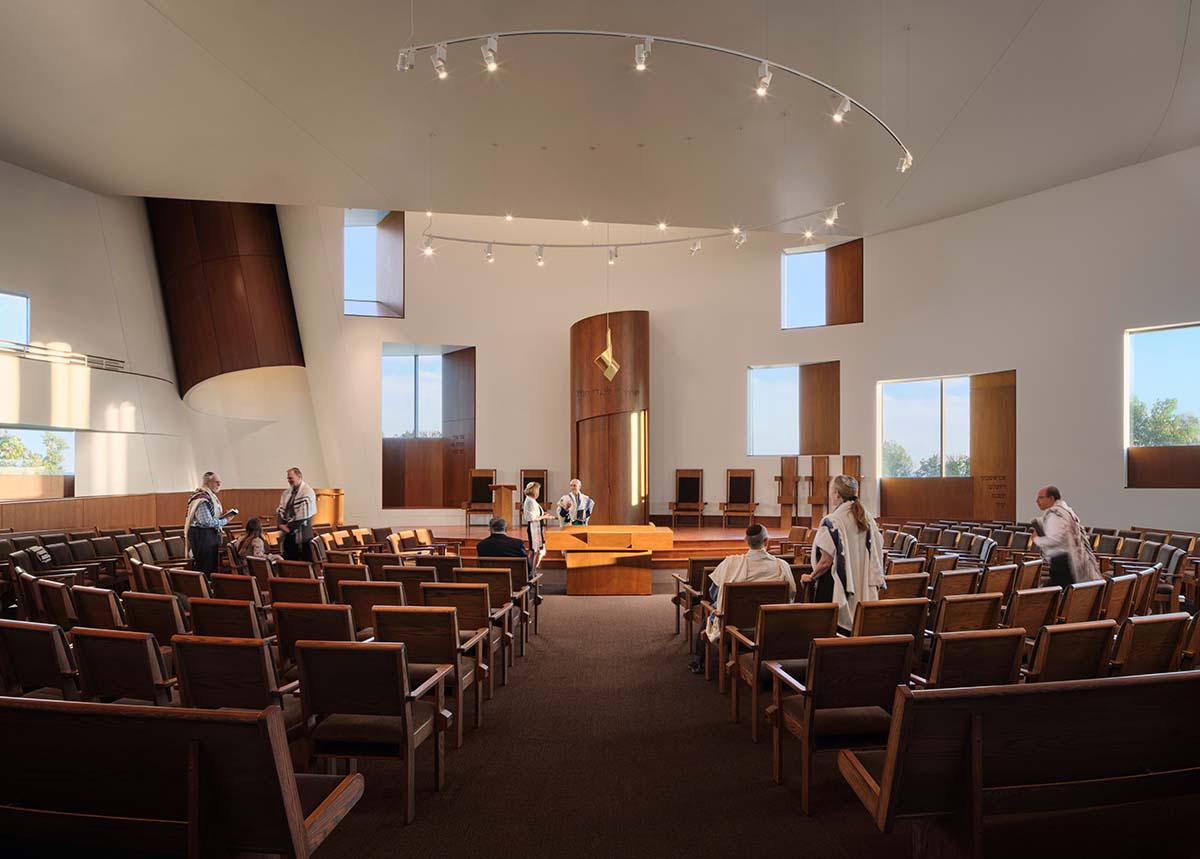
The arc, where the Torah scrolls are held, sits in the center of the bimah. Photo © Kendall McCaugherty

The scrolled forms function as light cannons. Photo © Kendall McCaugherty
If the interior is an architecture parlante for studying the Torah, the exterior is a lesson in geometry. Clad in corrugated galvanized siding, which, according to Cohen, “evokes the agricultural structures you might see in Kansas,” the scrolled forms are achieved by bending the ruled material along its grain. The result is that the building’s concave and convex curves, each composed as a developable surface, splice into each other such that the grooves of the metal misalign and make the distinct shapes legible. “The building is smoothly continuous,” Cohen notes, “but, owing to its geometry, these lines between sections of cladding inscribe another organization onto the architecture.”
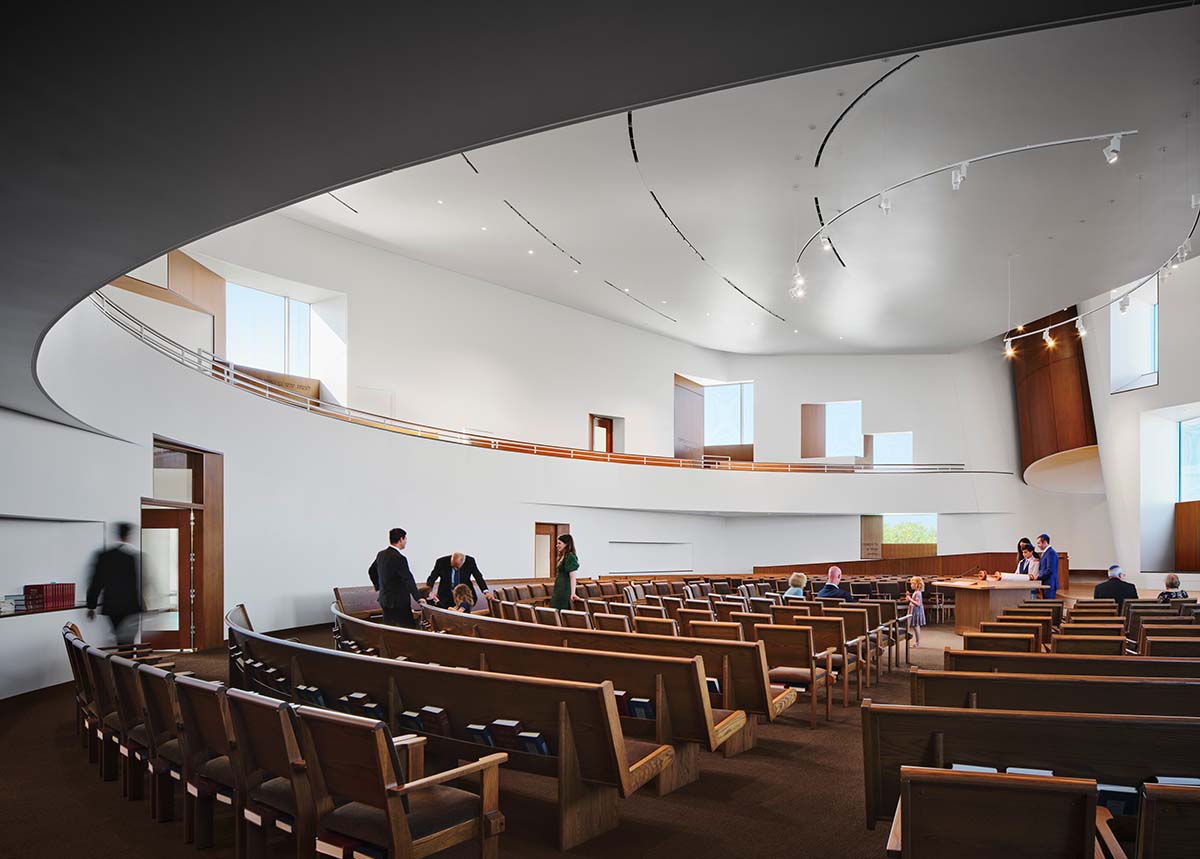
3
The mezzanine, which helps accommodate holiday overflow (3), sweeps around the sanctuary and seamlessly transitions into the light cannon (4). Photos © Kendall McCaugherty
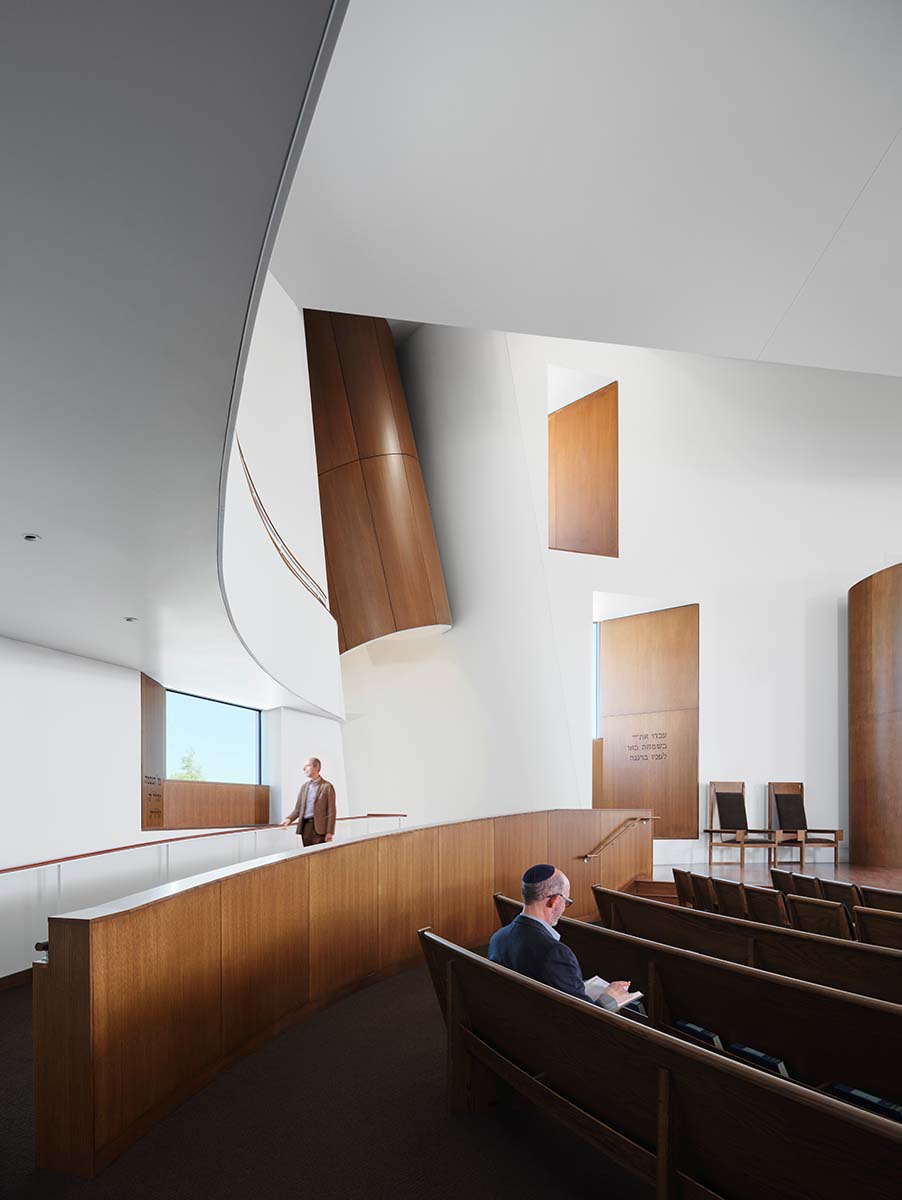
4
All successful buildings manage the exigencies of a particular site, cost constraints, client demands, and construction challenges. Exemplary ones also contend with architecture’s disciplinary legacy and its increasing environmental responsibilities, all while exhibiting a material and compositional finesse. Congregation Beth Shalom may not fulfill every one of these criteria, but, in this grassy suburban field, Cohen has nevertheless achieved something remarkable, setting the building apart from being merely successful. The architects have realized a rare fusion of theoretical ambitions with the gritty realities of a complex building.
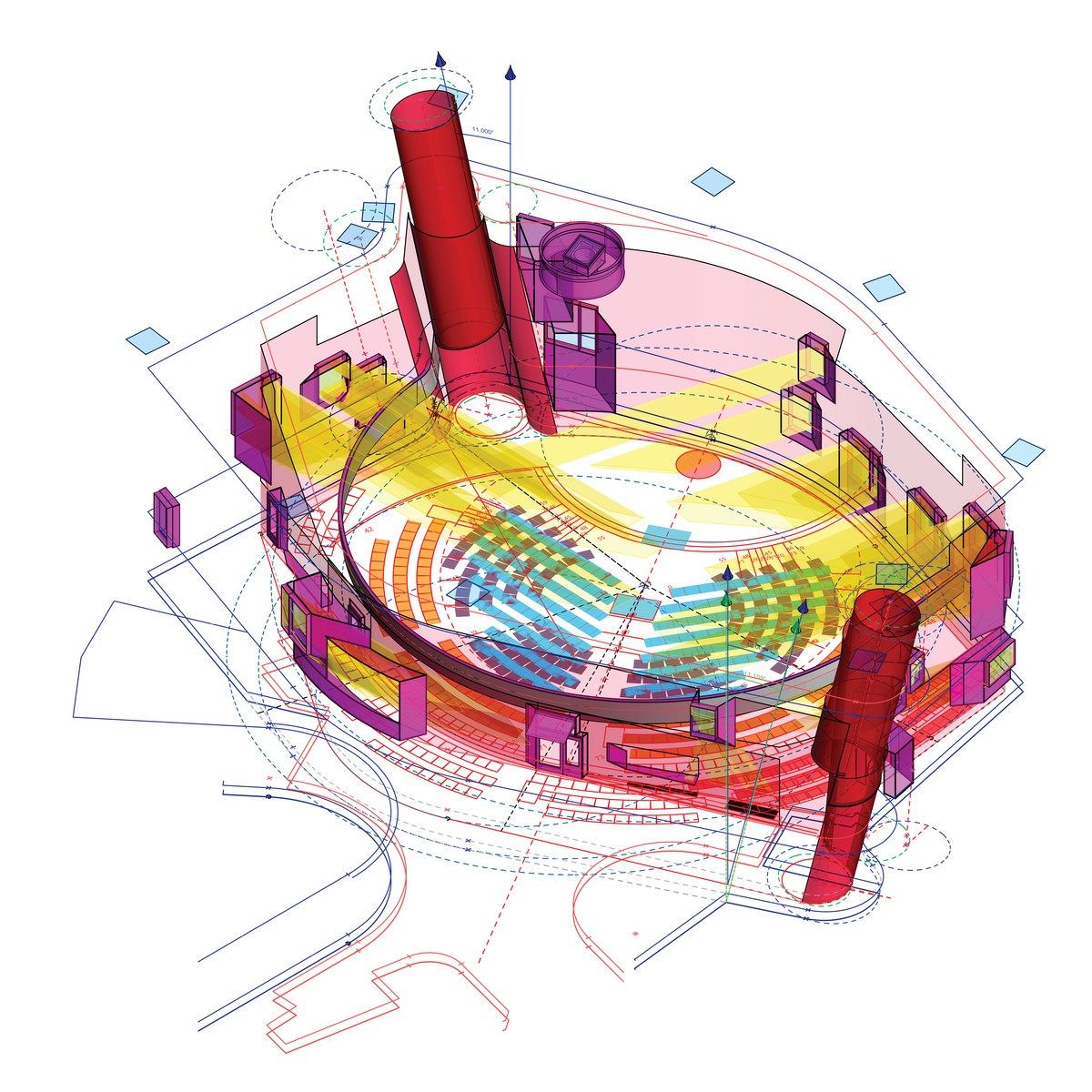
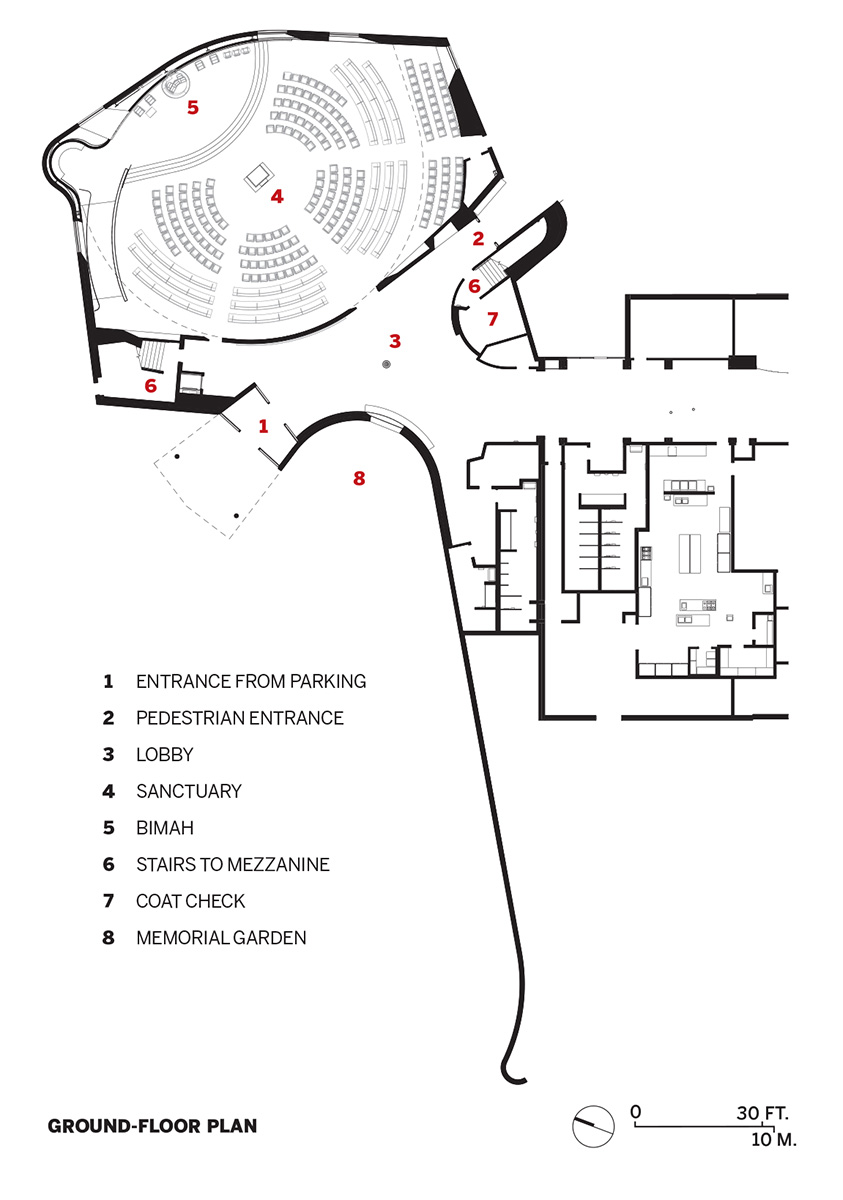
Images courtesy Preston Scott Cohen, Inc.
Credits
Architects:
Preston Scott Cohen, Inc. — Preston Scott Cohen, Carl D’Apolito-Dworkin, principal partners BNIM — Steve McDowell, principal in charge; Doug Stevens, principal; Katie Nichols, project architect, principal; Greg Sheldon, QA/QC specialist; Adam Wiechman, landscape architect; Alyssa Parsons, architect; Kaylee Drexel, designer
Engineers:
Henderson Engineers (m/e/p); KPFF (structural); SK Design Group (civil)
Consultants:
Rennaissance Infrastructure Consulting (landscape); Acentech (acoustics)
General Contractor:
A.L. Huber Construction
Client:
Congregation Beth Shalom
Size:
19,300 square feet
Cost:
Withheld
Completion Date:
August 2024
Sources
Cladding:
Metal Sales, Galvalume
Curtain Wall:
YKK
Moisture Barrier:
Carlisle
Glass:
Guardian Glass
Skylights:
Velux
Doors:
YKK (entrances); VT Industries (wood)
Hardware:
Schlage (locksets); LCN (closers); Von Duprin (exit devices)
Ceilings:
Armstrong (acoustical and suspension grid)
Solid Surfacing:
Caesarstone
Custom Woodwork:
SquareOne
Flooring:
Marazzi (tiling); Roppe
Lighting:
Kelvix, Metalux, LumenPulse, FluxWerx, Lithonia, Fineline, Amerlux, Times Square (ambient); Juno, Lumen Core (downlights); Selux (exterior)
Elevators:
Garavanta Lift
Looking for quick answers on architecture and design topics?
Try Ask RECORD, our new smart AI search tool.
Ask RECORD →
Looking for a reprint of this article?
From high-res PDFs to custom plaques, order your copy today!