Record NEWS
‘Manifesta’ Takes on Germany’s Deconsecration Crisis
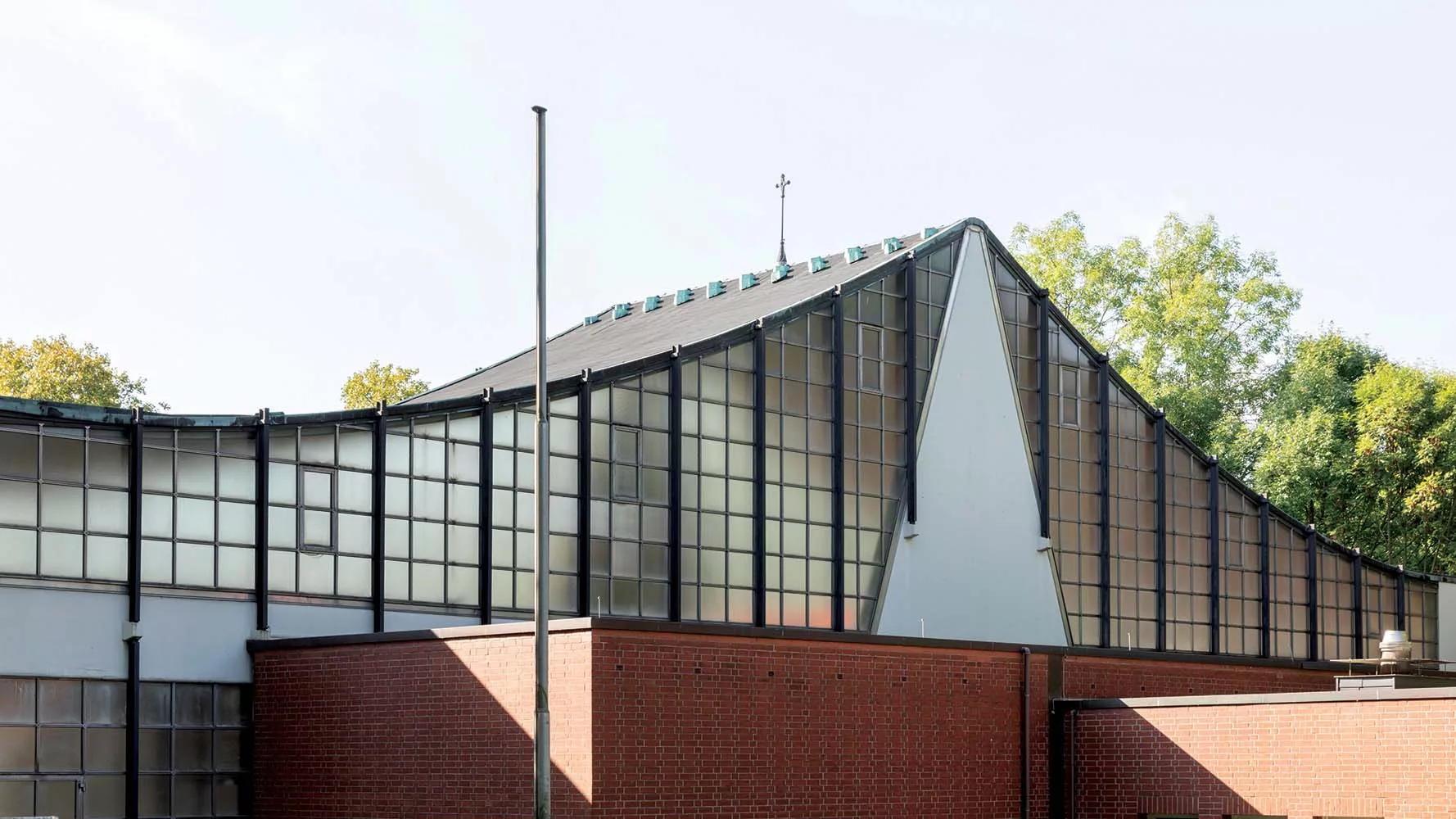
In Essen, Germany, in the shadow of the mighty Zollverein—“the world’s most beautiful colliery,” now a museum and UNESCO World Heritage Site—stands a rather curious building. With its redbrick wings and glass curtain walls hanging theatrically from a parabolic roof, one could be forgiven for supposing it is some kind of elaborately engineered sports hall. But the austere solemnity of the blind, rough-hewn-stone entrance front immediately dispels that idea. A small, easy-to-overlook noticeboard reveals that this striking structure was once Heilig-Geist-Kirche (Church of the Holy Ghost), constructed in 1955–57 by the Pritzker Prize–winning Gottfried Böhm. Closed in 2020 and empty for years, it is one of the lucky ones recently acquired by Berlin-based gallerist Johann König and now an independent arts space.

The Heilig-Geist-Kirche (top of page), in Essen, and Liebfrauenkirche (above), in Duisburg, are two of some 200 abandoned postwar churches. Photo © Daniel Sadrowski, click to enlarge.
The deconsecration of Heilig-Geist-Kirche is emblematic of a rapidly accelerating crisis in Germany’s churches. Though congregations have been declining for decades, post-Covid the hemorrhage has become torrential: in the period 2019–24, official membership of the Catholic Church fell by a staggering 2,064,019 people, according to statistics released by the German Bishops’ Conference, with equally calamitous figures among the Protestant denominations. In response, the ecclesiastical authorities are divesting at an unprecedented rate. “In 2023, the number of churches in Germany stood at around 44,000,” says art historian Barbara Welzel. “Over the course of the next decade, as many as 20,000 may close. Those figures don’t include monasteries, hospital chapels, et cetera, of which there are around 60,000. Many of those will close too.”
A professor at the Technical University of Dortmund, Welzel is one of the 10 academic and institutional authors of the 2024 Kirchenmanifest (Church Manifesto), an online document that seeks to stimulate debate about what this phenomenon means for both the built environment and society as a whole. Reasons for public disaffection with Germany’s churches include a series of recent child-abuse scandals and, among Catholics, the 2013 “bishop of bling” affair, when it was revealed that Franz-Peter Tebartz-van Elst, the prelate in Limburg, was spending upward of $36 million to renovate his official residence. The ecclesiastical authorities’ reaction, in a country where they are significant providers of social services and are financed by a government tax levied on members, has been to prioritize “people over bricks and mortar,” meaning they view their churches as mere real estate they can dispose of when no longer needed.
For the Kirchenmanifest authors, this is a denial of the wider cultural significance of these buildings, in a continent where, for over a millennium, communities have been physically and socially organized around a church. The issue, they feel, is not about Christianity but a more general question of spirituality. “If we abandon these buildings to purely private interests, or if we demolish them to construct, say, housing, we will lose precious public spaces that aren’t about buying or consuming something but are places where you can simply be, and where you can connect to spirituality,” says Welzel. “We need these spaces for democracy, as venues where different people can meet and say, ‘OK, it’s ours together, even if we disagree on everything else.’”
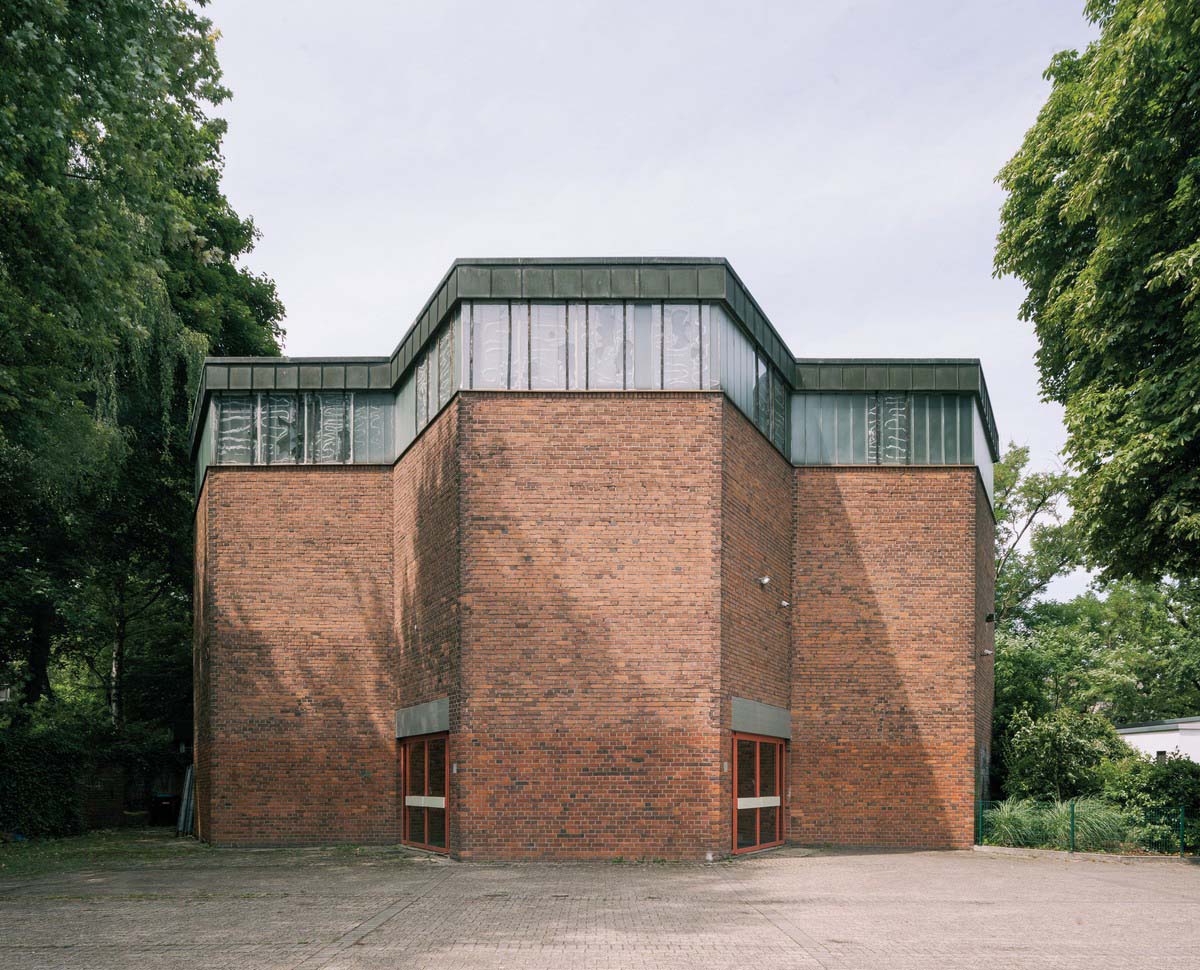
1
St. Bonifatius (1), also in Gelsenkirchen, and Kunstkirche Christ-König (2), in Bochum, were transformed into arts spaces. Photos © Anton Vichrov

2
The phenomenon of church closure is particularly acute in the Ruhrgebiet, the rust belt region near the French border that includes the towns of Bochum, Duisburg, and Gelsenkirchen, as well as Essen. The heart of Germany’s economic recovery after World War II, the area saw countless churches either reconstructed or built from scratch in the boom years that followed. Since the 1980s, however, when the Ruhr’s industrial activity ceased, its demographics have radically altered—non-Christian communities have grown, while overall population figures have declined. “In the Ruhrgebiet, the diocese of Essen will have abandoned 80 percent of its parish churches in the period 2005 to 2030,” says Welzel. The buildings in question often display postwar architectural styles that are not necessarily understood or appreciated by the general public, a factor that is grist for the mill of divestment policies.
In order to highlight the issue, Manifesta, the nomadic European art biennial, has chosen 12 deconsecrated Ruhrgebiet churches as the main exhibition spaces for its 16th edition, which will take place in the region next summer. Since its founding, in 1994, the biennial has developed its “own distinct interdisciplinary approach that includes architecture and urbanism and asks the question, ‘What does the city need to become?’” explains its director, Hedwig Fijen. As well as Essen’s Heilig-Geist-Kirche, Manifesta’s venues include Gelsenkirchen’s Thomaskirche (designed by Fred Janowski and Albrecht Egon Wittig, 1964–65), a significant example of postwar Protestant architecture; Bochum’s Gethsemane-Kirche (Otto Bartning, 1947–50), an “emergency church” erected in the immediate aftermath of wartime bombings; and Duisburg’s striking Liebfrauenkirche (Toni Hermanns, 1958–71), which features monumental clerestories in undulating fiberglass. Some of Manifesta’s sites have already found alternative uses—as social-service meetinghouses or as art, culture, and education spaces—that point the way toward how the issue of closure might be tackled.
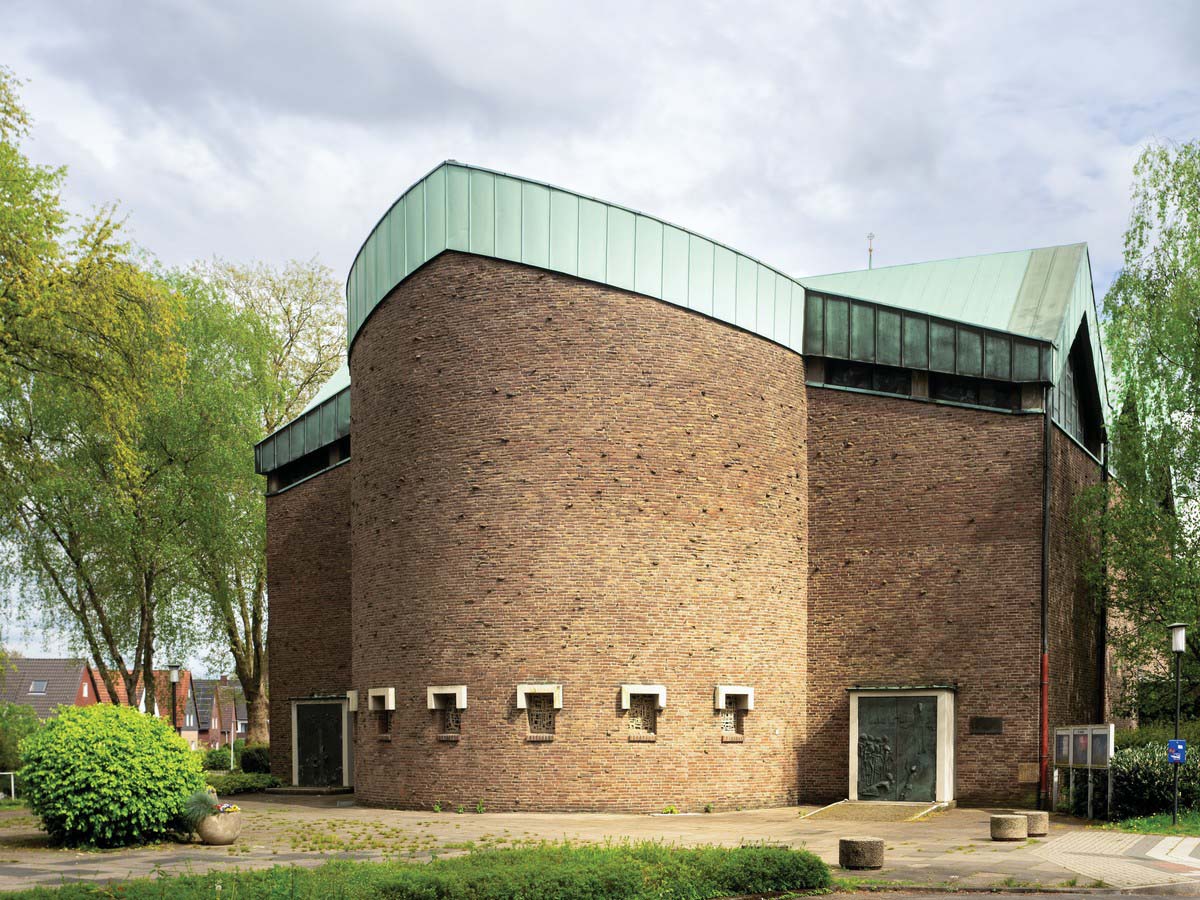
3
St. Suitbert (3), in Ruhr, and Thomaskirche (4 & 5), in Gelsenkirchen, have been selected as Manifesta 16 Ruhr sites. Photos © Dick Rose

4

5
As Welzel is the first to admit, not all the buildings facing deconsecration are as architecturally significant as Manifesta’s venues, but, in her view, this does not diminish their social potential. Since they are located in prime urban sites and were often constructed with help from the public purse, the Kirchenmanifest authors argue, they constitute a common good. Decided on a case-by-case basis and in cooperation with local stakeholders, repurposing could take the form of mixed ownership and mixed use—as music-school practice rooms in the morning and multifaith spaces in the afternoon, to give just one possible scenario. “In this vision, spirituality remains in these places,” Welzel concludes.
Looking for quick answers on architecture and design topics?
Try Ask RECORD, our new smart AI search tool.
Ask RECORD →
Looking for a reprint of this article?
From high-res PDFs to custom plaques, order your copy today!