RECORD Interviews
New York’s Jewish Museum Opens Transformed Galleries for its Permanent Collection
New York
Architects & Firms
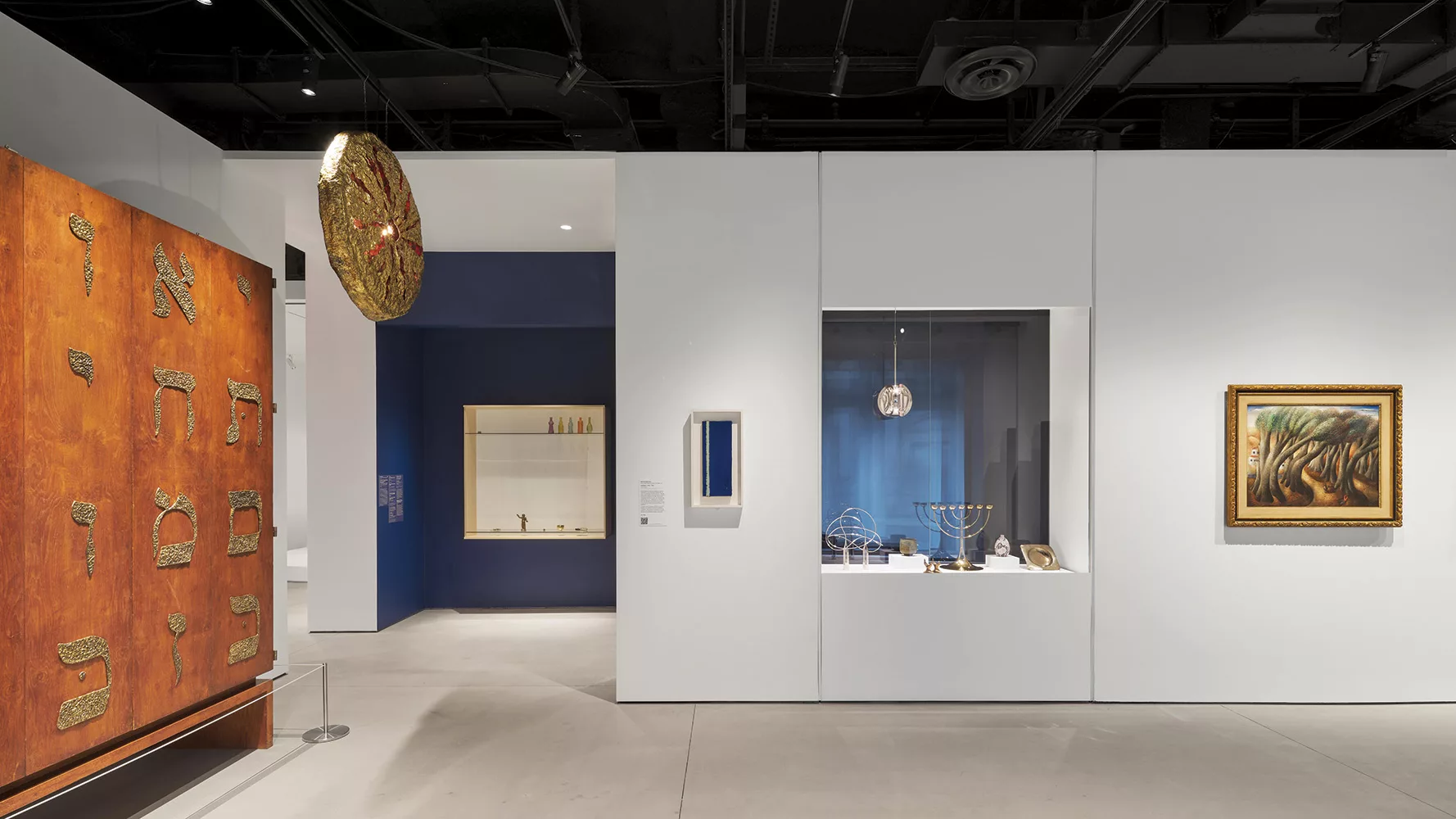
In October, the Jewish Museum on Manhattan’s Upper East Side unveiled its recently transformed third- and fourth-floor galleries, the longtime home of its permanent collection. Among the more than 200 works currently on display, as part of the exhibition Identity, Culture, and Community, are ritual objects from Ashkenazi, Sephardic, and Mizrahi traditions, relics from Colonial America, as well as paintings and sculpture by artists including Nicole Eisenman, Louise Nevelson, and Mark Rothko. The oeuvre of certain gentiles appears too: a Torah ark, designed by Philip Johnson in collaboration with Ibram Lassaw, for Kneses Tifereth Israel, is prominently featured in one of the new spaces. (In the 1950s, Johnson designed this congregation’s temple, free of charge, as an attempt to publicly atone for his political activities in 1930s Germany.) Spatially organizing this broad assortment of art and artifacts from the museum’s collection fell to Jaffer Kolb and Ivi Diamantopoulou, cofounders of New York–based New Affiliates. The duo spoke with RECORD managing editor Leopoldo Villardi about their previous collaborations with the museum and their approach to exhibitions.
I have fond memories of several shows at the Jewish Museum, particularly the one about architect Pierre Chareau in 2016.
Jaffer Kolb: That was actually our way into the Jewish Museum. I worked on the exhibition while at Diller Scofidio + Renfro. Ivi and I always think about how to exhibit architecture in a way that makes it feel alive.
Ivi Diamantopoulou: Not long after the Chareau show, we founded New Affiliates and got our first project at the museum, designing Marc Camille Chaimowicz: Your Place or Mine . . ., which was on the more domestic second floor. While we were building our practice, we continued working on exhibitions there, including Martha Rosler: Irrespective and Leonard Cohen: A Crack in Everything. We have gotten to know the museum very well.

Photo © Olympia Shannon, click to enlarge.

Photo © Olympia Shannon, click to enlarge.
How did this project come about?
JK: James Snyder, who became director two years ago, had been working with UN Studio and Method Design to overhaul the third and fourth floors, and to add a learning center. But, because of our history with the museum, we were brought on to focus on the galleries.
The interior architecture was being revamped while you were developing a new curatorial strategy—I’m sure that helped you think big.
JK: The existing spaces had an amazing museum quality, but they were confusing from a circulation standpoint. Visitors would arrive on the third floor and there was nothing guiding them left or right. And when they went left or right, there was nothing guiding them where to go next. Freestanding columns and awkward cheek walls created pinch points. It was a series of disconnected spaces where you could easily get lost.
We thought about how people should move between the galleries, how to play with layered views, and how to create connections between some of the different pieces on display. We concealed all the columns inside thick walls with built-in cases and used color to suggest where visitors should go first.
Now the idea is that museumgoers move in a clockwise circuit, from a large gallery to a small one to larger one, and so on. You get hints of what’s to come, by seeing through casework or directly into other spaces. There’s a biaxial symmetry that organizes the plan, and the curatorial narrative ends with a double-height gallery with casework showing the fourth-floor display areas, which also fell within our scope.

Photo © Olympia Shannon
Did the galleries’ location in a former mansion have any bearing on the project?
JK: In our previous projects at the Jewish Museum, we’ve always had to confront its domestic history. There are salon-style areas that are highly articulated and ornamented, especially on the piano nobile. But there are also white-box galleries. It’s interesting that the museum has both conditions. For this project, we were trying to play with wall thickness, which to us felt like a response to the poché of the original Warburg Mansion’s thick masonry and the programs it sometimes hides.
Looking for quick answers on architecture and design topics?
Try Ask RECORD, our new smart AI search tool.
Ask RECORD →
A few years ago you started Testbeds, an initiative to reuse architectural mock-ups for other projects, particularly public ones. Exhibitions can produce a lot of the waste. Has this research influenced your curatorial approach?
ID: In some ways, our work at the Jewish Museum was a progenitor to Testbeds. When we designed the Cohen show, which took place on three floors, we developed a real anxiety over excess and waste. We initiated a collaboration with the city’s Department of Sanitation, called the Museum Exchange Network, to help identify materials that could be redistributed after the show—for example, vitrines that could be traded, flooring and benches that could be reused. Thankfully, that happened.
With this project, because we were working with the permanent collection, we thought about the casework in a way that allows many different configurations and accommodates differences in materials and changes in scale. Even the rotation galleries can be easily adapted without having to reconfigure architectural components.
JK: As in architecture, we are increasingly thinking about circularity—not just at the scale of individual components but also at the scale of entire institutions.
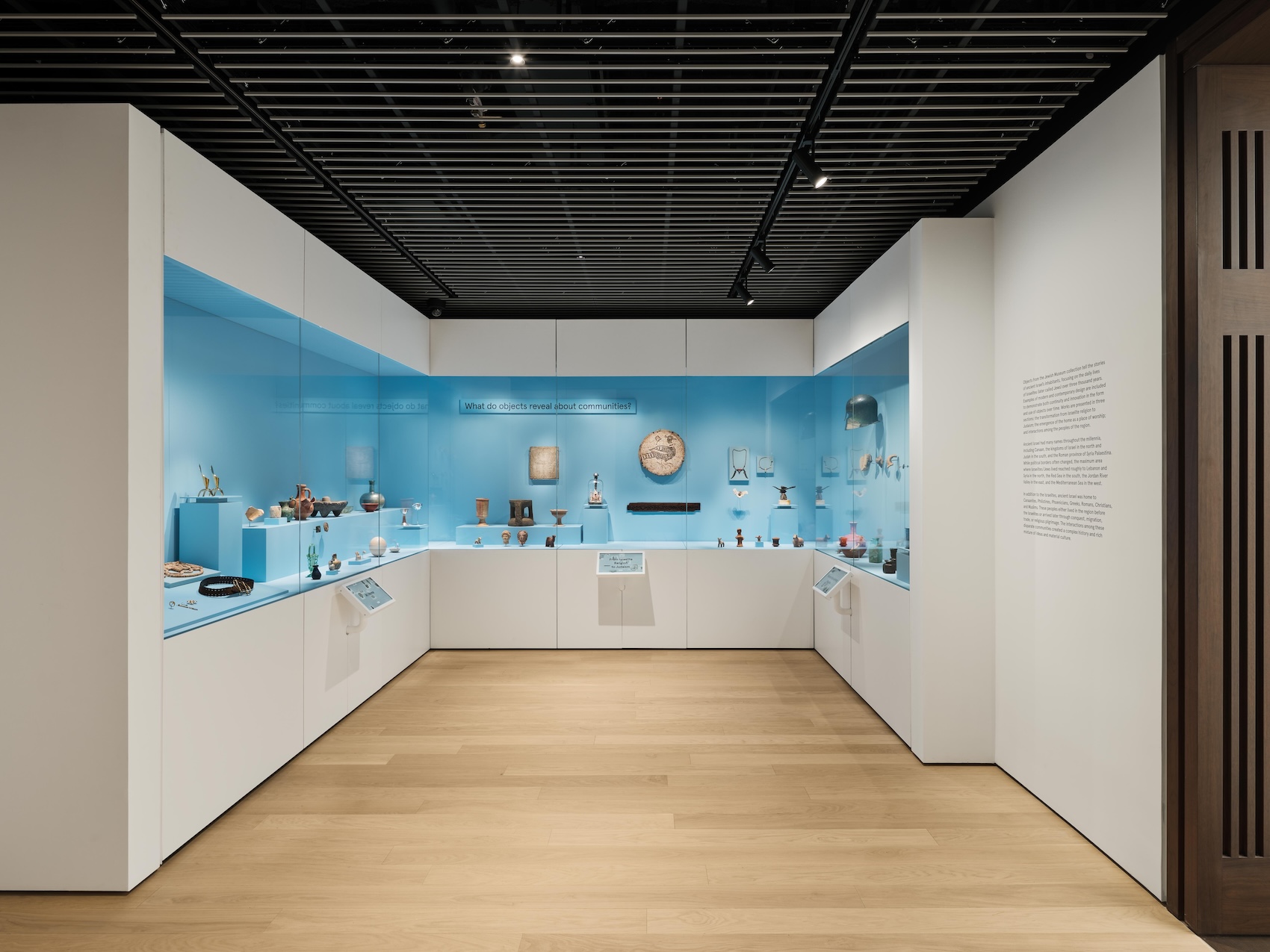
Photo © Olympia Shannon, click to enlarge.
Some architects see exhibition design as something to graduate out of, but you have continued to work in this area while taking on bigger projects. What’s next for New Affiliates?
JK: Early in our practice, I was worried about being pigeonholed as an exhibition designer, but the work captivated us and was a steady source of income. When I was in school it was very unfashionable to talk about phenomenology or the experience of being in a thing from a subjective point of view. We had been raised by the axonometric drawing, by form, but something weirdly satisfying about exhibition design was being able to shed disciplinary language while continuing to think as architects.
ID: I would add that, in architecture, you have to wait years and years to see your work realized. The speed and ability to test ideas quickly has very much shaped how we now work in other typologies.
JK: And that transition, from exhibition to institution, is the journey that we’re most excited about right now. We’re working on this new museum called the Canyon, which will be located downtown on the Lower East Side. It will be a 45,000-square-foot space for digital art. And we’re working with the entire team—the executive director, the funder—to essentially invent the institution too.
Looking for a reprint of this article?
From high-res PDFs to custom plaques, order your copy today!