From the RECORD Archives: ‘KTI Synagogue, Port Chester, NY’
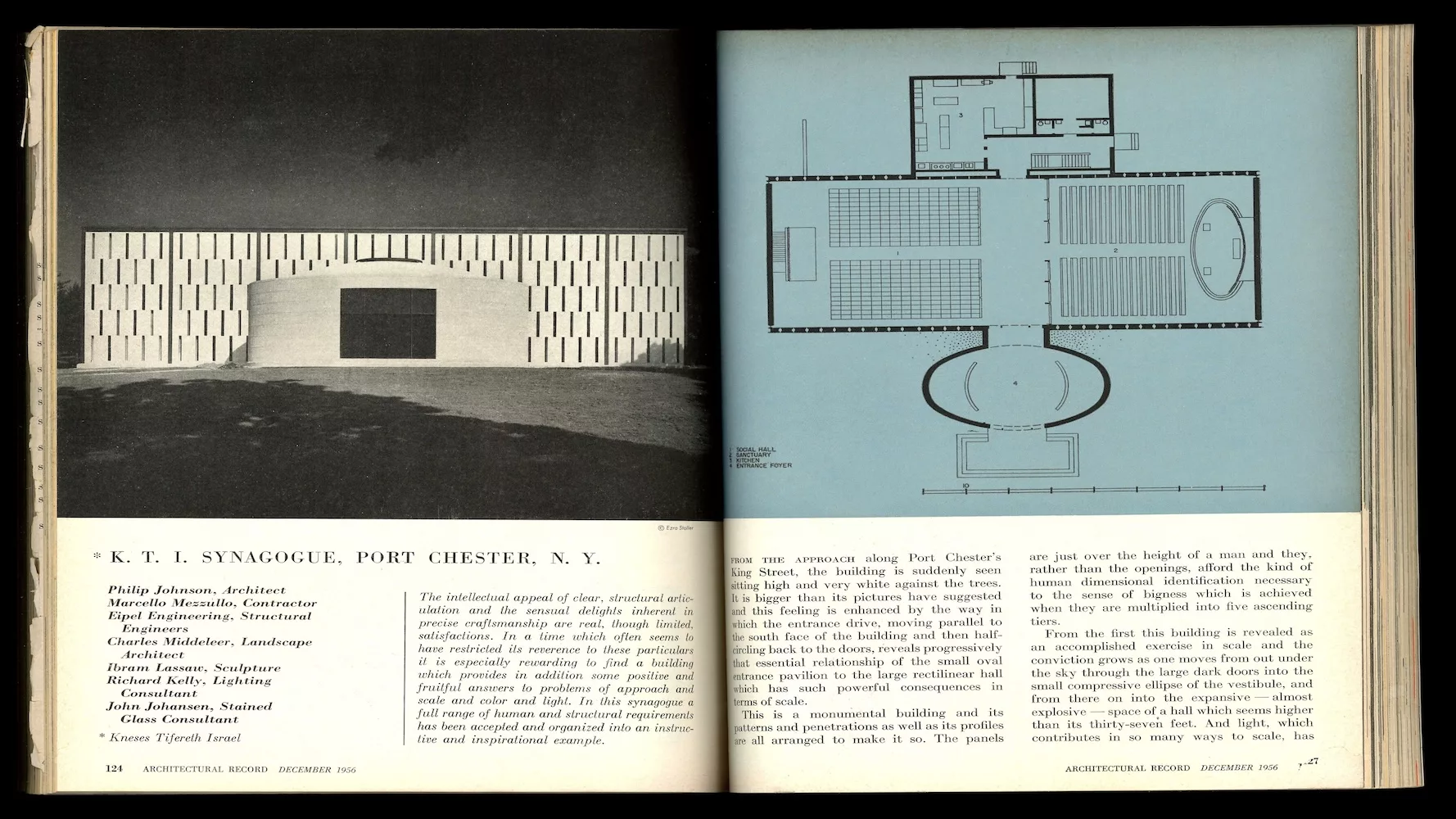
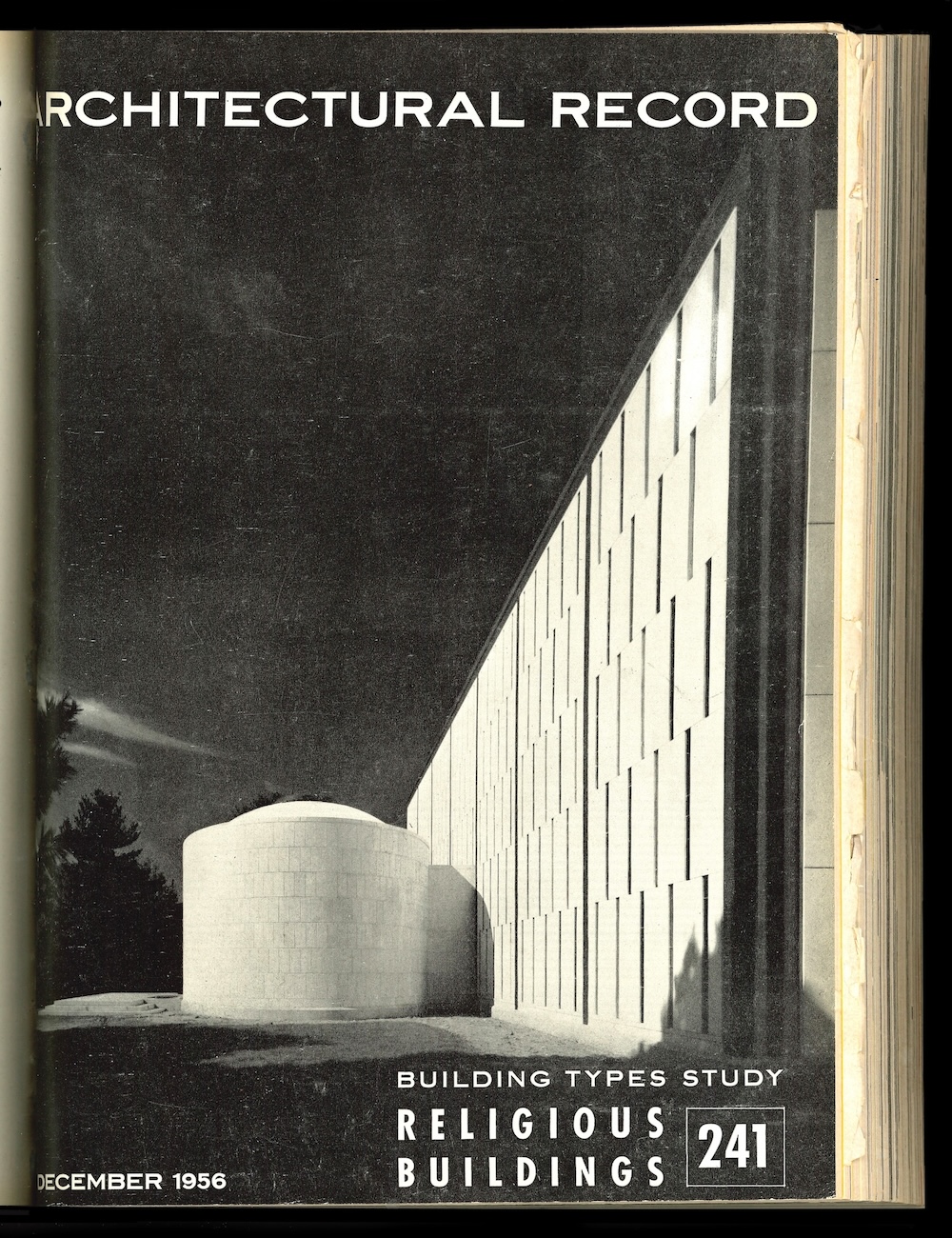
The Kneses Tifereth Israel (KTI) Synagogue was designed in the 1950s by Philip Johnson. The renowned architect and personality offered to realize the project free of charge in an attempt to atone for his activities in 1930s Germany—an effort that some critics say was not enough. (Later in life, Johnson also became close friends with many Jewish architects and artists, including Lincoln Kirstein, Mark Rothko, Robert A.M. Stern, and Peter Eisenman.) KTI’s temple appeared in RECORD’s December 1956 issue—as well as on its cover—as a part of a collection focusing on religious buildings. The article lauds the synagogue’s structural precision and aesthetic appeal, namely Johnson’s use of light, color, and scale. In 2006, the KTI Synagogue remodeled the sanctuary to better accommodate the needs of the congregation, and sold several items designed by Johnson and sculptor Ibram Lassaw to The Jewish Museum in Manhattan, which recently underwent a significant gallery transformation.
© Architectural Record, December 1956
“KTI Synagogue, Port Chester, NY”
No author
Architectural Record, December 1956
The intellectual appeal of clear, structural articulation and the sensual delights inherent in precise craftsmanship are real, though limited, satisfactions. In a time which often seems to have restricted its reverence to these particulars it is especially rewarding to find a building which provides in addition some positive and fruitful answers to problems of approach and scale and color and light. In this synagogue a full range of human and structural requirements has been accepted and organized into an instructive and inspirational example.
From the approach along Port Chester’s King Street, the building is suddenly seen sitting high and very white against the trees. It is bigger than its pictures have suggested and this feeling is enhanced by the way in which the entrance drive, moving parallel to the south face of the building and then half-circling back to the doors, reveals progressively that essential relationship of the small oval pavilion to the large rectilinear hall which has such powerful consequences of scale.
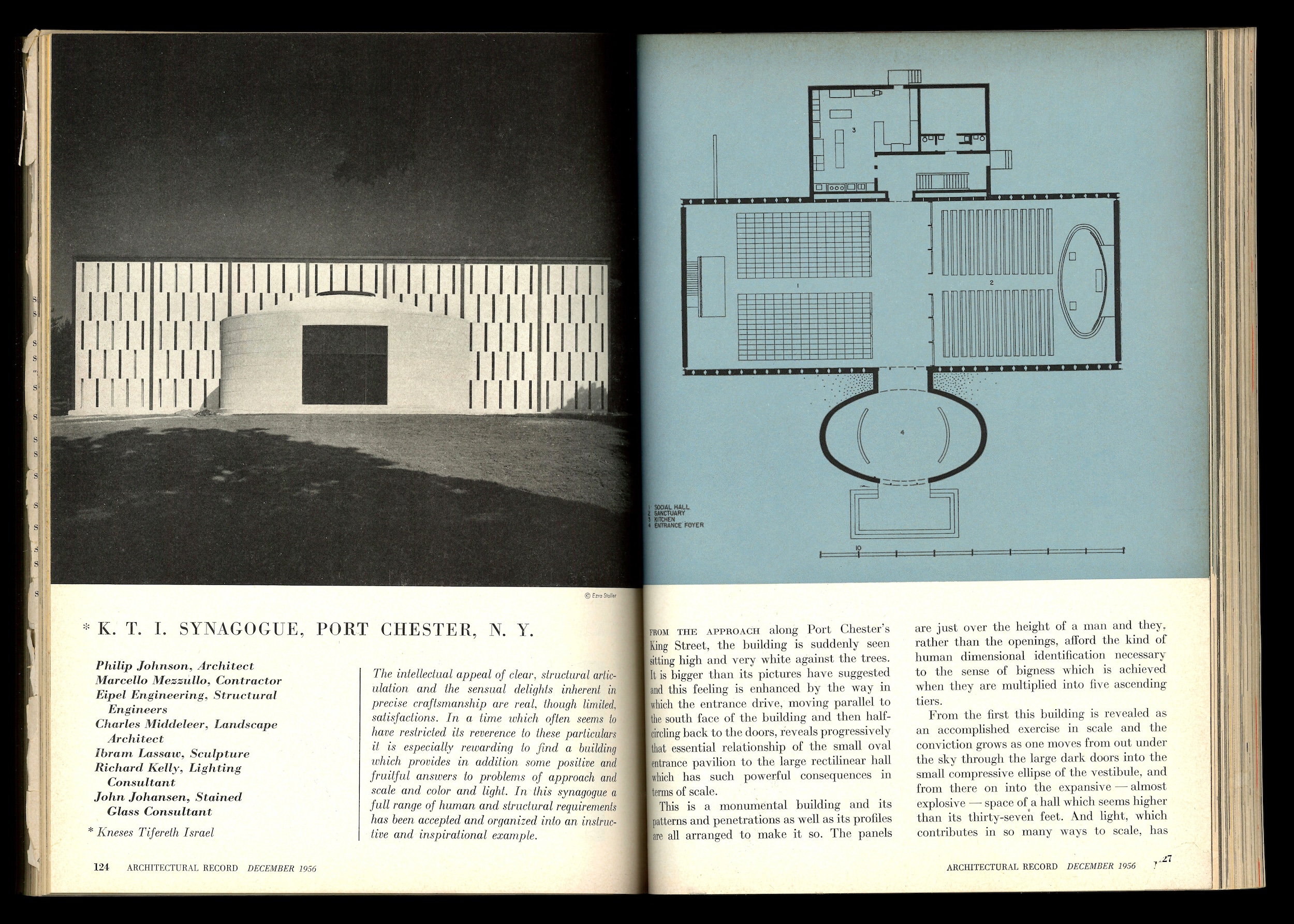
© Architectural Record, December 1956. Photo by Ezra Stoller
This is a monumental building and its patterns and penetrations as well as its profiles are all arranged to make it so. The panels are just over the height of a man and they, rather than the openings, afford the kind of human dimensional identification necessary to the sense of bigness which is achieved when they are multiplied into five ascending tiers.
From the first, this building is revealed as an accomplished exercise in scale and the conviction grows as one moves from out under the sky through the large dark doors into the small compressive ellipse of the vestibule, and from there on into the expansive—almost explosive—space of a hall which seems higher than its thirty-seven feet. And light, which contributes in so many ways to scale, has been manipulated equally well. The organization is the classic sequence of light to dark to light again in which the transition from outside to inside is prevented from robbing the windows of either dimension or brilliance. White—again inside—is a compelling impression but here it is subtly slashed from floor to ceiling and end to end with the Joseph’s coat palette of the stained glass light slits. The colors have great clarity. Each is used separately in a single slit and there are just enough clear panels to fortify the lighter colors and to contrast the full richness of the dark reds and blues. The floor is a white streaked, light gray asphalt tile; the straight rows of three hundred theater seats in the sanctuary are upholstered in a light silver gray which picks up just a little of the blues and reds from the glass. The bema is covered in gold colored carpeting and the screen behind it is clad in a metallic white acoustic cloth.

© Architectural Record, December 1956. Photo by Ezra Stoller
Across the middle, dividing the sanctuary and the social areas, are the parallel lines of eight-foot partitions which, framed in aluminum and steel braced, are bolted to the floor for easy removal on the High Holidays when over 1000 must be accommodated. Above all sail seven gently curving suspended vaults of plaster, giving a particular sense of containment to this space through their special ability to modulate the daylight and serving themselves as both light sources and baffles. In each rib are the direct downlights—six dark piercings when unlit, and only partially concealed behind the sail’s incurving sides are the dimmer-controlled lights which, directed toward the sidewalls, let the building glow at night like the “box of jewels” that had been promised even it its preliminary planning (ARCHITECTURAL RECORD, June 1955).
Perhaps only in the piercing of the plaster canopies does one find anything out of harmony in this inspirational space and even here it is difficult to find fault. The downlights and spotlights which undeniably remove some of the free-floating quality of the ceiling are nevertheless essential to the equally important control of illumination.
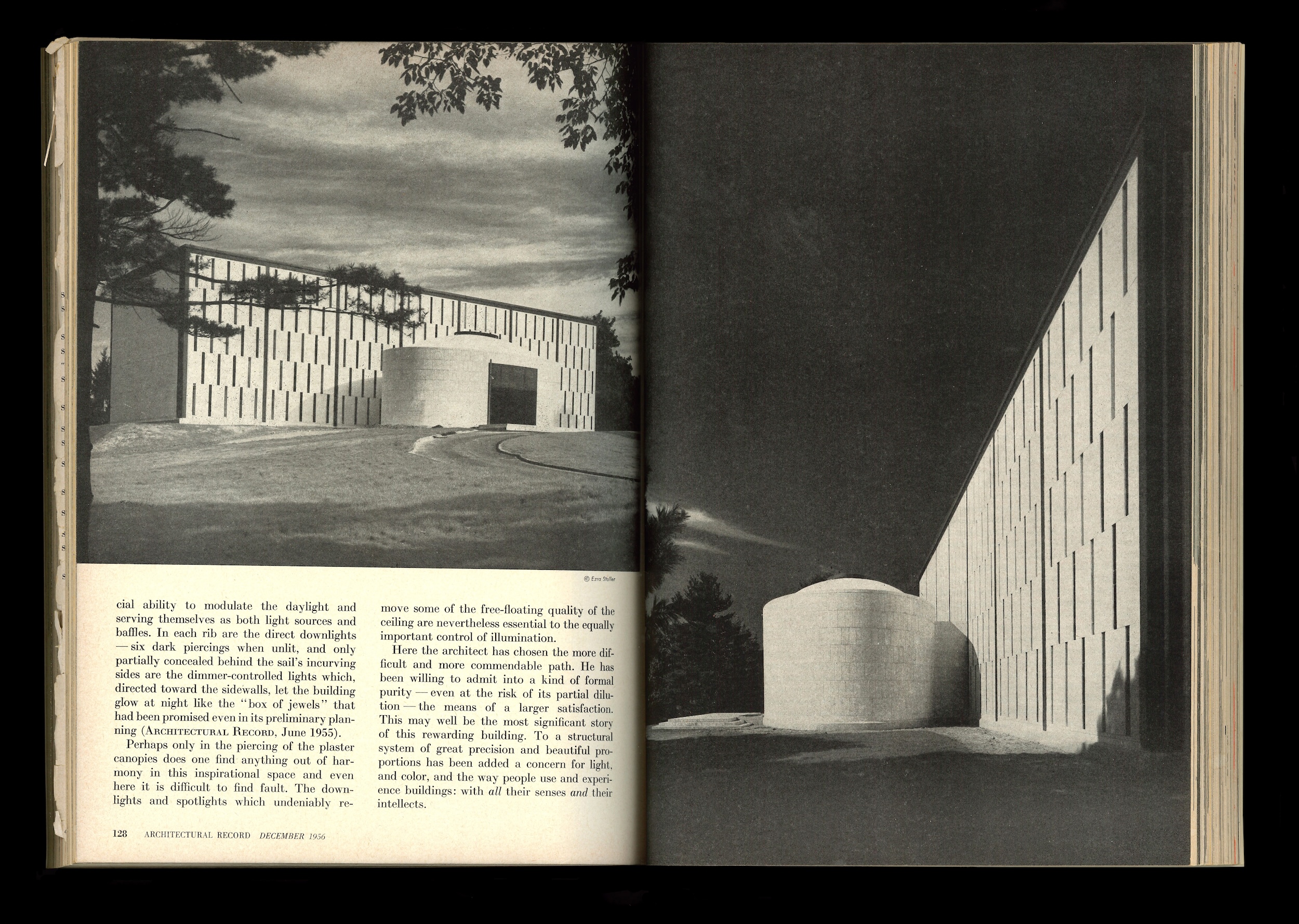
© Architectural Record, December 1956. Photo by Ezra Stoller
Here the architect has chosen the more difficult and more commendable path. He has been willing to admit into a kind of formal purity—even at the risk of its partial dilution — the means of a larger satisfaction. This may well be the most significant story of this rewarding building. To a structural system of great precision and beautiful proportions has been added a concern for light, and color, and the way people use and experience buildings: with all their senses and their intellects.
Looking for quick answers on architecture and design topics?
Try Ask RECORD, our new smart AI search tool.
Ask RECORD →
Looking for a reprint of this article?
From high-res PDFs to custom plaques, order your copy today!