L.A. Fires, One Year Later
Deregulation: Faster, Cheaper, Better?
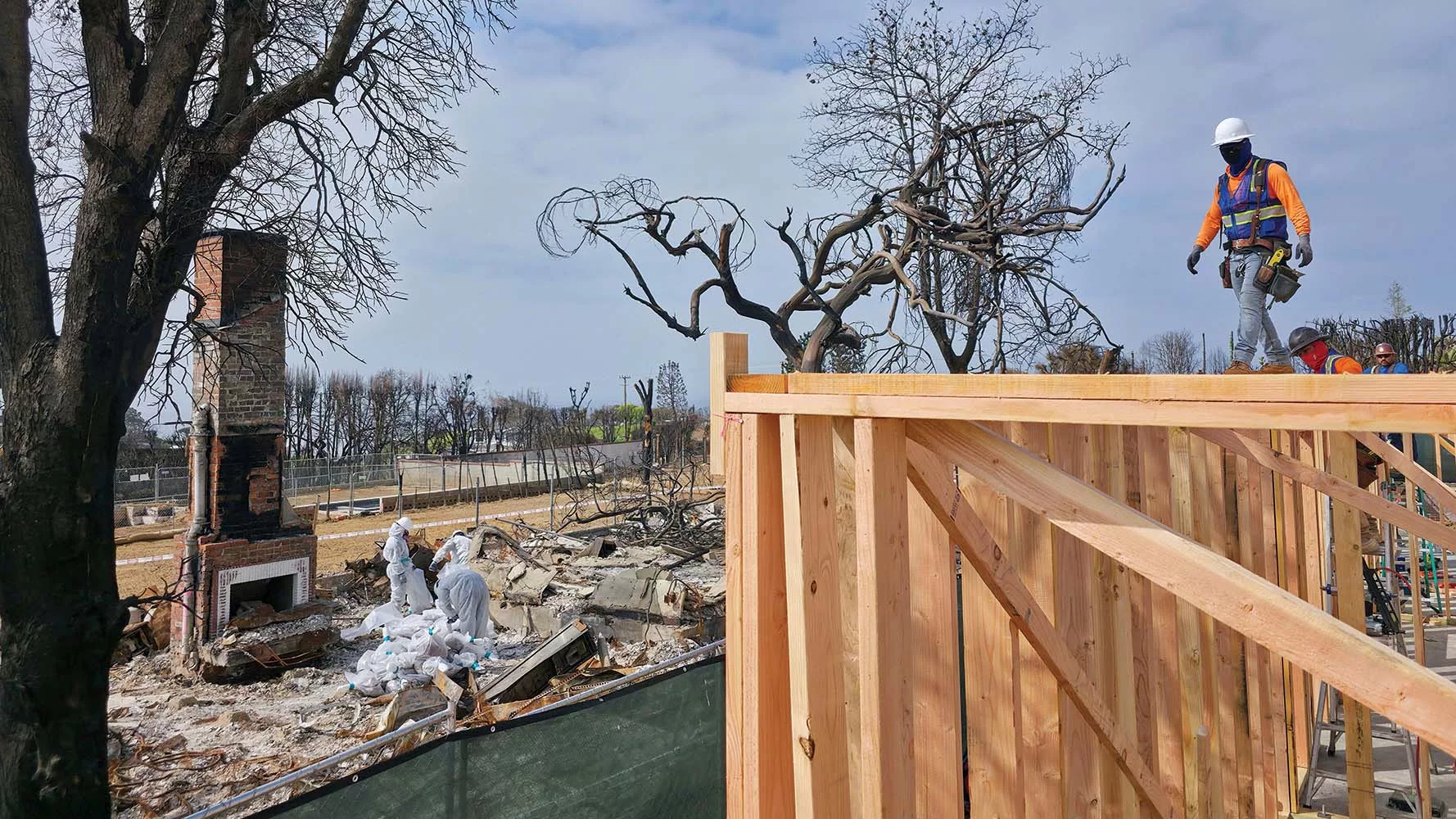
On January 13, 2025, less than a week after wildfires devastated the Pacific Palisades neighborhood, Los Angeles mayor Karen Bass issued Emergency Executive Order No. 1, which exempted rebuilding from compliance with the California Environmental Quality Act (CEQA). The order also exempted these projects from complying with the City of L.A.’s Ordinance No. 187,714, from 2022, which sought to eliminate fossil-fuel use in new houses by mandating all-electric appliances and systems.
Although the order was made in the spirit of expediting recovery, to many advocates of green building in California, the exemptions seem like a step back from the city’s and state’s otherwise progressive climate-action policies. To add to the sense of retreat, California governor Gavin Newsom’s Executive Order N-29-25, on July 7, 2025, rolled back codes for applicable reconstruction projects to 2022 standards and exempted them from newer code mandates for implementing solar photovoltaics and battery storage. Newsom also applied the CEQA exemptions across Los Angeles County, including in the cities of Altadena and Pasadena, which were affected by the Eaton Fire.
Michael Rochmes, the policy and advocacy coordinator for the U.S. Green Building Council California (USGBC-CA), says the rollbacks feel like a missed opportunity. “It sends a message that these sustainable building codes are expensive,” he says. “We did the cost-effectiveness studies when we developed these requirements, so we know you’re going to be better off in the long term if you comply with the latest code.”
Rochmes describes a fairly complicated picture for homeowners who have to weigh considerations concerning future fire risks, as well as costs, reliability of electricity and gas, and insurance. Cities and counties often adopt ordinances that expand building and energy codes set at the state level. They also enforce CEQA, which requires expansive environmental-impact reports that consider broader effects on infrastructure and climate. Confusion abounds, which is why Rochmes says a goal for the USGBC-CA is to educate homeowners about their options. “I was surprised when Mayor Bass said the city wasn’t going to enforce it because it really couldn’t be enforced anyway,” he says, noting that fossil-fuel bans in California cities were successfully challenged in federal court.
The experience for architects varies widely. Timothy Vortriede is a member of the Altadena Collective, which is a coalition of designers, architects, and engineers helping residents rebuild. They currently have nearly 75 residential projects in progress. Vortriede, who lost his own 1920s-era home in Altadena, says he remains committed to sustainable design for his projects. “I think, no matter what, we are significantly increasing our energy efficiency, because nearly all of the homes lost in Altadena were built between 1920 and 1970, and anything prior to 1960 had precisely zero insulation in the walls,” he says.
Scott Uriu—whose firm, Uriu Architecture, has 25 active residential projects in Altadena, including a replacement for his own house—says that about half of his clients are putting gas appliances for heating and cooking back into their homes, but the vast majority are including rooftop solar panels and electric heat pump water heaters. His firm is spending a lot of time investigating new materials and assemblies to address fire protection, which also happens to increase insulation values. Uriu has devised an envelope detail to put stone-wool batt insulation not only on the inside but between the cladding and the waterproofed-plywood layer beneath. “We’re definitely overinsulating the house, but it’s also a wildfire defense,” he says.
Code requirements aside, the broader CEQA-rollback implications are mostly a shrug from architects and designers. In so-called like-for-like projects, where a new house is within 110 percent of the original house’s square footage, it would be rare for CEQA reviews to be triggered even without the exemption. Several architects who spoke on condition of anonymity said the CEQA exemption felt like political optics and a diversion from the larger question of whether it made sense to rebuild in some of the more congested and inaccessible hillsides in the Palisades.
Roberto Sheinberg, whose L.A. firm, AyD, has five active residential projects in Altadena and Pasadena, says he thinks each city should have paused any rebuilding for several months to step back and to think strategically. He questions whether the state’s blanket policy for allowing new accessory dwelling units for single-family residential lots makes sense in overly dense, inaccessible mountainside neighborhoods. He also thinks gas appliances should have been the first thing to go. He warns that “we’re just recreating the same unsustainable neighborhoods over and over again.”
Looking for quick answers on architecture and design topics?
Try Ask RECORD, our new smart AI search tool.
Ask RECORD →
Looking for a reprint of this article?
From high-res PDFs to custom plaques, order your copy today!