Books
The First Biography of Ella Briggs Tells the Story of an Extraordinary Woman and Early Modern Architect
‘Finding Ella Briggs: The Life and Work of an Unconventional Architect’ edited by Despina Stratigakos and Elana Shapira

In the 1920s, the City of Vienna grew adept at using the official openings of its new communal housing blocks for propaganda purposes. And so it was on February 27, 1927, when thousands of people reportedly gathered in Döbling to inaugurate the latest such project, a large apartment block named after the Swiss pedagogue Johann Heinrich Pestalozzi to mark the centenary of his death. Its celebrated design was the work of architect Ella Briggs, who had been given the sizeable commission despite the fact that she had never completed a building of this scale before. Designing the project, a veritable urban landmark, had proven to be a formidable task.
To realize the enormously ambitious housing program the city had adopted in 1923, it would commission more than two hundred architects to plan Volkswohnhäuser (housing for the people). These urban projects distributed throughout the city ranged in scale, from small projects filling gaps within a city block to large complexes built on land recently cleared for development. Although diverse, the communal housing blocks of Red Vienna are still recognizable today by their inclusion of certain standardized elements specified by the municipal building authority.
The Volkswohnhäuser offered the working classes affordable, high-quality modern dwellings that would free them from the perennially cramped and overcrowded living conditions of Vienna’s tenements. In addition to improving the living conditions of working-class families, the Volkswohnhäuser also promoted the Social Democrats’ vision of a new proletariat society. The Volkswohnhäuser were thus about much more than mere accommodation.
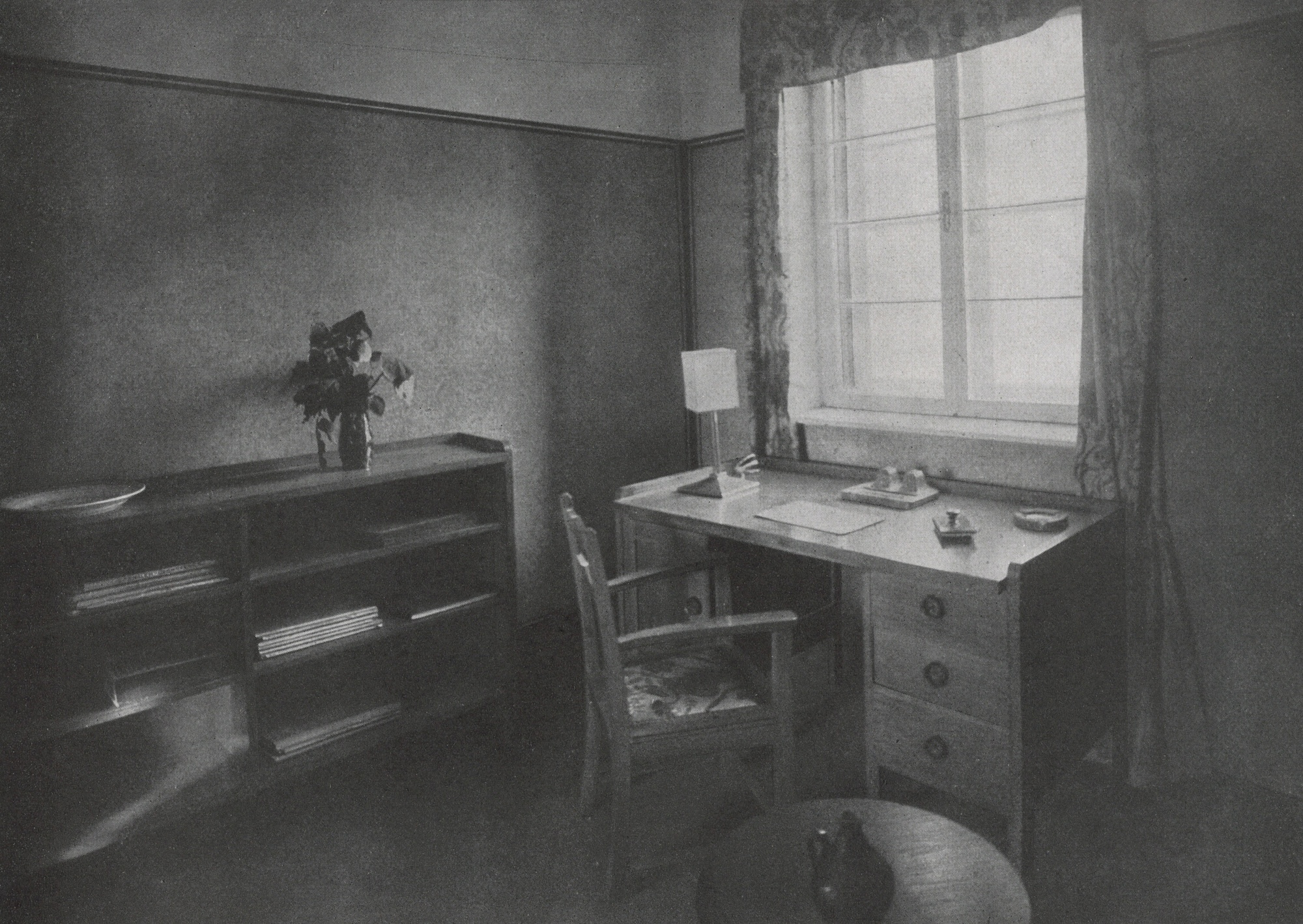
View of a small room with desk in a model apartment in the Pestalozzi-Hof, 1926. Image: Walter Müller-Wulckow, Die Deutsche Wohnung der Gegenwart (Königstein im Taunus: Langewiesche, 1932), 17. Public domain
Despite the generosity of this vision of a new type of living, the various requirements and restrictions imposed by the municipality at times severely reined in the architects’ latitude. How Briggs managed these, while still attempting to leave her own mark on Vienna’s urban landscape, tells us much about her emerging architectural sensibilities and casts light on her perspective on what constituted essential housing reform. We also get a glimpse of how she envisioned herself as a professional working in a male-dominated field. At the time the Pestalozzi-Hof commission was awarded, Briggs was the only female architect in Vienna who had been formally qualified as a Diplom-Ingenieur.
Construction of the Pestalozzi-Hof took about one year, beginning in fall 1925. The site was a challenging corner plot measuring nearly 4,000 square meters. Briggs built on a little more than half of that area, leaving extensive green spaces, as required by city regulations. The structure rose four to five stories above a subterranean level. It encompassed 119 apartments intended primarily for working-class families. Most of these had a Wohnküche (living room/kitchen) and one additional room, as well as a small foyer and a toilet room. The Pestalozzi-Hof’s communal spaces included nine laundries, bathing facilities with showers and bathtubs, shop premises, a kindergarten, and a playground. In planning the site, Briggs also had to take zoning laws into account, which prescribed a streetside courtyard midway along a perimeter block.
At a time of ongoing debates about what constituted the proper form for working-class housing in Vienna, Briggs’s design for the Pestalozzi-Hof was praised for its simplicity and lack of ornamentation. Although her approach may indicate some influence from the Italian buildings she admired, it also aligns with Briggs’s superb ability to absorb a model from a new context and rework and improve it, making it her own. Viennese social housing was influenced by the rise of Neues Bauen (New Building) in Austria and Germany after the First World War. This movement advocated a functionalist approach to design that rejected historical ornament and had its roots in the radical design movements that arose at the turn of the twentieth century, including the Secession. Briggs’s designs for the German Theater in New York from 1908 illustrate her longstanding familiarity with and contribution to the stylistic precursors of the Neues Bauen. But after the war, this new direction came to hold great political weight as a symbol of the new society that German and Austrian progressives hoped would emerge from the catastrophe of war.
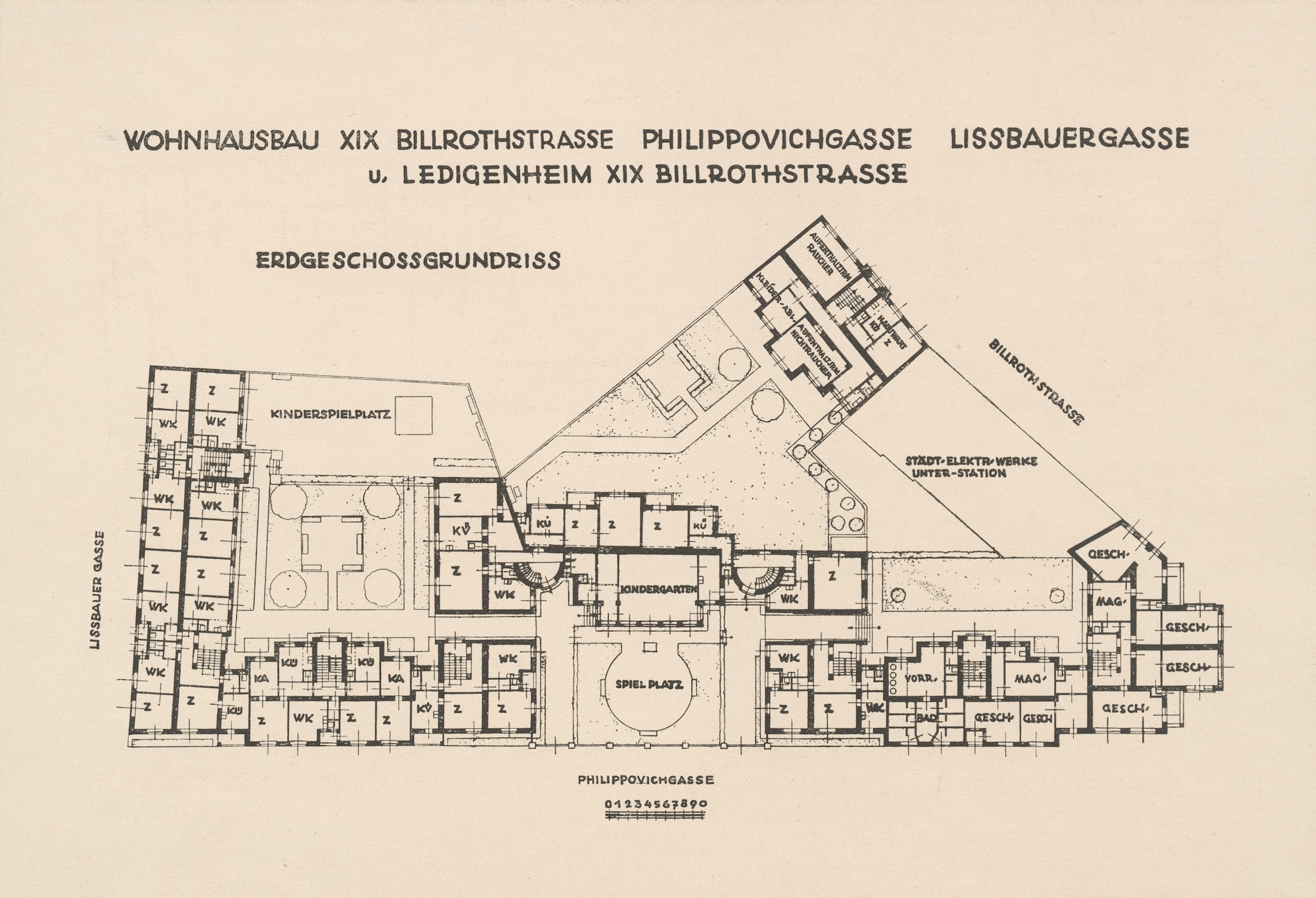
Site plan showing the ground floors of the Pestalozzi-Hof und Ledigenheim in Vienna, c. 1925–27. Image: Die Wohnhausanlage der Gemeinde Wien Pestalozzi-Hof im 19. Bezirk Philippovichgasse (früher Felix=Mottl-Straße) (Vienna: Vorwärts, c. 1926–27), 10. Public domain.
The design of the Pestalozzi-Hof demonstrates Briggs’s ability to deploy the new architectural syntax with great sensitivity to the building’s site and urban location. Briggs arranged the building’s masses to forge an overall impression of a whole while simultaneously creating a sense of movement, rhythm, and articulation. Despite Briggs’s efforts to give the Pestalozzi-Hof the sense of a whole through such elements as color, the unifying base, and the visual cadences of balconies and loggias, none of the facades are the same, which adds to its overall dynamic effect. In her American writings on the single-family house, Briggs had argued that a building’s external form should emerge honestly from the interior function of the rooms, and if the building were freestanding, this would result in no two sides being alike. As she emphasized, this picturesqueness was not produced for its own sake, although it did require the intervention of the architect to bring together the massing in a pleasing manner. In the Pestalozzi-Hof, Briggs has done just that on a grand scale, and it was this sophisticated interplay of architectural forms, variety, and accents that caught critics’ attention and earned their plaudits. As one journalist noted, Briggs’s functionalism did not replace beauty; instead, residents were given both.
Looking for quick answers on architecture and design topics?
Try Ask RECORD, our new smart AI search tool.
Ask RECORD →
In his remarks at the opening of the Pestalozzi-Hof in February 1927, Mayor of Vienna Karl Seitz referred to Briggs’s building as proof of women’s calling in architecture and of the city’s commitment (in having hired her) to the “principle of gender equality in business and work.” It is unknown if the architect was present herself at the ceremony to hear her work being praised. By the time this celebration took place, Briggs was preparing to move to Berlin, unable, it seems—and despite the accolades—to secure further municipal commissions in her hometown.
In this context, Briggs’s insistence that her work be judged only by “objective considerations,” as she told an interviewer for Frau und Gegenwart (Woman and Contemporary Times), a German women’s magazine that often published on pathbreaking female professionals, and not by the gender of the creator, is revealing. Despite all she had achieved in New York and Vienna, the fact that she felt compelled to make this plea suggests that she was still looking for that elusive level playing field, where she would have the same chances as her male colleagues to succeed. In the broader horizons of Berlin’s architecture world, she perhaps hoped to find it at last.
Looking for a reprint of this article?
From high-res PDFs to custom plaques, order your copy today!