House of the Month
High in Canada’s Coast Mountains, a Scott & Scott–Designed Retreat Offers Refuge to a Family of Skiers
Whistler, British Columbia
Architects & Firms
Extreme locations generate distinctive buildings, nowhere more than in the mountains. Vernacular alpine houses evolved to cope with difficult terrain and harsh weather: pitched roofs and broad eaves that shed snow, simple forms that are inherently strong and readily built on steep sites, thick walls that conserve heat, and materials drawn from the landscape itself. Their characteristic spatial order—in which the main living space sits atop a utilitarian ground floor, with additional quarters tucked into the volume of the roof—lifts daily life above the deep snow and into the light and air. As contemporary alpine architecture adapts to present-day sensibilities and construction techniques, the most thoughtful designs interpret rather than discard these traditional strategies. A new ski house for a couple and their teenage daughter, by Vancouver-based Scott & Scott Architects, is one such example.
1
2
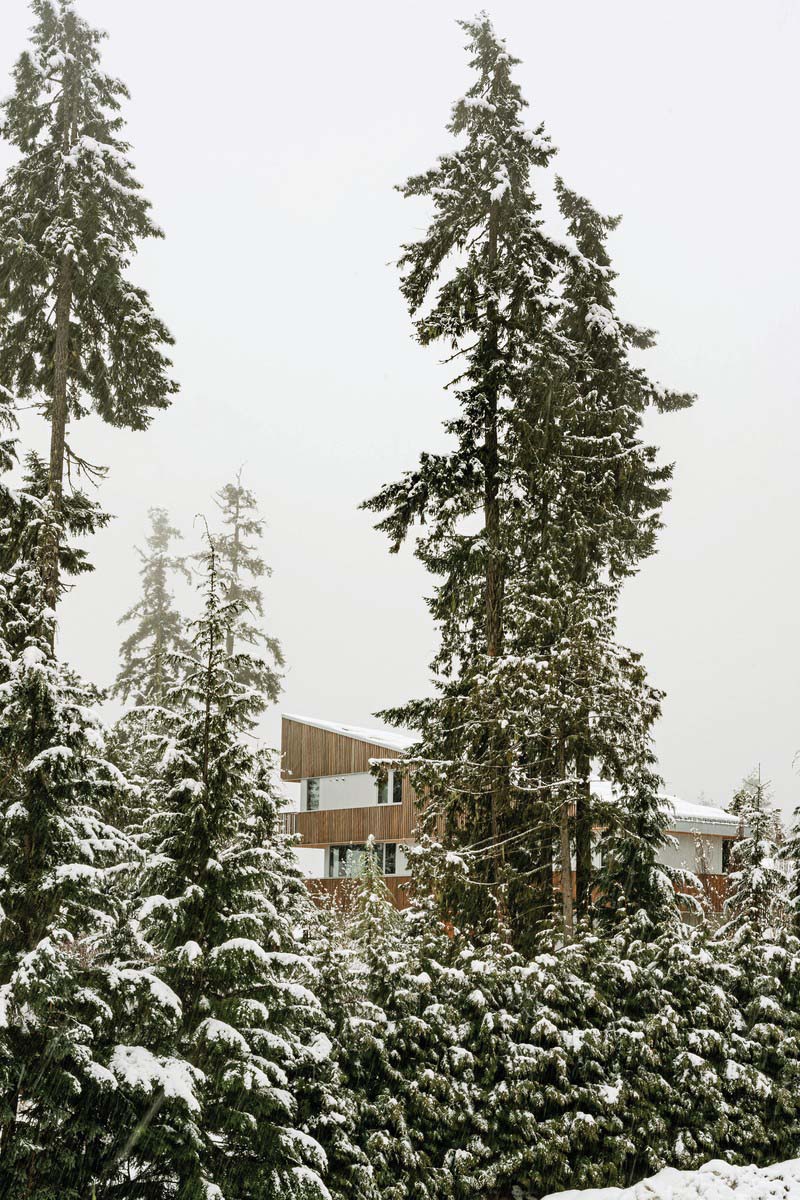
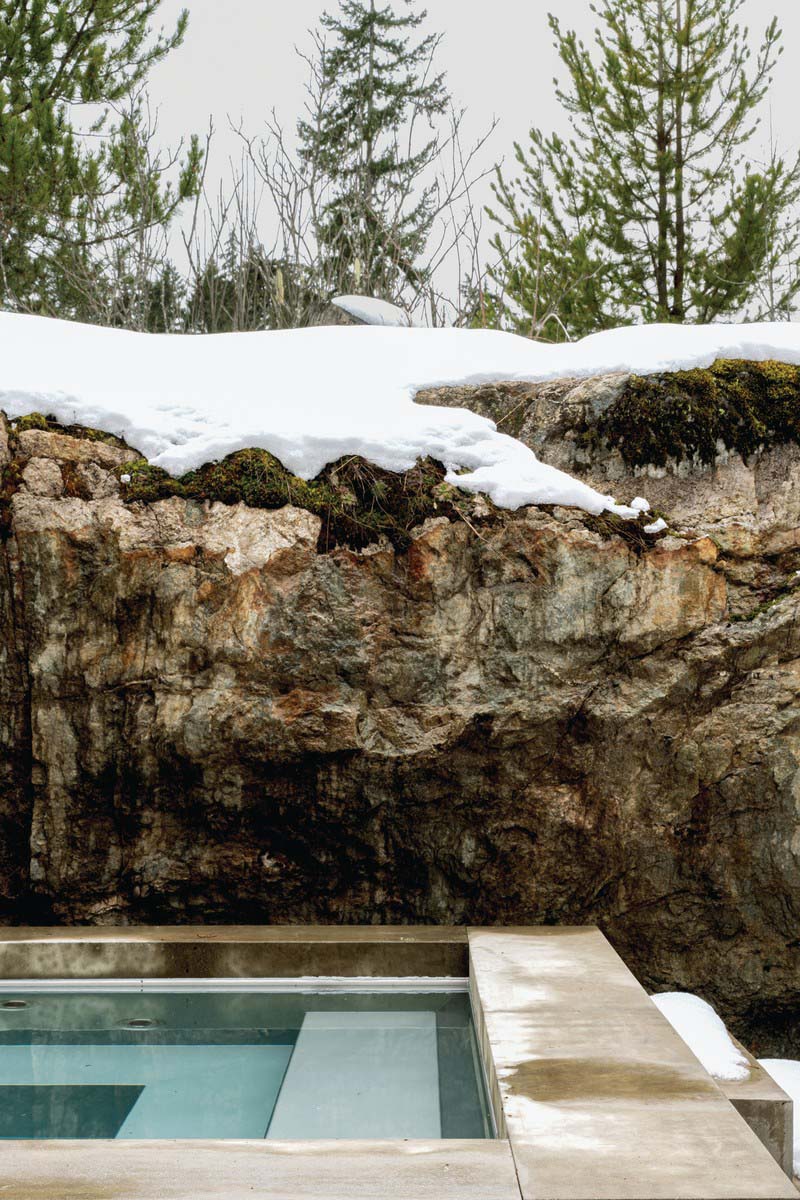
The Whistler Ski House is hidden among trees (1) and rocky outcroppings, which also shelter its terraces and pool (2). Photos © Olivia Bull, click to enlarge.
With views across a valley to the slopes of Whistler Mountain, in Canada’s British Columbia, the 4,560-square-foot wood-framed structure is set around the crown of a rocky bluff that defines its rugged 0.8-acre site. On approach, one sees only the rooftop above the hillside. Constructed of local materials—including unfinished red cedar cladding and an exposed rough-sawn Douglas fir structure—the house’s comfortable fit within both its natural and built surroundings owes much to its massing. Simple yet dynamic, the structure consists of two volumes that meet at an obtuse angle, each capped with a shed roof pitching along its length to direct snow away from entries, terraces, and outlooks. Even though the lot lies within a residential subdivision, about 40 newly planted trees create a sense of woodsy retreat.
“Working with the high-snow and seismic reality of the Pacific Northwest mountains, we’re always balancing the expression of structure, which has to be robust to deal with these loads, and the desire for daylit, open spaces that have visual connections with the landscape,” says David Scott, a director at the firm with partner Susan Scott. “That’s always the duality.”
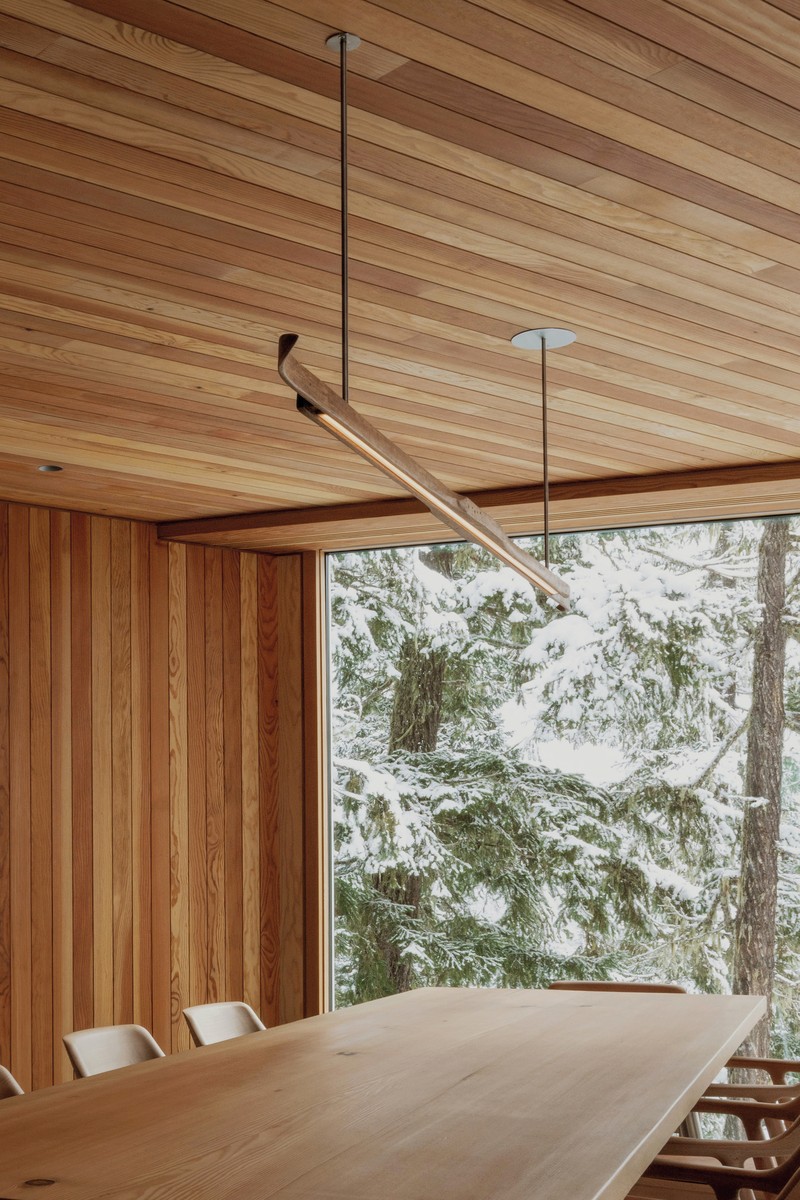
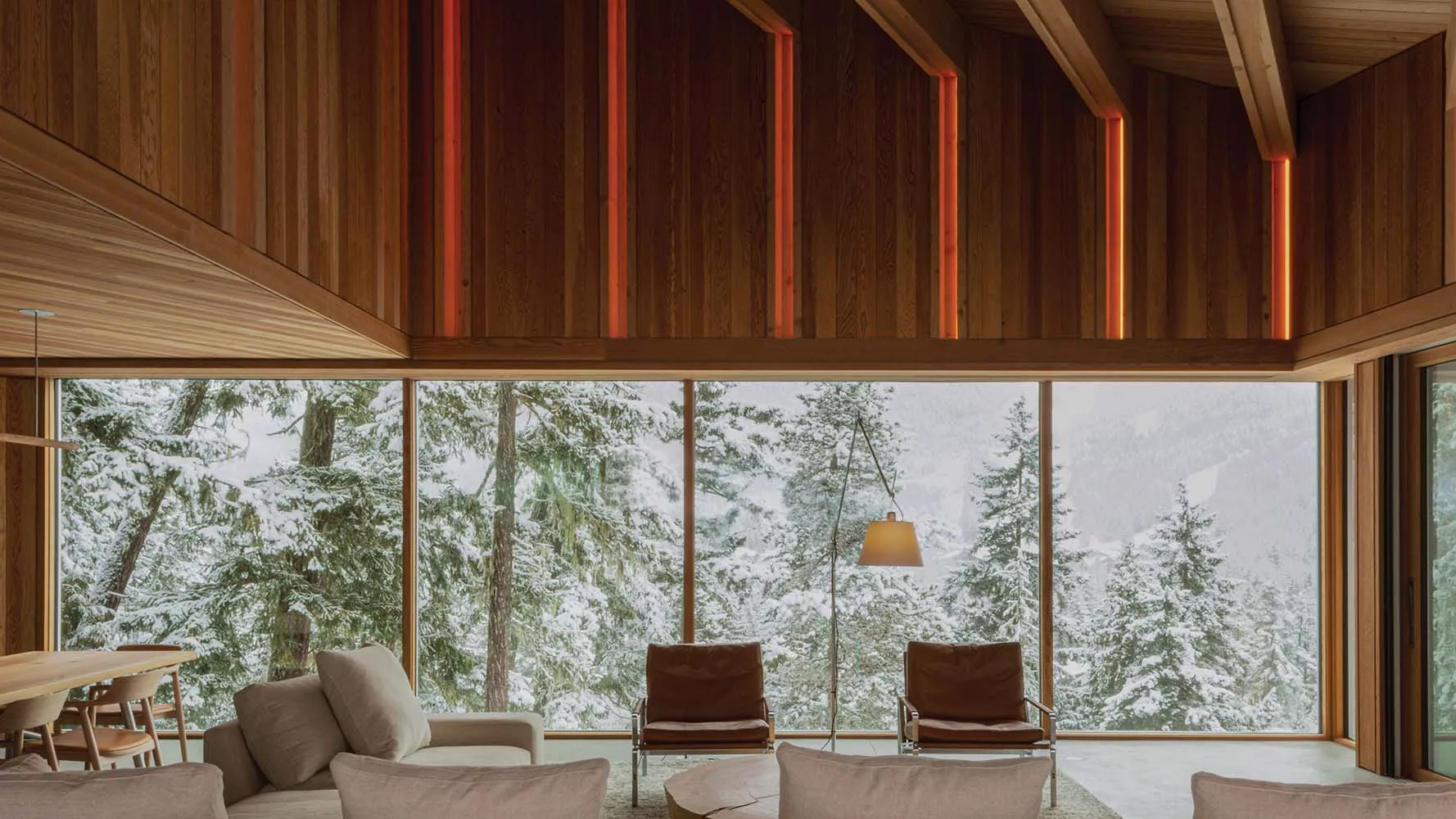
In the dining area, the architects made a fixture out of wood skis. Photo © Olivia Bull
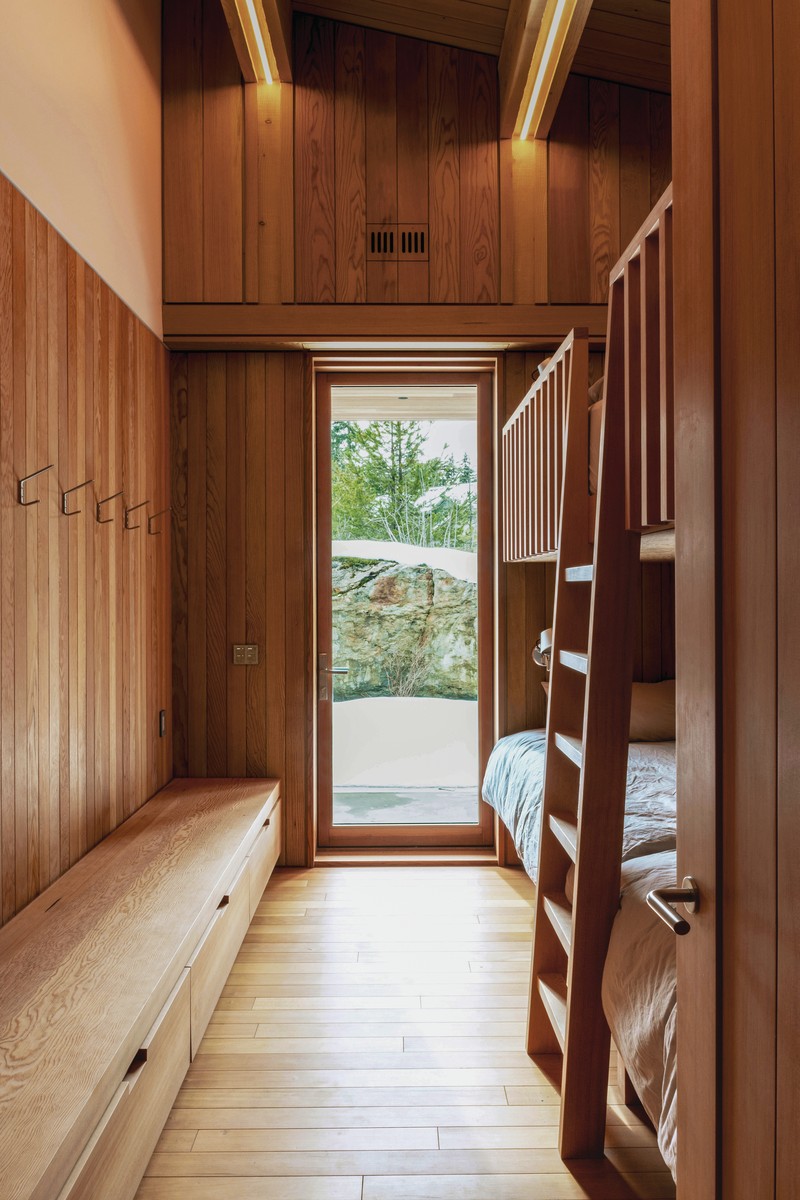
A bunk room offers space for guests. Photo © Scott & Scott
As in vernacular alpine houses, the lowest level is given over to utilitarian spaces, though instead of stables there’s a garage, laundry, fitness and movie rooms, and space for drying gear. A recessed entrance is sheltered beneath the overhang of the main floor above. On the principal level, a kitchen, living/dining room, and den open onto a covered terrace set into the bluff. “It’s really quite dramatic how the space opens up both to the mountain and to the rock behind,” says Susan. “And, even though it’s a large volume, the wood surfaces and the expression of the lower part of the roof as the structure slopes down over the living room give it that intimate quality that people look for in a ski cabin.”
With visitors often staying in the main level’s guest bedroom and bunk room, the clients wanted a separate zone for the family. This is located on the third floor, within the volume of the roof. The sloping ceilings and reduced floor area make for a cozy retreat, Susan says, “creating the comfort of a cabin in the woods within the larger home.”
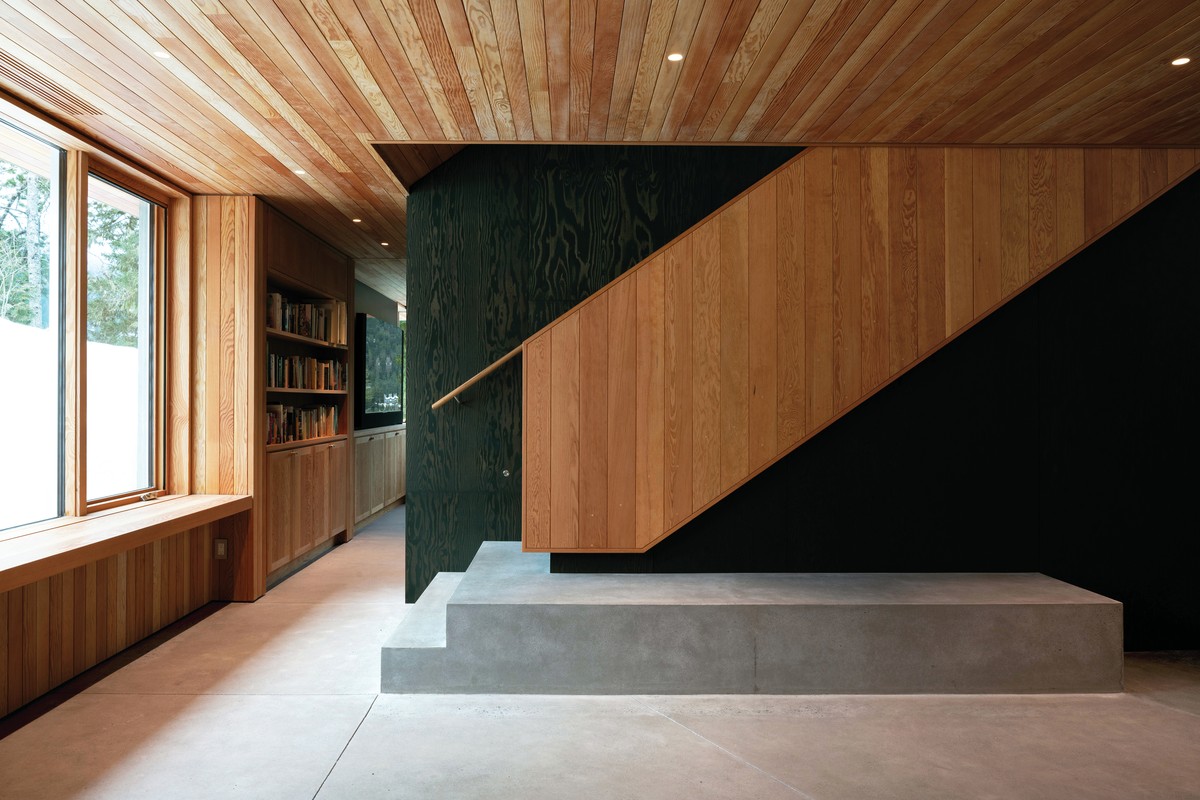
Guests might also wander to the cozy lower level. Photo © Olivia Bull
In addition to its traditional functions of sheltering sleeping quarters and shedding snow, the roof takes on a contemporary technological role, supporting a 35,100-watt photovoltaic array. Together with the house’s thickly insulated walls—roughly 10 percent of the building’s footprint—the system achieves net zero energy. “In an environment like this, there’s much more power generated in the winter months than you might expect,” David says. “You can have a bit of snow on the panels and they’re still functional.”
With reinterpreted vernacular strategies evident in the building’s form, materials, and configuration, to what degree did the architects adapt them deliberately versus generating them as a rational response to site conditions? “A bit of both,” David says. “It wasn’t a conscious decision, but we arrived in the same place.”
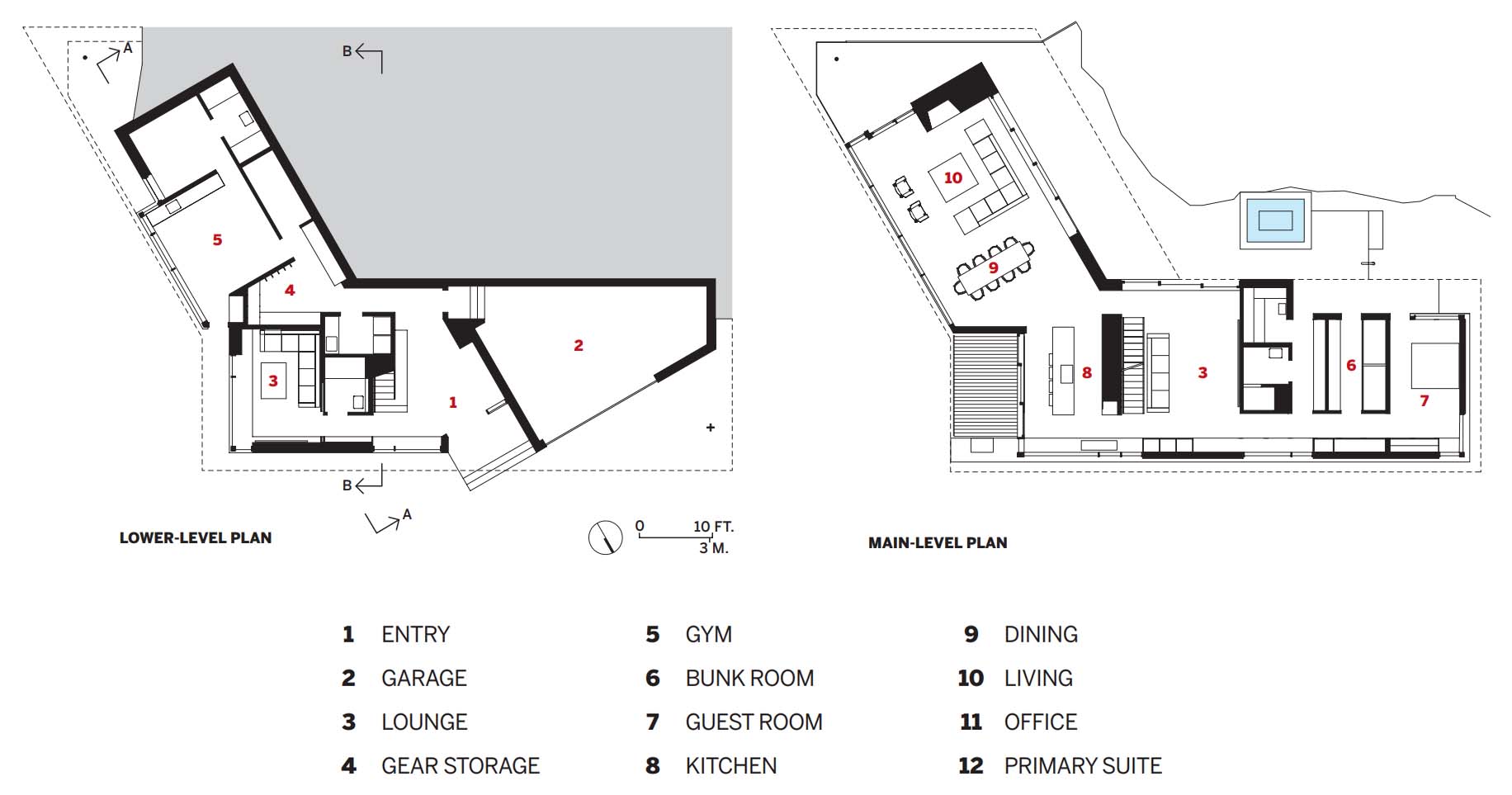
Image courtesy Scott & Scott
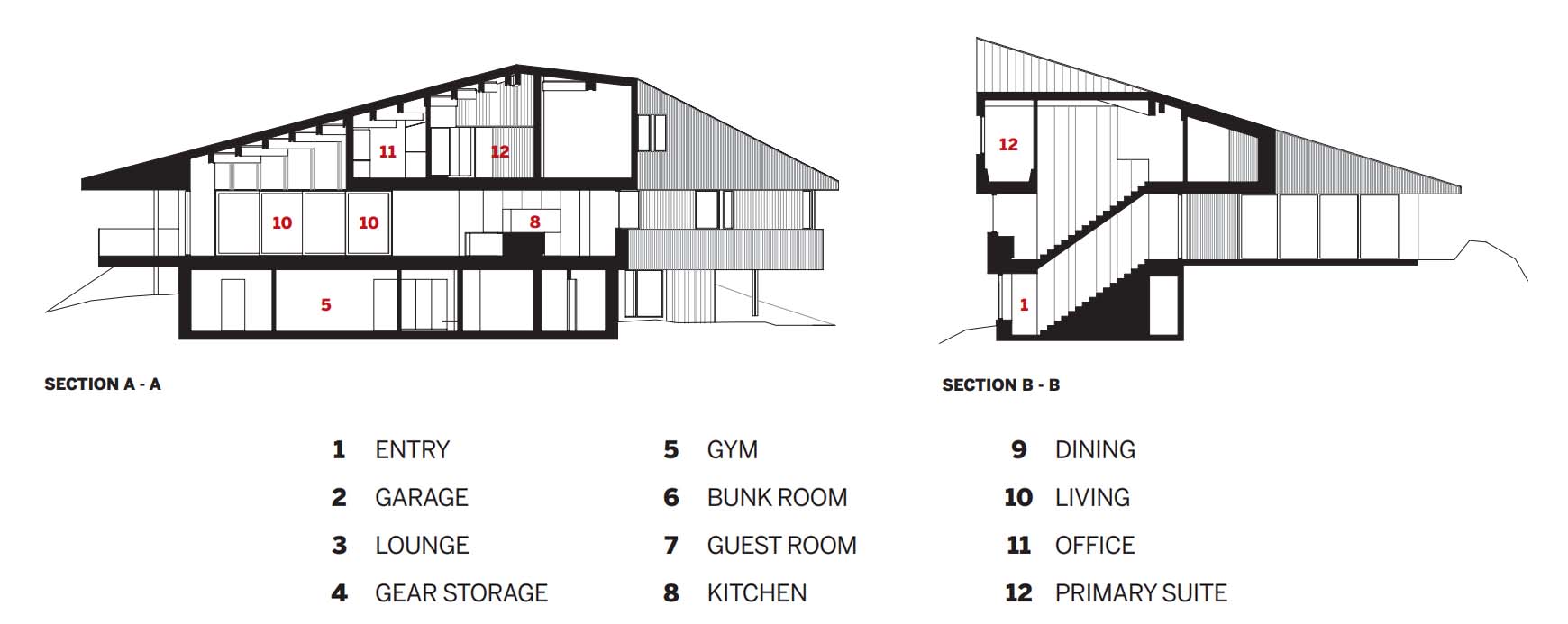
Image courtesy Scott & Scott
Credits
Architect:
Scott & Scott Architects — Susan Scott, David Scott, Genan Peng, Patrick Birch
Engineer:
WHM Structural Engineers
General Contractor:
Blueline Contracting
Client:
Withheld
Size:
4,560 square feet
Cost:
Withheld
Completion Date:
January 2024
Sources
Cladding:
Western Red Cedar
Roofing:
Galvalume
Windows:
Loewen
Interior Finishes:
Douglas fir (wallcovering); Vancouver Island Marble (tile)
Furnishings:
Maruni Hiroshima (chairs); Scott & Scott (dining table); Montauk (sofa)
Lighting:
Lutron (dimming)
Looking for quick answers on architecture and design topics?
Try Ask RECORD, our new smart AI search tool.
Ask RECORD →
Looking for a reprint of this article?
From high-res PDFs to custom plaques, order your copy today!