RECORD Interviews
Monumental Labs Turns to Automation and Robots to Revive the Art of Stone Carving
“We’re currently renting a tiny portion of a stone fabricator’s workshop,” says Micah Springut, the founder of New York–based start-up Monumental Labs. “But this is about 37,000 square feet,” he adds, standing in an industrial warehouse in Brooklyn’s Greenpoint neighborhood while the din of construction hums in the background. Springut is overseeing the space’s transformation as the future home of the company that he founded in 2022, which aims to revive the art of stone carving by leveraging advances in automation and machine learning. There will be room for seven robotic arms (up from his current two) as well as a host of cutting tools, infrastructure for moving blocks as heavy as 20 tons, ventilation equipment, a woodshop for crating objects, and a gallery. It is important to note that there will also be an on-site team of very human carvers. Springut argues that mechanization is a means to make the centuries-old craft more affordable to clients and more appealing to architects and builders. Robots do the heavy lifting, grinding away for long hours (even overnight), and people contribute the finishing touches. Springut learned how to carve stone at the Art Students League of New York—a welcome return to the physical realm, he says, following a long stint in the tech world of the San Francisco Bay Area. After touring the warehouse, Springut and I traveled to Monumental Labs’ current workspace in Mount Vernon, New York, to see his 23-person team of artists, fabricators, software engineers, and support staff in action. There, we spoke about the future he envisions for the profession and the role of robots in it all.
1
2
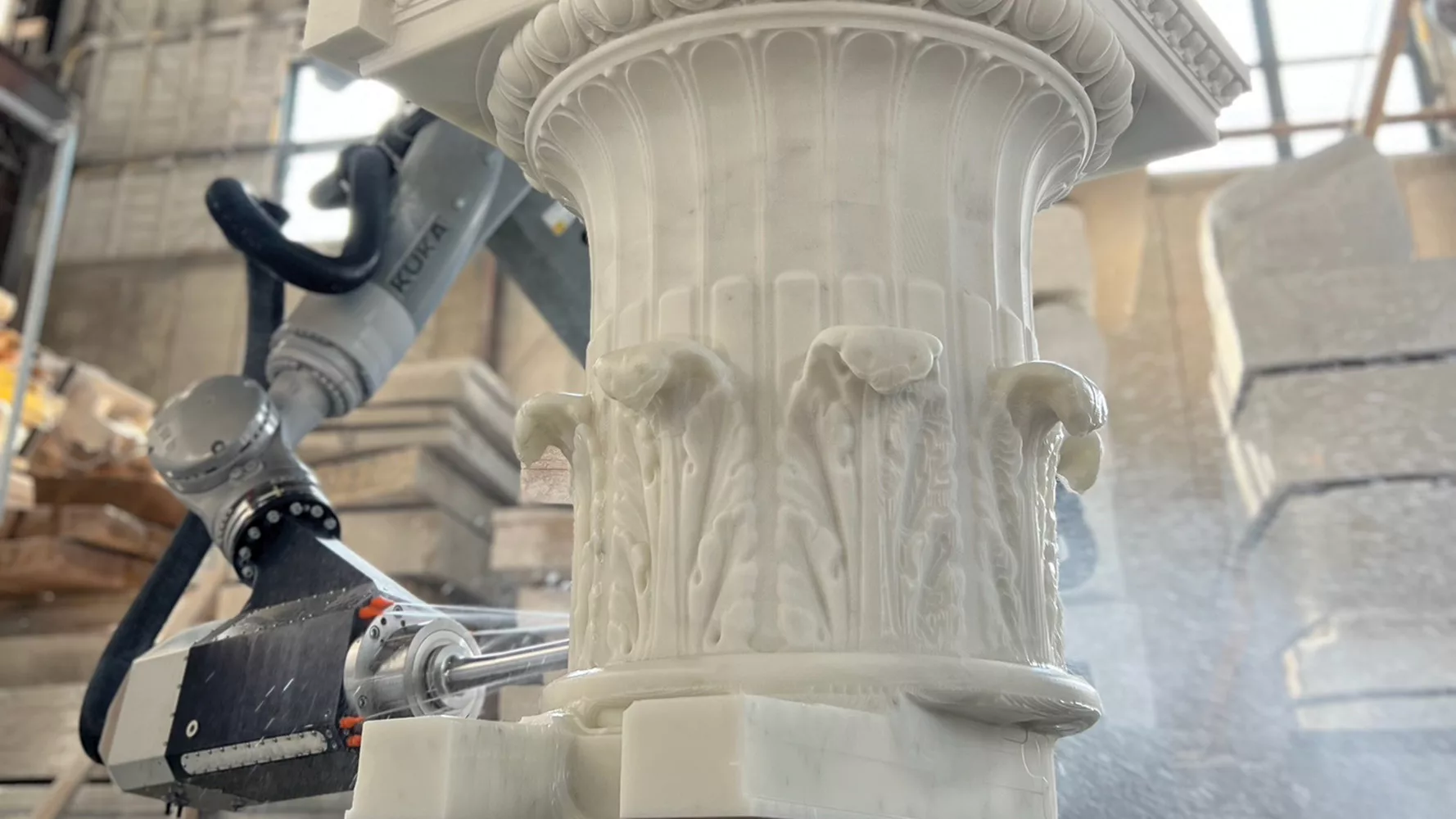
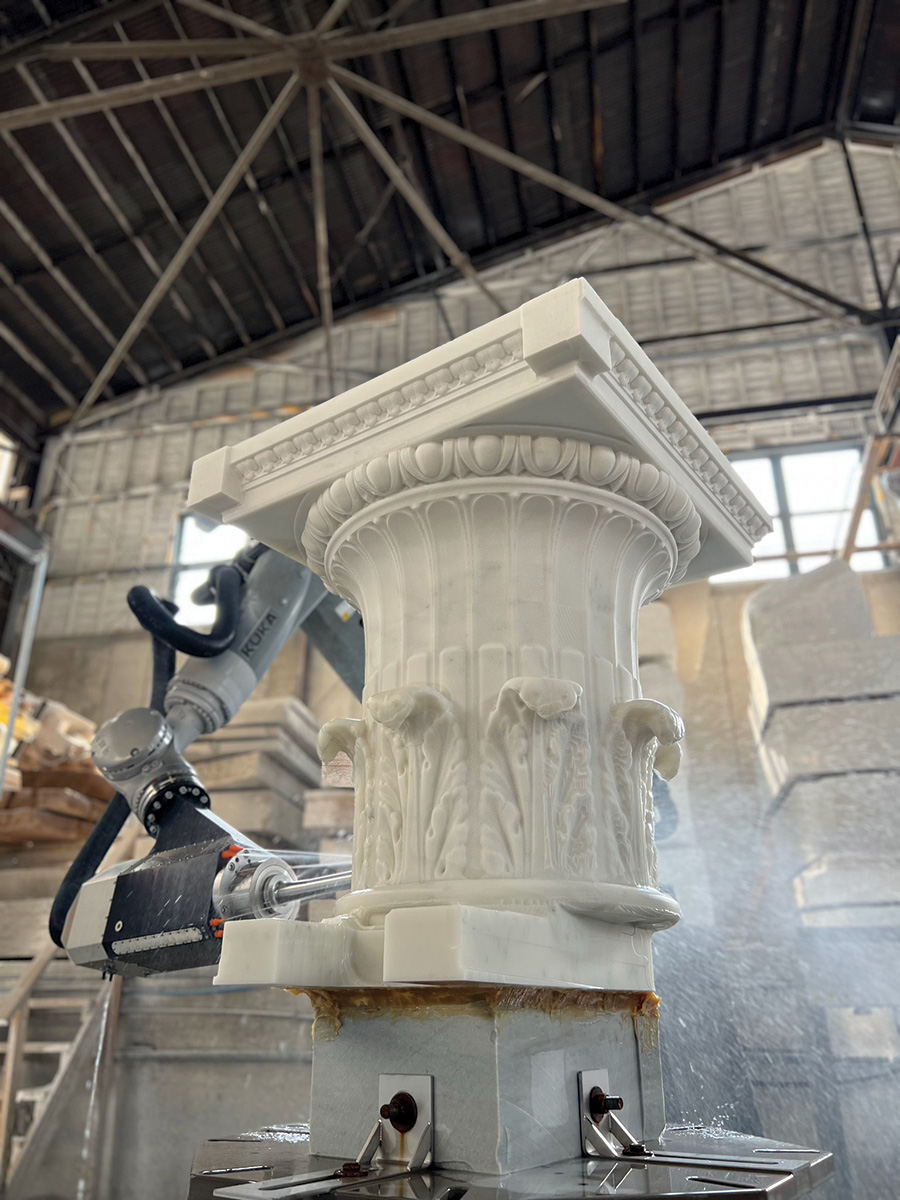
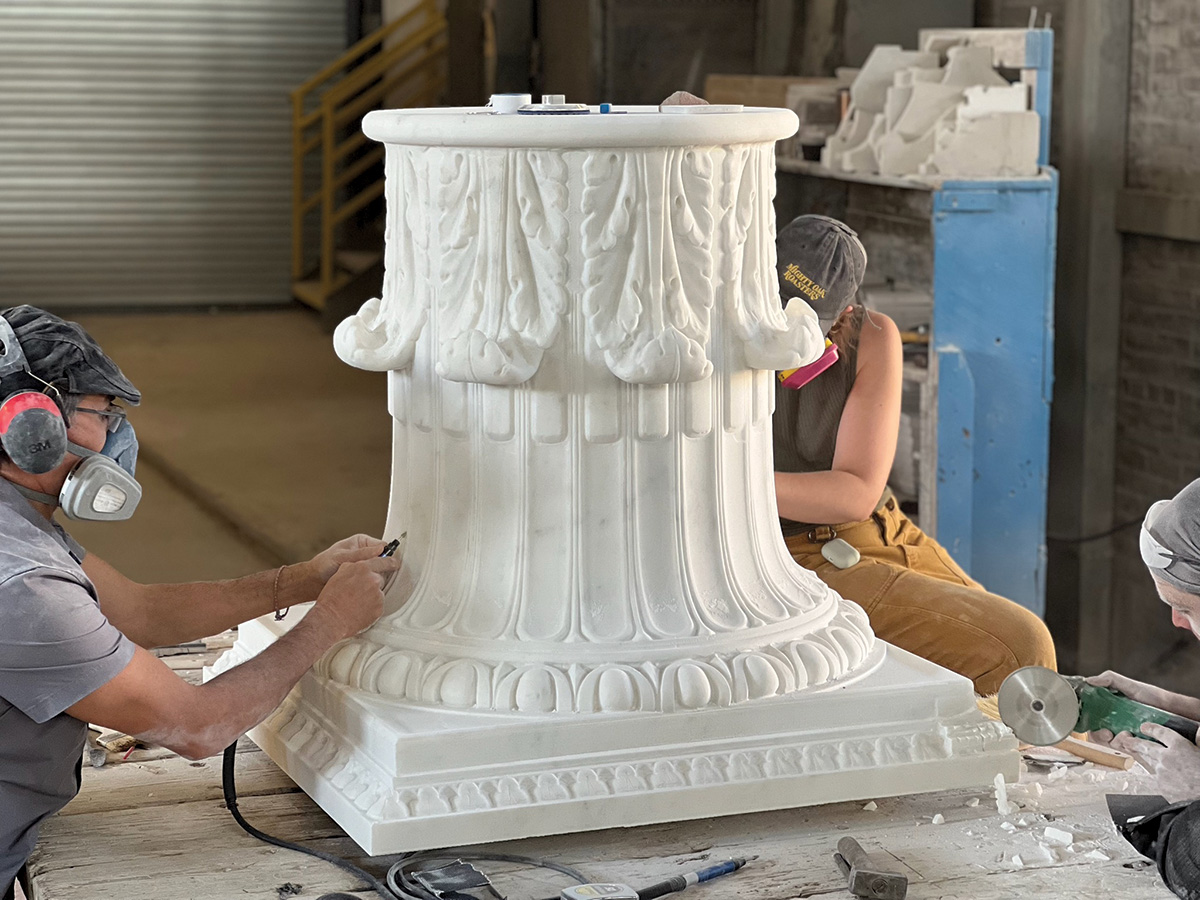
At the Monumental Labs workspace in Mount Vernon, New York, a KUKA robotic arm carves a column capital out of marble (1) before it is finished by hand (2). Photos © Monumental Labs, click to enlarge.
Many of your commissions seem to come out of restoration efforts. You’ve produced architectural elements for the Villard Houses, Carnegie Hall, and the Frick Collection—all historic buildings in New York City. But it’s clear that you have more ambitious goals for Monumental Labs. Where is the potential for contemporary projects?
As a company, we’re chisels for hire. We work in many different styles for many types of clients, including artists and architects.
Today we happen to be cutting pieces for more traditionally styled buildings, Erik Bootsma’s new hall at Benedictine College in Kansas and one of RAMSA’s projects. But there are also architects, like Mark Foster Gage, who are interested in the next big thing and the future of ornament: What if art deco had continued to evolve and art nouveau wasn’t a flash in the pan? Then there are others, like Amin Taha of London’s Groupwork, who are bringing back reinforced structural stone, which is where we are headed next. Amin was here the other day. We don’t have the capacity for that kind of work until we move into the larger space in Greenpoint.
The idea is to use automation to bring down the cost of stone enough that it can compete with concrete as an affordable building material, both in cases where it is being used structurally or ornamentally.
There are also environmental implications to using stone in place of concrete.
Yes, exactly. Stone is sold like a luxury good when it shouldn’t be. It’s a standard commodity—stone is just about everywhere. It is produced by nature free of charge. Pulling it out of the ground and cutting it requires relatively little energy compared to producing concrete, which accounts for around 8 percent of global carbon dioxide emissions. Replacing concrete elements with stone ones would drastically reduce the carbon footprint of a building, and, in the process, we would get a more durable, longer-lasting, and beautiful material.
You mention beauty—a topic seldom discussed by many contemporary architects. What do you make of the relationships between aesthetics, craft, and today’s built environment?
We’ve moved so far away from a craft-based culture in architecture that architects often don’t know how to work with craftspeople. Those worlds do not talk to each other as much as they used to or should, and we want to be in that line of work. If we can connect architects—who can do the massing, understand proportion, and know how everything fits together—with talented artists and artisans, who can ornament buildings, we would produce some amazing things. We could turn architecture back into an art instead of a financial vehicle.
Most of what gets built today is flat, panelized, and ugly. Often there is no architectural statement. The public has noticed. And you can’t blame the builders—I think the cost of construction is three times what it was in the early 1900s, when buildings were routinely ornamented. The labor and craft portions of said cost might be five, six, or even seven times higher. What we’re really trying to do is make craftsmanship accessible again. I think that fundamentally changes everything.
Enter the robots and automation. Aside from fewer human hours devoted to carving, how do they increase speed and decrease cost?
Well, the cutting done by the robots isn’t getting much faster—we’re limited by physics. But we are using automation to reduce the time wasted figuring out how to cut the stone. This reduces cost significantly.
Looking for quick answers on architecture and design topics?
Try Ask RECORD, our new smart AI search tool.
Ask RECORD →
When working with artists, often we start with a clay model or a full-size maquette, which we can scan and turn into a digital file. Sometimes clients come to us with a scan of their own, which we’ll fix up. Or we might be handed a sketch that we’ll reference to create a digital form. The process is very collaborative and we use different software. For more figurative or floral work, we might turn to ZBrush. Rhino is more useful for architectural or geometric projects.
3
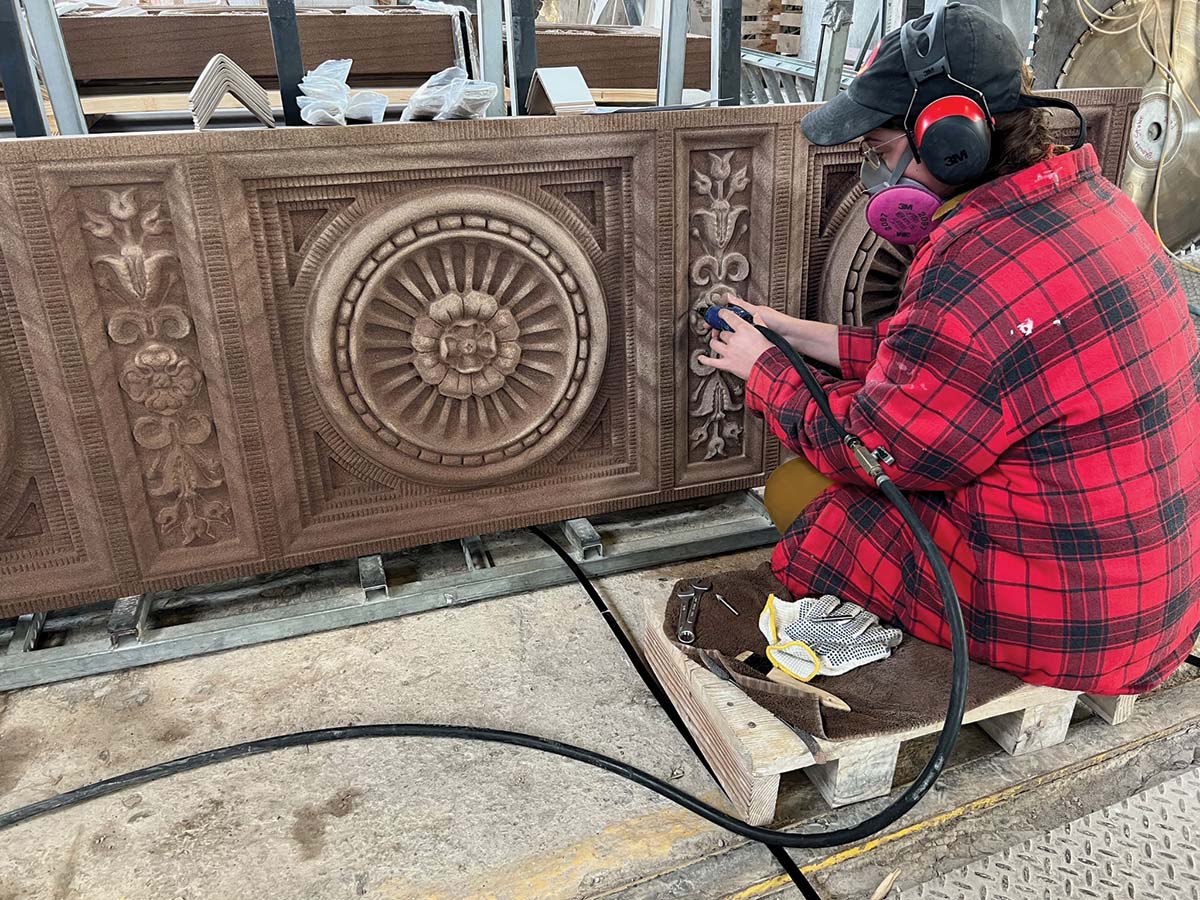
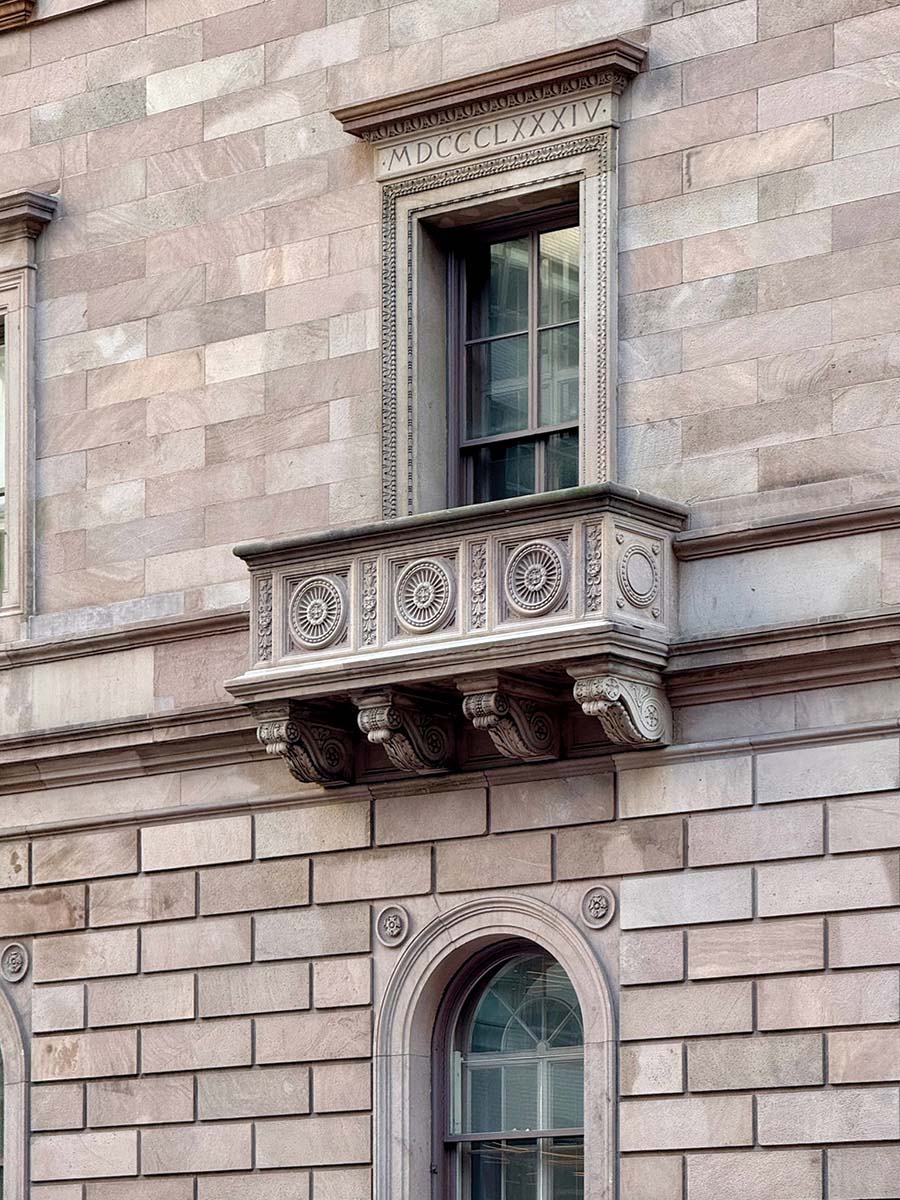
A decorative panel (3) is touched up before installation, at the Villard Houses in Manhattan, as part of a balcony (4). Photos © Monumental Labs
4
But taking that digital 3D model and then carving it out of a real block of stone is a very difficult and time-consuming process. We rough-cut stone blocks to minimize time with the robots and to reduce waste. Then we need to consider several variables, such as what tool bit or combination of bits is most appropriate. How fast should the bit spin? How fast does the arm move? What’s the angle of attack? What’s the distance between each pass of the machine? We take this information and then manually program tool paths—virtual lines that the robotic arms follow to carve the stone.
It takes highly specialized (and expensive) people to generate those tool paths correctly and to minimize robot error. But, good as the programmers are, they will never be faster than a computer. Manual programming creates a bottleneck. We currently only get about 50 percent uptime over the course of the day. It’s this process that we have been increasingly automating. In six months, we’ll be around 75 percent uptime, and so on. The machines will soon be running twice as much, and our programmers will be able to focus on more complex tasks and manage multiple machines. At that point, the process becomes really cheap really fast. The goal is to mount a block and calculate the tool paths within 15 minutes.
What can’t the robots do?
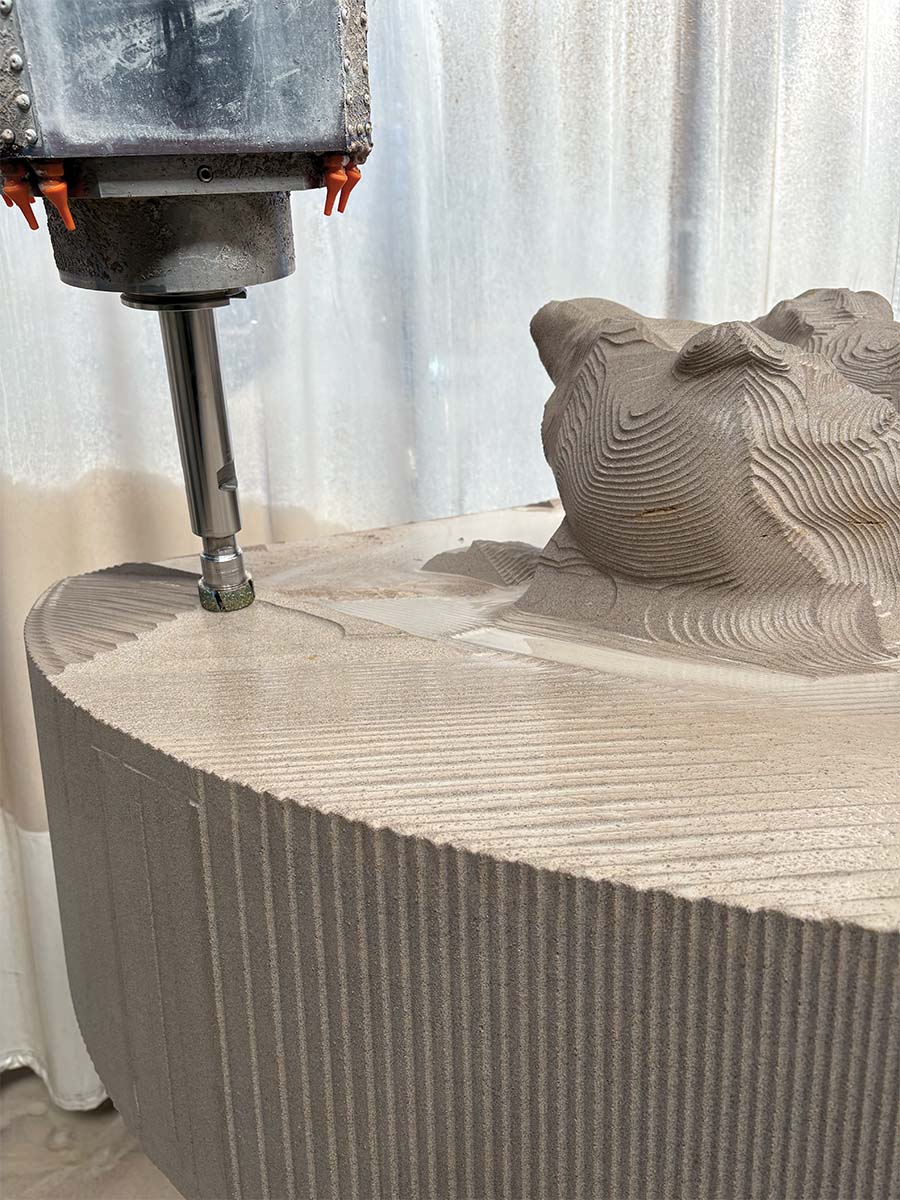
Initial passes of the robotic arm leave lines or steps that are removed with additional passes or carved by hand to achieve the desired surface finish. Photos © Architectural Record
They have their limitations. They can’t cut crisp inside corners because of the geometry and size of the tool bits. Each pass on the stone creates a step or a faint line. So a machine can’t achieve the same surface quality and polish that a human carver can.
Dimensional stone and architectural ornament do not need as much hand finishing as fine art sculpture does. People don’t get as close to those elements as viewers do to fine art in a museum setting, and certain stones commonly used in architecture, such as limestone, are forgiving. What this means for ornamental fabrication is that, if it costs $90,000 today to produce a massive Corinthian capital entirely by hand, it takes us, using the robot and some hand carving at the end, only $30,000. And this will get even cheaper as we automate the process more.
Couldn’t one argue that these technological limitations are temporary? That there could come a day when a robot can replace a carver entirely?
You’re never going to have fine art without handcraft—at least not anytime soon. Carvers will be some of the last people to be automated away, because what they’re doing is done at such a fine level of detail, of judgment, and of taste. By the time it is possible to replicate a carver’s dexterity, I think automation will be doing everything in our economy. So your question is really, “Will there be a day when humans are useless?”
Maybe by that point we’ll all become artists. Why should we have carved stone? It doesn’t give us any direct utility. Why should we have art, or music? These are all things that humans enjoy creating. And the more rote or unsafe tasks that robots take off our hands, the better.
How does automation’s efficiency trickle down to the human stone carvers?
The fact remains that you can’t sell something until it is at an affordable price point. And a carver, at the end of the day, can only make a living wage if he or she is constantly doing high-value work.
Let’s say a stone carver wants to make $100,000 per year but only has the time to produce a single large statue from start to finish. That piece is going to be very expensive, and that’s not even taking into account the cost of the stone, shipping, or the years of training under the artist’s belt. If a machine does the first 95 percent of work, then the carver might only need to spend two months on it. This lowers the cost of the statue significantly and the carver can still earn a living by focusing on the high-value labor of finishing pieces, and by working on multiple such projects over the course of a year.
I believe this process will enable stone carvers to come back into the market. We’re going to employ 25 to 30 of them at the Greenpoint space—that is, to my knowledge, more carvers than are working in New York City today. Our plan is to take folks who are coming out of schools like the New York Academy of Art, Grand Central Atelier in Queens, or other places around the country, and train them in stone craft. Giving them an opportunity to focus on the later stages of a piece will help them hone their skills more quickly, too.
How do you think about authorship in the context of robotics? Is that even important to you?
We’re in the business of shaping stone—that’s it. In a way, we’re just replacing the anonymous young apprentice, who was blocking out marble sculptures for Bernini, with a robot. Rodin, in some cases, never touched his sculptures. In the past, I suppose arguments sometimes broke out about who was really responsible for this or that. Kristian Schneider, Louis Sullivan’s terra-cotta modeler, should be as well-known a name as Sullivan’s. Both were essential to bringing those buildings to fruition.
My point is that everyone works differently—sometimes the artists who collaborate with us never touch their works either. Others come here and are heavily involved, chiseling themselves or working on the polish. These relationships exist in the world and always have and always will. Artists don’t have the time to spend a year carving a single statue, the same way a principal at an architecture firm can’t devote their time solely to a single project.
I imagine robotic arms don’t come cheap.
They cost between $200,000 and $350,000 each. Their lifespan is about six or seven years—so we haven’t reached that point yet. And the tool bits need to be regularly replaced.
Monumental Labs has many investors, but most seem to be tech entrepreneurs rather than folks from the AEC industry. What is drawing them to your team’s work?
We do have some investors in the AEC and real-estate spaces, including Shadow Ventures, Milstein Companies, Jan Sramek from California Forever, Nadeem Meghji from Blackstone, and Korman. But, yes, most are generalist venture capital funds and tech entrepreneurs. These people are interested in a cultural renaissance of sorts. Many feel the kind of innovation that came out of Silicon Valley and quickly transformed the internet has not been matched in the physical world. There is a lot of thinking about legacy, in an aesthetic sense, in a way that there hasn’t been for a long time. I hope some of our investors become true patrons of the arts and architecture. We’ve raised $18 million so far.
More generally, people can trace societal problems to the lack of care given to our built environment and the inhumanity in the way we often build. If we inject more of the human hand, even with a robotic assist, it won’t solve every problem—obviously, we have real obstacles in this country—but I think it will make better communities, better cities, and places where people find delight.
Looking for a reprint of this article?
From high-res PDFs to custom plaques, order your copy today!