In Belgium, an 18th-Century Religious Compound Becomes Home to the University of Hasselt’s Architecture School
Hasselt Beguinage, Belgium
“We adopted a picturesque attitude” says London architect David Kohn, describing his competition-winning proposal, with Belgian firm Bovenbouw Architectuur, for a large-scale adaptive-reuse project in the Flemish city of Hasselt. “We approached this very much as an urban and landscape problem before an architectural one.” The international partnership benefited from both British and Belgian traditions to revitalize and transform an 18th-century beguinage as the new home for the Architecture Faculty of the University of Hasselt and to open its courtyard as the largest public green space in the city’s historic center.

Photo © David de Bruijn
A beguinage is a typology distinct to the Low Countries. Like a convent, it has secluded dwellings for isolated religious devotion, but for beguines, or lay women, who did not take vows or give up their worldly possessions. This beguinage, with origins dating back to the 13th century, constructed a total of 13 joined houses and a gatehouse in the heart of Hasselt throughout the 1700s. The 2.5-acre walled complex is built around a courtyard with a church at its center. The last resident died there in 1886, and then the property changed hands several times, with many attempts to repurpose it and long periods of disuse.
In 1944, as Allied forces liberated Europe, the church was accidentally bombed and destroyed. An art gallery took over parts of the complex in the 1990s, but much of it continued to fall into disrepair. Hasselt University, with its architecture school well-known for its adaptive-reuse curriculum, acquired the former beguinage after proposals for private redevelopment spurred local protests and petitions.
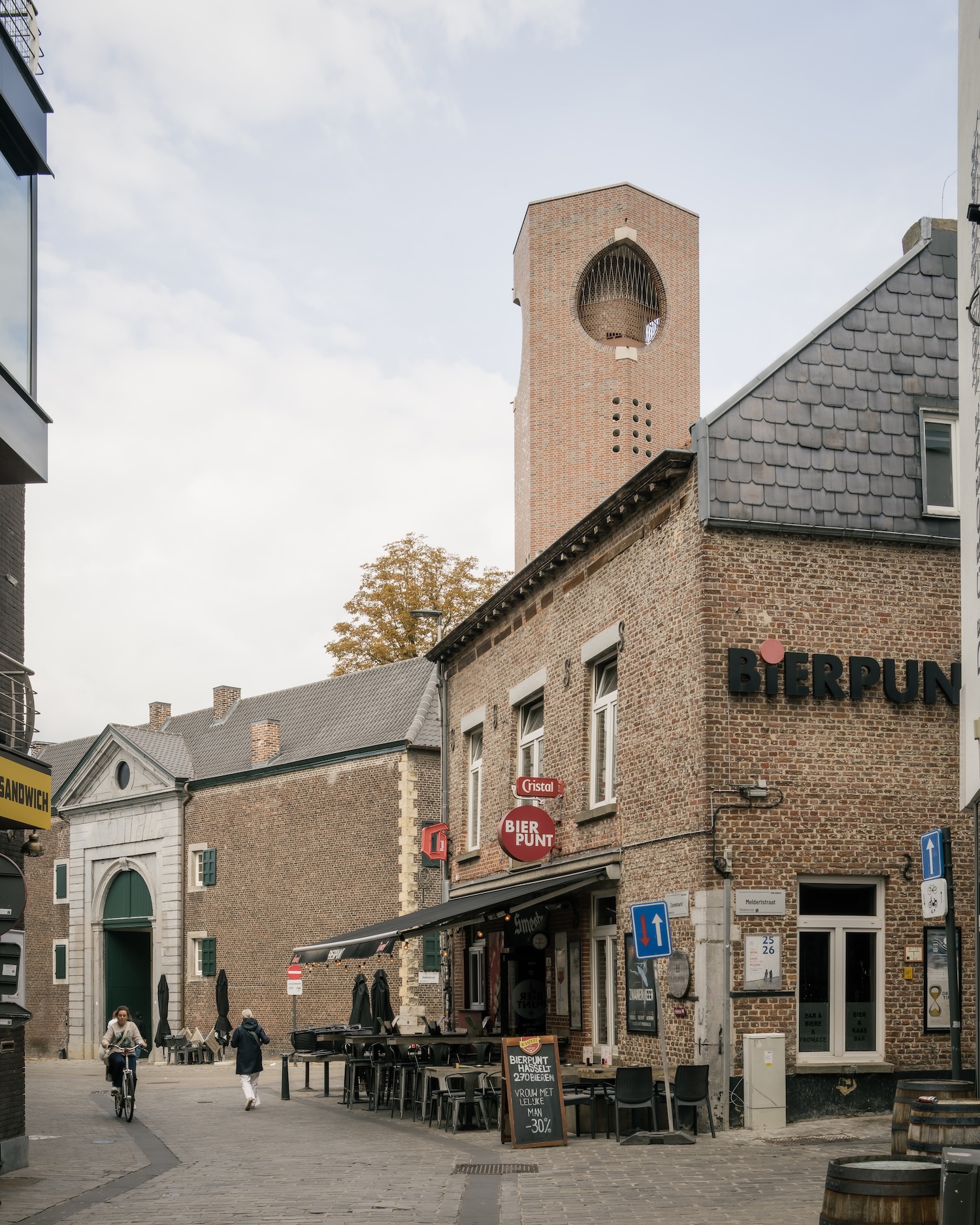
The design team’s approach to the renovation revolved around three main elements: the restoration of the houses and gatehouse with minimal interventions for their repurposing as educational spaces; preserving the rubble of the church as a ruin; and a new belvedere soaring nearly 100 feet at the courtyard’s southern corner.

Photos © Stijn Bollaert
This tower, constructed out of Flemish-bond purple-brown brickwork, stands out in the low-lying city and serves both as a wayfinding beacon—like the original church’s spire once did—and as a public attraction. At the top of the belvedere, large, circular openings—a recurring geometric motif throughout the project—allow for panoramic views.
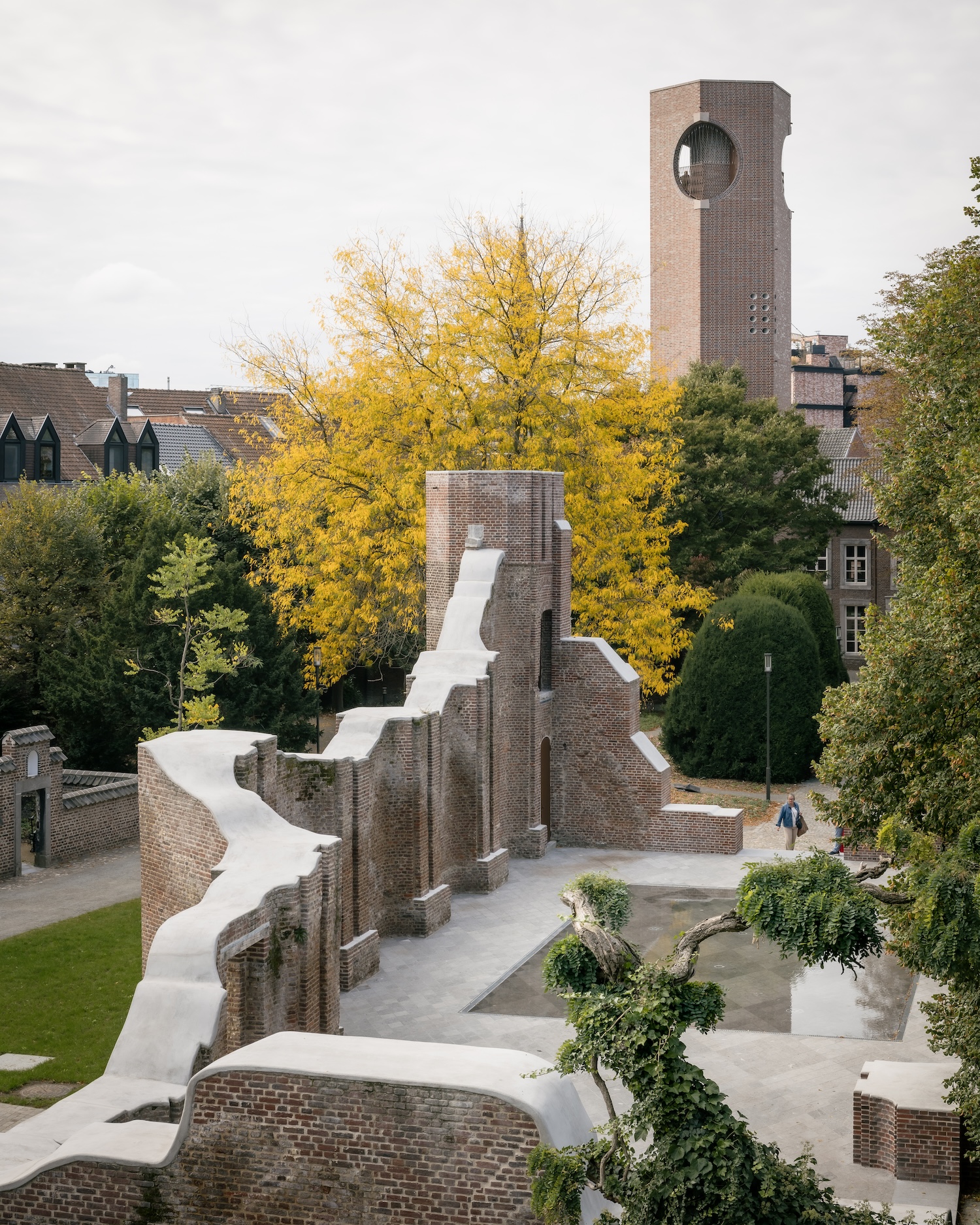
Photo © Stijn Bollaert
The church ruins, now framing a reflecting pool—which can also serve as a stage area when the water is drained—were cleaned up, stabilized, and capped. Parts of the footprint were reconstructed, but not fully, turning the (at least partially) faux church ruins into a folly, following the tradition of picturesque gardens.
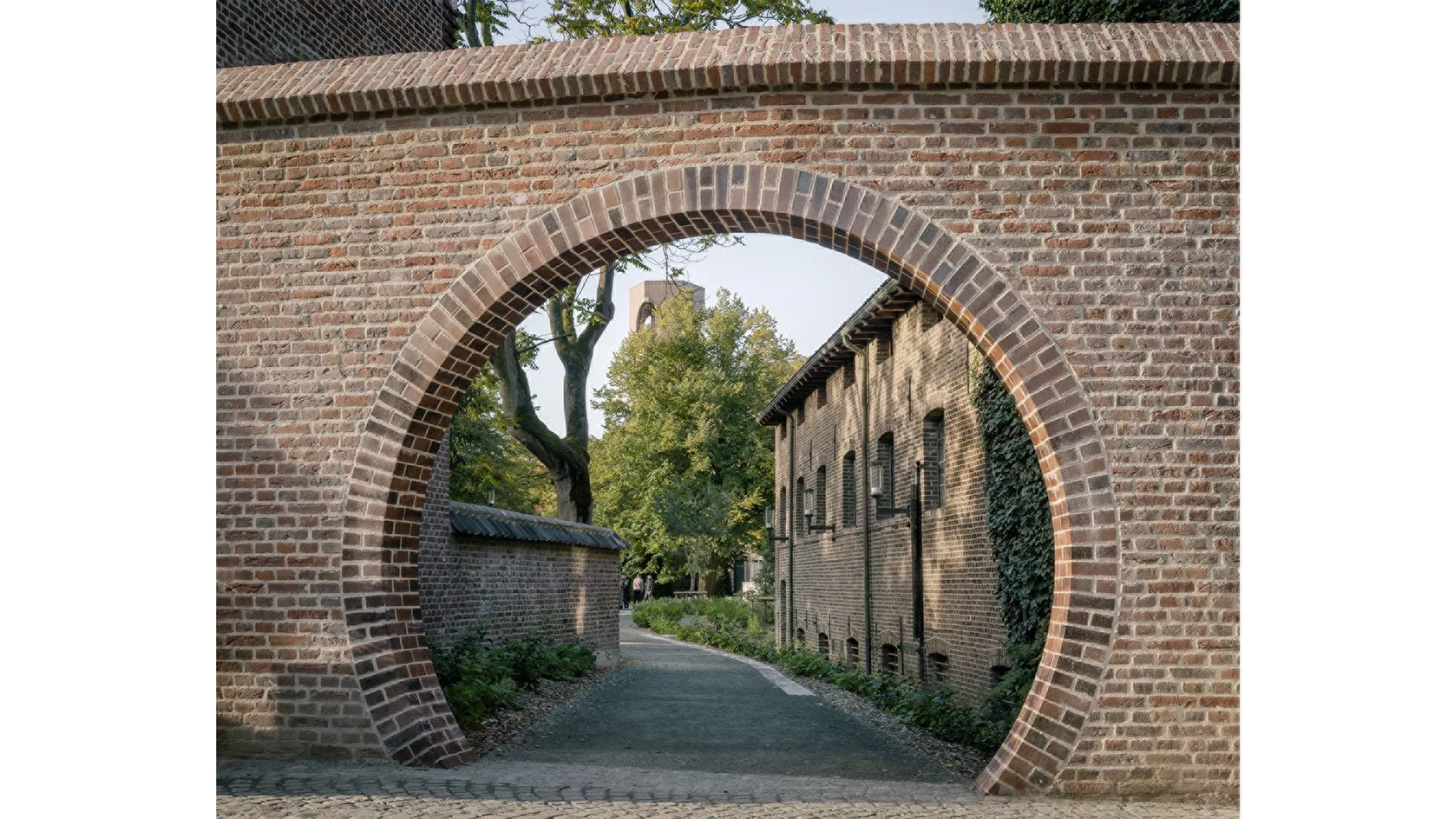
As a cloistered space for pious dedication, the beguinage was largely secluded from the city, with access through the gatehouse at the south end and a discreet, locked door at the north. The architects replaced the door with a large punched circular opening, framing the garden within. “All our interventions were to open up the beguinage but also to speak to this history of it being closed off,” says Dirk Somers, head designer at Antwerp-based Bovenbouw.
Looking for quick answers on architecture and design topics?
Try Ask RECORD, our new smart AI search tool.
Ask RECORD →
Along the perimeter block walls of the three-story houses, the architects left the austere structure largely untouched. The only additions to the exterior are copper-clad dormers protruding from the roof, blind on their fronts but open to the sides. On the courtyard side these dormers are inverted—glazed on their faces and clad in copper on the sides—playing with the open-closed dichotomy. “I really enjoy that in architecture you can say two almost contradictory things in one gesture,” adds Somers.
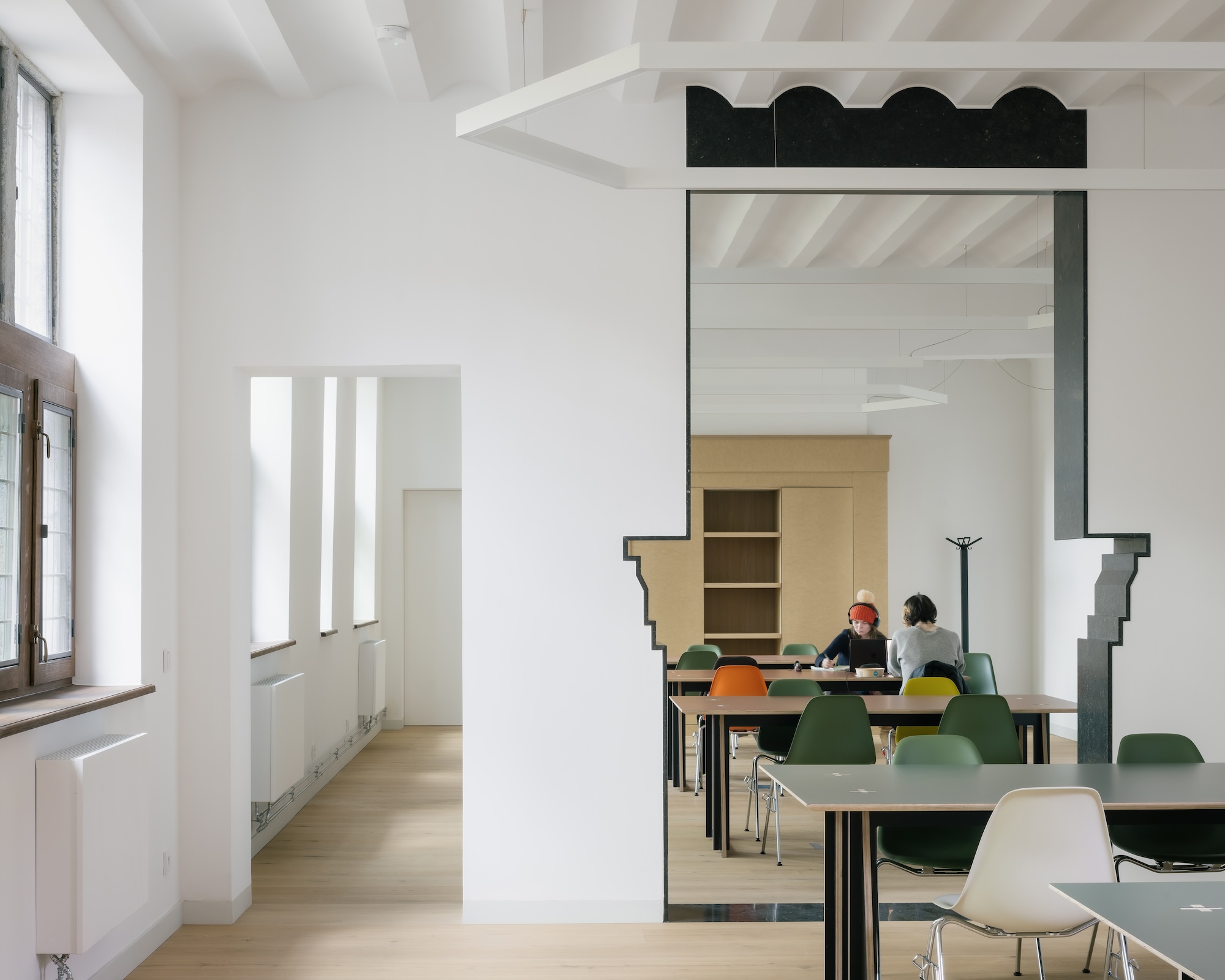
Photo © Stijn Bollaert
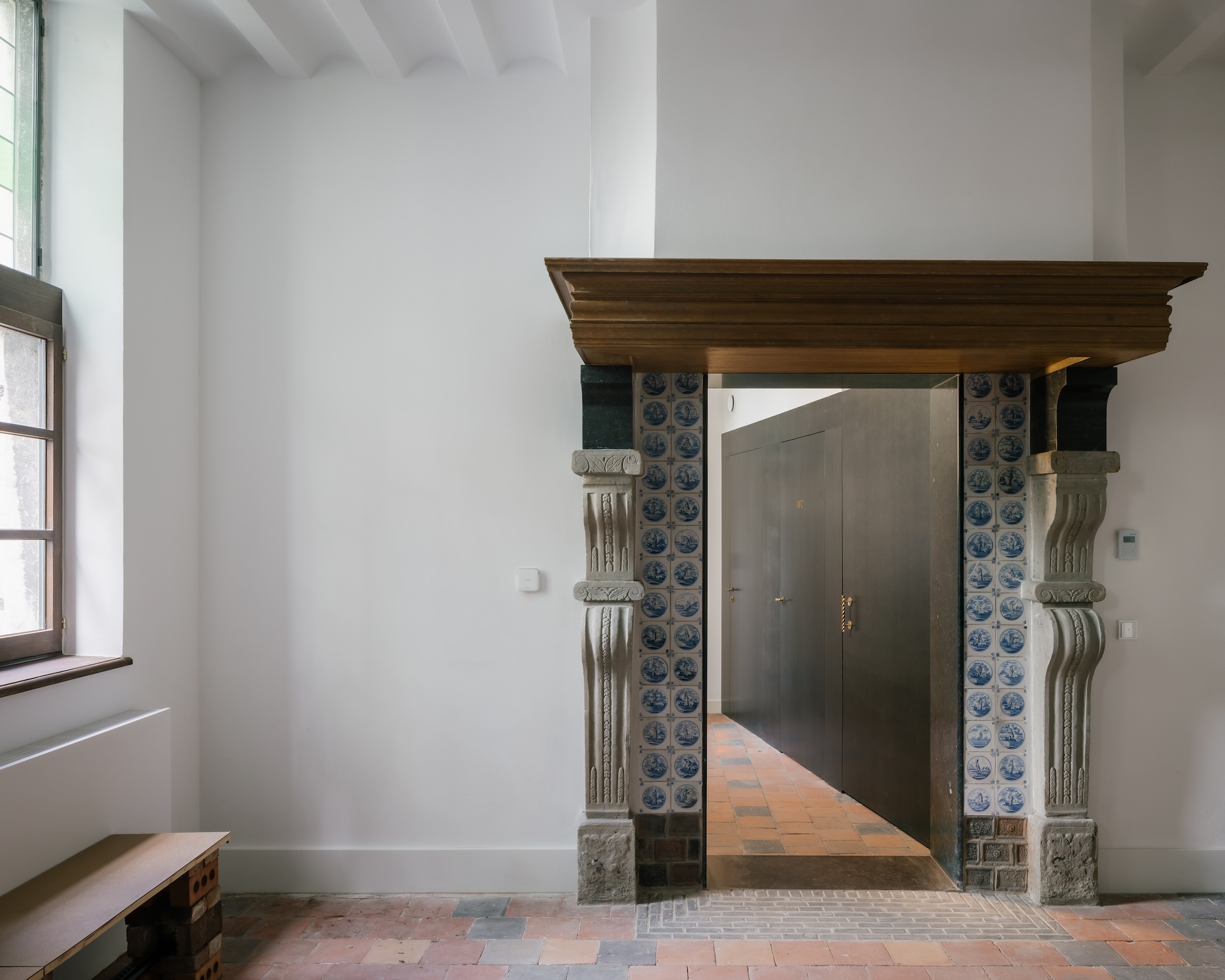
Photo © Stijn Bollaert
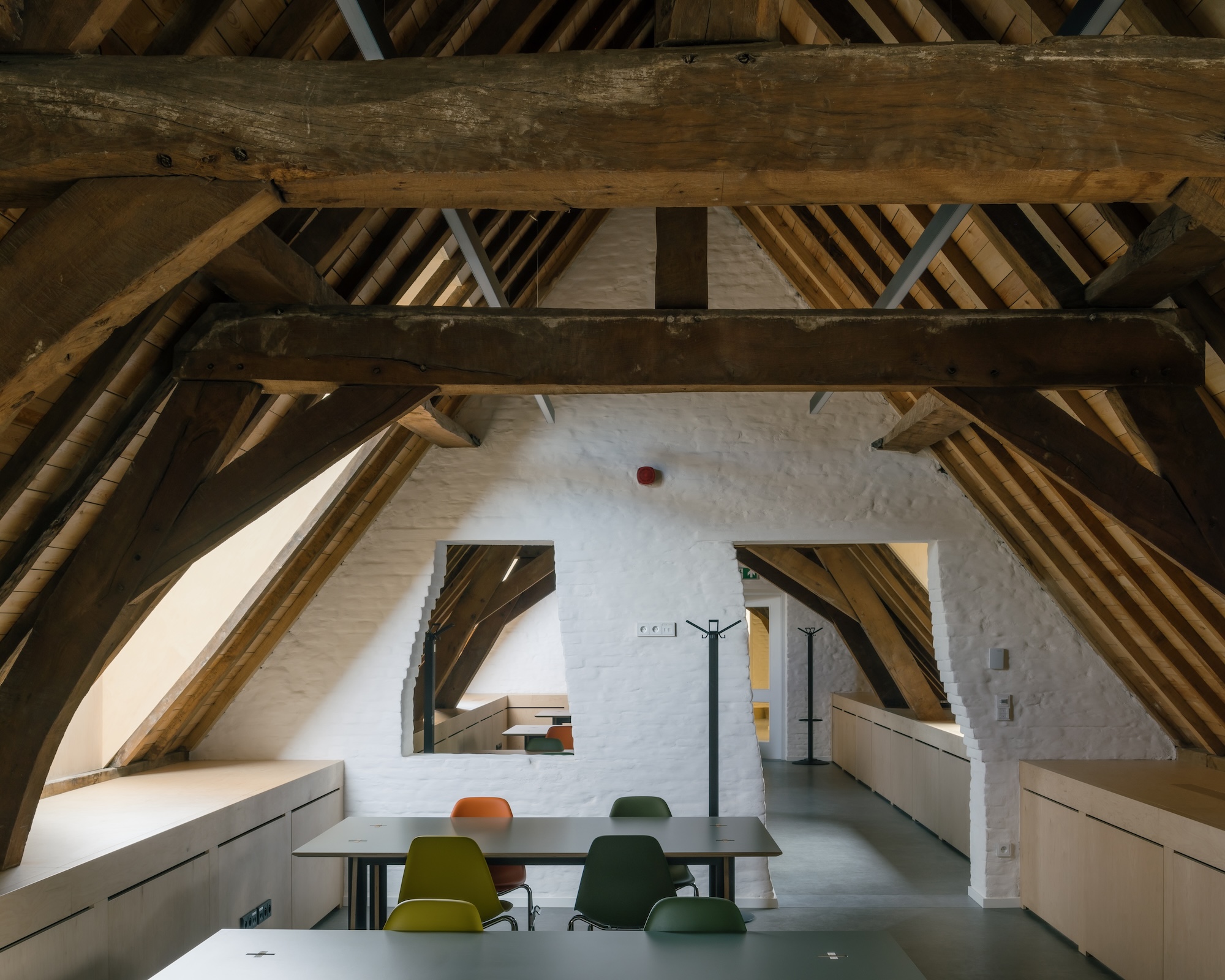
The interior restoration also elegantly plays with the dichotomies of the complex’s history and repurposing. Throughout the more than a century since the site stopped serving its original use, nearly every intervention had been to open the discrete residences, creating larger and more connected spaces. The architects, however, took the opposite tack, restoring the original domestic qualities of the beguinage. “We were trying to be quietly subversive,” says Kohn, “arguing that an institution like an architecture school can exist, in fact ought to exist, in a domestic model.” The houses were transformed as more than a dozen small studios spread across all three levels, lecture halls and exhibition spaces, as well as faculty offices. Additionally, a block of four single-room apartments at the north end accommodates PhD researchers who will live on-site.
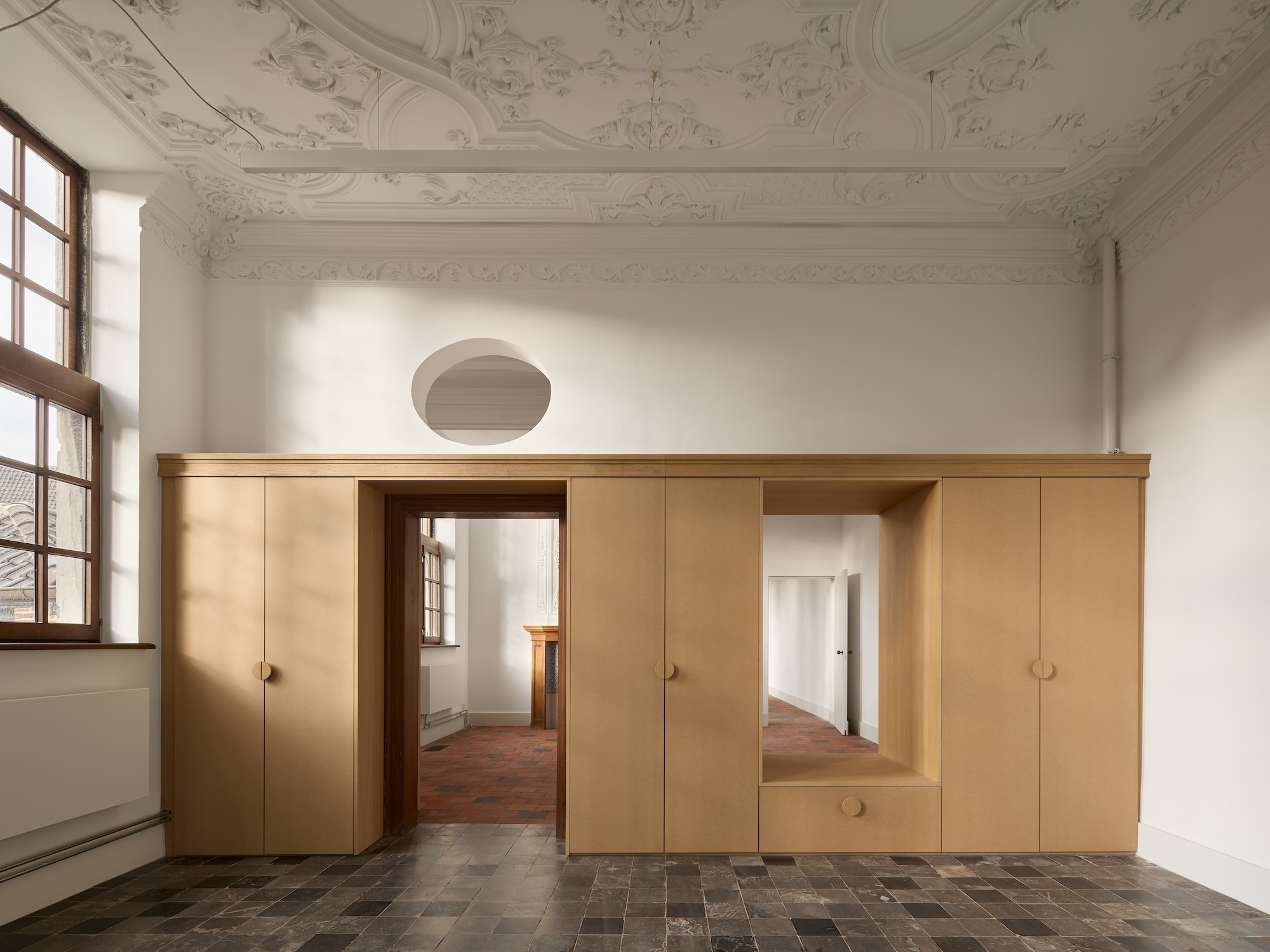
Photo © David de Bruijn
The terra-cotta floor tiles were removed and reinstalled, windows were restored and insulated, and fragments of the dilapidated staircases were integrated into the new woodwork of their replacements. Where the original walls and their fireplaces had been removed, new partitions were added with the profile of the lost fireplace inscribed as a passageway. In cases where the original materials were no longer usable, identical (or as close to identical as possible) replacements were sourced from within Belgium. The result is eclectic yet subdued, and the distinction between what is old and new is hard to define.
Photos © Stijn Bollaert
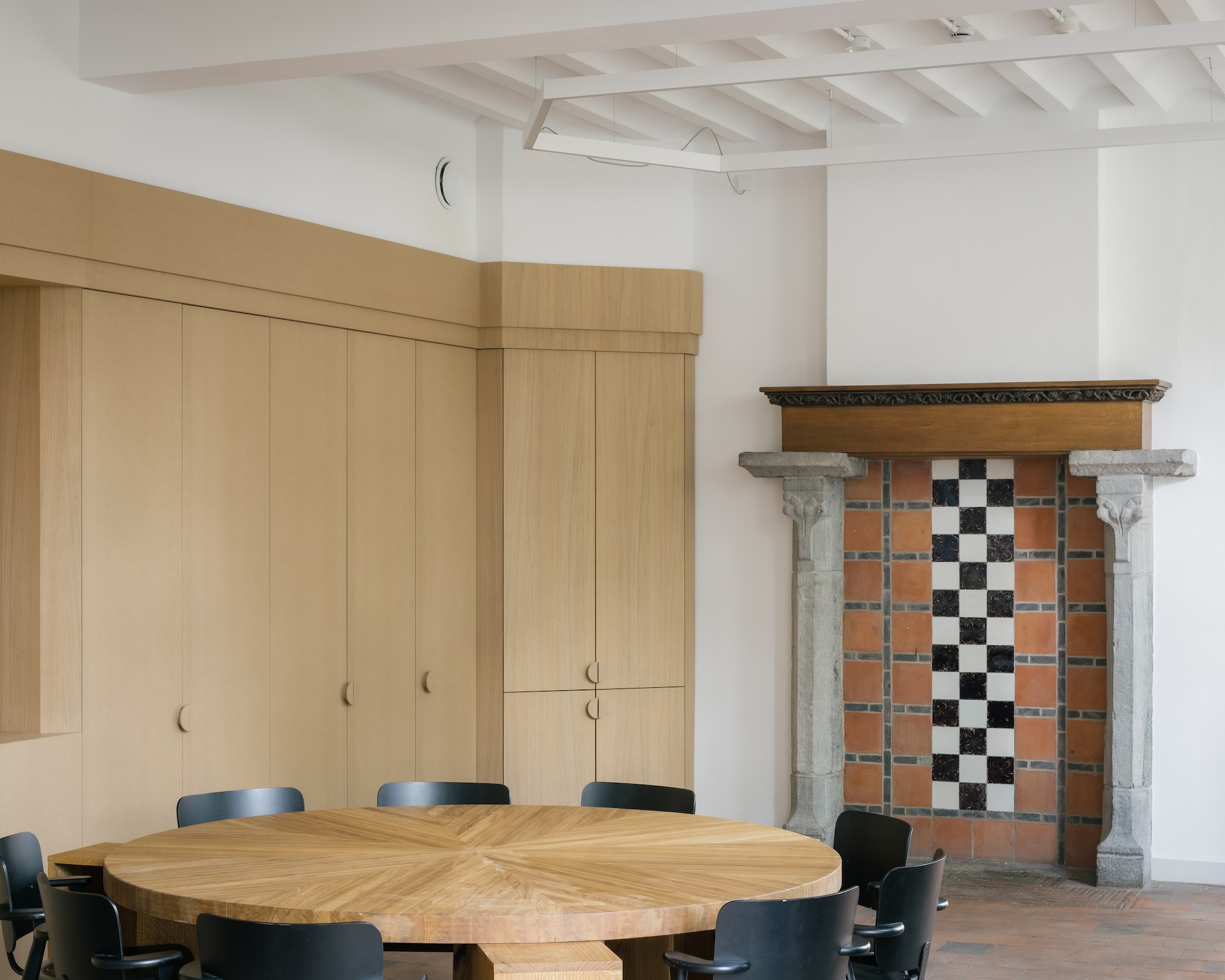
Storage and functionality serving the various program needs were added through new millwork—uniformly framed in oak with medium-density fiberboard infill panels—which certainly feels more like residential built-in closets rather than an institutional approach. The second level of the gatehouse was repurposed as a lecture hall, with the same engineered wood and oak lining the walls. This minimalist interior treatment highlights through contradistinction the ornate woodwork and vibrant Flemish tiles of the historic structure.
As a transformation for a school of architecture, especially for one that emphasizes adaptive reuse, the hope is that the renovated facility will serve as an educational tool. But rather than standing as an exemplar of technical prowess in historic preservation, the goal is to demonstrate a certain paradigm—what Kohn describes as a “rearguard provocation”—that old ideas, materials, forms, and even ruins still have value.
Looking for a reprint of this article?
From high-res PDFs to custom plaques, order your copy today!