Books
In ‘Public Space NY,’ MOS Catalogues the Shared Urban Landscape of Manhattan
‘Public Spaces NY’ by MOS, Michael Meredith, and Hilary Sample

To paraphrase Walter Benjamin, experienced collectively in a state of distraction, public space has never been idle. Public spaces are used out of habit: walking down the street, jogging in the park, letting a dog relieve itself, or grabbing a coffee in a plaza. Rarely are these spaces—or the fact that every part of them is regulated, designed, and constructed—considered as a whole. Much of the work of New York City architecture studio MOS (a 2008 Design Vanguard) is about turning attention toward the unconsidered. In its writing, this takes the form of cataloguing. In 2021, the studio published Vacant Spaces NY, the precursor to this book, which exhaustively documented every empty storefront in Manhattan. In Public Spaces NY, MOS maps and categorizes every type of public space on the island, from parks to community gardens, cemeteries, and shared streets. The book also documents the parades, protests, and festivals that activate these spaces. Following is an excerpt from the book’s introduction.
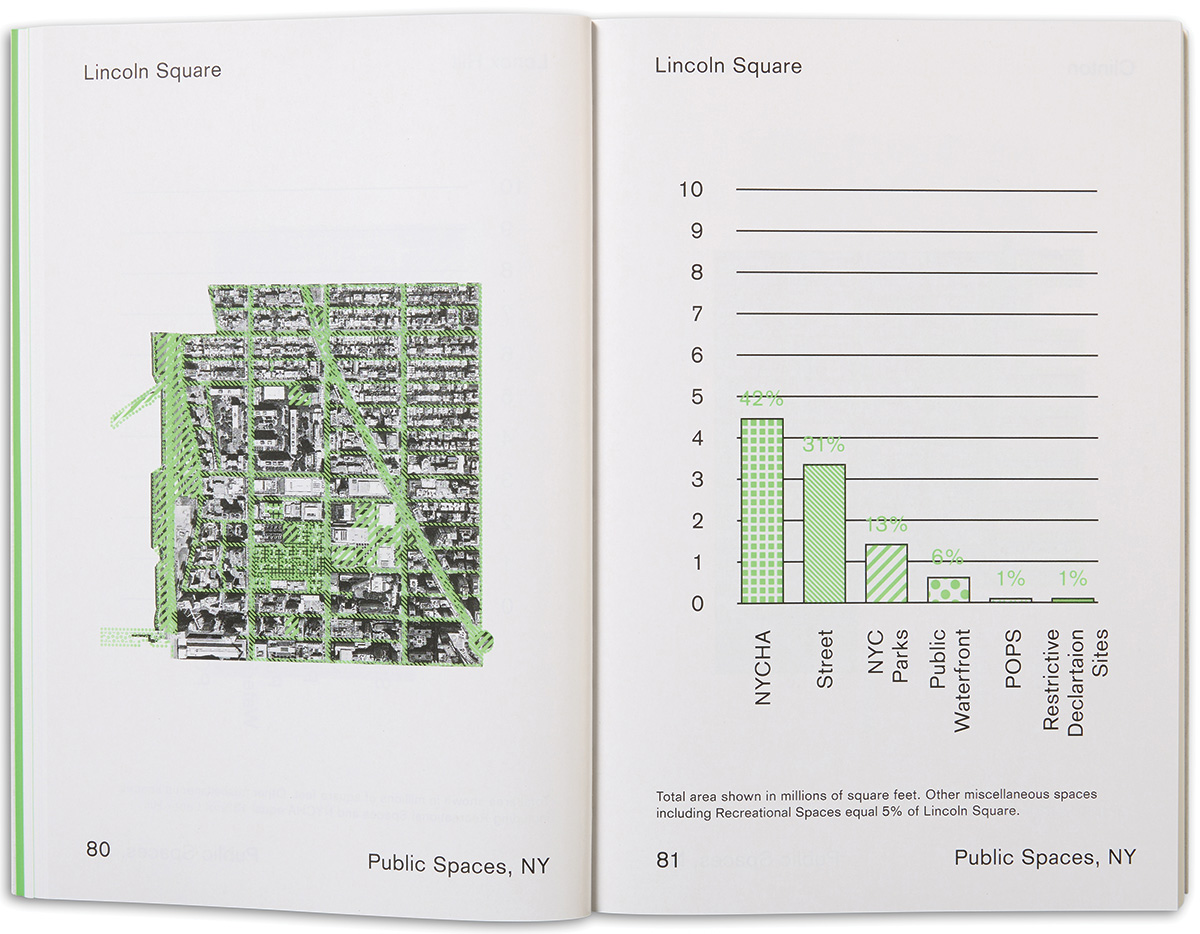
Image courtesy of MOS, click to enlarge.
There are no perfect public spaces. Public space is constantly changing, shifting, never quite fixed. It is shaped by laws, by regulations, private ownership, and city management. They are influenced both by the people who oversee them and by those who use them. And, because of this, public spaces are never neutral. They can’t be. They are unstable at their foundations, requiring constant upkeep. They are places of expression, debate, and conflict. A protest happens, a community garden is established, a new rule is posted, a public Wi-Fi station is built, a large cable is run across rooftops, a dying street tree is removed, a homeless encampment is constructed, a public toilet goes under renovation, a bike path is painted, a marathon happens, a police camera is installed, a park fence is delineated, an exercise class performs tai-chi, a concert is staged, a street is closed to cars, a café expands onto the sidewalk, an electric company upgrades their service, and on and on. Each of these events changes public space, ensuring that experiences of it are as varied and shifting as the public itself.
This book began by trying to understand those public spaces closest to us. We collected data, mapped relationships, and broke down governance over different types of spaces with the view that they mirror larger civic structures, reflecting our values. Henri Lefebvre writes about “the right to the city,” or the right of people to shape their cities and make claims on the spaces where they live. Public spaces are a stage where the concept of the public is formed and performed. They are where people come together, where they express themselves, and where they test their freedoms.
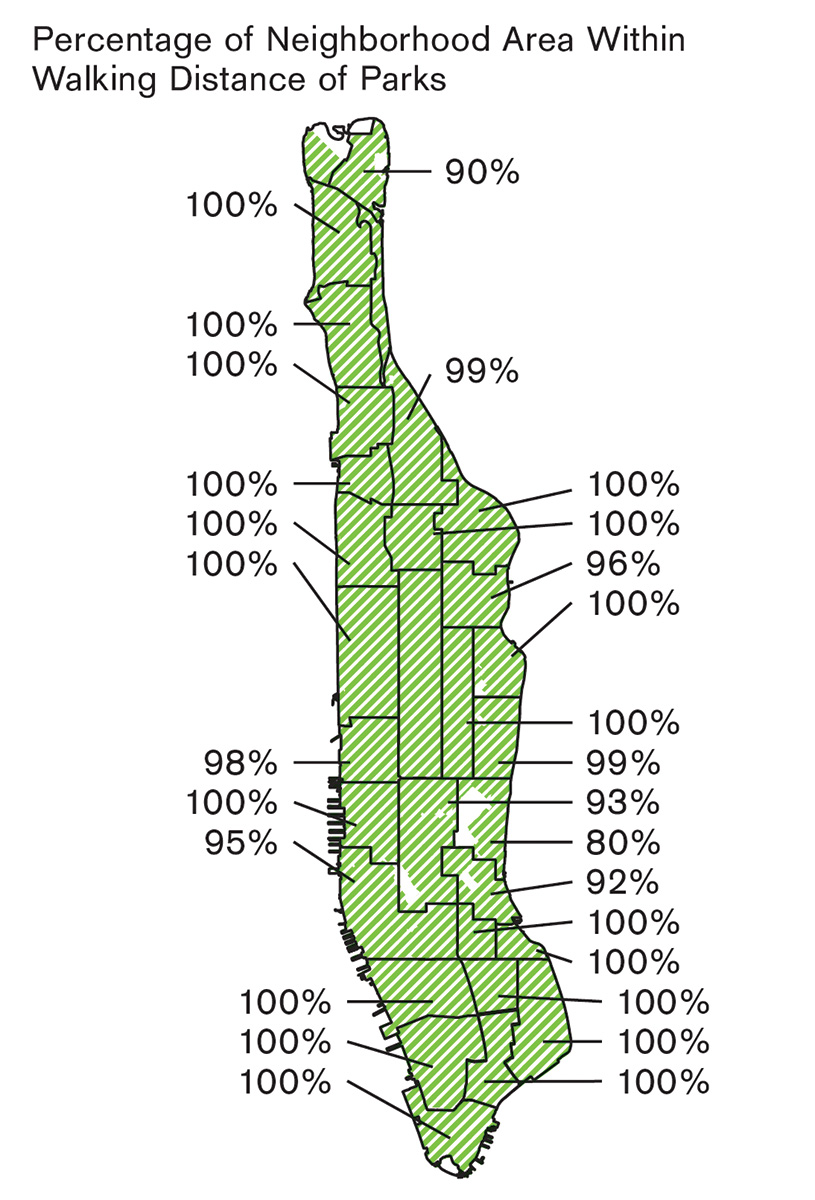
Image courtesy of MOS
Architect Giambattista Nolli’s 18th-century Map of Rome is typically upheld as a clear figure-ground drawing of public and private urban space. But in reality, many of the public spaces he depicted were privately owned, overseen, and controlled by the Church. An 18th-century Catholic man might have been able to walk seamlessly between a church and the street. A Muslim woman would have likely experienced something different. Neither public nor space is the same for everyone.
Public spaces are legal constructions as much as they are spatial. Their legal status can be complicated. Especially when we think about free speech and assembly rights. There isn’t one clear legal definition of public space. But we can point to three important principles that affect how free speech works in public spaces. First, spaces like streets, sidewalks, and parks are usually considered traditional public forums. This gives them special status under the First Amendment. You have the right to speak in these spaces. But this right is not without limits. Second, even though free speech is protected in public spaces, it is regulated: governments create rules. Permits are required for large protests. Limits are set on where and when people can legally gather. The right to speak is balanced with public safety and the rights of others. Third, when public spaces are privately owned—like a shopping mall—their owners can impose additional restrictions. The rules in these spaces must be content-neutral, but they can still restrict speech in ways publicly owned spaces cannot.
In addition to the legal rights of public spaces, these spaces can take on symbolic social value. Some public spaces provide a more important stage than others. City Hall, Times Square, and Columbia University’s West Lawn—these are more than just places. They are symbols. They hold political, cultural, and social weight. When something important happens, people gather in these spaces. Protests here are more visible, perhaps more public. They demand more attention.
Not all public spaces are equal. Some, by design or history, are sites of exclusion. Anti-homeless measures, like removing benches or installing spikes, send a message: this space is not for everyone. Restricting park access to daytime hours could be understood as another measure to limit homeless encampments. In privately owned public spaces (POPS), security guards enforce the regulations of the company that maintains it. Subways don’t consistently provide accessible entrances, again limiting public use. These spaces are constantly changing, as are both the technology that supports them and the public that engages with them. The various elements of public space never change in perfect synchronicity with one another.
New York City’s public spaces are some of the most contested in the country. But this is not just an urban issue. Public land in rural areas faces similar struggles. Ownership, access, and use are always being negotiated, whether in a city plaza, a town green, or a national park. Perhaps this is unsurprising, given that the country has lived on, benefited from, and negotiated contested ground since its founding. But as cities grow and become more crowded, the question of who controls public space becomes ever more urgent.
Looking for quick answers on architecture and design topics?
Try Ask RECORD, our new smart AI search tool.
Ask RECORD →
Looking for a reprint of this article?
From high-res PDFs to custom plaques, order your copy today!